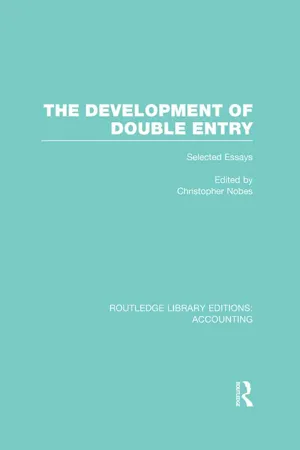
This compilation concerns account books, not books on accounting. Most of the essays analyse the account book(s) of a single person or business. In each case the account book(s) demonstrate the presence of, at least, elements of double entry. The essays come in pairs, beginning with Geoffrey Lee's paper on Florentine bank ledger fragments of 1211, some of the earliest relics of Italian bookkeeping. Subsequent papers trace the development of double entry over the centuries until 1786 when full double entry was achieved. There are papers from the UK and USA which illustrate the use of balance sheets, valuation techniques and the accruals convention as well as papers which analyse the causes of the development of double entry, using the evidence of others.
- 160 pages
- English
- ePUB (mobile friendly)
- Available on iOS & Android
eBook - ePub
accounting in colonial Virginia: a case study
by Almand R. Coleman, William G. Silenkir* and Williard E. Stone
Occasionally, we find business records from a previous era sufficiently complete to allow the accounting historian to undertake an analysis of the then existing accounting and management practices. Such is the case with the records of William Prentis and Company, a leading colonial store in eighteenth century Williamsburg, Virginia. This store has been described as the “most solvent and most respected business in Williamsburg, if not in the entire colony.”1 Though the store's journals and ledgers have been lost, its annual reports with balance sheet and supplementary information per mit speculation concerning the development of accounting during the colonial era.2
The store operated under the name of William Prentis and Company from 1733 to 1765. Its beginning can be traced to about 1701 when two brothers, Dr. Archibald Blair and the Reverend James Blair,3 and a mutual friend, Colonel Philip Ludwell, opened a general merchandise store in the home of the Reverend Blair. In 1719, the storr was relocated on the Duke of Gloucester Street, in Williamsburg, where it remained until 1740 when expanding operations required greater space, and a brick building was constructed on the same site. This building exists today in restored colonial Williamsburg.
The accounting practices of William Prentis and Company from 1733 to 1779 seemed to meet the requirements of the economic environment of the period.
The Blair-Ludwell partnership controlled and managed the store until sometime before Ludwell's death in 1727, when the Blair brothers bought Ludwell's interest. The next owner-manager change took place in 1733, when Archibald Blair died and the firm's organization changed from a simple partnership to a business operated by a professional manager, William Prentis. From 1733 the store was operated under the name of the owner-manager:
□ William Prentis and Company—1733 to 1765.
□ John Prentis and Company—1765 to 1775.
□ Robert Prentis and Company—1775 to 1779.
The business imported and sold goods from England as well as merchandise purchased locally. The company also acted as an exporter, and the 1733 balance sheet disclosed that two hogsheads of tobacco were awaiting shipment to England and a quantity of pork and corn, costing £56.4.0, was en route to Jamaica. Undoubtedly the trade with Jamaica included imports of sugar and rum.
The events leading to the Revolutionary War, and the war itself, brought the business to an end in 1779. Disruptions in trade abroad are indicated in the store's annual reports beginning in 1773. At the end of that year, the store's report showed inventory of imported goods at £4,476, the largest in the store's history. Imported goods inventory declined to £2,623 in 1774, to £1,560 in 1775, and to £280 on February 4, 1777, when the store's operations were suspended. Thereafter, Robert Prentis stayed on, at half salary, until 1780 to liquidate the assets of the business.
In summary, the business was in existence from 1701 to 1779, almost 80 years in the formative period of this country's economic and political de velopment.
Analysis of accounting records
For the period of William Prentiss tenure as professional manager, 1733–1765, and thereafter from 1765–1779, there were annual or biennial meetings of the owners. At these meetings, a financial statement was presented and attested to by the subscribers. These statements, fortunately preserved for us,4 serve as the basis for inquiry into the fol lowing aspects of the business: business organization, annual reporting format and disclosure, statement periods, accounting system, accounting principles, translation adjustments and management compensation.
Business organization
The owners of William Prentis and Company were designated subscribers and their proportionate ownership, which changed many times due to inheritance or sale of ownership shares, was disclosed in each of the reports accompanying the financial statements. The company was set up as a partnership, and ownership equity was not evidenced by formal certificates but stated in fractional proportions, e.g., 1/6, 9/24.
Although limited liability was not available to the owners, the organization had characteristics suggestive of a corporation:
1 It had a life independent of its owners, and owners' shares were transferable.
2 The managing owner had the autonomy usually associated with professional management and was paid a salary.
3 Owners' withdrawals were called dividends and were proportionate to the amount of each owner's capital account.
4 The company in 1759 repurchased the interests of two subscribers (similar to a corporation's buying its own stock) and adjusted the remaining owners' capital accounts accordingly.
5 Annual reports were provided for each owner, or his representative, just as today a stockholder is given a copy of a corporation's annual report.
The accounting books purchased must have been carefully kept since there is evidence that the company was a fiscal agent for the Virginia Colony, making payments for materials and work performed by individuals for the colony.
Annual reporting format and disclosure
Each yearend balance sheet was accompanied by a formally signed and witnessed report indicating the subscribers' “audit” of the company's accounts and their satisfaction with its owner-manager. The report began as follows:
“We the Subscribers having Examined and Audited the Accounts of William Prentis under the Name of himself and Company to the 25th of No...
Table of contents
- Cover
- Half Title
- Title Page
- Copyright Page
- Original Title Page
- Acknowledgments
- Table of Contents
- Introduction
- A Chronological Bibliography of Selected Writings on Surviving Account Books of the 11th to the 19th Centuries
- “The Florentine Bank Ledger Fragments of 1211: Some New Insights,”
- “The Development of Italian Bookkeeping: 1211-1300,”
- “The Coming of Age of Double Entry: The Giovanni Farolfi Ledger of 1299-1300,”
- “The Gallerani Account Book of 1305-1308,”
- “The Ledger of Jachomo Badoer: Constantinople September 2, 1436 to February 26, 1440,”
- “Jachomo Badoer, Renaissance Man of Commerce, and His Ledger,”
- “The Accounts of the Corporation of Bristol: 1532 to 1835,”
- “The Ledger of John Smythe, Merchant of Bristol,”
- “Selections from a Pre-Revolutionary Accounting Record,”
- “Accounting in Colonial Virginia: A Case Study,”
- A Note on Papers Concerning the Causes and Effects of Double Entry
- “The Functional Development of Double-Entry Bookkeeping,”
- “A New Perspective on the Evolution of Double-Entry Bookkeeping,”
Trusted by 375,005 students
Access to over 1.5 million titles for a fair monthly price.
Study more efficiently using our study tools.
Frequently asked questions
Yes, you can cancel anytime from the Subscription tab in your account settings on the Perlego website. Your subscription will stay active until the end of your current billing period. Learn how to cancel your subscription
No, books cannot be downloaded as external files, such as PDFs, for use outside of Perlego. However, you can download books within the Perlego app for offline reading on mobile or tablet. Learn how to download books offline
Perlego offers two plans: Essential and Complete
- Essential is ideal for learners and professionals who enjoy exploring a wide range of subjects. Access the Essential Library with 800,000+ trusted titles and best-sellers across business, personal growth, and the humanities. Includes unlimited reading time and Standard Read Aloud voice.
- Complete: Perfect for advanced learners and researchers needing full, unrestricted access. Unlock 1.5M+ books across hundreds of subjects, including academic and specialized titles. The Complete Plan also includes advanced features like Premium Read Aloud and Research Assistant.
We are an online textbook subscription service, where you can get access to an entire online library for less than the price of a single book per month. With over 1.5 million books across 990+ topics, we’ve got you covered! Learn about our mission
Look out for the read-aloud symbol on your next book to see if you can listen to it. The read-aloud tool reads text aloud for you, highlighting the text as it is being read. You can pause it, speed it up and slow it down. Learn more about Read Aloud
Yes! You can use the Perlego app on both iOS and Android devices to read anytime, anywhere — even offline. Perfect for commutes or when you’re on the go.
Please note we cannot support devices running on iOS 13 and Android 7 or earlier. Learn more about using the app
Please note we cannot support devices running on iOS 13 and Android 7 or earlier. Learn more about using the app
Yes, you can access The Development of Double Entry (RLE Accounting) by Chris Nobes in PDF and/or ePUB format, as well as other popular books in Business & Accounting. We have over 1.5 million books available in our catalogue for you to explore.