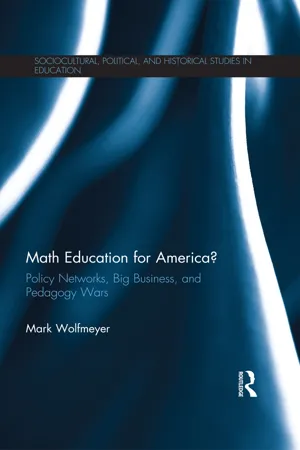
Math Education for America? analyzes math education policy through the social network of individuals and private and public organizations that influence it in the United States. The effort to standardize a national mathematics curriculum for public schools in the U.S. culminated in 2010 when over 40 states adopted the Common Core State Standards for Mathematics. Rather than looking at the text of specific policy documents, this book complements existing critical reviews of the national math education curriculum by employing a unique social network analysis. Breaking new ground in detailing and theorizing the politics of math education, Wolfmeyer argues that the private interests of this network are closely tied to a web of interrelated developments: human capital education policy, debates over traditional and reform pedagogy, the assumed content knowledge deficit of math teachers, and the proliferation of profit-driven educational businesses. By establishing the interconnectedness of these interests with the national math education curriculum, he shows how the purported goals of math education reform are aligned with the prevailing political agendas of this social network rather than the national interest.
eBook - ePub
Math Education for America?
Policy Networks, Big Business, and Pedagogy Wars
- 194 pages
- English
- ePUB (mobile friendly)
- Available on iOS & Android
eBook - ePub
About this book
Information
1
Introducing Math Education for America and its Historical Context
For the last half of the twentieth century, we witnessed an increase in the attempts to define and execute a national mathematics education for public schools in the United States. National math education, what I will also refer to as math education for America, means two things: a circumstance in which all students across the US are offered primarily the same instruction from among mathematical topics, and a process whose outcome is in the national interest. Efforts have swelled to a greater magnitude since 2000, culminating in 2010 with over 40 states adopting the same math education standards (the Common Core State Standards for Mathematics) in part because such action increased a state’s chances to win federal monies for use in schools. Such an emerging national math education warrants significant attention from those interested in education policy and math education. This book presents one approach for inquiring into these developments, namely an analysis of the social network of the persons and organizations surrounding them.
Focusing on a social network surrounding a policy domain is different than, for example, looking at the text of specific policy documents, policies or other events related to the domain. My choice represents a perspective on contemporary governance in which new forms of governing allow significant influence of private interests via a social network of individuals, private organizations and their overlapping interests.1 The individuals and organizations that comprise this policy network, what I will refer to as network actors, initially congregate over similar interests surrounding the policy’s domain, yet subsequently the alliances and compromises contained therein sometimes undermine both small scale interests in the network as well as the overarching explicit goals of policy and government.2
By using this perspective on governance, I have identified a policy network surrounding math education for America that presents the following interrelated interests: a national math education that develops human capital (the characteristics of productive workers), debates over traditional and reform pedagogy, agreement on a content knowledge deficit of math teachers, and a math education that fuels an education services sector. In the chapters that follow I elaborate on these themes by presenting the network constituents that support them, as well as the variations within each theme that exist among these constituents. In the final chapter I also argue how these variations can undermine specific interests in the network as well as, when taken together, these themes work in concert to undermine math education for America’s purported objective to increase the knowledge and use of mathematics by people living in the US.
Thus far, I have introduced this book’s primary subject matter and method of inquiry, an emerging national math education and the policy network surrounding it, respectively. I continue this chapter by elaborating first on my approach and findings. Second, I sketch the historical developments in national math education from World War II to 2000 in order to develop a framework for investigating contemporary national math education, including a review of how these developments neglect the important features that can allow math education to work against white supremacy. Quite the opposite, this work asserts how math education for America further enables a racial project in which white people benefit. The end of this chapter also includes an outline of the contents contained in this book.
The Social Network of National Math Education
Anthropologist Janine Wedel’s perspective on contemporary governance inspired my approach for analyzing national math education: “Emergent forms of governing, power, and influence… play out not in formal organizations or among stable elites, but in social networks that operate within and among organizations at the nexus of private and official power.”3 Accordingly, to construct a social network of national math education, I first comprised a list of individual actors who took part in authoring influential policy documents. I next researched these individuals, via publicly available information, for their affiliations to organizations and created diagrams to represent the social network of all actors, both individuals and organizations, at play in the policy domain. Finally, I assembled data on the activities and statements of these actors in the identification of strong themes present in the network. These themes are argued to be the dominant interests in math education for America.
My methodology begins with a particular perspective (Wedel’s) that is inherently suspect of contemporary policy-making. Given this upfront, I was expecting to find a “math education” that is “not for America,” hence the title of this book. However, I did not anticipate all the particular interests I came to find, such as the interest in stating that math teachers do not know math. Some readers will disagree with Wedel and my suspicion of policy-making. They might reject the creation of a social network for the study of policy, and instead focus on the policy documents themselves. Or, they might look at my list of network actors, research these themselves and describe the trends that they see in the network. In other words, I do not claim that my reading of the network is anything other than my own. More details of my methodology, including the definition of quasi-government, ethical considerations and the particulars of the math education documents, are in the next chapter. For this introduction, the following provides a brief example of the method without discussing the complexities of the project in total.
One of the documents I used to begin constructing the social network of national math education is the College and Career Readiness Standards for Mathematics.4 This document provided the blueprint for the Common Core State Standards for Mathematics5 that over 40 states have adopted as their curricular framework for math education, thereby indicating the influence of the document. The list of authors of the College and Career Readiness Standards included a “development team” and a “feedback group.” Delineation between the two groups is provided by the National Governors Association’s press release which announced the two groups:
The role of this Feedback Group is to provide information backed by research to inform the standards development process by offering expert input on draft documents. Final decisions regarding the common core standards document will be made by the Standards Development Work Group. The Feedback Group will play an advisory role, not a decision-making role in the process.6
In other words, the development group is the primary author of these curricular goals. Since they determined the contents of the standards adopted by over 40 states, I argue this group as the most influential in the development of the new national math standards.
Of the 15 people on the Development Workgroup, several are employees in the educational testing industry, including ACT and College Board. One member, Phil Daro, works for America’s Choice, a company that provides professional development for math teachers and was recently bought by Pearson, an educational corporation. Thus the interest in national math education by educational business has already been made clear. Furthermore, the initial founder of America’s Choice suggests another business interest: the National Center On Education and the Economy (NCEE) is a research and policy institute that aims to shape public education towards the needs of business. Specifically, they seek an education that develops in students the intangible qualities required to be a productive worker. Such qualities and investment in them are typically referred to as development in human capital. In light of this, funding for NCEE comes from the likes of Apple, Kodak and Walmart. Another research and policy institute that is well represented in this national math education event is Achieve, Inc. Funding this institute are Gates, Boeing, Hewlett, GE, IBM, JP Morgan Chase, Intel and Prudential, among others. Therefore, the drafting of the document indicates another interest in national math education, that of the corporations that find math education useful for developing the workers they need.
I offer this brief example to introduce how I looked at the organizations in the social network surrounding national math education. Ultimately, my construction of a representative social network surrounding national math education is more involved than what I describe here, but it does rest primarily on looking at the individuals involved in such national math education events and their links to other organizations. I will outline my methods in detail in chapter 2. This illustration also indicated the two primary interests in national math education, that of educational business and, more generally, businesses who seek to use math education as a means to develop the kinds of workers they need.
The Trends in Math Education for America
As I outlined with the brief example above, math education “in the national interest” actually is in the interest of corporations, mostly for its role in developing human capital and providing a scenario for educational businesses to make their profits. Of the two, math education for America exists primarily to develop those intangible qualities of productive workers. This is the subject of chapter 3, where I detail the several network actors who hold the interest, those that represent the interest (mainly because they are funded by corporations that hold the interest) and the many academics who adopt the interest. I also include how the educational businesses adopt this purpose for math education to advance their own interest in providing services related to the development of human capital.
Adopting the development of human capital as the primary purpose of national math education is a phenomenon that corresponds to Wedel’s understanding of the individuals in these social networks surrounding public policy. Terming them “flexians,” she posits that actors adopt other interests to advance their own. The several academics in the network adopt the interest of human capital to advance their own interests, which I describe in chapters 4 and 5.
Chapter 4 discusses the academic debate between the mathematicians and math education researchers in the policy network surrounding national math education that I constructed. Specifically, most of the involved mathematicians desire a traditional math education comprising teacher-directed learning that emphasizes the learning of math facts and computations. Most of the involved math education researchers desire a progressive math education comprising student-directed learning that emphasizes problem solving and mathematical reasoning. In the chapter I argue how both align themselves with the development of human capital. For example, the progressivist position resonates quite strongly with the writings on education by economic institutions like the Organization for Economic Cooperation and Development (OECD); each focuses on education for problem solving, collaboration and independent learning. On the other hand, the traditionalist perspective emphasizes a moral of hard work, an intangible quality I argue as useful for corporations.
Chapter 5 discusses another interest that the academics in the network put forth: that US math teachers do not know enough mathematics to teach effectively. There I highlight evidence from this network trend to indicate that this point is dubious. I also argue that the myth is a necessary component to the goals of educating for human capital, because it can be used to re-educate practicing math teachers in this interest as well as focus the preparation of future math teachers on only those aspects helpful to the goal. Taken together, both chapter 4’s “Math Wars” and chapter 5’s teacher mythology align themselves with the primary purpose of national math education: educating for the development of human capital. The involved academics have adopted the business interest of educating for human capital and aligned their particular academic interests with this goal.
The auxiliary business interest in the social context of national math education comes from the educational businesses that attempt to provide the services to develop human capital. I introduce their alignment to human capital in chapter 3, but in chapter 6 attend to their activities which include primarily the service to test students and then use test results to evaluate teachers. Ultimately, the services in their current form indicate a striking example of disharmony in math education’s policy network. The testing services do not fulfill all the components of educating for human capital, and specifically lack one of the most talked about: the problem solving, collaboration and independent learning needed by the contemporary knowledge economy. I argue this occurs because educational businesses find this service too costly to provide. Therefore, while educational businesses answer the call to develop human capital, their own interest to efficiently provide educational services undermines the goal.
Here I also introduce a few other considerations regarding this particular tension in na...
Table of contents
- Cover
- Title
- Copyright
- Dedication
- CONTENTS
- Preface
- Acknowledgments
- 1 Introducing Math Education for America and its Historical Context
- 2 Social Network Analysis and National Math Education
- 3 Human Capital: Math Education for America’s Purpose
- 4 Pedagogy Wars and Human Capital
- 5 The Content Knowledge Deficits of Math Teachers
- 6 Achieving Efficiency? The Testing Industry in Math Policy
- 7 The Failure of Math Education for America
- References
- Index
Trusted by 375,005 students
Access to over 1.5 million titles for a fair monthly price.
Study more efficiently using our study tools.
Frequently asked questions
Yes, you can cancel anytime from the Subscription tab in your account settings on the Perlego website. Your subscription will stay active until the end of your current billing period. Learn how to cancel your subscription
No, books cannot be downloaded as external files, such as PDFs, for use outside of Perlego. However, you can download books within the Perlego app for offline reading on mobile or tablet. Learn how to download books offline
Perlego offers two plans: Essential and Complete
- Essential is ideal for learners and professionals who enjoy exploring a wide range of subjects. Access the Essential Library with 800,000+ trusted titles and best-sellers across business, personal growth, and the humanities. Includes unlimited reading time and Standard Read Aloud voice.
- Complete: Perfect for advanced learners and researchers needing full, unrestricted access. Unlock 1.5M+ books across hundreds of subjects, including academic and specialized titles. The Complete Plan also includes advanced features like Premium Read Aloud and Research Assistant.
We are an online textbook subscription service, where you can get access to an entire online library for less than the price of a single book per month. With over 1.5 million books across 990+ topics, we’ve got you covered! Learn about our mission
Look out for the read-aloud symbol on your next book to see if you can listen to it. The read-aloud tool reads text aloud for you, highlighting the text as it is being read. You can pause it, speed it up and slow it down. Learn more about Read Aloud
Yes! You can use the Perlego app on both iOS and Android devices to read anytime, anywhere — even offline. Perfect for commutes or when you’re on the go.
Please note we cannot support devices running on iOS 13 and Android 7 or earlier. Learn more about using the app
Please note we cannot support devices running on iOS 13 and Android 7 or earlier. Learn more about using the app
Yes, you can access Math Education for America? by Mark Wolfmeyer in PDF and/or ePUB format, as well as other popular books in Education & Education General. We have over 1.5 million books available in our catalogue for you to explore.