- 312 pages
- English
- ePUB (mobile friendly)
- Available on iOS & Android
eBook - ePub
About this book
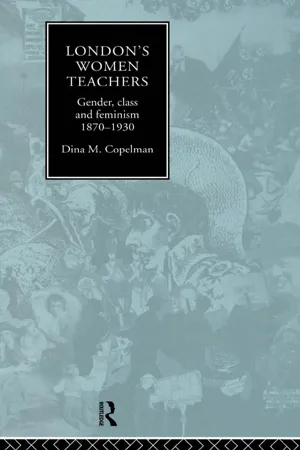
Dina Copelman's investigation of the public and private lives of women teachers reveals a strikingly different model of gender and class identity than the orthodox one constructed by historians of middle-class gender roles and middle-class feminism. Consequently, while the book focuses on women teachers from the beginning of state education in 1870 up to 1930, it is also an examination of how gender, class and professional identities were shaped and perceived. While offering a significant original contribution to the social history of teachers, this book is also driven by a consideration of broader historiographical questions.
Part I
CONTEXTS: GENDER, CLASS AND PROFESSIONALISM
1
LOOKING FOR WORK
Apart from the fact that you would, as village schoolmistress, become a strong local force – which is gratifying to your love of power as well as to your kindliness – … you would have a directing hand in the making of the next generation of the poor of the great towns…. In your schools you can be a strong mediating power in the social strife which is the greatest danger of the future. The village boy will afterwards wander to the cities and there hear bitter jealousy and hatred of the upper classes. He will hear it with very different ears, if his earliest recollections were all coloured by a lady’s gently refining influence.1
This book is about the women who taught in London elementary schools, not about ladies teaching in rural schools and their impact upon susceptible village boys. Yet this first chapter considers not the women teachers themselves, but the ideological discourses and social contexts which bounded teachers’ lives, structured contemporaries’ perceptions of teachers and shaped subsequent historical analyses.2 This is accomplished by examining middle-class women’s quest for meaningful activity, focusing particularly on their efforts to find a niche in social work and education. Through this analysis we will see that feminists argued that they were suited for various professions by emphasizing the professional commitment to serve – a properly female endeavor – alongside the traditional stress on merit and skill as hallmarks of professionalism. In constructing a feminist professional model, middle-class women simultaneously argued for their rights and shored up their class position.
Though it may seem diversionary to begin with a group of women who did not go into elementary school teaching, I do so for a number of reasons. First, for women of all classes the ability and right to pursue work and independence was severely constrained by cultural dictates which were both codified and most explicitly challenged among the Victorian bourgeoisie. Second, although elementary teachers were recruited from the upper working class and the lower middle class, the elementary teachers were, as we shall see, in frequent and fraught contact with middle-class authorities, and especially with middle-class women workers. Thus, the evolution of elementary teaching as a profession was a process simultaneously separate from and linked to the evolution of paid and unpaid work options for middle-class women.
Finally, before women elementary teachers can come into clear focus, we have to move beyond dominant representations – dominant both in the nineteenth century and still powerful in late twentieth-century scholarship – which present teaching as middle-class women’s work. Such representations were shaped by literary portrayals of governesses and schoolmistresses which provided the model of the ill-prepared daughter of a gentleman forced by unexpected circumstances to support herself by teaching middle-class children, in domestic settings, preferably away from or immune to the corrupting influences of urban life. By the 1880s a new image was emerging – that of the ‘professional’ girls’ high school teacher who, whatever the reasons which initially caused her to enter teaching, was qualified for her work and devoted to providing her pupils with a sound education. But, here too, the image was of a prim middle-class spinster who had chosen teaching, a form of public activity (though undertaken in a relatively domesticated setting), to perform what was women’s traditional role: service to others. Like the governesses, these women were also considered oddities. Whatever the accuracy of contemporaries’ perceptions of governesses and some schoolmistresses, these images never accounted for the vast majority of teachers, women teaching in working-class elementary schools.3
The hegemony of these middle-class paradigms was not complete enough to prohibit other models of gender identity from developing; but middle-class hegemony did mean that some forms of activity were recognized and condoned at the same time that other forms existed without the same level of public consciousness or influence in shaping the Victorian and Edwardian ‘woman question.’ Therefore, although it may seem a roundabout way to begin, before we can ‘see’ the woman elementary school teacher, we must first learn the language created to explain ‘respectable’ women’s relationship to work.
RAISING THE QUESTION
In the annals of women’s history, middle-class Victorian women’s hunger for education and occupational opportunities is legendary. By the mid-nineteenth century, according to the suffrage activist and early twentieth-century scholar Ray Strachey, ‘individual women [awakened] to their own uselessness’ and their efforts to alleviate their plight led to ‘the first stirrings of the feminist movement.’4 Alongside the search for a purpose, as Martha Vicinus has recently shown, financial necessity forced the ‘genteel poor woman … [into] three underpaid and overcrowded occupations – governess, companion, or seamstress.’ And the number of needy spinsters was supposedly ‘rising dramatically as their status fell. How could these women be made to fit into the rigid social pattern decreed by their culture and class?’5
This story has been told – and told well. Thanks to scholars such as Martha Vicinus, Deborah Nord, Jane Lewis, Phillippa Levine and numerous others, we know that although ‘separate spheres’ ideology had barely gained hegemony among the new industrial middle classes, women’s relegation to a private domestic sphere was already found wanting.6 Ruskin’s rhapsodic description of the separation of the sexes and woman’s special calling ‘for rule, not for battle – and her intellect is not for invention or creation, but for sweet ordering, arrangement and decision,’7 coexisted with W.R. Greg’s contemporaneous and alarming conclusion that thousands of women from the upper middle classes were destined to be ‘redundant’ or ‘involuntary celibates’ because emigration had unbalanced the sex ratio, leaving an excess of women.8 Simultaneously, the pioneer feminists of Langham Place – Jessie Boucherett, Bessie Rayner Parkes, Barbara Leigh Smith Bodichon, among others – were creating a forum arguing for the expansion of acceptable work for ‘respectable’ women and the reform of their legal status.9 This convergence of forces was productive and, from the 1860s on, these concerns stretched beyond the self-conscious circle of feminists, to the general middle-class public in the books and periodicals devoted to How Women May Earn a Living, as one of them was called.10 The process of legitimizing middle-class women’s desires for work and expanding their range of choices was a difficult uphill battle, but in the half century after 1860 middle-class women achieved significant gains and their efforts created a set of perceptions that both contemporaries and subsequent analysts have used to understand the nature of women’s professions.
Louisa Hubbard, for instance, wanted to make work respectable for middle-class women and in the 1870s and 1880s devoted all of her energies to that cause by founding a journal and year book devoted to publicizing work opportunities for women, and by being a part of numerous organizations with similar goals. She explained that what had led her to her life’s calling was that
I was not inclined for marriage … perhaps being too selfish or too independent to willingly and cordially face the prospect of merging my existence into that of another person. Influenced by my own disinclination to ‘step down’ merely because I might not feel disposed to marry, and feeling, too, some righteous indignation on behalf of others as well as myself, I gradually drifted into the position of wishing to champion the cause of the unmarried woman, and from the first I refused to apologize for her existence.11
This statement presented women’s search for independence in a positive light. However, it legitimized the need for work only for single women; middle-class women were not permitted to desire both work and marriage, and thus were forced to make a choice which men were not. Also, while not a reason for social ostracism, choosing to remain single was seen as possibly selfish, although it should be noted that marriage was viewed as necessarily subjugating woman’s individuality to her husband’s will. These attitudes were to a large extent characteristic of this period. Hubbard and her fellow reformers, while advocating that women’s work was not shameful, put limits on what women could aspire to. This was evident in Hubbard’s journal, Work and Leisure, where both gender and class restrictions were constantly imposed. In an article on civil service exams for women the writer advised that
subordination to constituted authority is a duty from a high point of view and a necessity from a worldly point of view … superiors in official position are superiors, or they would not be so placed. The law of subordination runs through the whole course of social life.12
What stands out in these accounts is the perpetuation of the idea of a separate female character, of specific needs and qualities which were considered to be naturally female. It was assumed that women should expect to serve and be subjugated. In practice, this meant that the notion of what was ‘ladylike’ was expanded, but the primacy of the ‘lady’ never diminished, and it exerted considerable influence over opportunities that were created for women. For instance, work that was considered appropriate almost always fell into one of three categories: it involved an extension of ‘natural’ feminine nurturing qualities (nursing, various forms of educational, philanthropic and civic work); it allowed women to specialize in the concerns of women in their chosen fields (medicine, literature and journalism; even the one woman stockbroker and the few women accountants in 1895 wanted to help women learn how to manage their money);13 or it benefited from women’s perceived creative, spiritual and emotional nature (music, various forms of art work, and flower arranging).
Paradoxically, though concepts of sexual difference were ever present, liberal notions of equality also played a key role. From the earliest pronouncements, liberal ideas of the extension of citizenship, the reward of merit and the goodness of human effort were central to the development of feminist arguments. Articles in the English Woman’s Journal, the voice of the Langham Place feminists, were peppered with arguments citing supposed laws of the marketplace or of politics in support of reforms in women’s status; others linked reforms to consolidating the position of the bourgeoisie. For Bessie Rayner Parkes the need to change the position of women was ‘closely connected with the growth of the middle class.’ Parkes argued that since household duties took up less of women’s time, they had to find some ‘occupation in the higher and more intellectual fields of work…. Women of the middle classes, belonging to professional or to commercial families, should heartily accept the life of those classes, instead of aping the life of the aristocracy.’14
In general, egalitarian rationales stressed the ennobling qualities of work for all people, viewing work as a sort of ticket to responsibility and citizenship and women’s participation in the labor force as an integral part of the continuing development of modern society. Maria Susan Rye, for instance, presented women telegraphists as merely the latest chapter in the long and glorious ‘Rise and Progress of Telegraphs,’ that most modern form of communication whose origins she traced back to the 1600s.15
If notions of sexual difference, service and liberal equality were constantly evident and complexly related in the development of feminist discourses, a third persistent logic was that of the division of society into different social classes. Throughout there was great anxiety to protect middle-class women from harmful contact with the lower orders. Concern over the physical environment in which women worked was one way of expressing this, and work which could be performed at home or in a homelike setting was always preferred. But at times such contact was difficult to avoid, especially for women involved in philanthropic work. As a consequence, contact with social inferiors was condoned only if middle-class women occupied a dominant position. With this loophole, women could develop a whole range of meaningful activities for themselves by extending the notion of service beyond the immediate family circle and becoming the guardians of the poor and the outcast. Thus ignorance, illness, sin, poverty and inequality were crucial elements in creating work for respectable women. From the 1860s on, then, a varied palette of ideas and activities was used to create a world of female professionalism. To understand that world we must turn to the changing role of professions in British society and to the specific products of middle-class women’s efforts.
CREATING PROFESSIONS
The ‘discovery’ of ‘redundant women’ and dissatisfactions with the domestic ideal – in other words, the creation of Victorian feminism – produced a language of female professionalism at the very time that middle-class men were engaged in a process of expanding and redefining virtuous work in a capitalist industrial society.16 Medicine, law, architecture, accountancy and various areas of the civil service were transformed as changing educational requirements, increasing government attention and the creation of new public areas of professional concern (e.g. public health, administration of poor relief, an expanding educational bureaucracy), and a proliferation of occupational associations battled to define the role of professionals. The multiple responses that emerged contained three essential characteristics: (1) professionals were precariously poised between pre-industrial ideas of service and modern competition; (2) they were inextricably linked with the definition of and entry into the middle class; and (3) definitions of what professions were and who could perform them were profoundly gendered.
First, the modern professional was simultaneously supposed to be above market forces – supposed to serve rather than profit – yet at the same time was supposed to represent the end product of a rigorous competitive training that rewarded merit. Second, advanced training and the possession of esoteric knowledge, professional authority and increasingly successful claims to self-regulation, and the supposedly open yet difficult process of qualification – all provided essential characteristics that distinguished practitioners from working-class craftsmen, while promising sufficient means of entry into the middle class to the diligent and deserving. Finally, professional ideology self-consciously sought to define itself as manly work. It was work for gentlemen, requiring mental efforts and an unswerving dedication unsuited to women. Furthermore, to the extent that the professional ideal succeeded in providing a model of what it meant to be a Victorian bourgeois, it was an ideal applied to home and family, defining not just the work of the male ‘head’ but a gendered ideology for all family members.
While numerous scholars have analyzed the unstable nature of the professional ideal and the class-based nature of professional ideology, viewing the process as shaped by notions of gender has been less developed. I will endeavor to do that by exploring the gendered tensions and potentials of professional ideologies, and examining how middle-class women of the second half of the nineteenth century both adopted and adapted the language of professionalism.
Evelyn Fox Keller’s work on the development of science provides a useful framework for understanding the gendered evolution of professional ideologies. Keller argues that modern views of what constitutes scientific endeavor reflect a struggle where ‘male’ qualities and concepts triumphed over an earlier landscape where male- a...
Table of contents
- Cover
- Half Title
- Title Page
- Copyright Page
- Dedication
- Table of Contents
- List of illustrations
- Acknowledgements
- Introduction
- Part I Contexts: Gender, class and professionalism
- Part II Work: Teachers and the London school system
- Part III Lives: The job, activities and relationships
- Part IV Politics: Professionalism and feminism in the early twentieth century
- Notes
- Index
Trusted by 375,005 students
Access to over 1.5 million titles for a fair monthly price.
Study more efficiently using our study tools.
Frequently asked questions
Yes, you can cancel anytime from the Subscription tab in your account settings on the Perlego website. Your subscription will stay active until the end of your current billing period. Learn how to cancel your subscription
No, books cannot be downloaded as external files, such as PDFs, for use outside of Perlego. However, you can download books within the Perlego app for offline reading on mobile or tablet. Learn how to download books offline
Perlego offers two plans: Essential and Complete
- Essential is ideal for learners and professionals who enjoy exploring a wide range of subjects. Access the Essential Library with 800,000+ trusted titles and best-sellers across business, personal growth, and the humanities. Includes unlimited reading time and Standard Read Aloud voice.
- Complete: Perfect for advanced learners and researchers needing full, unrestricted access. Unlock 1.5M+ books across hundreds of subjects, including academic and specialized titles. The Complete Plan also includes advanced features like Premium Read Aloud and Research Assistant.
We are an online textbook subscription service, where you can get access to an entire online library for less than the price of a single book per month. With over 1.5 million books across 990+ topics, we’ve got you covered! Learn about our mission
Look out for the read-aloud symbol on your next book to see if you can listen to it. The read-aloud tool reads text aloud for you, highlighting the text as it is being read. You can pause it, speed it up and slow it down. Learn more about Read Aloud
Yes! You can use the Perlego app on both iOS and Android devices to read anytime, anywhere — even offline. Perfect for commutes or when you’re on the go.
Please note we cannot support devices running on iOS 13 and Android 7 or earlier. Learn more about using the app
Please note we cannot support devices running on iOS 13 and Android 7 or earlier. Learn more about using the app
Yes, you can access London's Women Teachers by Dina Copelman in PDF and/or ePUB format, as well as other popular books in History & World History. We have over 1.5 million books available in our catalogue for you to explore.