eBook - ePub
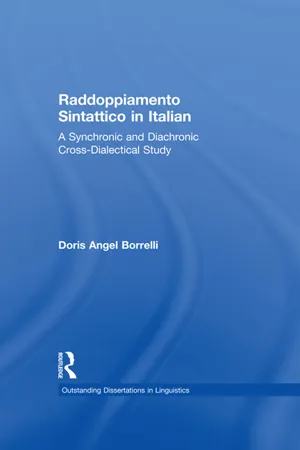
Raddoppiamento Sintattico in Italian
A Synchronic and Diachronic Cross-Dialectical Study
- 128 pages
- English
- ePUB (mobile friendly)
- Available on iOS & Android
eBook - ePub
Raddoppiamento Sintattico in Italian
A Synchronic and Diachronic Cross-Dialectical Study
About this book
First Published in 2002. The Italian phenomenon known as raddoppiamento sintattico, or sometimes raddoppiamento fonosintattico, has received a vast amount of attention. Long recognized in Italian grammar books, the process consists of the gemination of a word-initial consonant in certain environments. The word raddoppiamento means "doubling," and it is deemed "syntactic" or "phonosyntactic" because the process spans word boundaries. This offers a synchronic and diachronic cross-dialectical study of this phenomenon.
Trusted by 375,005 students
Access to over 1.5 million titles for a fair monthly price.
Study more efficiently using our study tools.
Information
RADDOPPIAMENTO SINTATTICO IN ITALIAN
CHAPTER 1
Introduction and Prosodic Preliminaries
1.1 Introduction
The Italian phenomenon known as raddoppiamento sintattico, or sometimes raddoppiamento fonosintattico, has received a vast amount of attention in recent years. Long recognized in Italian grammar books, the process consists of the gemination of a word-initial consonant in certain environments. The word raddoppiamento means “doubling,” and it is deemed “syntactic” or “phonosyntactic” because the process spans word boundaries. The environments that cause raddoppiamento sintattico (hereafter RS) in Standard Italian follow:
Environments of RS:
(1) following a word with final stress
a. [t∫it:á#b:έl:a] città bella | ‘beautiful city’ |
b. [víta#bέl:a] vita bella (no RS) | ‘beautiful life’ |
(2) following certain words without final stress
a. [cóme#m:é] come me | ‘like me’ |
b. [a#k:ása] a casa | ‘home’ (motion or locative) |
c. [páne#duro] pane duro (no RS) | ‘stale bread’ |
As illustrated in (1), a word-initial consonant is geminated following word-final stress but not following a word with penultimate stress. In the environment shown in (2), the gemination occurs following a closed class of lexical items that do not have final stress; some have penultimate stress and others are unstressed monosyllables. The environment in (2) has been considered by traditional grammars (as well as several contemporary linguists) to be the key to the true origins of this phenomenon, rooted in a historical assimilation of a final consonant (subsequently lost) to the initial consonant of the following word. Much recent work on RS focuses instead on the environment in (1)—that following a stress—and many synchronic analyses have been proposed to account for this stress-induced gemination.
The greater part of the attention given to RS has been within the scope of what is known as Standard Italian. Several studies however have acknowledged the importance of the dialects with respect to RS, given that they behave quite differently from the standard and thus offer a wider spectrum in which to study this phenomenon.
It is important to understand the nature of the relationship between Standard Italian and the dialects. A common misconception is that the dialects of Italy were derived from the Standard Italian language. In fact they are not daughters of Standard Italian but rather its sisters. Standard Italian, originating from the region of Tuscany, was one of many Romance varieties developing in Italy in the first millennium. Florence, emerging as a seat of cultural and political prominence in the thirteenth century—aided by illustrious citizens such as Dante, Petrarch, and Boccaccio, who in a revolutionary manner wrote in the Vulgar (spoken) language of the people rather than in Latin—had the good fortune of having its own regional variety embraced as the literary standard and ultimately, with the political unification of Italy, as the national language.
The introduction of the media in Italy in the twentieth century has caused Standard Italian to become pervasive and the use of regional dialects to dwindle some. This is exacerbated by a strong sense of prescriptivism along with sociolinguistic attitudes that relegate dialects to a class of substandard colloquial varieties, the use of which is viewed as a token of lack of education (or exceptionally, membership in the cultural elite, as in the case of Venetian—but in any event a sign of identification with a local language community). Nevertheless, the dialects offer a wealth of opportunity for linguistic study, for they are spoken language varieties that have been able to evolve unconstrained for many centuries, unlike the more conservative literary language that is Standard Italian (Maiden 1995). Essentially, the standard and other dialects are linguistically equivalent entities—we could call them all dialects or all languages, for certainly many of them are divergent to the point of mutual unintelligibility. But without pursuing the vague distinction between dialect and language, which is often based on factors more social, political, and historical than linguistic, we will consider all of the varieties to be dialects, Florentine-Tuscan being the standard dialect as well as the national language. (Keep in mind that of course not all Tuscan is Standard Italian, and another dialectal variety exists in Florence different from the standard.) One other point that needs mentioning is that Standard Italian tends to be colored by the regional influences of its speakers; Fanciullo (1986) in particular argues that all such varieties of Standard Italian should be considered in the study of RS rather than limiting data to that of Tuscan speakers.
The dialects of Italy are extremely diversified, and their geographical classification is traditionally based on an imaginary line that connects La Spezia and Rimini, separating upper North from Center and South. An additional though less clearly defined division has also been acknowledged, one that connects Rome and Ancona (Maiden 1995), separating the central regions of Italy—including Tuscany, Umbria, the Marches, and the upper parts of Lazio and Abruzzi (the vague transitional border falls somewhere in these two latter provinces)—from the rest of the South, the former often being referred to as the Center-South. According to what we will discover from the patterns of RS explored in Chapter 3, the dialects will be organized as northern, central, and southern, keeping in mind that this does not map perfectly onto a geographical division of three equal parts.
This study offers a comprehensive and unified account of RS incorporating both environments in which it occurs: the lexical in (2) and stress-induced in (1). The account addresses the variation in the dialects with respect to this phenomenon. The resulting analysis, while uniting diachronic and synchronic aspects, will thus account for general patterns throughout Italy. The remainder of this chapter provides an overview of prosodic properties in Italian relevant to RS. Chapter 2 addresses historical gemination in general in ...
Table of contents
- Cover
- Title Page
- Copyright Page
- Dedication
- Table of Contents
- Acknowledgments
- Chapter 1: Introduction and Prosodic Preliminaries
- Chapter 2: Historical Gemination
- Chapter 3: Raddoppiamento Sintattico: Data
- Chapter 4: Previous Analyses
- Chapter 5: Lenition
- Chapter 6: Analysis
- References
- Index
Frequently asked questions
Yes, you can cancel anytime from the Subscription tab in your account settings on the Perlego website. Your subscription will stay active until the end of your current billing period. Learn how to cancel your subscription
No, books cannot be downloaded as external files, such as PDFs, for use outside of Perlego. However, you can download books within the Perlego app for offline reading on mobile or tablet. Learn how to download books offline
Perlego offers two plans: Essential and Complete
- Essential is ideal for learners and professionals who enjoy exploring a wide range of subjects. Access the Essential Library with 800,000+ trusted titles and best-sellers across business, personal growth, and the humanities. Includes unlimited reading time and Standard Read Aloud voice.
- Complete: Perfect for advanced learners and researchers needing full, unrestricted access. Unlock 1.5M+ books across hundreds of subjects, including academic and specialized titles. The Complete Plan also includes advanced features like Premium Read Aloud and Research Assistant.
We are an online textbook subscription service, where you can get access to an entire online library for less than the price of a single book per month. With over 1.5 million books across 990+ topics, we’ve got you covered! Learn about our mission
Look out for the read-aloud symbol on your next book to see if you can listen to it. The read-aloud tool reads text aloud for you, highlighting the text as it is being read. You can pause it, speed it up and slow it down. Learn more about Read Aloud
Yes! You can use the Perlego app on both iOS and Android devices to read anytime, anywhere — even offline. Perfect for commutes or when you’re on the go.
Please note we cannot support devices running on iOS 13 and Android 7 or earlier. Learn more about using the app
Please note we cannot support devices running on iOS 13 and Android 7 or earlier. Learn more about using the app
Yes, you can access Raddoppiamento Sintattico in Italian by Doris Angel Borrelli in PDF and/or ePUB format, as well as other popular books in Languages & Linguistics & Italian Language. We have over 1.5 million books available in our catalogue for you to explore.