eBook - ePub
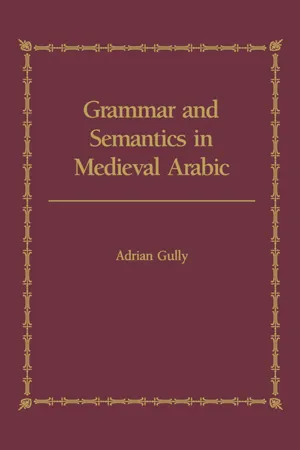
Grammar and Semantics in Medieval Arabic
The Study of Ibn-Hisham's 'Mughni I-Labib'
- 228 pages
- English
- ePUB (mobile friendly)
- Available on iOS & Android
eBook - ePub
About this book
The study focuses on a famous work by a mediaeval Arab grammarian who was once called the 'second Sibawayhi' (the pioneer of Arabic grammatical studies).
Information
Chapter One
ML AND ITS PLACE IN THE MEDIEVAL ARABIC GRAMMATICAL LITERATURE.
‘…and it (ML) became as famous as Sībawayhi’s Kitāb’.1
A cursory perusal of a selection of biographical and secondary sources substantiates the view that ML has always been held in high esteem by scholars and students of grammar alike.2 We are not so much concerned here with the generally accepted observation that ML continues to enjoy popularity as a text book of grammar in educational institutions, since that applies to a reasonably large, if select, number of medieval works of Arabic grammar. Rather more benefit could be gained from an examination of the importance of ML within the context of the scholarly community of the time, and an inquiry into why it has so frequently been referred to as a unique work, although this claim, to the knowledge of the present writer, has never been thoroughly substantiated.
Ibn Hishām was one of the last in a line of distinguished medieval Arabic grammarians. He was born and lived in Cairo from 708/1308 until 761/1359, and studied under, amongst others, the famous Spanish grammarian, Abū Ḥayyān al-Ghamāṭī. He became a professor of Qur’ānic exegesis and wrote many works on Arabic grammar for which he achieved considerable acclaim.3 We can say, therefore, that ML was one of the last great works of Arabic grammar. It has been noted that at least twenty commentaries were devoted to this work during the later medieval period, although only a handful of these are extant.4 What seems to have captured the imagination of scholars writing about I-H, and ML in particular, is the tribute allegedly paid to him by the eminent historian Ibn Khaldūn. It is rare to find an account of I-H’s achievements in the biographical literature and secondary sources without a direct reference to the apparently immortal words of Ibn Khaldūn that describe I-H as ‘a better (?) grammarian’ (anḥā) than Sībawayhi! There is in fact evidence to suggest that Ibn Khaldūn’s assessment of I-H’s ability to this degree was not based on personal judgement; rather he was merely recounting what he had heard. Nonetheless, it is clear from remarks made by Ibn Khaldūn elsewhere that I-H enjoyed an excellent reputation as a grammarian. It is also worth noting that he was acknowledged as a scholar in the mould of Ibn Jinnī even at that time, which is in itself a significant comparison.5
Given the nature of ML, however, it is tempting to pursue this reference to I-H on the understanding that the word naḥw is, the most accurate generic term employed specifically for syntax. This term should, of course, be seen in juxtaposition with morphology, which is known as ṣarf. The use of naḥw as an umbrella term for anything to do with grammar has prevailed for some considerable time, and it is certainly a convenient way of describing the discipline to which the naḥwiyyūn ‘grammarians’ subscribed. However, a thorough analysis of ML soon reveals how Ibn Khaldūn’s alleged tribute could be interpreted prima facie as a comment on I-H’s meticulous attention to detail and the finer points of syntax in the Arabic language, particularly in the latter’s capacity as the pure expression of the Holy Book. So far as we know there is no obvious reason why I-H should have been so highly acclaimed by Ibn Khaldūn, although these two scholars were contemporaries. Neither is there evidence to lead us to believe that they were friends, nor that there was any form of patronage between them. At any rate, assuming that Ibn Khaldūn was the source of these laudatory words it might be useful to offer two possible interpretations of their significance.
It is barely conceivable that modern scholarship could attempt to determine whether one medieval grammarian was more proficient in his trade than another, particularly when the two grammarians involved are generally held to be among the finest of their profession. As we shall see later, some of the medieval grammarians themselves were not averse to passing judgement on the competence of some of their contemporaries or predecessors. It is unrealistic, however, to subscribe to a belief that I-H was ever considered by Ibn Khaldūn to be a better grammarian than Sībawayhi. Admittedly there is evidence to suggest that the timing of I-H’s arrival on the grammatical scene was particularly apposite for Ibn Khaldūn, who had been advocating a resurgence of intellectual advancement in all the Islamic sciences, not least in grammar. So far as he was concerned, the intellectual austerity of that time was destined to restrict any further development of Islamic civilization:
‘Grammar has come to the point of being allowed to disappear, along with the decrease in the other sciences and crafts which we have noted and which is the result of a decrease in civilization’.6
It is in this very context that Ibn Khaldūn alludes to the virtues of I-H. He adds that what sets ML apart from most previous grammars is I-H’s avoidance of repetition; this is a point which I-H makes emphatically in his introduction to ML. If I-H has been considered in some circles to be a better grammarian than Sībawayhi, one can only speculate that it was due in part to the former’s unequivocal interest in certain grammatical issues which may be subsumed within the domain of semantics. As a starting point to this hypothesis, however, a note of caution should be offered. Any discussion about semantics in relation to medieval Arabic grammar should not lose sight of the formal constraints within which the grammarians worked. It is safer, at this preliminary stage at least, to discuss the issue of meaning within the context of the close relationship between semantics and syntax. In many cases the inquiries of the earlier grammarians were based on the same linguistic material as the later ones; and it was not unusual for them to elucidate their discoveries through the employment of the same grammatical devices, such as ḥadhf ‘elision’ or taqdīm wa ta’khīr ‘pre/post-posing (of a syntactic element)’. The significant difference, however, is that scholars with an interest in semantic issues would utilize these devices to a different end. According to Versteegh (to appear) grammarians like Sībawayhi set out to explain the form of sentences, and although they were interested in meaning it is fair to say that they took it for granted to a certain degree.
The interesting feature about all this is that the application of semantic principles to the linguistic data applied more to the earlier commentators on the Qur’ān than to the main body of grammarians: I-H was perhaps exceptional in his approach. In Versteegh’s view (to appear) ‘from the time of Sībawayhi onwards, the mainstream of the Arabic linguistic tradition was characterized by an emphasis on the formal-syntactic aspect of language’. This may be contrasted with an earlier exegete like al-Farrā’ who ‘very often includes semantic constraints in his linguistic reasoning’ (Versteegh, ibid.). This observation enhances further the value of ML because it suggests that I-H was possibly reviving a long-standing tradition of hermeneutics, but through the eyes of a grammarian. This point forms the main focus of our study here.
The relationship between naḥw and balāgha (the generic term for the science of ‘eloquence’) is a complex and, to date, a somewhat indeterminate one. Baalbaki (1983) certainly takes a step in the right direction in his examination of the treatment of certain grammatical features by Sībawayhi and al-Jurjānī.7 Baalbaki compares the approach taken by both of these medievalists on, amongst other things, one or two of the particles. It is no surprise that the results confirm the restricted nature of Sībawayhi’s analysis in a rhetorical context, whilst illustrating the advanced techniques employed by al-Jurjānī. However, the evidence is fascinating, and helps to set our objectives here in a wider and more important context. The complexity of this subject will become more apparent later on as we reflect on the difficulty of identifying the division between purely grammatical issues and those of a more rhetorical nature.
If we return to Baalbaki’s argument, it is clear that in spite of some similarities in approach between the two medievalists, the most noteworthy distinction to be made is that al-Jurjānī apparently never draws a line between meaning and form. On the other hand, Sībawayhi ‘sometimes focuses on formal issues that have little or nothing to do with meaning’ (Baalbaki 1983:12). The relevance of all this to the present study is that in ML, I-H is concerned a great deal with issues that would fit happily into the categories of ma‘ānī and bayān, two of the three main prongs of the science of eloquence. Although this is not the forum for a detailed analysis of these rhetorical devices, (‘ilm al-) bayān may be defined as ‘(the science of) clear speech’. On the other hand, (‘ilm al-) ma‘ānī is ‘(the science of) meanings’, which constitutes a skill acquired by the eloquent speaker enabling him to convey the desired meaning in the most accurate fashion using his judgement to manipulate the syntax to that effect. The context of communication often played an important role in this respect. These two concepts overlap inasmuch as they both involve syntax and style, although there is an unequivocal distinction to be made between them: in fact, the lines of demarcation were set by the rhetoricians themselves who understood that such major linguistic phenomena as majāz ‘figurative usage’ belong to bayān, whilst elements like ḥadhf and iḍmār ‘suppression’ are part of ma’ānī. At any rate there is substantial evidence in ML that I-H was well aware of the different ways in which the grammarians tackled these issues. This will be examined later.
To return to the somewhat speculative comparison between Sībawayhi and I-H, any suggestion that the latter’s approach to the language was akin to that of al-Jurjānī’s cannot be put forward without considerable reservation. In the first instance we may safely assume that I-H’s extensive analysis and rigid categorisation of such phenomena as elision and pre/post-posing, or parenthetical sentences (jumal mu‘tariḍa), for example, indicate a more intricate concern with syntactic and, at times, semantic, elements which constitute a significant part of the category of ma‘ānī, and, of course, the inimitability (i‘jāz) of the Qur’ān. Moreover, little consideration is given to morphology in ML - at least not in isolation without consideration of its relationship to meaning- and almost none to phonology; this is not the case in Sībawayhi’s Kitāb. It is worth adding here that I-H went beyond even the works of later grammarians such as Ibn ‘Aqīl and al-Zamakhsharī in terms of the attention he gave to syntax over morphology and phonology.8 On the other hand, we must be careful not to suggest that I-H’s objectives or even the level of sophistication he reaches are necessarily equal to those of al-Jurjānī.9 Bohas et al. (1990:125), admittedly referring only to I-H’s treatment of nominal and verbal sentences, believe that his mature analysis was still bound by formal considerations.
One of the many features of ML which immediately prompts a further investigation is its innovative layout and the methodology employed by I-H. Both of these factors signalled a break from traditional methods of grammatical analysis in which individual grammatical categories were treated in isolation according to ‘class’. There is little doubt that scholars of the time were also drawn to the work;10 some of these factors will be dealt with in more detail later on. On the one hand I-H continued with his painstaking discussions of all grammatical issues in a manner redolent of all his major works; supporting his arguments with innumerable shawāhid ‘textual evidence’ from the Qur’ān, Prophetic Tradition and poetry while refuting the claims and arguments of many preceding grammarians. If we are seeking to determine any overt advantage that I-H might have had over Sībawayhi, then the simple answer may be found in the chronology. I-H was fortunate to be writing nearly six centuries later than Sībawayhi. In many ways, therefore, ML represents an eclecticism and a culmination of those six centuries of grammatical debate, and prima facie reflects the view that the later grammarians had few original ideas to offer but found ingenious ways of restructuring arguments based on the same data.11 The Zahirite Ibn Maḍa’ was one who remarked explicitly in the sixth century A.H. that the aims of the grammarians to protect the Arabic language from speech errors and change had been fulfilled and exhausted beyond the call of duty.12 In mitigation, however, we hope to demonstrate in later chapters how I-H did contribute some innovative ideas to the problem of interpreting syntactic and semantic issues.
ML illustrates unequivocally the ideas of a scholar who derived much benefit from many previous language-related discussions on philosophical, legal and theological matters of an advanced nature that would not have been possible during the Sībawayhi era. He frequently demonstrates the breadth of his accumulated knowledge by referring to such eminent rhetoricians as al-Sakkākī or little-known scholars like al-Mahdawī, where I-H even distinguishes between his particular reference to the latter and another scholar of the same name who was an exegete and not a grammarian (ML 2:420). These points of detail serve to underline the highly eclectic nature of ML.
The classification of chapters in ML is wholly original even by I-H’s own standards. It comprises eight chapters in which I-H presents a comprehensive analysis of the syntax of the Arabic language with due consideration being given to a number of semantic issues, as we have already noted. The pivot of the work is i‘rāb, a term which incorporates the concepts of inflection, syntactic parsing, and, in a more specific sense, syntax.13 More than half the work is devoted to the mufradāt (a category of single lexical items embodying mainly grammatical particles), while the remainder investigates all aspects and types of the sentence. I-H reveals more overtly perhaps the extent of his aims in ML in Chapter Seven which is entitled ‘On the Nature of I‘rāb’, where he notes that ‘when the item under scrutiny is a particle, he (the one giving the exposition) demonstrates its type, meaning and operating power (if it is an operator)…then after talking about the mufradāt he will go on to talk about sentences’ (ML 2:667–68).
Let us return now to the rather unqualified comparison which has been made between I-H and Sībawayhi. There is perhaps a second possible interpretation of the reasons behind Ibn Khaldūn’s alleged tribute to I-H which may well be more plausible than the first. When a...
Table of contents
- Cover
- Half Title
- Title Page
- Copyright Page
- CONTENTS
- Acknowledgements
- Preface
- 1 ML and its place in the medieval Arabic grammatical literature
- 2 Historical and epistemological considerations. and principles of community agreement in ML
- 3 Ibn Hishām and his position as a grammarian in ML
- 4 Polemical categories in Chapter Five of ML
- 5 Particles: the grammarian’s stock-in-trade
- 6 Further semantic and structural aspects in Part Two of ML
- Conclusion
- Bibliography
- Index
Trusted by 375,005 students
Access to over 1.5 million titles for a fair monthly price.
Study more efficiently using our study tools.
Frequently asked questions
Yes, you can cancel anytime from the Subscription tab in your account settings on the Perlego website. Your subscription will stay active until the end of your current billing period. Learn how to cancel your subscription
No, books cannot be downloaded as external files, such as PDFs, for use outside of Perlego. However, you can download books within the Perlego app for offline reading on mobile or tablet. Learn how to download books offline
Perlego offers two plans: Essential and Complete
- Essential is ideal for learners and professionals who enjoy exploring a wide range of subjects. Access the Essential Library with 800,000+ trusted titles and best-sellers across business, personal growth, and the humanities. Includes unlimited reading time and Standard Read Aloud voice.
- Complete: Perfect for advanced learners and researchers needing full, unrestricted access. Unlock 1.5M+ books across hundreds of subjects, including academic and specialized titles. The Complete Plan also includes advanced features like Premium Read Aloud and Research Assistant.
We are an online textbook subscription service, where you can get access to an entire online library for less than the price of a single book per month. With over 1.5 million books across 990+ topics, we’ve got you covered! Learn about our mission
Look out for the read-aloud symbol on your next book to see if you can listen to it. The read-aloud tool reads text aloud for you, highlighting the text as it is being read. You can pause it, speed it up and slow it down. Learn more about Read Aloud
Yes! You can use the Perlego app on both iOS and Android devices to read anytime, anywhere — even offline. Perfect for commutes or when you’re on the go.
Please note we cannot support devices running on iOS 13 and Android 7 or earlier. Learn more about using the app
Please note we cannot support devices running on iOS 13 and Android 7 or earlier. Learn more about using the app
Yes, you can access Grammar and Semantics in Medieval Arabic by Adrian Gully in PDF and/or ePUB format, as well as other popular books in Social Sciences & Ethnic Studies. We have over 1.5 million books available in our catalogue for you to explore.