- 260 pages
- English
- ePUB (mobile friendly)
- Available on iOS & Android
eBook - ePub
About this book
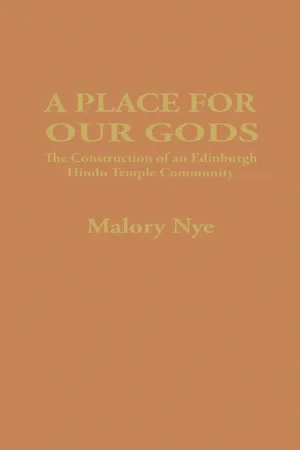
Study of some 150 Hindu families (and about 1000 persons) living in Edinburgh, and particularly about the fact that two associations exist among them, one of which is based on activities at a temple.
Information
Chapter One
INTRODUCTION
Visitors, and even residents, in Edinburgh are rarely aware that there is a Hindu temple in the capital of Scotland. On reflection it is perhaps not altogether surprising to find such an institution in the midst of an important city—there are now many Hindu communities and Hindu temples in Britain. Indeed it is estimated that in 1992 there were around two hundred and fifty Hindu temples in the country (see Vertovec n.d.1), and so it is not unreasonable to assume that temples will be built wherever Hindus have settled. However, from the outsider’s perspective it seems quite unexpected to find a vibrant temple community based around such an exotic faith. Furthermore, even if we accept that this is not an unusual development to find among British South Asians, it is still necessary to be cautious of the contrary expectation that a group of Hindus living together will inevitably form temples and communities.
1.1.1 The bases of community
Those people who are considered ‘Hindu’, ‘Asian’, or even ‘immigrants’, are also (in most cases) British citizens—they have multiple social roles and attachments in the various segments of white British life. For example, most Hindus in Edinburgh are employed in positions where their ‘Hindu-ness’ is far less important than most other aspects of their social identities, they often mix in predominantly non-Hindu social networks, and so on.
Of course, Hindus are usually quite noticeable when they do participate in such networks—there is a widespread British cultural assumption that skin pigment is a significant marker of social identity—therefore ‘Asians’ are often perceived as being different from ‘whites’. But other elements may mark out a Hindu as distinct—s/he may choose to wear clothing influenced by sub-continental Indian styles (e.g. a sari or a salwar kamiz), rather than British styles, or s/he may wear a mark on his/her forehead (a tilak, tikka, or bindi). Skin colour cannot be easily changed, but these other marks of distinction are more optional. Likewise, to form a community based around the notion of being Hindu is equally optional—and so when people choose to do so, there must be some important reasons motivating them.
If these communities were based purely on family groups—close kin, cousins, maybe even extended a little further—then perhaps it would be easy to understand the bases of such social organisation. Indeed a number of ‘Hindu’ groups in Britain are based on kinship networks—there are many different Lohana and Patidar communities, which organise around common membership of the same caste-jati1 group, and hence around a cluster of related families. In the Lohana and Patidar cases, however, the small groups have built up into large national organisations, with memberships of around 40-50,000 each (Michaelson 1983: 34, Kalka 1987: 75). Other groups are organised around people who share close ties, which may well extend back before migration to Britain. People who migrated from nearby villages or towns are well disposed to forming social networks once settled in this country. Their shared past helps them to share a present, and to form a communal group.
The Edinburgh community is made up of strangers, however—out of people who know nothing of each other, but who choose to create social networks across this ignorance, based on the assumption that they have something in common. The formation of such a ‘community’ requires some explanation. Even people who share a common language, a common religion, and common traditions, may not have enough to motivate them to mix with each other. This is especially the case if they are living in an urban environment in which there are many other claims on their time, and some effort is required to participate in Hindu social networks.
But despite these inhibiting factors, there is a Hindu community in Edinburgh. Many people choose to overcome the boundaries of strangeness, and to use the basis of a shared religion and shared non-British traditions to form friendships. Not all Hindus in Edinburgh do choose to do this—some refuse to have anything to do with the ‘community’, others are simply indifferent to it—but a sizeable proportion talk as if this is what is happening, they talk about a Hindu community.
1.1.2 Hindus and Hinduism
This tells us perhaps why there is a community, but it does not tell us why the basis of this community is a perception of a common cultural identity—as Hindu Indians—or why it is primarily centred around a notion of a common religion, i.e. Hinduism. The answer to this may well lie in the relationship between religious institutions and communality—or to put it in more Durkheimian terms, the relationship between religion and society. Religious institutions can (and often do) serve as important centres for social networks, they can help to bring disparate groups of people together and lay the bases of a community.
The Edinburgh Hindu temple can play this role. Although worshippers may attend the temple for their own personal reasons—to do puja to Hindu gods, and to bring auspiciousness on themselves and their families—by doing so they meet other Hindus living in Edinburgh. The physical congregation of a number of Hindus can lay the basis for social networks to develop between them. However, this is not an inevitable process—the mere fact that people are together in the same room does not mean that they would wish to form a community, no matter what they are doing. A group of students sitting in a lecture may or may not form social ties amongst themselves outside the lecture room—similarly people gathering together to worship and pray do not have any mystical bond that will inevitably encourage them to form a community.
So the temple can provide a forum in which a community can be created—but only if the worshippers wish it to happen. When dealing with a Hindu group, it is important to be aware that Hindu temple traditions are very different from Christian church models—many Hindu temples are not ‘community centres’ like the stereotypical English parish church—they are places where individuals and small groups of people can go to worship on their own. Furthermore, there is an assumption among many people—both within and outside the Hindu community—that Hinduism is a religion that is shared by all those who call themselves Hindu. But it is necessary to question whether this assumption is correct. Can we say that Hindus share a religion, in the same way that Christians do? India is a large country in which there is great diversity—many different forms of religious belief and practice come within the rubric of ‘Hinduism’, and it is extremely difficult to find a common element amongst these varieties. Some writers even argue that the notion of Hinduism is a western construction, and that instead the many forms of religious practice in India do not constitute a single world religion (like Islam and Christianity), but different religions, which are each distinct, although similar in some respects.
In this book I shall be examining this problem from the perspective of western anthropological approaches to Indian/Hindu diversity—to see how we can account for diversity, and to also ensure that we are clear with our own (and others’) uses of the terms ‘Hindu’ and ‘Hinduism’. This is essential in understanding the ways in which the terms are being used and understood by those who label themselves as such in Edinburgh. The process of participating in a ‘Hindu’ community requires a construction of particular connotations and significances around these notions, which perhaps they did not have before.
1.1.3 Diversity
The problem of cultural diversity within the umbrella of Indian-Hinduism is very real among the groups being described here. I shall show that the Hindu population originates from a number of different areas in India, and thus from a number of different traditions. In each of these traditions there is a distinctive understanding of what it means to be religious, and so what it means to be a ‘Hindu’. Some of these traditions are not easily accommodated within a single institutional framework.
It is important to realise, therefore, that the co-operation that is occurring between these groups within the Hindu community should not be taken for granted. There is no obvious reason why a number of different factional groups originating from different cultural and religious traditions should try to work together as ‘Hindus’, rather than work separately. It would be equally possible for groups to organise in terms of their differences, rather than unite under the common identity of being ‘Hindus’. Why should these people wish to overcome the centrifugal forces of regional and sectarian difference with the more vague and ill-defined centripetal forces of common Hindu/Indian identity?
A simple answer to this is that if they did organise according to their differences, then they would not be able to construct a temple building. The Hindu population is quite small—less than one thousand—and so if each factional element worked separately, then no one group would be able to raise sufficient funds to make a temple project successful. By pooling their resources, and also their differences, they can establish a Hindu temple in Edinburgh.
But this begs the question of why they should want a temple. Why should they make so much of an effort (since a temple building is expensive to construct, and time-consuming to run)? There are many different reasons for this, none of which are exhaustive. There is a general feeling that there should be a temple: so that the gods can be worshipped effectively; so that traditions can be maintained; so that Edinburgh Hindus can be comparable with other Hindus in Britain, who already have temples; so that children can be taught Hindu traditions and religious values, and so on. A temple is also a useful project for self-designated community leaders—it is an arena in which they can hope to acquire prestige, and maybe some power.
There is also a feeling that the temple should be a ‘community centre’, it should be the place where the Hindu community can meet together and develop. The temple organisation is called the ‘Edinburgh Hindu Mandir and Sanskritic Kendra’, which members usually translate as the ‘Edinburgh Hindu temple and community centre’. The project envisages the temple building as having catering facilities for social (as well as religious functions), and also a hall ‘for the community’ (as well as for the non-Hindu ‘local community’).
But this brings us back to where we started—if the temple is to serve the community, and the community is being formed around the temple, how on earth did all this start? I do not claim to be able to answer this question, if indeed there is an answer. What I will be attempting to discuss in this book are the relationships that exist between the three ideas—the temple, the community, and the religion. The ways in which these constructions are occurring—as well as the forms that they are taking—give us an idea of why there is such an ongoing process—even if they do not fully explain the process itself. When I talk of construction, I use the word both metaphorically and literally—the idea of the temple is being constructed alongside the building in which it is housed. And within this building site I—as an anthropologist—am treading carefully in an attempt to find some order, to understand the blueprints and the foundations, and maybe even have a view of what the future result will be.
1.2 Introducing Edinburgh Hindus
1.2.1 Statistical background
The presence of people of South Asian origin in Britain is well known and well documented. It is notoriously hard to give any exact figures about how many are now living within the United Kingdom, but estimates range from approximately one to two million (Clarke, Peach, & Vertovec 1990: 2; Knott 1991; King 1984). South Asians2 are by no means a homogeneous population—in Britain they are divided by a great many factors, most importantly by country and region of origin, and by religion.
The three major religions of British South Asians are Hinduism, Sikhism, and Islam and the three main countries of origin are India, Pakistan, and Bangladesh. This present study will be concentrating on a group of Indian Hindus who are now settled in Scotland. Of these, the two main regions of emigration were Panjab (in the north west of the country) and Gujarat (on the west coast north of Bombay).
Many of these came to Britain directly, emigrating during the postwar years in the 1950s and 60s. However, in the 60s and 70s there was another wave of migration of South Asians (including Indians) who had previously settled in the British colonies of East Africa but who left (either voluntarily or were expelled) following the independence of these countries. In many respects these East Africans are culturally the same as the direct migrants; but their histories are significantly different and this is still importan...
Table of contents
- Cover
- Half Title
- Title Page
- Copyright Page
- CONTENTS
- LIST OF TABLES AND FIGURES
- PREFACE
- 1 INTRODUCTION
- 2 AN ‘ETHNIC’ COMMUNITY
- 3 HINDUISM IN A DIASPORA CONTEXT
- 4 THE EDINBURGH HINDU MANDIR AND SANSKRITIC KENDRA
- 5 THE MANDIR SATSANG
- 6 DEVOTIONAL WORSHIP—BHAJANS AND SATSANGS
- 7 FESTIVALS AT THE MANDIR
- 8 THE EDINBURGH INDIAN ASSOCIATION
- 9 RELIGION, SOCIETY, AND THE CONSTRUCTION OF COMMUNITY
- GLOSSARY
- BIBLIOGRAPHY
- INDEX
Trusted by 375,005 students
Access to over 1.5 million titles for a fair monthly price.
Study more efficiently using our study tools.
Frequently asked questions
Yes, you can cancel anytime from the Subscription tab in your account settings on the Perlego website. Your subscription will stay active until the end of your current billing period. Learn how to cancel your subscription
No, books cannot be downloaded as external files, such as PDFs, for use outside of Perlego. However, you can download books within the Perlego app for offline reading on mobile or tablet. Learn how to download books offline
Perlego offers two plans: Essential and Complete
- Essential is ideal for learners and professionals who enjoy exploring a wide range of subjects. Access the Essential Library with 800,000+ trusted titles and best-sellers across business, personal growth, and the humanities. Includes unlimited reading time and Standard Read Aloud voice.
- Complete: Perfect for advanced learners and researchers needing full, unrestricted access. Unlock 1.5M+ books across hundreds of subjects, including academic and specialized titles. The Complete Plan also includes advanced features like Premium Read Aloud and Research Assistant.
We are an online textbook subscription service, where you can get access to an entire online library for less than the price of a single book per month. With over 1.5 million books across 990+ topics, we’ve got you covered! Learn about our mission
Look out for the read-aloud symbol on your next book to see if you can listen to it. The read-aloud tool reads text aloud for you, highlighting the text as it is being read. You can pause it, speed it up and slow it down. Learn more about Read Aloud
Yes! You can use the Perlego app on both iOS and Android devices to read anytime, anywhere — even offline. Perfect for commutes or when you’re on the go.
Please note we cannot support devices running on iOS 13 and Android 7 or earlier. Learn more about using the app
Please note we cannot support devices running on iOS 13 and Android 7 or earlier. Learn more about using the app
Yes, you can access A Place for Our Gods by Malory Nye in PDF and/or ePUB format, as well as other popular books in Social Sciences & Ethnic Studies. We have over 1.5 million books available in our catalogue for you to explore.