eBook - ePub
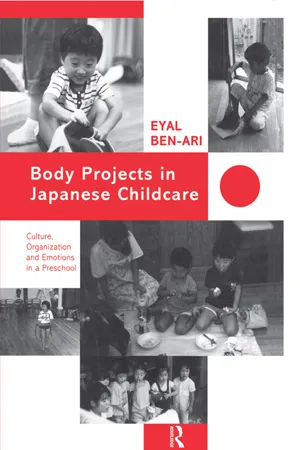
Body Projects in Japanese Childcare
Culture, Organization and Emotions in a Preschool
- 178 pages
- English
- ePUB (mobile friendly)
- Available on iOS & Android
eBook - ePub
About this book
Examines the place of body practices and the management of emotions in Japanese preschools. Early childhood socialization is explored as a set of 'body projects': a series of practices undertaken (over time) to design the body according to prevailing cultural definitions and images.
Information
Chapter 1
Introduction
This book examines the place of body practices and the management of emotions in Japanese preschools. I proceed from the following, rather simple, proposition: while a host of very good studies of Japanese preschools have been published in the past decade, these works tend to overlook a number of key issues related to embodiment and to affects. Borrowing from Featherstone (1991; also Fruhestueck 1994), I propose to explore early childhood socialization as a set of ‘body projects’: a series of practices undertaken (over time) to design the body according to prevailing cultural definitions and images. The concept ‘body projects’ allows us to understand how the body is, at one and the same time, a malleable material good capable of being fashioned in a certain manner, an entity which represents social relations and notions, and an embodiment of affective attitudes and stances towards the world. To be sure, body projects can be seen as individual undertakings in which people intentionally fashion their physical frame to conform to accepted social notions. But the intriguing question in regard to such projects in preschools involves the organizational schemes that use the body in enculturating children. The analytical challenge then, is to uncover the procedures and methods utilized by such institutions to fashion children’s physical forms and emotional postures and attitudes.
This volume tackles this set of themes by examining one institution of early childhood education: Katsura Hoikuen (Day-Care Center). Based on fieldwork carried out in the summer of 1988 and (for a short while) in the fall of 1994, my perspective is basically ethnographic in its approach. In order to situate my study in relation to contemporary scholarship of the ‘body’ and of Japanese preschools, and in order to clearly identify the issues I have singled out for analysis, let me answer three questions in the framework of this introduction: why the focus on body practices and emotions? Why day-care centers? And why the specific case I have chosen to study?
From Cognition to Embodiment
There have been two waves of post-war research by Western scholars on childhood socialization in Japan. The first wave of studies which was published in the 1950s and 1960s focused on the family and the home. These studies dealt with such issues as motivation (De Vos 1973; 1986), personality (Lanham 1966; 1986), or infant-mother relations (Caudill and Weinstein 1969; Caudill and Plath 1986). Most (but not all) of these studies appear to have been grounded in one or a combination of two ‘grand’ approaches: the ‘culture and personality’ school as evinced in Benedict’s (1746) classic volume and various versions of modernization theory (De Vos 1773; Vogel 1963).
The second wave of studies, which began during the late 1970s, continued to concentrate on families (for instance, Hess et al. 1980; Conroy et al. 1780; Fuller et al. 1786; Tanaka 1984), but added a new interest in preschools, in institutions of early childhood education. The rationale underlying these later studies was empirical and theoretical. On the one hand, scholars directed their attention to the extent and prevalence of such institutions. With about 95 per cent of children who enter first grade having attended kindergartens (yoochien) or day-care centers (hoikuen) (Tobin et al. 1987: 70) preschool is now nearly a universal experience for Japanese youngsters. On the other hand, the focus on preschools grew out of a recognition that as the exposure to formal education in preschool was a formative experience influencing children’s later schooling, an examination of this experience would provide insights into how Japanese people gain abilities to carry out various social roles throughout their lives (Rohlen 1789a; 1787b).
Along these lines, in the past decade or so, a host of excellent studies of preschool education in Japan had been published. These studies include overviews like Hendry’s (1786a) book or Boocock’s (1989) article as well as examinations of specific institutions (Peak 1991a; Sano 1989; Tobin, Wu and Davidson 1989). In addition, other scholars have examined more specific issues such as preschool curriculum, relations between teachers and mothers, peer control and the inculcation of individual responsibility and cross-cultural differences in notions of childcare (DeCoker 1989; Fujita 1989; Fujita and Sano 1988; Lewis 1989; Peak 1991b). These discussions have done much to further our understanding of the dynamics of custody and instruction in kindergartens and day-care centers.
At the base of the various studies of preschools which have been published during the 1980s and 1990s stand two kinds of models each of which belongs to a somewhat different intellectual tradition. The first, or cognitive model is found in the work of such scholars as Bachnik (1992; 19941, Rosenberger (1992) and Tobin (1992). The focus in this model is on the culture-specific definitions of self as found in Japan (Kelly 1991). As a consequence of this focus in examining socialization, advocates of this model either explore how children come to master certain basic cultural notions (such as the uchi/soto distinction), or reveal the ethno-classifications which underlie the care and instruction given to children (cf. White and Levine 1986; Kojima 1986). The advances made within this approach have been in the systematic presentation of the basic cognitive categories by which the Japanese self is defined.
The second model is a sophisticated version of an educational or learning model. It has been formulated in the work of such scholars as Peak (1989; 1991a), Shields (19891, DeCoker (1989) and foremostly Lewis (1987; 1991). Here the emphases are primarily on the relationships between teachers and pupils; the preparation of children for school life (and other social roles); and the inculcation of certain basic routines and habits. The contributions of this approach have been both to provide sound ethnographic depictions of pre-schools, and to underscore the role of caretakers in teaching children fundamental school related abilities (such as the capacities to concentrate or to be orderly in personal habits).
While both models have made considerable contributions to our understanding of Japanese preschools, they are seriously limited in terms of addressing issues of embodiment. Thus while there have been occasional openings in regard to other aspects of Japanese society (Kondo 1990; 1992; McVeigh 1993; 1994), as yet little has been done within both approaches to address the question of how body practices and the management of emotions enter the complex set of processes we term socialization. But this question is critical for understanding what happens during childhood. Take Berger and Luckmann’s (1967; 203) proposition that socialization does not simply involve the intrinsic problems of learning, because
the child resists the imposition of the temporal structure of society on the natural temporality of his organism. He resists eating and sleeping by the clock rather than by the biologically given demands of the organism.
From our point of view, the import of Berger and Luckmann’s contention is not only that some children resist patterns imposed on them by caretakers (and parents), but that from the teachers’ point of view these children become ‘organizational problems’. The administration of naptimes and mealtimes, to put this by way of their example, is thus saturated with issues of power, physiological needs and demands, and cultural definitions of proper demeanor and behavior. The situation in which issues related to the body and to emotions have not been systematically integrated into the examination of Japanese preschools is all the more surprising given the growing social scientific attention to embodiment (Csordas 1993). Let me very briefly describe some of the features of this scholarly interest and then indicate the kinds of questions that it raises about early childhood education in Japan.
In general, the move towards ‘the body’ grew against the background of a wider dissatisfaction with the grand theories of the post-War social sciences: the ‘modernization’ and the ‘culture and personality’ schools. While the former dealt with roles and statuses defined in ideal terms, the latter considered configurations of personality type induced by cultural socialization. Both approaches, however, “fell foul of the difficulties implicit in dealing with the questions of deviance and change” (Strathern 1994: 43). At first the discontent with these approaches led to an appreciation of the dynamic processes – the negotiations, inventions and contestations – by which cultures are constructed. Then, a study of ‘the person’ began to be seen as offering the possibility of drawing on both of the older grand traditions without taking on their less tenable propositions: distinguishing between self and the person enabled a rerun of the older distinction between the individual and his or her social role to be incorporated into new debates. In the newer approach, “the focus has been cultural: self and person are seen as culturally defined concepts. Sociality enters when the negotiation of transactions between selves and persons is taken into account” (Strathern 1994: 43–4).
More recently, the discontentment with older approaches has led away from a mentalistic or cognitive model of social life and the focus on the ‘person’ has been combined with a wider move towards studying the body. While lack of space precludes a more ordered overview, it seems that interest in the body is the outcome of both social and theoretical developments; specifically, changes in the meaning of the body in contemporary post-industrial societies (Martin 1992). The main theoretical developments have been a gradual shift away from simple mind/body dichotomies and the reconceptualization of the mind/body relationship in a more holistic manner1 (Lutz 1985; 1987); the incorporation of Pierre Bourdieu’s (1977) ideas about habitus as propensities or inclinations which are beyond the grasp of consciousness into social scientific thought; and the influence of Michel Foucault’s (1979; 1980) propositions about discipline and body/power on current studies. As a consequence of these developments ‘conventional’ issues such as childhood socialization are beginning to be examined in a new light. In this volume, I propose to examine and to offer a new approach to three issues which emerge out of the recent development in the scholarly study of embodiment.
Culture and motivation. The first issue is related to the limitation of the cognitive model in studies of early childhood socialization. Specifically, it is associated with the link between cognition, emotion and motivation. As I mentioned, a number of recent studies have illuminated the ‘folk-’ or ‘ethno-theories’ of childhood and childcare in Japan (White and Levine 1986; Tobin 1992). Such essays should be seen as part of a much broader move towards uncovering the basic cognitive categories or classifications that underlie what may be termed the Japanese world-view (Bachnik 1994; Rosenberger 1992). But if we are to gain a full understanding of socialization, we must not be content with sketching the main cultural definitions or schemas of child socialization that underlie the care given to youngsters in Japan. The trouble is that without an account of the relations between culture and motivation we may have an intuitive sense that there are culturally based strivings but we have no explanation for how these strivings are internalized and then govern behavior in subsequent situations (D’Andrade 1992: 23). As Strauss (1992: 10) notes, “motivation is not automatically acquired when cultural descriptions of reality are learned. Thus the problem is to show how cultural definitions gain ‘directive’, or motivational force.
Specifically, I contend that the assumption in most recent works about Japanese preschools is that the practices and educational forms found in these institutions somehow “naturally” lead to the inculcation of such cultural emphases as group orientedness or personal discipline. In many previous studies, preschool activities are treated as a sort of ‘black box’ through which the children move only to emerge properly socialized. What I do in this volume is to open up this ‘black box’ and to explore the interpersonal dynamics and individual centered experiences by which the children internalize the cultural definitions. My aim is to examine the manner by which educational goals and practices (many of which have been illuminated in previous studies) acquire motivational significance for the children. I suggest that this motivational significance is achieved via a link between official educational aims and both the bodily needs and demands of the children and their emotional stances toward others.
The dual nature of body practices. The second issue involves a limit of the educational model in studies of Japanese preschools. It centers on making problematical what we mean by the place of body practices in the internalization of cultural constructs. A reading of recent studies reveals that there are two analytically distinct dimensions involved in the manner – the actual mechanisms – by which children learn to embody culture. The first is the method by which certain practices gain strong motivational significance. The second, however, is the way in which preschool practices lead to educational goals becoming natural, habitual parts of the children’s lives. Thus although the matter is not always clear, studies of the body and of emotions tend to lead in one of two directions: either the accent is on the coupling of cultural meanings to motivation via a set of positive reinforcements and more negative controls; or the stress (a la Bourdieu) is on propensities and implicit habits carried in one’s comportment.
My contention is that while promoters of the educational model have been well aware of the importance of habits and the inculcation of propensities, they have done little to place these issues in an explicit theoretical framework. Along these lines, my second aim is to differentiate and then to integrate (within the ‘black box’ of preschool) the more ‘passive’ mode of gradually learning to embody certain taken for granted habits and the more ‘active’ connection of such habits and practices to a set of incentives and inducements.
The body and resistances. The third issue is related to something that has hardly been touched upon either in the general literature on embodiment or in specific studies of Japanese preschools: the resistances that children mount in and around body processes and the emotional commitment and involvement demanded of them in preschools. These protests and oppositions are expressed in direct denials of teachers’ requests and directives, but (given the power of caretakers over them) they are also expressed through a variety of obscenities, jokes, and general mischief that form an essential part of any child’s life. The range of such behaviors all contain a potential for children to assume a critical stance towards preschool and towards what is being done to them.
The reason for examining these kinds of critical play are twofold. Empirically they help us appreciate the variety and the complexity of the experience of early childhood education in Japan. Theoretically, an analysis of such playful behavior raises questions about our conceptualization of (Japanese) children and just what it is that goes on in such institutions. If we accept the basic independent capacities of children then we begin to see them not as dependent and needing to be socialized, but as independent actors who participate in their own socialization and who can take an autonomous stance vis-à-vis teachers, other people and themselves.
Why Study Day-Care Centers?
Primarily as a result of the entry of women into the labor force (Hayashi 1985; Yamagata 1986; Carney and O’Kelly 1990) a substantial part of primary socialization in Japan takes place within preschools. In Japan, institutions of early childhood education are differentiated into yoochien (kindergartens) and hoikuen (day-care centers). Kindergartens are usually open half-days and cater for children aged four and five. Day-care centers normally operate for a whole day (often from seven in the morning until six at night) and cater to children of working mothers between the ages of a few months and six (in reality most of the children attend only after the age of two). In addition, while kindergartens fall under the jurisdiction of the Ministry of Education, day-care centers are run under the aegis of the Ministry of Health and Welfare.
In the past two decades, however, the type of institution which has shown the greatest rate of growth has been the day-care center. Today there are 22,000 public or publicly recognized day-care centers that cater to over 2 million children (Koseisho 1993; Tochio 1986: 3). At the point of entry into schools – that is, entry into primary school – about 30 per cent of children have attended day-care centers (Fujita 1989: 77). But as Tobin and his associates (1989: 209) state, with the falling birthrate “some Japanese preschools will have to close, and a gradual shift in women’s life-styles from full-time mothering toward a more job- or career-centered orientation seems to favor survival of hoikuen over yoochien in the long run”. Thus the grounds for studying day-care centers are primarily that these institutions are becoming more important in ‘designing’ the face of Japan’s future generations: both in terms of preparing them for the Japanese educational system and (later) for entry into the work force.
But the justification for studying day-care centers also has to do with their organizational features. Many studies of Japanese pre-schools – like Tobin et al. (1989) or Hendry (1986a: 125) – have tended to examine institutions of early childhood education without differentiating between the special characteristics of kindergartens and day-care centers. Indeed, for these scholars’ analytical purposes to a large extent both types of institutions are similar in major respects: for example, in terms of curriculum and educational goals. But the differences between them bear importance for our analysis. The fact that children attend day-care centers for whole days involves, from an organizational point of view, a much more complex set of tasks which are to be managed and arranged: not only educational activities, but also such thi...
Table of contents
- Cover Page
- Half-title Page
- Title Page
- Copyright Page
- Dedication Page
- Table Of Contents
- Acknowledgements
- Chapter 1: Introduction
- Chapter 2: The Institutional Framework: Katsura Day-Care Center
- Chapter 3: From Mothering to Othering: Organization, Culture and Naptime
- Interlude I: Hoikuen, Kibbutz and Sleep
- Interlude II: Three Little (Japanese) Pigs
- Interlude III: The Marathon
- Interlude IV: Menus
- Interlude V: An Instance of Discipline?
- References
- Index
Trusted by 375,005 students
Access to over 1.5 million titles for a fair monthly price.
Study more efficiently using our study tools.
Frequently asked questions
Yes, you can cancel anytime from the Subscription tab in your account settings on the Perlego website. Your subscription will stay active until the end of your current billing period. Learn how to cancel your subscription
No, books cannot be downloaded as external files, such as PDFs, for use outside of Perlego. However, you can download books within the Perlego app for offline reading on mobile or tablet. Learn how to download books offline
Perlego offers two plans: Essential and Complete
- Essential is ideal for learners and professionals who enjoy exploring a wide range of subjects. Access the Essential Library with 800,000+ trusted titles and best-sellers across business, personal growth, and the humanities. Includes unlimited reading time and Standard Read Aloud voice.
- Complete: Perfect for advanced learners and researchers needing full, unrestricted access. Unlock 1.5M+ books across hundreds of subjects, including academic and specialized titles. The Complete Plan also includes advanced features like Premium Read Aloud and Research Assistant.
We are an online textbook subscription service, where you can get access to an entire online library for less than the price of a single book per month. With over 1.5 million books across 990+ topics, we’ve got you covered! Learn about our mission
Look out for the read-aloud symbol on your next book to see if you can listen to it. The read-aloud tool reads text aloud for you, highlighting the text as it is being read. You can pause it, speed it up and slow it down. Learn more about Read Aloud
Yes! You can use the Perlego app on both iOS and Android devices to read anytime, anywhere — even offline. Perfect for commutes or when you’re on the go.
Please note we cannot support devices running on iOS 13 and Android 7 or earlier. Learn more about using the app
Please note we cannot support devices running on iOS 13 and Android 7 or earlier. Learn more about using the app
Yes, you can access Body Projects in Japanese Childcare by Eyal Ben-Ari in PDF and/or ePUB format, as well as other popular books in Social Sciences & Ethnic Studies. We have over 1.5 million books available in our catalogue for you to explore.