- 288 pages
- English
- ePUB (mobile friendly)
- Available on iOS & Android
eBook - ePub
About this book
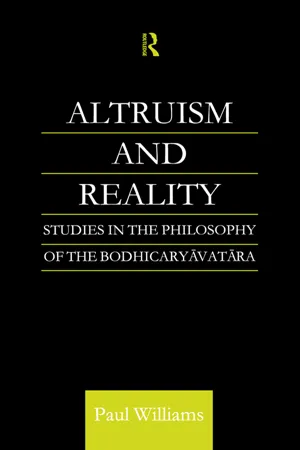
Brings together Paul Williams' previously published papers on the Indian and Tibetan interpretations of selected verses from the eighth and ninth chapters of the Bodhicaryavatara.
Information
One
On Prakṛtinirvāṇa/Prakṛtinirvṛta in the Bodhicaryāvatāra
A Study in the Indo-Tibetan Commentarial Tradition
According to Tsong kha pa, writing in his early Legs bshad gser phreng commentary to the Abhisamayālaṃkāra, in general texts speak of four types of nirvāṇa: the prakṛti or ‘natural’ nirvāṇa, the nonabiding (apratiṣṭhita) nirvāṇa of bodhisattvas and Buddhas, and the nirvāṇas with and without remainders familiar – although not necessarily with the same meaning – from both Mahāyāna and non-Mahāyāna Buddhism. The first of these, the prakṛtinirvāṇa (rang bzhin gyis mya ngan las ’das) is defined by Tsong kha pa as ‘the nature of dharmas which is free from extremes of verbal differentiation’.1 It is clear therefore that for Tsong kha pa the prakṛtinirvāṇa is a type of nirvāṇa, although why it should be called this remains to be seen. It is a rang bzhin, a (fundamental) nature, the nature of dharmas. The Tibetan rang bzhin translates prakṛti here, but of course it is more familiar as the Tibetan translation for svabhāva, inherent existence. The equivalence of prakṛti and svabhāva in the expressions prakṛtinirvāṇa and prakṛtinirvṛta is attested from Sanskrit sources. Prajñākaramati, commenting on Bodhicaryāvatāra 9:104cd (=Tib. 103cd) glosses the verse’s prakṛtyā parinivṛtāḥ with prakṛtyā svabhāvena parinivṛtāḥ. Interestingly, the Tibetan here uses only one expression, unusually in this context rang gi ngo bo nyid kyis mya ngan las ’das pa. Rang bzhin had been used for prakṛtyā in the verse, so the use of rang gi ngo bo nyid in the commentary preserves some sort of distinction although it lacks the clarity of the Sanskrit. For Prajñākaramati the equivalence of prakṛtyā or svabhāvena parinirvṛta with prakṛtinirvāṇa is attested from his subsequent comment – enormously important from the point of view of Tsong kha pa and the dGe lugs interpretation – that living beings have the nature of liberation ‘because of the continued existence in the continuums of all sentient beings of the prakṛtinirvāṇa which is defined as absence of inherent existence’. This time the Tibetan for prakṛtinirvāṇa is the usual rang bzhin gyis mya ngan las ’das pa.2 Much earlier the Samādhirājasūtra had spoken of all dharmas by nature (svabhāvena) conforming to an identity with nirvāṇa, ‘in all dharmas nirvāṇa is set forth’.3 The idea that all dharmas are by nature ‘nirvanated’ is of course familiar from the Prajñāpāramitāsūtras and works in the same genre. It is clear that for Tsong kha pa, presumably following Prajñākaramati, the prakṛtinirvāṇa is another name for emptiness found in all dharmas without exception but particularly with reference to the mental continuum of sentient beings. It is the nirvāṇa which is the rang bzhin of dharmas. For a Tibetan there immediately resonates two references here. The prakṛtinirvāṇa as an unchanging nature within the continuum of sentient beings, a nirvāṇa, carries with it a flavour of the tathāgatagarbha theory found in the Ratnagotravibhāga. The prakṛtinirvāṇa as a nature, a rang bzhin, in dharmas indicates Candrakīrti’s Madhyamakavāvatārabhāṣya on 6:181–2 in which Candrakīrti talks about the true nature of things, the dharmatā which is the same whether Buddhas occur or not, the true rang bzhin, svabhāva, of entities which is their emptiness of any svabhāva.4 In dGe lugs thought these two frames of reference come very firmly together. The prakṛtinirvāṇa is emptiness, which applies to all dharmas. In the mental continuum of sentient beings this emptiness is called the tathāgatagarbha, and with it goes other terms perhaps originally not thought of in this vein in the Madhyamaka context of the Bodhicaryāvatāra such as ‘purified by nature’ (prakṛtipariśuddha) and ‘radiant by nature’ (prakṛtiprabhāsvara).5 In Tibetan almost invariably the standard word for nirvāṇa – mya ngan las ’das, the transcendence of sorrow – is used for prakṛtinirvāṇa and prakṛtinirvṛta. If all dharmas are fundamentally or by nature nirvṛta, in Tibetan they have by nature transcended sorrow. There is a psychological and soteriological aspect implicit in the language used which draws together the two dimensions of emptiness and tathāgatagarbha in a much stronger way than is necessarily the case with the Sanskrit. In spite of the apparent identity of prakṛtinirvṛta and prakṛtinirvāṇa for Prajñākaramati, it is the former term which is used more often than not in Sanskrit texts, with its implications of ‘by nature, fundamentally, from the point of view of inherent existence, extinguished’, that is, empty. As the sūtras say, this is the nature of things whether there are Buddhas or not. It does not necessarily carry with it the direct psychological and soteriological overtones of ‘nirvāṇa’. And if we look at the use of these notions in the commentaries to the Bodhicaryāvatāra it is striking that there is no employment of what might be called ‘tathāgatagarbha concepts’ in Indian commentaries on the relevant verses. These are, however, abundant in Tibetan commentaries, where the notion of the prakṛtinirvāṇa/prakṛtinirvṛta – and thus also the Bodhicaryāvatāra – become absorbed into the nexus of tathāgatagarbha thought.
The concepts of prakṛtinirvāṇa and prakṛtinirvṛta, and their relationships to the tathāgatagarbha, have been dealt with in his usual thorough and lucid way by David Seyfort Ruegg in his monumental La Théorie du Tathāgatagarbha et du Gotra. Ruegg has noted some of the relevant verses from the Bodhicaryāvatāra, together with Prajñākaramati’s commentary. In addition he has particularly devoted some space to a discussion of the prakṛtinirvāṇa and the prakṛtiprabhāsvara nature of citta found in the work of the eighteenth-nineteenth century Tibetan lama Gung thang ’Jam Pa’i dbyangs. In common with late dGe lugs writings, Gung thang lama’s work is a culmination of much that had gone before and is replete with subtle definitions and distinctions. As I have pointed out elsewhere, however, the contemporary study of Tibetan Madhyamaka is rather like shining a narrow beam at various points in a dark attic.6 We cannot see the whole picture, we do not yet know much about relationships and rivalries involved, the development of ideas, alternative interpretations of the same text and how these relate to their Indian precedents. In spite of the pioneering work by scholars like David Seyfort Ruegg, we cannot yet write a history of Tibetan Madhyamaka. Ruegg has approached the issue of the prakṛtinirvāṇa in Tibet largely through reference to dGe lugs materials. By way of a footnote to his study I would like to take just four verses of the Bodhicaryāvatāra which their commentators deem to be particularly relevant to our issue, and see what of interest for understanding the development of Madhyamaka can be derived from looking at a wider range of Indo-Tibetan commentaries.
1 Indian commentaries
a) | Śāntideva seems to have lived during the early eighth century. His earliest commentator appears to be Prajñākaramati, who wrote the Bodhicaryāvatārapañjikā, which survives in Sanskrit, and was apparently written towards the end of the tenth century.7 The Cone edition of the Tibetan text can be found in mDo 26, folio 39a ff. (abbreviated as Praj.). |
b) | The Bodhisattvacaryāvatārasaṃskāra, by someone whose name was probably Kalyāṇadeva, was composed perhaps in the early eleventh century. The Tibetan alone survives, as with the other commentaries apart from that by Prajñākaramati. It can be found at Cone mDo 27, folio 1 ff. (abbreviated as Kaly.). |
c) | Vairocanarakşita lived at the same time as Atiśa, and was a monk at the great monastery of Vikramaśīla. His Bodhisattvacaryāvatārapañjikā, written in the eleventh century, is at Cone mDo 27, folio 95b ff. (abbreviated as Vair.). |
d) | The Bodhicaryāvatāratātparyapañjikā Viśeṣadyotanī was written by Vibhūticandra, from the monastery of Jagaddala, in about 1200. He accompanied Śākyaśrībhadra to Tibet in 1204. The text is Cone mDo 27, folio 192b ff. (abbreviated as Vibh.). |
e) | Finally there is an anonymous commentary to chapters 9 and 10 of the Bodhicaryāvatāra, the Vivṛti, mDo 27, folio 177b ff. (abbreviated as Anon.). |
All these commentaries were found to be of interest in looking at the relevant verses from the Bodhicaryāvatāra. Others listed in the bsTan ’gyur were not.
2 Tibetan commentaries
a) | Byang chub sems dpa’i spyod pa la ’jug pa’i ’grel pa Legs par bshad pa’i rgya mtsho, by rGyal sras dNgul chu Thogs med. Twelfth century (abbreviated as Thogs. – 1994 note: I have now changed my understanding of the date of this text. See ‘An Argument for Cittamātra’, note 15). |
b) | Byang chub sems dpa’i spyod pa la ’jug pa’i’grel pa, by bSod nams rtse mo (1142–82), the second Sa skya hierarch (abbreviated as bSod.). According to David Jackson (1985), pp. 22–3 bSod nams rtse mo followed in this commentary Phywa pa Chos kyi seng ge (1109–69) who is known to have been hostile to the Prāsaṅgika approach. The commentary also includes quoted material from rNgog lo tsa ba bLo ldan shes rab (1059–1109). |
c) | Byang chub sems dpa’i spyod pa la ’jug pa’i ’grel pa Byang chub kyi sems gsal bar byed pa zla ba’i ’od zer, by Bu ston Rin chen grub (1290–1364, abbreviated as Bu.). |
d) | Byang chub sems dpa’i spyod pa la ’jug pa’i rnam bshad gZhung don rab gsal snang ba, by Sa bzang mati paṇchen ’Jam dbyangs blo gros. Fourteenth century (abbreviated as Sabzang.). I do not know whether this Sa skya pa lama is the same as Sa bzang mati rin chen, who was a pupil of Dol po pa Shes rab rgyal mtshan (1290–1361). The dates are possible, and some of Sa bzang mati paṇchen’s comments do suggest a possible gzhan stong orientation in his interpretation of Madhyamaka, as we shall see. |
e) | Spyod ’jug shes rab le’u’i ṭikkā bLo gsal ba, rJe Tsong kha pa’s (1357–1419) brief commentary on the ninth chapter of the Bodhicaryāvatāra (abreviated as Tsong.). |
f) | Byang chub sems dpa’i spyod pa la ’jug pa’i rnam bshad rGyal sras ’jug ngogs, by Tsong kha pa’s pupil, rGyal tshab rje Dar ma rin chen (1364–1462, abreviated as rGyal.). |
g) | Byang chub sems dpa’i spyod ’jug rnam bshad Theg chen chos kyi rgya mtsho zab rgyas mtha’ yas snying po, by the great historian dPa’ bo gTsug lag phreng ba (d. mid-sixteenth century), a Karma bKa’ brgyud scholar and pupil of the eighth Karma pa, Mi bskyod rdo rje. An enormous, rambling commentary (abbreviated as dPa’.). |
h) | Spyod ’jug gi ’bru ’grel dBu ma’i lam gyi sgron ma, by the ’Brug pa bKa’ brgyud lama Padma dkar po (1527–92, abbreviated as Padma.). |
i) | Spyod ’jug shes rab kyi le’u’i tshig don go sla bar rnam par bshad pa Nor bu ke ta ka, by the rNying ma lama ’Jam mgon ’ju Mi pham rgya mtsho (1846–1912, abbreviated as Mipham.). This commentary to the Prajñā chapter of the Bodhicaryāvatāra initiated a fierce written controversy with certain dGe lugs lamas the sources for which survive and would form an interesting and valuable field for further research.8 |
BODHICARYĀVATĀRA 9:13 (=TIB. 13CD/14AB) (AB)
nirvṛtaḥ paramārthena saṃvṛtyā yadi saṃsaret /
[buddho’pi saṃsared evaṃ tataḥ kiṃ bodhicaryayā //]
gal te don dam mya ngan ’das /
’khor ba kun rdzob de lta na /
[sangs rgyas kyang ni ’khor ’gyur bas /
byang chub spyod pas ci zhig bya //]
If from an ultimate point of view there is cessation, from a conventional point of view there would be saṃsāra /8b
[Then the Buddha too would be in saṃsāra. Because of this, what is the point of conduct towards enlightenment? //]
Kalyāṇadeva alone of our commentators gives us a canonical reference. It is said in the Prajñāpāramitā(sūtras) that ultimately all dharmas are mya ngan ’das – here, to parallel the verse, nirvṛta, ceased or extinguished (f.69b). The opponent argues against the Mādhyamika that it follows that a Buddha is in saṃsāra and the religious life is useless. One interpretation of this is that the opponent confuses nirvṛta, ceased, which applies to all dharmas from an ultimate point of view precisely because ‘from an ultimate point of view’ refers to a hypothetical inherent existence which simply does not exist – that is, from an ultimate point of view there is emptiness of inherent existence – with nirvāṇa, the attainment of enlightenment by (in this case) a Buddha. Thus for the opponent all are already enlightened (a view held consciously, of course, sometimes in a very strong sense, by some Tibetan and East Asian traditions influenced by the tathāgatagarbha). Since all are already enlightened there is no difference between a Buddha and others. Interestingly, the conclusion then is not that others can act like Buddhas – they patently cannot – but that Buddhas are in saṃsāra. Such an interpretation of the opponent’s position and its confusion is broadly correct, but it has no consistent linguistic basis ...
Table of contents
- Cover
- Half Title
- Title Page
- Copyright Page
- Dedication
- Table of Contents
- Preface
- Acknowledgements
- 1 ON PRAKRTINIRVĀNA/PRAKRTINIRVRTA IN THE BODHICARYĀVATĀRA
- 2 ON ALTRUISM AND REBIRTH
- 3 AN ARGUMENT FOR CITTAMĀTRA
- 4 IDENTIFYING THE OBJECT OF NEGATION
- 5 THE ABSENCE OF SELF AND THE REMOVAL OF PAIN
- NOTES
- Bibliography
- Index
Trusted by 375,005 students
Access to over 1.5 million titles for a fair monthly price.
Study more efficiently using our study tools.
Frequently asked questions
Yes, you can cancel anytime from the Subscription tab in your account settings on the Perlego website. Your subscription will stay active until the end of your current billing period. Learn how to cancel your subscription
No, books cannot be downloaded as external files, such as PDFs, for use outside of Perlego. However, you can download books within the Perlego app for offline reading on mobile or tablet. Learn how to download books offline
Perlego offers two plans: Essential and Complete
- Essential is ideal for learners and professionals who enjoy exploring a wide range of subjects. Access the Essential Library with 800,000+ trusted titles and best-sellers across business, personal growth, and the humanities. Includes unlimited reading time and Standard Read Aloud voice.
- Complete: Perfect for advanced learners and researchers needing full, unrestricted access. Unlock 1.5M+ books across hundreds of subjects, including academic and specialized titles. The Complete Plan also includes advanced features like Premium Read Aloud and Research Assistant.
We are an online textbook subscription service, where you can get access to an entire online library for less than the price of a single book per month. With over 1.5 million books across 990+ topics, we’ve got you covered! Learn about our mission
Look out for the read-aloud symbol on your next book to see if you can listen to it. The read-aloud tool reads text aloud for you, highlighting the text as it is being read. You can pause it, speed it up and slow it down. Learn more about Read Aloud
Yes! You can use the Perlego app on both iOS and Android devices to read anytime, anywhere — even offline. Perfect for commutes or when you’re on the go.
Please note we cannot support devices running on iOS 13 and Android 7 or earlier. Learn more about using the app
Please note we cannot support devices running on iOS 13 and Android 7 or earlier. Learn more about using the app
Yes, you can access Altruism and Reality by Paul Williams in PDF and/or ePUB format, as well as other popular books in Social Sciences & Ethnic Studies. We have over 1.5 million books available in our catalogue for you to explore.