- 244 pages
- English
- ePUB (mobile friendly)
- Available on iOS & Android
eBook - ePub
About this book
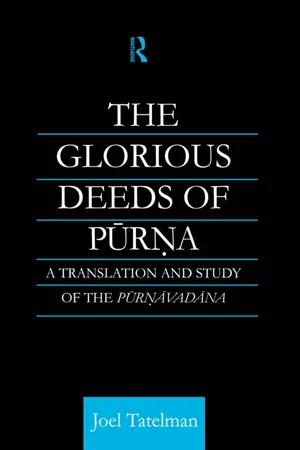
By providing an annotated translation of, and applying the methods of literary criticism to, a first-century account of the life of the saint Purna, this study introduces the reader to the richness and complexity of an essential Buddhist genre.
Information
CHAPTER ONE
Introduction
Buddhist tradition identifies the monk Pūrṇa (Puṇṇa)1 of Śūrpāraka (Suppāraka)2 as the great evangelist who introduced Buddhism to the land of Śroṇāparāntaka (Sunāparanta),3 which corresponds to much of the present Indian state of Gujerat. Śūrpāraka City,4 for many centuries a busy seaport and commercial centre and principal city of Śroṇāparāntaka, survives today as the village of Sopāra, its channel to the sea silted up since the seventeenth century.5
The earliest datable evidence from Śūrpāraka, circa 250 B.C.E., are fragments of Aśoka’s Major Rock Edicts VIII and IX.6 The presence of these suggests that the city had been an important centre for some time before that – how long before is impossible to say. The Mahābhārata mentions Śūrpāraka as a site of religious importance (tīrtha).7 According to the fourth-to-fifth-century Theravādin chronicles, it was from Suppāraka that Prince Vijaya, during the reign of Aśoka, led the first settlers from India to Sri Lanka.8
Other evidence indicates that Śūrpāraka was an active Buddhist centre for at least the first five centuries of the Common Era.9 Seven Prakrit cave inscriptions mention Śūrpāraka (Sopāra). 1. The earliest, from the Shrine (caitya) Hall at Kārli, some fifty miles south of Śūrpāraka, and dated circa 50 C.E., records the donation of a pillar by Bhadanta Sātimita, a Buddhist teacher (bhāṇaka) from Sopāra, who belonged to the Dharmottarīya branch of the Vātsīputrīyas.10 2. From a cave inscription at Nāsik, about fifty miles inland from Śūrpāraka, we learn that Uṣavadāta, son-in-law of the Scythian satrap Nahapāna, who ruled the western coast between 119 and 125 C.E., donated two buildings and eight thousand coconut saplings to the congregation of Carakas at the Rāmatīrtha Monastery in Sopāra.11 3. From Kānheri, twenty miles south of Śūrpāraka, a mid-second century inscription records that Samika, a merchant (negama) and Buddhist lay-disciple (upāsaka) from Sopāra, donated Cave VII and a cistern to the Buddhist Order at Kānheri.12 4. Also from Kānheri and also dated circa 150 C.E., another inscription states that Puṇaka, a guild-leader (seṭṭhi) from Sopāra, donated a reservoir to the Order.13 5. From the late second century, an unidentified patron from Sopāra donated a cistern at Nānāghat, seventy miles inland from Śūrpāraka.14 6. Again to the Kānheri Saṃgha, in 230 C.E., Mudapāla, a Sopāra merchant, donated agricultural land and a number of buildings.15 7. A Kānheri inscription from the mid-fifth century (patron’s name illegible) records the donation of three monastic cells to a monastery at Sopāra.16 Finally, a second-century stūpa containing miniatures of Śākyamuni, the six Buddhas of the past and the Bodhisattva Maitreya, was found in Śūrpāraka itself.17
The cave monastaries at Kānheri near Śūrpāraka were inhabited up to the ninth century18 and the city itself receives mention in Buddhist, Brahmanical and Jain literature right up until the fifteenth century.19 During the last centuries B.C.E. and the first several centuries C.E., Śūrpāraka maintained trade relations with Gangetic India, the Mediterranean, Arabia and Southeast Asia.20
The name Aparānta (Aparanta), which appears in Aśoka’s fifth rock edict, appears to be the older name for Śroṇāparāntaka. The Arthaśāstra, generally assigned to the fourth century B.C.E., refers to the fine cotton cloth produced in Aparānta.21 Again, according to the Theravādin chronicles, during Aśoka’s reign the Elder Moggaliputtatissa despatched Yonaka Dhammarakkhita to spread the Dhamma in Aparanta.22 This, however, is not confirmed in the literature of other Buddhist schools.23 A late (first century B.C.E.) Theravādin canonical text, the Apadāna, mentions an established trade-route between Suppāraka and Suvaṇṇabhūmi (Suvarṇabhūmi), which has been identified with present-day Burma or Malaysia.24
Whatever the exact dates, these meetings of Buddhism and business, monks and merchants, constitute the historical context out of which arose such stories as that of Pūrṇa.
A variety of sources concur in portraying Pūrṇa as one of the Buddha’s immediate disciples, entrusted by the Master himself with the task of converting his homeland. Although we have no verifiable evidence that Buddhism spread beyond the Ganges Basin during the Buddha’s lifetime, it is not impossible that, as several traditional accounts have it, Pūrṇa was a contemporary of the the Buddha who joined the Order of Monks while on a business trip to Śrāvastī. More likely, the historical Pūrṇa (assuming there was one) lived sometime during the Mauryan period (324–187 B.C.E.), began his career as a merchant in Śūrpāraka, later in life joined the Buddhist Order in one of the major centres of northern India and, sometime after that, returned home, where he was instrumental in establishing a viable local Buddhist tradition.25 However, it is also possible that sometime around the beginning of the Common Era, imaginative monks, inspired by the composition of the great biographies of the Buddha and by the character and accomplishments of a revered teacher, created a composite character – ‘Pūrṇa, Apostie to the Śroṇāparāntakans’ – to whom, over time and with much borrowing between different local Saṃghas, they attributed a variety of adventures in order to glorify and authenticate their thriving local Buddhist tradition. Exactly what happened we will probably never know. Fortunately, our focus here is narrative traditions, not historical events.
The particular account of Pūrṇa’s life which is examined in this study is the Pūrṇāvadāna or ‘Glorious Deeds of Pūrṇa,’ a biography of the saint which in its extant Sanskrit recension occurs as the second story in the Divyāvadāna. I propose to study the Pūrṇāvadāna first and foremost as a work of literary art, not unlike a literary critic might study a novel by Conrad or Woolf, much as many scholars now study Biblical narrative. Accordingly, the second part of this introduction discusses methodological issues in some detail. This is followed, in Chapter II, by an annotated translation of the text and, in Chapter III, by a detailed literary analysis. After brief concluding remarks, the appendices present translations of four other versions of the life of Pūrṇa: two from the Theravādin Commentaries (aṭṭhakathā); one, very much based on the Pūrṇāvadāna but written in a more formal poetic style, from the eleventh-century Bodhisattvāvadānakalpalatā of Kṣemendra; and one which exhibits a number of curious features not found in any of the others, from the Mahāsāṃghika Vinaya.
In studying the Pūrṇāvadāna, I shall be primarily concerned with literary and religious meaning rather than historical truth – though seeking the former in no way precludes, and sometimes enhances, one’s understanding of the latter. Nevertheless it is axiomatic for literary analysis that every text requires a context. Texts do not occur in vacuums: they are composed or redacted in specific literary, historical and cultural environments to which, explicitly or implicitly, they constantly allude and the conventions of which they constantly employ. For the Pūrṇāvadāna the overarching contexts are the history, doctrines and practices of Indian and Sinhalese Buddhism and the history of India prior to the seventh century. Of these, I shall assume, the reader possesses some generał knowledge. Nevertheless, it may not be out of place here to say something about the history of the term avadāna and about the development of the avadānas as a Buddhist literary genre.
If the title of the ‘Life’ of Pūrṇa with which we are concerned is Pūrṇa-Avadāna and it occurs as the second story in a collection entitled Divya-Avadāna, what, then, is an avadāna? What does the term mean? Did its meaning, as often happens in the history of words, change over time? How may we define avadāna as a genre of Buddhist literature? To begin with, we may note that John Strong, the contemporary scholar who has done the most interpretive work on the early Sanskrit avadāna literature, translates avadāna as ‘karmic history’ or ‘karmic biography.’ In his study of the legend of the emperor Aśoka (Aśokāvadāna), he offers the following definition:
An avadāna is a narrative of the religious deeds of an individual and is primarily intended to illustrate the workings of karma and the values of faith and devotion. It can often be moralistic in tone, but at the same time there is no denying that it has a certain entertainment value. The avadānas were and are still used by Buddhist preachers in popular sermons and as such have often been compared to the jātakas (stories of the Buddha’s previous lives). Unlike the jātakas, however, the main protagonist of the avadāna is usually not the Buddha himself, but a more ordinary individual, often a layman.26
Such a definition is consistent with those offered by such pioneering scholars as Léon Feer and J.S. Speyer, who also specify that avadānas invariably present an individual’s circumstances in his or her present life as the result of a deed or deeds in a previous birth.27 This is apparently confirmed by the mediaeval avadāna specialists. In a story from one of the late anthologies, the Kalpadrumāvadānamālā, which retells in verse stories from the much earlier Avadānaśataka, we read: “From virtue, beings enjoy happiness, from vice, they experience misery; from deeds which partake of both, they experience both: so say the Avadānists.”28 Later in the same text, the narrator states: “By the standards of Dharma there is no authority whatever in birth. So teach the Buddhist Avadāna experts.”29
In its root etymological sense, avadāna, and its Pāli form, apadāna, mean ‘cutting off’.30 In Brahmanical ritual, the term was specialised to mean that portion of the sacrifice (havis) which is offered to the gods. In the Aggañña-sutta of the Dīgha-nikāya and in a parallel passage in the Lokottaravādin-Mahāsāṃghika Mahāvastu, apadāna and avadāna, respectively, are given the specialized agricultural sense of ‘reaping’ or ‘harvesting’.31 By a process of semantic development which, at least for Pāli, has been clearly delineated, this agricultural sense of the term became identified with the central Buddhist doctrine of karman, the moral causality of volitional action, in which the deeds one ‘sows,’ performs, in a given birth, ‘bear fruit’ or are ‘harvested,’ produce their results, in subsequent births. In the predominantly agricultural societies of ancient and mediaeval South Asia, employing such universally understood concepts as doctrinal terms made per...
Table of contents
- Cover
- Half Title
- Title Page
- Copyright Page
- Dedication
- Table of Contents
- Acknowledgements
- Abbreviations
- Chapter One Introduction
- Chapter Two The Glorious Deeds of Pūrna (Pūrnāvadāna)
- Chapter Three A Study of the Pūrnāvadāna
- Chapter Four Concluding Remarks
- Appendix One Exposition of the Discourse on the Exhortation of Punna (Punnovādasuttavannanā)
- Appendix Two Exposition of the Elder Punna’s Verse (Punnatheragāthāvannanā)
- Appendix Three The Glorious Deeds of Pūrna (Pūrnāvadāna: Bodhisattvāvadānakalpalatā XXXVI)
- Appendix Four Anāthapindada, Pūrna and Kotikarna in the Mahāsāmghika Vinaya (Translated by Mark Dennis and Joseph Dennis)
- Bibliography
- Index
Trusted by 375,005 students
Access to over 1.5 million titles for a fair monthly price.
Study more efficiently using our study tools.
Frequently asked questions
Yes, you can cancel anytime from the Subscription tab in your account settings on the Perlego website. Your subscription will stay active until the end of your current billing period. Learn how to cancel your subscription
No, books cannot be downloaded as external files, such as PDFs, for use outside of Perlego. However, you can download books within the Perlego app for offline reading on mobile or tablet. Learn how to download books offline
Perlego offers two plans: Essential and Complete
- Essential is ideal for learners and professionals who enjoy exploring a wide range of subjects. Access the Essential Library with 800,000+ trusted titles and best-sellers across business, personal growth, and the humanities. Includes unlimited reading time and Standard Read Aloud voice.
- Complete: Perfect for advanced learners and researchers needing full, unrestricted access. Unlock 1.5M+ books across hundreds of subjects, including academic and specialized titles. The Complete Plan also includes advanced features like Premium Read Aloud and Research Assistant.
We are an online textbook subscription service, where you can get access to an entire online library for less than the price of a single book per month. With over 1.5 million books across 990+ topics, we’ve got you covered! Learn about our mission
Look out for the read-aloud symbol on your next book to see if you can listen to it. The read-aloud tool reads text aloud for you, highlighting the text as it is being read. You can pause it, speed it up and slow it down. Learn more about Read Aloud
Yes! You can use the Perlego app on both iOS and Android devices to read anytime, anywhere — even offline. Perfect for commutes or when you’re on the go.
Please note we cannot support devices running on iOS 13 and Android 7 or earlier. Learn more about using the app
Please note we cannot support devices running on iOS 13 and Android 7 or earlier. Learn more about using the app
Yes, you can access The Glorious Deeds of Purna by Joel Tatelman in PDF and/or ePUB format, as well as other popular books in Social Sciences & Ethnic Studies. We have over 1.5 million books available in our catalogue for you to explore.