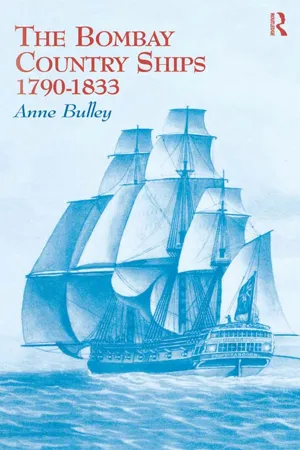
Concentrates on the period 1790-1833, especially the early nineteenth century when the Bombay merchant fleet was at its zenith, studying the ships, their trade and the men who owned or sailed in them. The picture is built up from a mass of details and references unearthed in the English East India Company's records and elsewhere, and includes contemporary experiences of sailing in these ships.
It is really astonishing to see the Persees at work in the dockyard which for expedition, proportion, strength and beauty beat any ship building I ever heard of. It is more like cabinet work. … and the speed with which they despatch the largest fleets equipped with everything is truly admirable.
So observed Captain FitzMaurice of H.M.’s 10th Regiment, arriving in Bombay in 1801 on board a Calcutta ship, Cuvera, to join the great seaborne expedition aimed at evicting the French from Egypt. He was an intelligent observer, whose diary records the transporting of troops in Country ships. General Baird, commanding the expedition, sailed in the William ‘a fine ship from this port’, which had been launched the year before in Bombay for Alexander Adamson, a Company servant in his role of private merchant, and had already completed a trading season in China. (She had been caught in a typhoon in the China sea and almost lost.) Once arrived in the Red Sea the William was used by Baird as his Headquarters.1
FitzMaurice was only one of numerous travellers who marvelled at the unique Indian shipbuilding processes and materials. From the seventeenth to the late eighteenth century, ships for private merchants had been built at Surat; a traveller there noted the Parsis’ attention to detail and slavish following of the European designs but the use of a quite different technique:
The ship-carpenters at Suratt will take the Model of any English Vessel, in all the Curiosity of its Building, and the most artificial Instances of Workmanship about it, whether they are proper for the Convenience of Burthen, or of quick Sailing, as exactly as if they had been the first Contriver. The Wood with which they build their Ships would be very proper for our Men of War in Europe; for it has this excellence, that it never splinters by the Force of a Bullet, nor is injur’d by those violent Impressions beyond the bore of a Shot.2
Because of the predominance of the Parsis in the Bombay dockyard it is easy to overlook another Gujarati community who were also involved in shipbuilding, the Konkani Muslims, such as the Chelliaby [Chillaby], who continued to build at Surat until the end of the eighteenth century although much less is known about their ships.
In 1736, the Parsi, Lowjee Nusserwanjee, already a noted shipbuilder, was persuaded to take the momentous step of leaving Surat and moving to Bombay Island, to assist in the building of a 90 foot grab. With him in the first instance came eleven other Parsi carpenters. He himself was to found a dynasty of Master Shipbuilders which after 1774 became known as the Wadias (from the Gujarati vadia – a ship builder) Other Parsis were to follow such as the Banias who acted as brokers to the English.
The first report on Bombay harbour was made by a Dutchman3 in 1666, only a year after it formally came under British control and was rented to the English East India Company. The harbour had a depth of six fathoms at high and four at low water. Four years later the East India Company Court of Directors in London ordered the making of docks. Nothing was then done although in 1689 iron work was sent for repairing vessels. The marine yard was established around a mud basin. Five years after Lowjee’s arrival the English Master carpenter died before he could complete the vessel they were building. Lowjee completed the task to the complete satisfaction of the Bombay Council. Mid century saw a marked increase in shipbuilding for the Bombay Marine in order to counter Maratta aggression at sea and in 1748 instructions were sent from London for work to start on a dry dock and by 1750 it was finished. A second dock was added before the end of 1762. With the completion of a third, they would become known as the Upper, Middle and Lower Old Bombay Docks. Built of granite they were deepened during the 1780s on the advice of the Admiral, because they were too shallow to allow large warships to leave during ‘neaps’.4 From 1764 Lowjee was always referred to as Master Builder. No English shipwrights were employed in the Bombay yard until the retirement of his great grandson.
An Englishman, Anthony Parsons commented on the three pairs of strong gates, allowing three ships of the line to be repaired at the same time ‘as the outermost ship can warp out and another be admitted in her place every spring tide without any interruption of the work to the second and innermost ships.’5 (The timber for the gates was brought from Tellicherry.) Near the dock was a fine ropewalk and a ‘convenient place to haul down several ships at once’. In the 1770s another traveller commented that ‘among the large number of good arrangements made by the English in Bombay for trade and shipping, the dock is most considerable and important … Two ships can be careened at a time and a third basin is preparing. … When I was in Bombay I saw a ship of war belonging to the Imam of Sana which he had sent to be refitted.’
To the Country merchants the docks were of prime importance. A dispatch from the East India Company Court of Directors in 1755 encouraged them to trade from Bombay. In peacetime, when the Maratta threat had receded, the docks were seldom used by the East India Company French and they were able to monopolize the facilities for the construction of their own ships. In the fourth Dutch war and the French wars that followed, they were invaluable to the Royal Navy for repairs to their ships. A rent of RslO was charged when ships were built on the slips and a higher rate for the docks. The Wadias organized the supply of timber and inspected the ships. The Company charged 20% on the cost and even if the merchant supplied his own he was still, until 1813, charged 10%. All imported items were supplied from the Company’s warehouses.6 Successive Admirals were so impressed with the excellent workmanship of Lowjee’s successors, his sons and grandsons, that at the beginning of the nineteenth century orders were placed for line of battle ships to be built here. Jamsetjee Bomanjee built the first, the 74 gun Minden launched in 1810. (On the deck of H.M.S. Cornwallis, 74 guns, launched in 1813, was signed the treaty of Nanking (1842) by which Hong Kong was ceded to the British. She was adapted to steam and saw action in the Baltic against the Russian fleet. She survived the last ninety years of her one hundred and forty four year existence immobilized but sound as part of the jetty at Sheerness. A model (
size) of her, built at the same time by Jamsetjee’s son Nowrojee, is displayed today at Greenwich National Maritime Museum.)
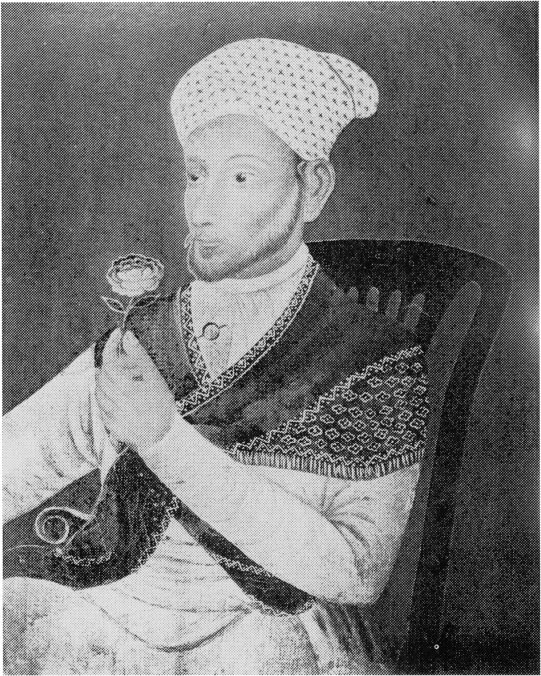
Plate 1. Maneckjee Lowjee (b.1720, d.1792). On the death of their father Lowjee Nusserwanjee in 1774, he and his brother Bomanjee were appointed joint Master Shipbuilders in the Bombay dockyard. They built many of the Country Ships. (From R.A. Wadia Bombay Dockyard (1957))
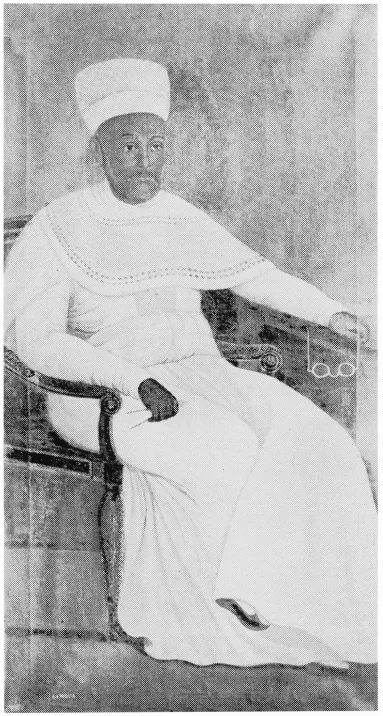
Plate 2. Framjee Maneckjee (b. 1749). Joint Master Shipbuilder in Bombay with his cousin Jamsetjee Bomanjee, until his early death in 1804. (From R.A. Wadia Bombay Dockyard (1957))
Not until the beginning of the century did the Company again use its docks for its own purposes – building large ships for carrying cotton to China, it was hoped, on its own account. By this time some India-built Country ships had appeared in the Thames, causing something of a sensation and alarm. By special permission of the Governor General in certain years in the 1790s a few were given permission to take cargoes to England. At the beginning of the nineteenth century even more were adopted as ‘Extra’ East Indiamen’ to take rice to England to relieve near famine conditions in parts of the country and within a few years to carry cargoes of cotton and some hemp. Their construction and management caused much heart searching and antagonism on the part of the English owners and shipbuilders, whose views may be explored in the numerous pamphlets published in the run up to the renewal of the East India Company Charter in 1813.7
By 1830 the cost of renting the dock, payable to the Company, was Rs.450 & Rs.350 for British ships and Rs.600 & Rs.500 for foreign ships. The Royal Navy also paid for the privilege of using them for ship repairs during the war and for the building programme of warships. Ships were also built at Mazagon, just to the north of Bombay where there was a gunpowder works. A mud dock was recorded there in 1774 (154 ft. × 33ft. × 7ft. deep). In 1800 repairs were made to it. The Bombay Courier of 1810 refers to a dry dock at Mazagon and it was considered a good dock for small vessels.8 In 1812 new dock gates were said to be essential also a workshop and shed for the carpenters with tiles instead of a cajan roof.9 The dock referred to as the Old Moghul Dock, was established in 1835 by Age Muhammad Rahim Siraji, a Konkani Muslim trader and bought in 1846 by the newly arrived P&O line, who with great difficulty had at last got a toe-hold in India.10 It was much used in the Arab trade, by dows from the Persian Gulf and the Red Sea. It was common practice to build ships on the slips at both Bombay and Mazagon. Rustomjee Maneckjee, (1766–1812), a grandson of Lowjee, was the Head Builder at Mazagon in about 1801, followed by his two sons. The second son Dhunjeebhoy Rustomjee Wadia (b. 14 Dec 1799), Master Builder at Mazagon, also built ships. These included, three ships at Cochin, two for Bengal and one, Oriental for Bombay. He returned to Bombay in 1834 but in 1837 moved over to Calcutta to work first in Howrah Dock and the following year at Kidderpore as Master Builder. He had married the owner, Rustomjee Cowasjee’s daughter and built while there the Syren, Framjee Cowasjee & Rustomjee Cowasjee and some of the notoriously fast opium clippers. He went back to Mazagon in 1842 to become Master Builder of the Moghul Dock and stayed on as such for P&O until his death in 1854.
There were also some mud docks on Colaba and a Superintendent was appointed in 1800. A slip at that time was constructed by the Calcutta shipwright, William Stalkarts. On his leaving Bombay to reside in Calcutta in 1800 – ‘his plan for rolling sheet copper a failure’ – the Company determined to keep the slips on Colaba in its own hands.11 In 1802 an Arab ship was building there. (Ferry boats were forbidden to run from Bombay to Colaba at spring tides during the monsoon and if small boats were taken, no more than fifteen passengers and no palanquins were allowed and no horses would be conveyed across even in large boats in tempestuous weather and ‘not at any time when their is a lady on board’.(The ferries were ominously named Styx & Charon.)12
The lighthouse was the first sight voyagers had of Bombay. Built in 1770, on the southern end of Colaba, circular in form, about 150 feet high with a flight of steps to the top, it w...
Table of contents
Cover
Half Title
Title Page
Copyright Page
Contents
Dedication
Foreword by Anthony Farrington
Preface
List of Maps
List of Illustrations
INTRODUCTION
PART ONE: Shipping
PART TWO: East India Company control
PART THREE: The Bombay maritime Country trade
PART FOUR: The Country Ship owners
PART FIVE: The mariners
CONCLUSION:
Notes
Select Bibliography
Glossary of Indian and Nautical Words
Index
Trusted by 375,005 students
Access to over 1.5 million titles for a fair monthly price.
Study more efficiently using our study tools.
Frequently asked questions
Yes, you can cancel anytime from the Subscription tab in your account settings on the Perlego website. Your subscription will stay active until the end of your current billing period. Learn how to cancel your subscription
No, books cannot be downloaded as external files, such as PDFs, for use outside of Perlego. However, you can download books within the Perlego app for offline reading on mobile or tablet. Learn how to download books offline
Perlego offers two plans: Essential and Complete
Essential is ideal for learners and professionals who enjoy exploring a wide range of subjects. Access the Essential Library with 800,000+ trusted titles and best-sellers across business, personal growth, and the humanities. Includes unlimited reading time and Standard Read Aloud voice.
Complete: Perfect for advanced learners and researchers needing full, unrestricted access. Unlock 1.5M+ books across hundreds of subjects, including academic and specialized titles. The Complete Plan also includes advanced features like Premium Read Aloud and Research Assistant.
Both plans are available with monthly, semester, or annual billing cycles.
We are an online textbook subscription service, where you can get access to an entire online library for less than the price of a single book per month. With over 1.5 million books across 990+ topics, we’ve got you covered! Learn about our mission
Look out for the read-aloud symbol on your next book to see if you can listen to it. The read-aloud tool reads text aloud for you, highlighting the text as it is being read. You can pause it, speed it up and slow it down. Learn more about Read Aloud
Yes! You can use the Perlego app on both iOS and Android devices to read anytime, anywhere — even offline. Perfect for commutes or when you’re on the go. Please note we cannot support devices running on iOS 13 and Android 7 or earlier. Learn more about using the app
Yes, you can access The Bombay Country Ships 1790-1833 by Anne Bulley in PDF and/or ePUB format, as well as other popular books in Social Sciences & Ethnic Studies. We have over 1.5 million books available in our catalogue for you to explore.