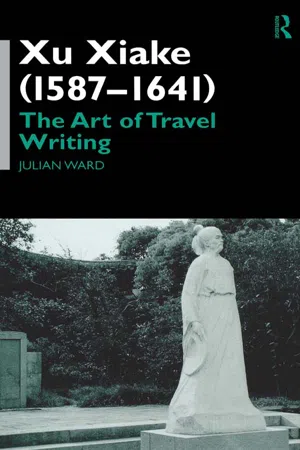
In this, the first full-length study in English of China's best-known travel writer, new light is shed on the importance of the diaries of Xu Xiake (1587-1687) a compulsive traveller who spent a lifetime visiting and writing about China's 'beauty spots'. The general view of his work, that he brought a sober, analytical approach to a genre previously the domain of the dillentante and that his writing was 'utilitarian' and lacking in literary merit is cast aside, revealing Xu to be a figure of his age, his concerns perfectly in tune with the exuberant tastes of other late Ming literati.
Essential background is provided with a survey of the history of Chinese travel writing in general with particular emphasis given to the late-Ming period and a resume of Xu Xiake's life. The core of the work examines the wealth of new information to be found in a longer version of Xu's account of his great journey to southwest China, rediscovered in the 1970s. Detailed study of Xu's use of language serves to underline the breadth of achievement of a man who utilised traditional and contemporary Chinese poetic language in order to express an emotional response to the landscape through which he passed. This is reinforced by a complete annotated translation of a deeply personal essay, written towards the end of Xu's life.
The book covers a broad spectrum of voguish sinological subjects relating to late Ming China ranging from the huge growth in all forms of geographical writing to the anthropological analysis of the non-Han peoples of southwest China. This book will interest both seasoned sinologists and anyone who has spent time travelling in China or is interested in the art of travel writing.
Trusted by 375,005 students
Access to over 1.5 million titles for a fair monthly price.
From ancient times, nature in China has been the basis of countless myths and legends: these mythologies coalesced to create what has been called ‘a vast spatiotemporal edifice, imbued with moral/aesthetic overtones.’1 While the youji
(Travel Account or travel diary) arose as a genre in its own right during the Tang dynasty (618–907 AD), its origins can be traced back several hundred years earlier. The strong fantastical elements contained in early geographical and pseudo-geographical works provided a wealth of source material for travel writers who could switch from sober analysis of a scene to the recital of a litany of fantastic figures and landscapes. Travel writing also drew on and fed off developments in Chinese poetry, especially the notion of climbing on high in order to achieve a view into a distance imbued with both temporal and spatial significance. By the start of the Tang dynasty, there was already a well-established tradition of poetry relating specifically to landscape, the best exponents of which were Xie Lingyun
(385–433) and Tao Yuanming
(365–427).
By far the greatest part of the extant body of traditional Chinese travel diaries deal with journeys undertaken within China. There were exceptions to this pattern, such as the long accounts of perilous journeys to India by monks searching for the genuine Buddhist sutras. However, China’s vastness and the variety of its landscape, coupled with regularly changing national boundaries ensured that the lure of the other, different exotic peoples and beautiful scenery, afforded a beguiling constant. In concentrating on western colonial and post-colonial attitudes, recent western scholarship on travel diaries, is thus, for the most part, of little relevance.
For some writers, the journey itself was everything: Xu Xiake’s account of his journey to southwest China focuses on the minutiae of his progress through the landscape, with such matters as food, accommodation and human encounters given considerably less attention. Xu’s diaries, the journeys of the Buddhist pilgrims and the diaries of the Song writers Lu You
(1125–1210) and Fan Chengda
(1126–1193) are all similar in this respect. Some of the best known travel diaries, however, have a minimal element of travel and are concerned instead with place. Liu Zongyuan’s
(773–819) celebrated essays Yongzhou baji
(Eight Records of Yongzhou) do not involve a journey but are concerned with the description of scenery and the suggestion of an intense nostalgia for the writer’s home town. In this category can also be placed Yang Xuanzhi’s
(fl. ca. 528–547) Luoyang Qielan Ji
(The Temples of Luoyang), which combined factual and fictional sources to present a comprehensive picture of a large imperial city. The difference between these two kinds of travel writing has been described by Kenneth Ganza as the difference between the expression of place consciousness and travel consciousness.2
Other critics have looked at the genre from a different angle. James Hargett considered matters of linguistic style, and also outlined different categories of travel diaries, ranging from short pieces dealing generally with day-long excursions to well-known beauty spots, in which the author usually travelled in the company of a select group of friends, to longer pieces dealing with diplomatic missions or internal journeys by officials, while yet others have looked at the combination of fact and authorial opinion.3 Yu Guangzhong described the relative balance in different travel diaries accorded to opinion and fact, contrasting the accurate recording of geographical changes and historical development with the feelings and impressions engendered by the journey. Yu suggests that, in order to be distinguished from a gazetteer, the travel diary must go beyond the mere reporting of accurate information to contain the opinions and emotions of the writer.4 Elsewhere, this has been described as the distinction between subjective and objective writing, Chou Chih-ping stating that Xu’s essays ‘are objective-descriptive while Yuan’s (ie Yuan Hongdao
[1568–1610]) are subjective-personal.’5 This is too clear-cut a distinction to be applicable to the work of Xu Xiake, who succeeded in utilising the two qualities to create a form of travel diary that contained both subjective and objective elements.
In contrast with the overwhelmingly anthropocentric style of most western travel writing, the Chinese youji is concerned with place or movement in Nature. Individuals journeyed not in search of amusing encounters with exotic locals, but rather for a chance to retreat into Nature, an idea popular in China from very early times. While Confucius held that an honourable citizen should serve an enlightened ruler, he nevertheless allowed that it was shameful to serve a bad ruler and accordingly did not consider withdrawal from the world of men necessarily to be reprehensible behaviour. Indeed, he praised the early recluses Bo Yi
and Shu Qi
as ‘excellent men of old.’6
The Early History of Chinese Geographical Works
A recent work on cartography in East Asia shows how, since the time of the Zhouli
(Zhou Book of Rites), thought to have been written during the Warring States period (475–221 BC), geography has been of paramount importance in China. Furthermore, from the Han dynasty (206 BC-220 AD) on, China’s rulers have striven to collect precise geographical information on the territories under, or adjacent to, their control.7 Jiang Shaoyuan, tracing the earliest days of Chinese travel, claimed that Chinese people, fearful of encountering anything unusual, were wary of travelling to remote parts of the country.8 Between 500 BC and 500 AD, Chinese geographical writing shows a marked progression from the earliest fear-laden works to the later period when fear had been replaced by a respectful awe. During the pre-imperial period, there were a number of works of proto-geography, of which the most important are the ‘Yu Gong’
(Tribute of Yu), part of the Shu Jing
(Book of Documents) and the Shanhai Jing
(The Mountains and Seas Classic, hereafter SHJ).
The ‘Yu Gong’, written some time between 475 and 221 BC, divided China into nine regions, on the basis of different geographical characteristics. The ‘Yu Gong’ was also of great ideological importance, establishing the idea of China as a series of concentric sq...
Table of contents
Cover
Half Title
Title Page
Copyright Page
Dedication
Table of Contents
List of Illustrations
Introduction
Acknowledgements
Explanatory note
List of Abbreviations
Chapter I The History of Chinese Travel Writing
Chapter II Traveller in the Sunset Clouds
Chapter III Old Certainties and New Discoveries
Chapter IV Coveting Strangeness
Chapter V The Exotic Southwest
Chapter VI Mountains and Caves
Conclusion Xu Xiake as Wandering Recluse
Appendix 1
Appendix 2
Appendix 3
Bibliography
Index
Frequently asked questions
Yes, you can cancel anytime from the Subscription tab in your account settings on the Perlego website. Your subscription will stay active until the end of your current billing period. Learn how to cancel your subscription
No, books cannot be downloaded as external files, such as PDFs, for use outside of Perlego. However, you can download books within the Perlego app for offline reading on mobile or tablet. Learn how to download books offline
We are an online textbook subscription service, where you can get access to an entire online library for less than the price of a single book per month. With over 1.5 million books across 990+ topics, we’ve got you covered! Learn about our mission
Look out for the read-aloud symbol on your next book to see if you can listen to it. The read-aloud tool reads text aloud for you, highlighting the text as it is being read. You can pause it, speed it up and slow it down. Learn more about Read Aloud
Yes! You can use the Perlego app on both iOS and Android devices to read anytime, anywhere — even offline. Perfect for commutes or when you’re on the go. Please note we cannot support devices running on iOS 13 and Android 7 or earlier. Learn more about using the app
Yes, you can access Xu Xiake (1586-1641) by Julian Ward in PDF and/or ePUB format, as well as other popular books in Social Sciences & Ethnic Studies. We have over 1.5 million books available in our catalogue for you to explore.