eBook - ePub
Sikh Religion, Culture and Ethnicity
- 220 pages
- English
- ePUB (mobile friendly)
- Available on iOS & Android
eBook - ePub
Sikh Religion, Culture and Ethnicity
About this book
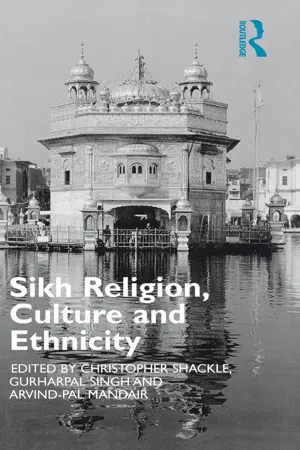
This book brings together new approaches to the study of Sikh religion, culture and ethnicity being pursued in the diaspora by Sikh academics in western universities in Britain and North America. An important aspect of the volume is the diversity of topics that are engaged - including film and gender theory, theology, hermeneutics, deconstruction, semiotics and race theory - and brought to bear on the individual contributors' specialism within Sikh studies, thereby helping to explode previously static dichotomies such as insider vs. outsider or history vs. tradition. The volume should have strong appeal both to an academic market including students of politics, religious studies and South Asian studies, and to a more general English-speaking Sikh readership.
Information
Chapter One
Introduction: New Perspectives in Sikh Studies
Developments in any academic field are too dependent upon complex combinations of clusters of individual and team talent with more general changes in social trends and ideological fashions to make predicting patterns of growth and transformation anything other than a very risky business. It certainly now seems extraordinary that it should have been possible for one of us less than twenty years ago to question the status of Sikh studies as a field that was going to be able to claim genuinely viable academic existence in Western universities (Shackle 1985). That scepticism has for a while now seemed increasingly implausible, and it is certainly strikingly disproved by the variety and vitality displayed in the present volume of essays.
The book has developed from an international workshop held at SOAS on 28–29th May 1998 under the joint auspices of De Montfort University and the SOAS Centre of South Asian Studies. The workshop’s title ‘New Perspectives in Sikh Studies’ was intended to focus the discussion on the many lines of fresh inquiry being pursued by the growing numbers of scholars actively involved in Sikh studies with positions in Western universities, and this purpose was amply fulfilled in the liveliness of the ensuing debates between the participants who were brought together from both sides of the Atlantic, often for their first opportunity to meet face to face.
The opportunity was also provided for reflection upon the development of Sikh studies in the West and how these have typically come to differ from Indian Sikh studies. Whereas Indian scholars, clustered in the universities of Punjab and the surrounding area, are able to rely upon a central institutional position, if at the price of considerable political and ideological constraints, the freedom enjoyed by those in the West is counterbalanced by their lack of institutional density. As tends generally to be the case for any field of study whose practitioners are relatively isolated in their own institutions, international conferences and workshops and the collaborative volumes issuing therefrom have therefore had a particular importance for the development of Western Sikh studies, beginning little more than two decades ago on the West Coast of the United States with the conference organized at Berkeley by two of its leading American pioneers (Juergensmeyer and Barrier 1979).
The Punjab crisis culminating in the events of 1984 radically transformed the face of Sikh studies across the globe. In India these effects were almost entirely negative, including not only the tragic loss of irreplaceable archival resources as the result of army action but also the subsequent stifling of many academic freedoms, especially the freedom to adopt scholarly positions which might be interpreted as impugning the integrity of received but threatened tradition.
In the West a greater variety of effects was experienced. The crisis brought the Sikhs to the centre of world attention and they became for the first time the subject of mainstream political science. At the same time the extreme sensitivities excited by the crisis exacerbated the hostility directed by significant numbers of Sikhs in the West as well as in India against the historicizing critiques of religious traditions associated with Western scholarship, especially with the New Zealand scholar W.H. McLeod ever since the publication of his critical study of the sources for knowledge of Guru Nanak (McLeod 1968). Both these currents were well to the fore of debate at a major international conference held in Canada at Toronto in 1987 which subsequently resulted in a large volume of papers on Sikh History and Religion in the Twentieth Century (O’Connell 1988).
As this title itself suggests, Western Sikh studies have been marked in general approach among humanities scholars by a primacy of history over religion, which was hardly displaced by the new found interest of some political scientists in the Sikhs as a case study for the comparative investigation of the threatening workings of religious fundamentalism. More far reaching challenges to the earlier pattern of Western Sikh studies were to come from within Western Sikh society. While a very substantial Sikh population had first been established in Britain as the result of immigration in the 1950s and 1960s, it was the somewhat later settlement in Canada and the United States of Sikhs with a generally higher socio-economic profile which really began to give the diaspora a voice in a field hitherto occupied by a few, mostly non-Sikh Western academics.
Recent years have thus seen the emergence of new demands, both actively expressed and tacitly anticipated, for a Sikh studies agenda capable of addressing the needs of a Sikh diaspora in the English-speaking world which is itself of exceptional size and significance in relation to the parent Indian Sikh community in comparison to most other Asian religious communities now established in the West. First emerging in North America, these demands have been partly articulated through various – not always happy – attempts to boost the position of Sikh studies through the foundation of community funded university posts. They are also starting to be formulated through broader academic agendas for Sikh studies programmes, as broached in the proceedings of a conference held on the East Coast of America at Columbia University in 1989 (Hawley and Mann 1993).
Most of these various lines of development can be seen to underlie the essays contained in the present volume, which itself collectively marks an important step into a future whose unpredictability is happily guaranteed by the volume’s intellectual variety and excitement. A glance at the following list of contributors will show that this is the first Sikh studies volume to have both a roughly equal distribution of authors from either side of the Atlantic and an overwhelming majority of Sikh authors with Western academic training. Simultaneous inspection of the bibliography will indicate how their various disciplinary formations have resulted in approaches which draw quite as much upon a wide range of reference to contemporary Western intellectual trends as they do to primary sources in South Asian languages, thus quite successfully avoiding the inward looking cross-references to fellow practitioners which can characterize a small field when it feels itself to be on the defensive.
By contrast, the dominant tone of this volume is a strongly positive one, with individual contributors being quite unafraid to suggest new theoretical approaches in their questionings of many previously unexamined understandings. Although some of the papers originally presented to the workshop had to be excluded during an editorial process guided by the desire to give as wide a range of readers as possible a clear view of leading lines of current inquiry, the scope of those included is still considerable. They are grouped in accordance with the collection’s title under the broad categories of religion, culture and ethnicity. The first set of essays explores classic religious formations in Sikhism and ends by relocating the study of religion within Sikh studies, the second broadens the concept of Sikh culture in relation to comparative literature and psychoanalytic theory, and the final set provides searching examinations of the concept of ethnicity in Sikh studies.
The volume opens with Gurinder Singh Mann’s essay on ‘Canon Formation in the Sikh Tradition’ which reconstructs the formation of Sikh scriptural canon based on two elements: the data available in early manuscripts and the way that these manuscripts are located in the context of early Sikh institutional development. The results are both exciting and unnerving, depending on whether the viewpoint is that of received tradition or modern historiography. Mann distinguishes successive stages of a sequential process in which the origins of the Sikh scriptural text are linked to Guru Nanak rather than to the Goindval Pothis, which are a manifestation of the later expansion of scriptural text in the sixteenth century, and examines the formation of the Adi Granth text in the sixteenth century. His analysis provides a comprehensive picture of the text’s evolution, one which extends the memory of tradition forwards to the present day and backwards to Guru Nanak as the originator of the scripture. The conviction of traditionalist scholars that Sikh scripture was an ahistorical entity revealed as a totality masks the reality presented by historiographical analysis that Sikh scripture was shaped over time, and in Mann’s concluding words, the ‘process apparently began in the days of Guru Nanak himself and continues to evolve even as we speak.’
Jeevan Deol’s paper then deals with two related processes in the formation of eighteenth century Khalsa identity, namely the discourses and narratives created by the Khalsa in constructing itself as a community of believers and as a body politic. The specific focus of the paper is on the contesting uses and the role of the classical Indian myth of the four ages (chaturyuga) in political and religious discourses during the period. Deol argues that the letters of Banda Bahadur initiate a discourse in which the Khalsa and its political ascendency will initiate a new satyuga. While several compositions in the Dasam Granth extend this political narrative, other voices within the eighteenth century Panth contest these constructions. A crucial set of texts for understanding the political implications of the chaturyuga narrative and the various constructions it enjoyed during the period are the works of the Chhibbar family, particularly the Chaupa Singh Rahitnama and the Bansavalinama. These texts and the history of the Chhibbar family itself are used to flesh out the narrative of political dissent during this period. One of the most intriguing observations made by Deol points to the tension between desire and reality. While the prescriptive texts created by the Khalsa seek to define the community in terms of a corporeal identity and social boundaries that are distinct from a Hindu ritual universe, the realization of these aspirations comes to be linked with a metanarrative derived from the Dasam Granth which places the Khalsa within a framework broadly based on Puranic myth and cosmology.
If the foregoing papers provide new readings of such key historical formations as Sikh scriptural tradition or the Khalsa, the next two papers question the preoccupation of much of Sikh studies with the historical approach particularly in relation to the study of religion. One of the central issues in these papers concerns the way in which scholarship in Sikh studies, despite a rhetorical commitment to multi-disciplinary practice, always already predetermines the nature of the object being studied as an aspect of society. In other words, they ask, why, in accordance with the tenets of social constructivism, questions concerning religion or the religious are automatically reduced to social phenomena. Most religious responses to social constructivism have tended to stick to the belief that religion is sui generis – that religion has transcendental or metaphysical foundations.
However, as Arvind-pal Singh Mandair argues, in the case of Oriental religions secular scholarship has managed to dismiss the sui generis argument by resort to a paradigm which, insofar as it has come to define the very criteria for academic scholarship in the humanities and social sciences via such notions as ‘impartial understanding’ ‘disinterested inquiry’, has come to be regarded as entirely natural, and therefore, insurmountable. This paradigm is centred on the idea that historicism or historical method must be the grounding principle for any inquiry into religion or the religious, steering between the two alternatives of theology and secular historicism. Mandair’s argument – written partly as a response to a methodological crisis in Sikh studies – points to a different way of reading the complex relationship between religion and history, one that can be located in Hegel’s classic though much ignored text: Lectures on the Philosophy of Religion. This alternative genealogy charts the simultaneous emergence of two fields: the philosophy (or theory) of religion and the history of religions, where history defines the criterion for ordering any potential threat from the diversity of religions studied. Given this mutual imbrication of religion and history, many of the problems which faced Hegel and his contemporaries are repeated in the formation of the modern discipline of the history of religions – as exemplified by W.H. McLeod’s demarcation of the field of Sikh studies. Mandair demonstrates the far reaching result of deconstructing history’s claim to foundational status in the humanities. Critique and critical thinking, long associated solely with the secular domain, can just as easily be associated with approaches to religion and the religious. It serves as a double warning to academic scholarship not to place too much faith in secular reason and to be aware of the ethical and political consequences of translation into a Western context.
Remaining broadly within the space that is opened up for religious thinking in the preceding paper, Balbinder Bhogal explores new ways of resisting what he terms as myths of finality, i.e. the tendency in academic and traditionalist domains towards closed definitive versions of scripture. Despite an apparent conflict between traditional and academic modes of interpretation, both versions valorize and perpetuate forms of timelessness. But as Bhogal argues, this particular tendency which happens to be characteristic of modernist thinking cannot be attributed to the Adi Granth scripture without imposing a certain degree of violence. Taking Guru Nanak’s Japji as a working example Bhogal shows that it is possible to tease out interpretative strategies from within this text which resist reductionism and absolutization, thereby beginning the task of delineating an internal hermeneutic of the Japji itself.
A greater urgency is imparted to this task by the diasporic context within which Bhogal is writing, a context which asks whether the words of Guru Nanak can ‘speak again’ – more specifically whether they can speak and thereby be heard in English. The main argument of this paper therefore hinges on a close reading of selected passages from the Japji, aiming to show that Guru Nanak’s bani does not make absolute statements about a particular view or darsana. This reveals not only the existential relevance of Nanak’s bani today but just as importantly its resistance to the twin dangers of idolization and classification. By reading Sikh scripture in the context of recent hermeneutic theory, Bhogal calls for a new understanding and recontextualization of Sikh thought, not as a once and for all statement but as an ongoing process of intellectual engagement and political praxis.
Sited in the growing overlap between religious studies and literary studies which is so notable a feature of contemporary Western academic practice, the next two papers focus on two cultural formations which in comparison to the central areas of religion, history and political studies have received relatively little attention in modern Sikh studies, namely comparative literature and psychoanalytic theory in relation to the study of religions. Christopher Shackle’s paper on ‘The Making of Punjabi Literary History’ draws attention to the important though sadly neglected influences on the Sikh and Punjabi literary traditions of its Muslim heritage as primarily articulated by its Sufi poets. Scholars of Punjabi literary history generally agree that the making of twentieth century Punjabi literature owes its primary inspiration to three sources: Sikh scripture and its related texts, the pre-modern works of Sufi poetry and Western literature. Acknowledging this rich background, Shackle’s paper explores the original construction and some implications of this tripartite scheme of culture reference through a comparative analysis of the work of two early twentieth century pioneers of Punjabi literary history, the Muslim poet Kushta, and the pioneer Sikh literary historian, Bava Budh Singh. What becomes evident through this comparison are the respective differences and degrees of influence exerted by Sikh and Muslim literary traditions. For example, whereas a striking characteristic of the Muslim materials surveyed by Shackle is the marginality of the Sikh presence to the Punjabi literary enterprise, the importance of parts of the Punjabi Muslim literary and cultural presence to the projects of Sikh religious reform and its associated programme of cultural redefinition can hardly be underplayed. Moreover, in view of the drive by Hindu nationalists to reconstruct an overarching Hindu literary and cultural identity by excluding the Muslim heritage especially associated with Urdu, the largely secular Sikh cultural framework in post-independence India has owed much to Budh Singh’s pioneering work in continuing to lean heavily upon Sufi poetry as a guarantor of its cultural integrity long after the disappearance of the Muslim presence from Indian Punjab.
An unexpected outcome of the post-1984 representation of Sikhs in the Western media is the increasing attention given to the physical form of the male Khalsa Sikhs, particularly in Western film. Although the Western film and literature have represented Sikhs largely through fragmentary and stereotypical images as terrorists (Satanic Verses 1989), taxi drivers or shop keepers (Coneheads 1992), Sikhs themselves have seldom appeared as vital characters. As Nikky Guninder Kaur Singh argues in her paper ‘The Mirror and the Sikh: Ondaatje’s Kip’ from this perspective alone Michael Ondaatje’s masterpiece The English Patient represents something of a breakthrough. For not only is Kirpal Singh a central figure in Ondaatje’s novel, he is also the embodiment of Sikh moral and ethical values. Unfortunately, however Ondaatje’s reviewers and admirers have neglected the Sikh elements in the novel, and even the very popular and tantalizing 1996 Miramax film version depicted Kirpal Singh as but a minor figure.
Nikky Singh’s paper focuses on the forgotten Sikh character of Kirpal Singh, and explores his transformation from a colonial ‘kip’ (short for ‘kipper grease’, perhaps also an inversion of Rudyard Kipling’s ‘Kim’) mechanically diffusing bombs for the British army in Europe during the World War II, to a post-colonial Sikh elder sitting at home in the Punjab. Much happens in between, sometimes slowly, sometimes suddenly. Though Kirpal Singh maintains his Sikh identity throughout Ondaatje’s text, his Sikh ‘religious’ experience radically changes from a formal and rather external lifestyle. Singh follows a Lacanian theory in her interpretation of this as a transformation from a colonial false consciousness to a deeper, more conscious and authentic mode of postcolonial being.
The last three papers in this volume contribute each in their very different ways to new understandings of Sikh ethnicity. In his essay on Sikh ethno-nationalism Gurharpal Singh presents a new departure from conventional theories of Indian ethnic nationalism in India, with special reference to the situation established after Operation Bluestar. He argues for the need to situate Sikh ethno-nationalism in the context of ethno-national movements in India’s border states which have been largely misunderstood due to the manner in which ethnicity itself has been defined since 1947. By drawing attention to the ahistorical nature of ‘conventional wisdom’ and to the interlinked roles of the state and persistence of ethno-nationalist movements in peripheral regions of the traditional readings of political identity in India, his paper suggests the need to reconsider India as an ‘ethnic democracy’ in which hegemonic control is exercised over ethnic minorities. The Indian state is not therefore a non-national civilizational state but one which has explicitly laid claim to an exclusive ethnicity rooted in an ancient past, which in turn defines the limits of sub-national pluralism. The dynamics of Sikh ethno-nationalism are to be discovered in its dialectical relationship to this meta-ethnicity.
Although also concerned with ethnicity, the next essay by Darshan Tatla, switches our attention towards the Sikh diaspora which is such an important context for the understanding of the volume as a whole, as has been pointed out above. Tatla argues that the Sikh diaspora has contributed to a vigorous debate on the idea of ‘Sikhs as a nation’ and the need for a Sikh homeland. By exploring the extant literature on the idea of Sikh homeland and Sikh self-perception as an ethnic community, the paper highlights competing visions and asks searching questions about Sikh imagining. Why, for example, has the idea of Punjab as a Sikh homeland come to be naturalized among diaspora Sikhs? How has the incipient Indian nationalism of early Sikh immigrants been replaced by the Punjab as an imagined homeland? Tatla’s paper chronicles changes in the meaning of Sikh imagination caused primarily by events on Punjab in the 1980s. By exploring certain nuances of the diasporic imaginings towards different notions of homeland, Tatla situates this construction in terms of the complex set of choices faced by the Sikh elite in the diaspora. The paper draws upon literary writings, individual testimonies and the position of social and political groups in Britain, Canada and the USA.
The last essay in the book represents an innovative departure fro...
Table of contents
- Cover
- Half Title
- Title Page
- Copyright Page
- Table of Contents
- Contributors
- Acknowledgements
- 1. Introduction: New Perspectives in Sikh Studies
- 2. Canon Formation in the Sikh Tradition
- 3. Eighteenth Century Khalsa Identity: Discourse, Praxis and Narrative
- 4. Thinking Differently about Religion and History: Issues for Sikh Studies
- 5. On the Hermeneutics of Sikh Thought and Praxis
- 6. Making Punjabi Literary History
- 7. The Mirror and the Sikh: the Transformation of Ondaatje’s Kip
- 8. The Limits of ‘Conventional Wisdom’: Understanding Sikh Ethno-nationalism
- 9. Imagining Punjab: Narratives of Nationhood and Homeland among the Sikh Diaspora
- 10. What Has a Whale Got to Do With It? A Tale of Pogroms and Biblical Allegories
- Bibliography
- Index
Trusted by 375,005 students
Access to over 1.5 million titles for a fair monthly price.
Study more efficiently using our study tools.
Frequently asked questions
Yes, you can cancel anytime from the Subscription tab in your account settings on the Perlego website. Your subscription will stay active until the end of your current billing period. Learn how to cancel your subscription
No, books cannot be downloaded as external files, such as PDFs, for use outside of Perlego. However, you can download books within the Perlego app for offline reading on mobile or tablet. Learn how to download books offline
Perlego offers two plans: Essential and Complete
- Essential is ideal for learners and professionals who enjoy exploring a wide range of subjects. Access the Essential Library with 800,000+ trusted titles and best-sellers across business, personal growth, and the humanities. Includes unlimited reading time and Standard Read Aloud voice.
- Complete: Perfect for advanced learners and researchers needing full, unrestricted access. Unlock 1.5M+ books across hundreds of subjects, including academic and specialized titles. The Complete Plan also includes advanced features like Premium Read Aloud and Research Assistant.
We are an online textbook subscription service, where you can get access to an entire online library for less than the price of a single book per month. With over 1.5 million books across 990+ topics, we’ve got you covered! Learn about our mission
Look out for the read-aloud symbol on your next book to see if you can listen to it. The read-aloud tool reads text aloud for you, highlighting the text as it is being read. You can pause it, speed it up and slow it down. Learn more about Read Aloud
Yes! You can use the Perlego app on both iOS and Android devices to read anytime, anywhere — even offline. Perfect for commutes or when you’re on the go.
Please note we cannot support devices running on iOS 13 and Android 7 or earlier. Learn more about using the app
Please note we cannot support devices running on iOS 13 and Android 7 or earlier. Learn more about using the app
Yes, you can access Sikh Religion, Culture and Ethnicity by Arvind-Pal S. Mandair,Christopher Shackle,Gurharpal Singh in PDF and/or ePUB format, as well as other popular books in Social Sciences & Ethnic Studies. We have over 1.5 million books available in our catalogue for you to explore.