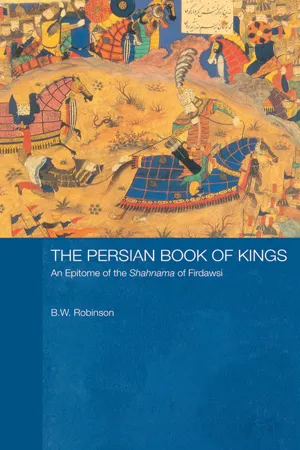
The Shahnama, written in the tenth century by Firdawsi, is the national epic poem of Persia. It chronicles at great length (nine volumes in the full English translation, currently out of print) the reigns and deeds of the earliest Persian kings, over fifty of them, in four dynasties - the Pishdadians, Kayanians, Ashkanians, and Sasanians. This book, illustrated with early Persian paintings which depict the deeds described, presents in easily accessible language a summary and re-telling of the Shahnama. It covers the entire epic in one volume, includes an introduction, together with lists of kings and dynasties, and thereby provides a concise overview of, and introduction to, this key work.
eBook - ePub
The Persian Book of Kings
An Epitome of the Shahnama of Firdawsi
- 184 pages
- English
- ePUB (mobile friendly)
- Available on iOS & Android
eBook - ePub
About this book
Information
PROLOGUE
Firdawsi devotes the first 230-odd couplets of the Shahnama to a variety of introductory matter: the praise of God, of his wisdom, and of the making of the world, of Man, and of the Sun and Moon; praise of the Prophet Muhammad and his Companions, an account of the compilation of the Shahnama; an account of the poet Daqiqi (a profligate who came to an early and tragic end), and of how the Shahnama was begun; eulogies of Abu Mansur b. Muhammad (a fellow-citizen of Tus and an early and generous patron of Firdawsi), and of Sultan Mahmud of Ghazna. After this the poem proper begins.
I
THE PISHDADIAN DYNASTY
REIGN OF GAYUMARTH
The first King was Gayumarth, who dwelt on a mountain surrounded by his courtiers all clad in leopard skins. They lived in peace and tranquillity and on friendly terms with all the wild beasts. But this happy state of affairs was soon disturbed by the envy of Ahriman, the Evil Principle, who sent his son, the Black Demon, to invade Iran at the head of a vast demon host. Siyamak, the King’s gallant young son, led out an army against them, but was defeated and slain in single combat by the Black Demon. In due course Hushang, the son of Siyamak, encouraged and accompanied by his grandfather, embarked on a war of revenge, engaging the demons in battle, and, with the assistance of a squadron of angels and a troop of lions, leopards, and tigers, inflicted on them a crushing defeat,6 killing the Black Demon in single combat. Shortly after this Gayumarth died, leaving the kingdom to his grandson.
REIGN OF HUSHANG
Hushang taught his subjects to mine and work iron and to use it to make tools and other metalwork. He encouraged agriculture and irrigation, and certain animals were domesticated.
One day as Hushang rode out with his followers, he encountered a loathsome dragon. The King seized a stone and hurled it at the monster, but he missed his aim, and the stone struck a rock. Sparks flew, and a fire was started. Hushang and his men were impressed by this phenomenon, and in due course discovered that fire can also be produced by striking stone with iron. Fire was welcomed as a heavenly gift and became an object of worship. The King instituted the Feast of Sada in its honour, and died soon afterwards.
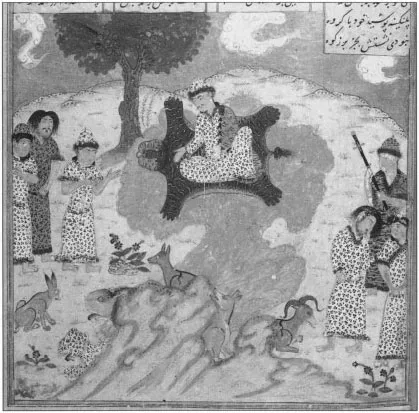
PLATE 3 Gayumarth the first king and his court
REIGN OF TAHMURATH
Hushang was succeeded by his son Tahmurath, under whose rule more useful arts were discovered and developed: spinning and weaving, horse breeding, and the training of cheetahs and falcons for the chase.
In all this he was assisted by his wise counsellor Shidasp, and soon felt capable of tackling the evil Ahriman and his demons. He bound Ahriman with spells, and rode him about the world like a horse. Enraged by his humiliation of their leader, the demons once again came out to battle, but were quickly dispersed by Tahmurath and the royal troops. The captive demons begged for quarter, promising to instruct the king in a new and fruitful art – the art of writing. Tahmurath agreed and learnt to write in various scripts, but kept the demons in subjection, thus gaining the title of Div-band, Binder of the Demons.
REIGN OF JAMSHID
The Splendour of Jamshid
Jamshid son of Tahmurath succeeded his father, ushering in what was at first a golden age. He excelled all his predecessors in wealth and magnificence. He taught his subjects the armourer’s craft, how to make fine garments of silk and brocade, and other luxuries. He divided them into four classes: priests, warriors, farmers, and artisans; building and architecture he left to the subject demons. He also initiated the use of perfumes and gems, and of medicinal herbs. Finally he had a jewelled throne made, which the demons were employed in raising into the air, and from which he proclaimed the festival of New Year (Nawruz).
But after a while he became corrupted by his good fortune, ending up by imagining himself equal to the Almighty. It was then that the Royal Splendour (see note 19) departed from him, and after that his path ran steeply downhill.
The Tyranny of Zahhak
In Arabia at this time there ruled a good old king named Mirdas. But his son Zahhak was a young man of evil tendencies, and in order to gain the throne and under the persuasion of Iblis (the Devil)7 he murdered his father by causing him to fall into a deep pit which he had prepared. Once on the throne he was visited by Iblis in the form of a cook, who provided him with such delicious meals that Zahhak offered him whatever favour he might ask. Iblis simply requested the honour of kissing the King’s shoulders. No sooner had he done so than two writhing serpents grew from Zahhak’s shoulders, and Iblis vanished. The serpents were cut off, but grew again immediately causing the king intense pain, and Iblis soon reappeared, this time in the guise of a physician. He counselled the wretched king that the only way to relieve the pain was to feed the serpents daily on human brains. Accordingly every day two youths were sacrificed to satisfy the serpents’ horrible appetite.
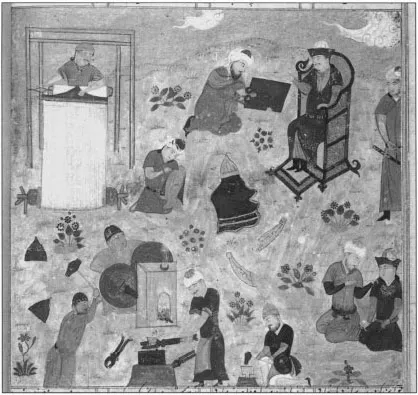
PLATE 4 Jamshid teaching the crafts
The Coming of Faridun
Meanwhile in Iran Jamshid’s overbearing pride and tyranny were provoking open rebellion, and some of the disaffected nobles sent a deputation to Zahhak, of whose character they had unfortunately received a favourable account, inviting him to come to Iran and to take over the Kingdom. He responded eagerly, drove out the ill-starred Jamshid (who was eventually run down and sawn in two), seduced his two sisters, Shahrinaz and Arnawaz, and forced the Persians to pay the daily toll of two young lives to feed his serpents. However the bloody toll was halved by the ingenuity of two young Persian patriots, Irma’il and Karma’il. They contrived to secure positions as royal cooks, and when the two daily victims were brought to the kitchens, they killed only one of them, turning the other free, and substituting for his brains those of sheep and goats. In this way they saved the lives of 200 young men, from whom the Kurdish nation is said to have sprung.
A certain smith named Kava lost seventeen sons in this way, and when the eighteenth was threatened he burst into Zahhak’s presence, denounced him violently, and procured a reprieve for the boy. But when the king asked him to add his name to a statement (already signed by the abject court nobles) to the effect that his reign had been benevolent and just, Kava scornfully refused, stormed out into the marketplace, mounted his leather apron on a spear for a banner,8 and called on the crowd to follow him. They first sought out a young prince of the old royal race, named Faridun, who Zahhak had been warned in a dream would bring about his downfall. Faridun’s father, Abtin, had been killed by Zahhak, and when his mother Faranak was in hiding with her child, they were sheltered and fed by a beautiful cow called Birmiya. In memory of this cow (also slain by Zahhak), Faridun later ordered Kava to make him an iron mace with a cow’s head. So far Faridun had evaded the tyrant’s efforts to find and destroy him, and now he saw his chance. A mighty host of the exasperated Persians, led by Kava with his apron-banner, gathered round him, and boldly advanced on Zahhak’s palace, after swimming their horses across the river Arwand. There Faridun found Jamshid’s two dishonoured sisters, whom he rescued and married, but there was no sign of the tyrant himself. He had been in India, learning sorcery, but his minister, Kundrav, saw Faridun enthroned in the palace, and hastened to inform his master of this reverse of fortune. So after a while, mad with jealousy at Faridun’s appropriation of his mistresses, Zahhak ventured back to the palace. There he encountered Faridun, who struck him down with a mighty blow of his cow-headed mace, and, on the advice of the angel Surush, had him chained above a bottomless chasm on Mount Demavend, where he was left to die miserably.
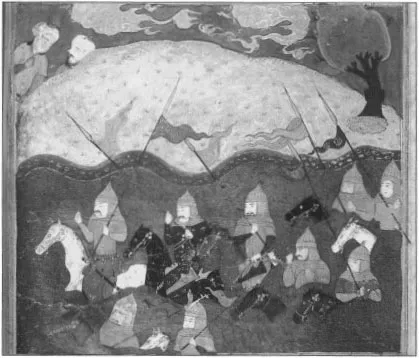
PLATE 5 Faridun crossing the Arwand
REIGN OF FARIDUN
Faridun & his Three Sons
Faridun now ascended the throne. His mother Faranak, as soon as the joyful news reached her in her hiding place, brought out the hoarded treasure she had amassed during her years of seclusion, and distributed it lavishly amongst her son’s supporters, making a special gift to Faridun himself. He had three sons by the sisters of Jamshid, Salm and Tur by Shahrinaz, and Iraj by Arnawaz, and in due course as the result of a successful embassy by Jandal, Faridun’s trusty minister, they were married to the three daughters of Sarv, the King of Yemen. On their return journey after this triple wedding, the brothers were confronted by a dragon, before which Salm prudently retired, while Tur strung his bow and prepared to fight. But Iraj interposed, boldly confronting the monster and conjured it to vanish in the name of their father Faridun. The dragon accordingly vanished; it was, in fact, Faridun himself, who has assumed this shape in order to test his sons.
So Faridun divided his realm between the three: to Salm he gave Rum (Rome) and the West; to Tur the North and East, comprising Turan (Turkestan) and Chin (China); and to Iraj the choicest lands of Iran and Arabia in the South. But before long the two elder brothers became jealous of Iraj, and began to plot against him. A meeting was arranged to settle matters between them, in the course of which Tur attacked Iraj, striking him down with a stool and finishing him off with his dagger.
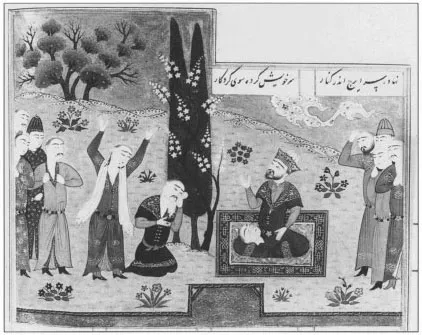
PLATE 6 Mourning for the murdered Iraj
Faridun was prostrated with grief when he received the news in the form of the severed head of his youngest and favourite son. Iraj, however, had left a daughter who in due course was married to Faridun’s nephew, Pashang, and their son was Minuchihr. As soon as he was of age his great grandfather urged him to execute vengeance upon his great-uncles. This he faithfully performed, first on Tur and then on Salm, both of whom he slew in single combat. Soon after this the aged Faridun died, leaving the throne and kingdom to Minuchihr.
REIGN OF MINUCHIHR
Zal & Rudaba
With the accession of Minuchihr the scene of action moves to the eastern frontier province of Zabulistan, or Sistan, to the household of the great paladin Sam. For long childless, he at length became the father of a sturdy son, Zal; but the baby’s hair was pure white – thought to be a sure sign of demon blood – and he was accordingly exposed on a mountainside as a prey for the wild beasts. From this predicament the baby was rescued by the miraculous bird Simurgh, who carried him off to her nest, and brought him up with her own chicks. Meanwhile Sam was sternly reproved in a dream for what he had done, and was directed to seek out his son, whom he eventually traced and received back from the Simurgh. Before their sad and affectionate parting, the great bird gave Zal a feather from her breast, and instructed him to burn it if he should ever be in dire need, and she would immediately fly to his assistance. So Zal was restored to his father Sam, and they returned home.
Zal grew up a pattern of beauty and chivalry, was given a part in his father’s government, and decided to pay a call on his neighbour Mihrab, King of Kabul. While there, he fell in love with the King’s daughter, the fair Rudaba, and after a distant wooing had his first meeting with her, climbing up to her apartment in a high tower of the palace with the aid of his lasso.9
But there were difficulties and objections. Mihrab was a descendant of the hated tyrant Zahhak, and his people were idol-worshippers; they, on the other hand, taunted Zal with his white hair and unconventional upbringing. However, after a long process of royal correspondence, threatened hostilities, and female intrigue, and not before Zal had undergone a kind of third degree interrogation and given an impressive display of his various military accomplishments, the families were eventually reconciled and the marriage consummated.
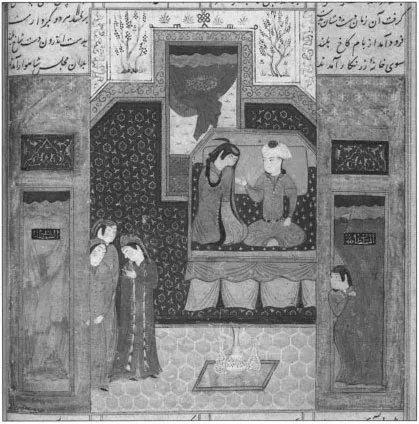
PLATE 7 Zal wooing Rudaba
Birth & Early Exploits of Rustam
Rudaba’s pregnancy was difficult, and a portentous birth was indicated. Zal became so worried that he burned the Simurgh’s feather. The faithful bird immediately appeared, took in the situation, and counselled a caesarean operation, Rudaba having been first made senseless with wine. This advice was followed successfully, the wound healed by a preparation provided by the Simurgh, and the national hero Rustam was ushered into the world. At one day old he appeared like a child of a year’s growth, and soon the services of ten wet-nurses were required to satisfy his appetite.
When still quite a small boy, Rustam used to join in drinking bouts with his father and friends, and while sleeping off the effects of one of these he was rudely awakened by an alarm that the royal white elephant had broken loose and was rampaging through the streets and trampling the citizens. The boy seized his grandfather’s mace, knocked down a gate-keeper who attempted to stop him, smashed the gate open, confronted the elephant, and slew it with a single blow to the head. He then returned calmly to bed.
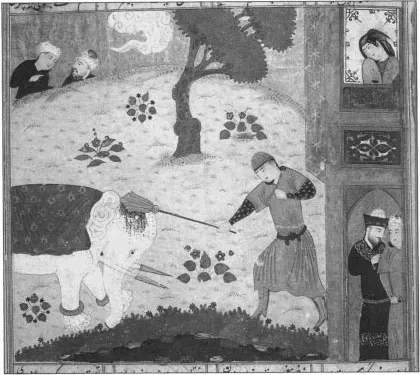
PLATE 8 Rustam and the mad elephant
It was not long before Zal decided that it was time his son was blooded in war, so he sent him to avenge his greatgrandfather Nariman, who had been killed in an unsuccessful attack on the fortress of Sipand. An attempt by Sam had also failed. Rustam, however, gained access to the impregnable stronghold with his men disguised as salt merchants, made a great slaughter of the inhabitants, and carried off an immense booty. Soon after this King Minuchihr died.
REIGNS OF NAWDAR, ZAV & GARSHASP
War with Turan
Minuchihr was succeeded by his son Nawdar, an oppressive monarch, under whom the people revolted, and the country was invaded by Afrasiyab, the young son of Pashang, King of Iran’s northern ne...
Table of contents
- Cover
- Title Page
- Copyright Page
- Dedication
- Table of Contents
- List of Illustrations
- Preface
- Introduction: The Poet & the Poem
- EPITOME OF THE SHAHNAMA
- Notes
- Table of the Kings in the Shahnama
- Select Bibliography
- Index
Trusted by 375,005 students
Access to over 1.5 million titles for a fair monthly price.
Study more efficiently using our study tools.
Frequently asked questions
Yes, you can cancel anytime from the Subscription tab in your account settings on the Perlego website. Your subscription will stay active until the end of your current billing period. Learn how to cancel your subscription
No, books cannot be downloaded as external files, such as PDFs, for use outside of Perlego. However, you can download books within the Perlego app for offline reading on mobile or tablet. Learn how to download books offline
Perlego offers two plans: Essential and Complete
- Essential is ideal for learners and professionals who enjoy exploring a wide range of subjects. Access the Essential Library with 800,000+ trusted titles and best-sellers across business, personal growth, and the humanities. Includes unlimited reading time and Standard Read Aloud voice.
- Complete: Perfect for advanced learners and researchers needing full, unrestricted access. Unlock 1.5M+ books across hundreds of subjects, including academic and specialized titles. The Complete Plan also includes advanced features like Premium Read Aloud and Research Assistant.
We are an online textbook subscription service, where you can get access to an entire online library for less than the price of a single book per month. With over 1.5 million books across 990+ topics, we’ve got you covered! Learn about our mission
Look out for the read-aloud symbol on your next book to see if you can listen to it. The read-aloud tool reads text aloud for you, highlighting the text as it is being read. You can pause it, speed it up and slow it down. Learn more about Read Aloud
Yes! You can use the Perlego app on both iOS and Android devices to read anytime, anywhere — even offline. Perfect for commutes or when you’re on the go.
Please note we cannot support devices running on iOS 13 and Android 7 or earlier. Learn more about using the app
Please note we cannot support devices running on iOS 13 and Android 7 or earlier. Learn more about using the app
Yes, you can access The Persian Book of Kings by B W Robinson,B. W. Robinson in PDF and/or ePUB format, as well as other popular books in Social Sciences & Regional Studies. We have over 1.5 million books available in our catalogue for you to explore.