- 416 pages
- English
- ePUB (mobile friendly)
- Available on iOS & Android
eBook - ePub
About this book
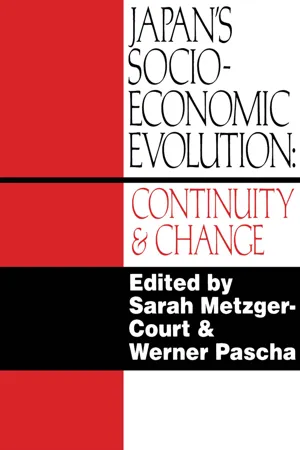
From the commercial and industrial transformation of Osaka in the late 19th century to the role and status of Japanese multinationals in Europe: these two themes represent both the time-span and the breadth of this volume.
Information
1
Rules, Goals, Information - A Key to the Question of Continuity and Change in Japan
ERICH PAUER
Introduction
THROUGHOUT the decades in which Japanese affaire have slowly assumed more importance for European countries, the ranks of observers — from commentators in the media to diplomats — who followed the Japanese political scene, both domestic and foreign, were faced with the problem of indicating clearly recognizable directions in the behaviour of the Japanese themselves. Every now and then, television journalists or secretaries of state, returning from a stay of any length in Japan, would claim to have discovered some new insight into Japanese policy, based either upon publications of the Japanese Ministry of Foreign Affairs concerning new 'principles' in Japan's foreign policy, or upon quotations from the latest (English language) statements of the Ministry of International Trade & Industry (MITI), in which they had discovered the supposedly new 'Policy on Basic Aims of Technology'. On such occasions, illustrations from official publications were regularly handed around, the 'doctrines' behind the new policies explained, and so on.
No sooner had they begun to believe that they were on to this or that fresh trend in Japanese politics than Japan behaved in a manner entirely contrary to the identified trend and the previously so confident observer was forced to start all over again. Having surmounted the normal quota of difficulties, the observer once more came forward with a brand new collection of principles, concepts or blueprints appropriate for the analysis of Japanese behaviour. Again, alter the shortest of intervals, these, too, were revealed to be nothing more than false veneer, for Japan had once again gone a different way to that mapped out for it by the experts.
After a number or such experiences it would have been no surprise if any such expert Japan-observer, tired of feeling foolish, abandoned the whole frustrating business and saw to it that Japanese politicians in particular received a bad write-up. Often enough, this was indeed the case. Yet another instance of the ability of the Japanese, who, despite all protestations to the contrary, wish to present themselves to the West as 'inscrutable', to emerge as apparent winners.
From an external point of view, it must, however, become clear that this process is in fact repeated every couple of years, with supposedly new 'principles' or 'fundamental ideas' behind this or that current of Japanese politics being discovered at regular intervals and solemnly announced by this or that 'Japan-expert'. Simultaneously, one is forced to watch while the very principles, which were so recently vaunted as the key to a better understanding of Japan's politics and which were claimed to have rendered Japanese politics finally and immediately accessible (and indeed calculable), cease to have any further validity and duly vanish from view. Such glaring lack of continuity is then promptly held to prove by definition the 'basic lack of concept or principle' in Japanese behaviour.
Yet, in the last resort, this type of criticism is the result of the false assumption that Japan as an industrial nation can be viewed through the same lens as that applied to the West, and that it must therefore move, act and think as Western industrial nations are wont to do. It is precisely at this level of analysis that such assumptions go wrong.
Certainly, it would be a mistake to create the impression that Japan acted according to some special logic of its own. For, as far as institutions and policy tools are concerned, Japanese politics or business make use of similar mechanisms to those observable in other industrial nations. At the same time, however, it would be wrong to ignore the fact, that in Japan, certain attitudes spring from a background which is both different and continually changing. Japanese patterns of behaviour arise out of ways of thinking which are diverse — and therefore frequently 'inscrutable' for the Western visitor — ways of thinking which we must nonetheless attempt to understand if we are adequately to comprehend the reasons why Japan behaves the way it does.
The seemingly ad-hoc way in which decisions are reached — as one very common line of interpretation would have it — has frequently led to Japan's approach being called flexible or pragmatic. One variant of this is the 'strategic pragmatism', coined by Schmiegelow (1989), which aimed to characterize this particular aspect of the political decision-making process. Alternatively, the Japanese are referred to as realists, who 'change what must be changed under changed circumstances'1 in which the emphasis is quite clearly placed on the supposedly crucial criterion of (permanent) change in Japanese decision-making.
Japanese firms, too, are accused of lack of decision and principle. For years, we are told, attempts have been made to understand the concept of Lean Production and to put it into practice, as set out in books, only to find that the Japanese themselves did not practise it as had been believed. Astonishment knew no bounds upon discovering that even Japanese assembly-lines sometimes stood idle . . .
In addition to any misunderstanding, regarding the nature of Lean Production and whether there ever was or indeed still exists in Japan such a thing as the Lean Production model favoured in European companies, there is a prevailing sense of having been somehow deceived, implicit in the charge levelled at the Japanese that they themselves do not act according to the principles of Lean Production they are said to have propagated. The result is that people are annoyed with the Japanese, not wishing to admit that mistakes were perhaps made or something overlooked when such ideas were originally adopted.
The fact is that Lean Production, or rather 'Toyotism', was never seen as a 'principle' per se, but rather as a bundle of separate measures which have been employed at particular times, and under specific conditions to achieve defined ends. Today, twenty years on from Lean Production's first appearance in Japan (though it never actually operated under that name), the circumstances have changed and other production methods are being developed. This is precisely where any investigation must begin: what exactly is happening? Why should something, seen as a leading edge approach at one time, now be changed or even partly abandoned?
The above example demonstrates, too, that this flexible approach, itself very difficult to pin down, is in a constant state of change, adapting itself to changing conditions. Such an approach can be detected in many different areas of public life, in business, and in politics as well. At this point, we may justifiably ask whether there is not to be observed here a certain element of continuity. Continuity of the kind that regards change and transformation as normal, standing still and clinging to the past, on the other hand, as abnormal.
Nor are Western historians free from the tendency to condemn outright individuals who do not stick to avowed principles, who, in other words, appear not to act according to the time-honoured formula 'A man (sic) and his word'. Thus, Itagaki Taisuke, the outstanding figure of the Popular Rights Movement (jiyū minken undō) in the 1870s and 1880s, was characterized by E.H. Norman as someone having 'the instinctive sensitivity of a chameleon to the colouring of his political environment'.2 A similarly negative judgement is meted out to numerous politicians and leading intellectual figures, of the period between the wars, who not infrequently went through a process of transformation from communists and anarchists to nationalists and fascists (or vice versa) — an evolution which remains substantially incomprehensible and distasteful in Western eyes. For, it is said, they simply did not stick to their principles!
These few examples demonstrate that what we are actually dealing with here is no isolated phenomenon. Rather, we can see that this denoted special behaviour-pattern, always ready to change should conditions require it, and so often referred to disparagingly by representatives of the West as chameleon-like or, more positively, though considerably less often, as flexible or pragmatic, is in fact a fundamental component of Japanese behaviour. While the effects of such behaviour are noted with relative ease, the hidden causes and origins remain obscure.
Aims and Rules: Elements of Japanese Ways of Thinking
It has been established that Western economists find Japanese economic behaviour hard to understand, in terms both of past and present behaviour. The search for adequate explanations is usually limited, however, and ventures no further than underlining the supposed disinclination of the Japanese towards abstract rational systems of thought or defining their largely pragmatic-empirical approach to things as 'intuitive'. As an explanation for such an approach, the supposed lack of precision of the Japanese language is cited. The analysis, as a rule, stops right there.
The institutions and instruments of economic activity in Japan are similar to those of other industrial nations. Differences can be found, however, in the Japanese approach to a wide range of matters. For, while Western industrial nations follow a 'principle-based' mode of thinking, based on the thought of classical thinkers from ancient Greece to the present, in Japan we are confronted with a so-called 'rule-oriented' mode of thought, which those who are caught up in the Western way of thinking can initially scarcely hope to understand.
Thesis 1: Western Thinking is Principle-Oriented, Japanese Thought is Rule-Oriented
If Japanese behaviour is felt to be 'incomprehensible', this is because, so far, scarcely any attempt has been made to connect behaviour with ways of thinking. By attempting this, however, it is possible to draw out certain elements, which allow not only Japanese methods and behaviour (in particular with regard to decision-making processes), but also Japanese successes to be explained.
Japanese thought is dominated by three great religious-spiritual traditions: Shintoism, Buddhism and Confucianism. Though there are differences between these spiritual currents, they nevertheless possess common features which interlock mutually, providing the basis for a widely, often unconsciously, accepted set of attitudes (or 'deep structure'3) in the Japanese population.
Shintoism, as an unsystematic body of thought, is mainly concerned with life in this world. The individual is seen in a continuum, stretching from past to future worlds. Plans are made for the future, goals are formulated and an attempt is made to attain them, and all this takes place in the absence of absolute commandments or rules.
The Buddhist traditions of Japan tend to stress worldliness, i.e. practical moral behaviour and human relationships. Part of the 'worldliness' in this kind of Buddhism is seen in the particular desire to concentrate less on grappling with the actual problems of this world than with acceptance of such problems.
When Confucianism was adopted in Japan, only those elements were taken over which fitted in with the already existing, (Shintoism), or acquired, (Buddhism), bodies of spiritual thought. Ideas of virtue and social obligation, which regulate human relations, play a central role here. They are put into practice, not through a system of commandments but through certain 'rules', not explicitly formulated within Confucian teaching, that are rather illustrated with the aid of examples taken from life and passed on in this way.4 The need for 'moral virtue' is seen as justification why the rules should be followed. 'Moral virtue' itself, however, is not questioned, since metaphysical questioning has scarcely any place in Confucianism. Consequently, Confucianism in its original form could be defined as 'super-imposed'. For the people at large that meant following rules legitimated through a code of 'moral virtue', which in turn was neither clearly defined nor open to question. Everything that was deemed to be good for society by the community was seen to be 'morally virtuous'. Neo-Confucianism, which represented the dominant state ideology in Japan from the seventeenth century onwards, did provide a certain metaphysical justification of the rules, yet ultimately any all-embracing principle of 'reason' remained beyond reach of critical questioning.
All three spiritual traditions, in their Japanese versions at any rate, have in common their grounding in this world. Their aim is to help people to live in this world. They fulfil this function within a framework of rules which, by virtue of being only loosely defined, in no way represent a closed body of doctrine and cannot be used, therefore, as a guide, even less as a justification for any specific action. Herein lies a significant difference with Western systems of thought, which are dominated by universal principles and make use of axiomatic rules. Such principles allow laws and rules of behaviour to be defined which, in turn, are reproducible under specific circumstances. This permits rules to be formulated in a repeatable way and in a form appropriate to specific ends. Western thought is thus, if not exclusively, then largely, principle-oriented.
This is not the case with Japanese, and especially Japanese Confucian thought. We find here no universally applicable and explicitly deducible norms. The rules which are elaborated within Confucian thought and which are dominated by their content and ultimate aim, are pragmatic-speculative instructions for action, judged in terms of virtue and morality. This means that they are acceptable as rules if they are seen to be good for society, that is, they can be accepted by society here and now. Exactly what is perceived to be 'good for society', and how people have to behave on each occasion, is then decided from case to case. Such a rule-led body of thought permits a choice from a range of 'rules', in order to arrive at a specific goal. The formulation of the goal is the first step in the choice of the rules to be followed.5
It is important to make this distinction between 'principles' and 'fundamental beliefs', on the one hand, and 'goals' and 'rules' on the other, and to realise that it is not simply a matter of splitting hairs. For this reason it is pointless to look for fundamental beliefs, long-term concepts and hard and fast principles in Japanese politics and business — they simply do not exist. Their place is taken by different phenomena. People do not follow ready-made principles or those derived from a set of commandments, they act according to the circumstances, pragmatically, in order to achieve fixed goals. The rules for daily behaviour are created ad hoc. They are not reproducible, because they are not based on any special principles. Naturally, we should not here lose sight of the fact that, in Japan, many specific modes of behaviour are also determined by tradition.
At this point, the term 'rule' requires some explanation. We understand the term 'rule' to mean an instruction or motivation to perform a particular action, including prescriptive orders to do something concrete, whereby the command or instruction may take on different forms. In this way, a 'rule' can refer to any one of a number of formal and informal variants on both abstract and concrete levels of action (e.g. laws, regulations, administrative guidance, personal contacts, and so on). The available sources for such instructions, which may be referred to but not always clearly delineated, are used as much by individuals, in order to achieve their own aims, as they are by the State. By contrast with basic assumptions in the economic sciences, 'rules' are not taken to mean differentiation and limitation, reducing the room for possible future action. Even less are they allowed to act as rules of exclusion, which would limit the room for action of each individual. On the contrary, the basic approach, in any search for suitable rules, can perhaps best be described as 'anything goes' or 'nothing is (to begin with) impossible', though of course the setting of a goal itself does provide at least a vague path for formulating the rules (for action) which are deemed necessary.
This means that the behaviour which is triggered by such rules (of action), in the complete absence of any fundamental normative concept at bottom, is determined by the openly formulated goal (see below); the notorious pragmatism of the Japanese is the result.6 It is precisely here that misunderstandings arise between Japan and Western industrial nations, here that incomprehension between government departments and business partners originates. Principled behaviour is expected, but what they are in fact confronted with are ad hoc, rapidly-changing rules of action,7 developed pragmatically on the spur of the moment out of the particular circumstances, and often enough they fail to notice the difference! This has the result that Japan is accused of ignoring the rules of the game, rules which, when all is said and done, are the principle-oriented rules of the West.
For the sake of clarity, we must pause to define more precisely the terms 'goal' or 'aim', for here also Japanese assessments differ from those of the West. In Western thought, aim is mostly seen as identical to target, and it is assumed that it is possible to know in advance what that target will hold in store for us. In Western eyes, rules serve to direct actions towards the goal (and therefore to exclude all other non-relevant actions). Rules based on accepted stocks of information are formulated, on the basis of which expectations can be plotted which draw upon a foundation of principle about future occurrences and circumstances. On the basis of such principles and fundamental standards of behaviour, actions become more predictable and an agenda for stable (i.e. calculable and reproducible) behaviour can be set. The existence of such an agenda allows justified expectations to be held about the future. Japanese behaviour, on the contrary, does not possess this predictability.8
While, in the West, targets are fixed and expectations are aroused about what is likely to be found in the target area when the rules governing action have been followed, the Japanese idea of a goal is diffuse, broad and lacking in any order that is recognisable in advance. In the Japanese way of thinking, any such order cannot simply be extrapolated from factors known here and now. What will be found on arriving at the goal should emerge in good time. What direction should be steered, in order to reach the goal, is found by relying on information which reflects the constant transformation of conditions in time and space, leading in turn to re-formulation of, and alterations to, the rules of conduct (and action). This is why the said rules (of action) which we fo...
Table of contents
- Cover
- Title
- Copyright
- Contents
- List of Contributors
- Preface
- 1 Rules, Goals, Information — A Key to the Question of Continuity and Change in Japan
- 2 On the Analysis of Change and Continuity in Japan's Socio-Economy
- 3 Tradition and Change in the Early Marketing of Japanese Silkworm Eggs: The First Large-scale Japanese Inroad into Western Markets (1863-1875)
- 4 From Kitchen to Workshop: the Commercial and Industrial Transformation of Osaka in the Late Nineteenth Century
- 5 Continuity and Change in the Japanese Labour Market: Rural Impoverishment and the Geographical Origins of Female Textile Workers
- 6 Institutional Continuity and Functional Change: the Development of the System of Minsei-iin in the History of Social Welfare in Japan
- 7 Scottish Political Economy in Meiji Japan (1868-1912) — Fukuzawa Yukichi and Liberal Economic Thought
- 8 The Dimension of Dreams: Discussion of the Pacific Age in Japan 1890-1994
- 9 Evolutionary Socio-Economic Aspects of the Japanese 'Era of Localities' Discourse
- 10 Development Versus Growth? Aspects of Quality Gaining Ground in Japan
- 11 The Changing Role of Competition Policy in Japan
- 12 Economic Guidance and the Antimonopoly Law: Traditions Versus Legal Changes
- 13 The Change and Continuity of Amakudari in the Private Banking Industry
- 14 Heritage, Discontinuity and Creation: Business Activities that Achieved Post-war Economic Growth —'Japanese Management' Reconsidered
- 15 Beyond the Japanese Perimeter: Continuity and Change in Japanese Foreign Direct Investment from the 1870s to the Year 2000
- 16 Future of 'Toyotism': Preliminary Reflections on the Critical Points of a Japanese Model of Production
- 17 Japanese Business Practice, Overseas Joint Business of Venture Firms, a Case Study, and International Collaboration Council
Trusted by 375,005 students
Access to over 1.5 million titles for a fair monthly price.
Study more efficiently using our study tools.
Frequently asked questions
Yes, you can cancel anytime from the Subscription tab in your account settings on the Perlego website. Your subscription will stay active until the end of your current billing period. Learn how to cancel your subscription
No, books cannot be downloaded as external files, such as PDFs, for use outside of Perlego. However, you can download books within the Perlego app for offline reading on mobile or tablet. Learn how to download books offline
Perlego offers two plans: Essential and Complete
- Essential is ideal for learners and professionals who enjoy exploring a wide range of subjects. Access the Essential Library with 800,000+ trusted titles and best-sellers across business, personal growth, and the humanities. Includes unlimited reading time and Standard Read Aloud voice.
- Complete: Perfect for advanced learners and researchers needing full, unrestricted access. Unlock 1.5M+ books across hundreds of subjects, including academic and specialized titles. The Complete Plan also includes advanced features like Premium Read Aloud and Research Assistant.
We are an online textbook subscription service, where you can get access to an entire online library for less than the price of a single book per month. With over 1.5 million books across 990+ topics, we’ve got you covered! Learn about our mission
Look out for the read-aloud symbol on your next book to see if you can listen to it. The read-aloud tool reads text aloud for you, highlighting the text as it is being read. You can pause it, speed it up and slow it down. Learn more about Read Aloud
Yes! You can use the Perlego app on both iOS and Android devices to read anytime, anywhere — even offline. Perfect for commutes or when you’re on the go.
Please note we cannot support devices running on iOS 13 and Android 7 or earlier. Learn more about using the app
Please note we cannot support devices running on iOS 13 and Android 7 or earlier. Learn more about using the app
Yes, you can access Japan's Socio-Economic Evolution by Sarah Metzger-Court,Werner Pascha in PDF and/or ePUB format, as well as other popular books in Social Sciences & Ethnic Studies. We have over 1.5 million books available in our catalogue for you to explore.