- 262 pages
- English
- ePUB (mobile friendly)
- Available on iOS & Android
eBook - ePub
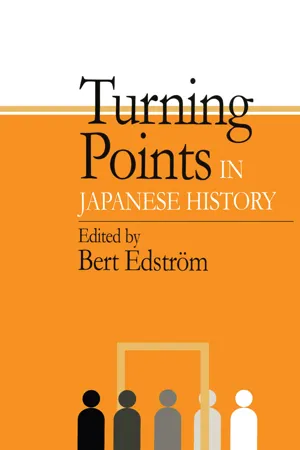
Turning Points in Japanese History
About this book
So-called 'turning points' or 'defining moments' are both the oxygen and grid lines that historians and researchers seek in plotting the path of social and political development of any country. In the case of Japan, the ninth Conference of the European Association of Japanese Studies provided a unique opportunity for leading scholars of Japanese history, politics and international relations to offer an outstanding menu of 'turning points' (many addressed for the first time), over 20 of which are included here. Thematically, the book is divided into sections, including Medieval and Early Modern Japan, Japan and the West, Contested Constructs in the Study of Tokugawa and Meiji Japan, Aspects of Modern Japanese Foreign Policy, and Democracy and Monarchy in Post-War Japan.
1

Bukkyō Denrai: The True Turning Point
Discussing such a contentious and subjective concept as turning point, one feels obliged to take a methodological stand. What is in fact a ‘turning point’? I would like to recall the idea of bifurcation, used by Jurij Lotman from the Moscow–Tartu school of semiotics. In opposition to Marc Bloch from the famous Annales school, who subscribed to relative determinism based on the idea of ‘longue durée’, Lotman believed that periods of determined historical process are separated by certain points of special importance. On the one hand, such a point is the crowning of the past process, while on the other, the result is a ‘point of choice’, from which multiple lines of possible development emerge. Entering into one of those lines sets the historical process on track for a certain period of time. Lotman called such points ‘points of bifurcation’, a mathematical term referring to a change in a certain dynamic system.
Japanese historiography dealing with the period from the beginning of the sixth century until the beginning of the Nara period (710–794) seems to disregard the above-mentioned possibilities, concentrating on the historical process itself. I posit, however, that defining the development of a culture or a civilization and keeping the possibilities within one’s frame of reference is of great value, especially when one is concerned with ‘turning points’. As the famous German historian Johann Gustav Droysen (1808–84) said, ‘Unsere Methode ist forschend zu verstehen’ (see Topolski, 1998).
Taking a closer look at the so-called ancient period of Japanese history one can distinguish four candidates for such a ‘turning point’. First I must declare, however, that the point is to be the turning from the Yamato state, with a relatively weak position for the emperor, or rather ‘the great ruler’ [ōkimt], and with society organized into professional groups of be concentrated around great clans, into a centralized state modelled after that of Sui and Tang China. The four events are: the transmission into Japan of Buddhism [bukkyō denrai] (538, 548, or 552), the Itsushi coup [Itsushi no hen] or the Taika Reforms [Taika no kaishin] (645), the Jinshin Disturbances [Jinshin no ran] (672), and the promulgation of the Taihō Code [Taihō ritsuryō] (702).
In this essay I shall try to explain why the arrival of Buddhism to Japan can be seen as the true turning point, but first I would like to justify briefly why the three others are not such turning points.
Some time had already passed since the Taika Reforms, which Taika was supposed to start, were ‘deconstructed’ (to use this up-to-date word). The only fact we cannot deny is the Itsushi coup itself. Leaving aside my view that the Itsushi coup and the ensuing reforms were the direct result of bukkyō denrai, the political enterprises of the new regime were more or less the continuation of the politics of the Soga clan. We do not know the exact moment of introducing the most important reforms; the shōsei, or regency of Prince Naka no Ōe and his later years as Emperor Tenji (r. 661–72), and the reign of Emperor Temmu (r. 672—86) are most frequently mentioned. The consequences of the coup itself turn out to be limited. Let me call it an ‘apparent’ turning point.
The Jinshin Disturbances had greater meaning, giving the winner, Prince Ōama, later Emperor Temmu, a better and most of all a stronger position as a reformer, than that of Emperor Tenji. Nevertheless, the Jinshin Disturbances and the Temmu regime, which emerged from it, strengthened an already existing tendency, rather than constituted the beginning of a new one.
And last but not least, the promulgation of the Taihō Code was undoubtedly an important event, but I prefer to see it as the crowning peak of the process started by bukkyō denrai, the peak that decided the frame of the historical process. If we imagine history as a sine graph with the ‘turning points’ in the places of a line crossing the axis, the Taihō Code would be in the most remote point from the axis, between two turning points.
In this essay it is argued that the true turning point was the transmission of Buddhism into Japan, which I would like to interpret as an event consisting of two elements: first, an act of international politics, and I am speaking here of the official transmission [kōden]; and, secondly, a process of accepting Buddhism, an act of internal politics. After examining these two elements I would like to introduce my views on the revolutionary aspects of the new religion.
The political character of the official transmission of religion from one state to another is obvious. In China Buddhism did not have the position enjoyed by Christianity in Europe during the Middle Ages. The act of transmitting Buddhism to a foreign polity by a decision taken by ruler of a Chinese state meant that the former joined the Chinese vassal system, chaifeng (Jap. sakuhō). The Korean Three Kingdoms are a good example. In 372 Fu Jian, the ruler of Earlier Qin dynasty ordered Buddhism to be transmitted to Koguryŏ. Similarly, in 384 Emperor Xiaowu of the Eastern Jin dynasty had it transferred to Paekche. However, in the case of the third Korean kingdom of Shilla, the process was twofold, for Buddhism was introduced from Koguryŏ and the official acceptance of Buddhism by King Pŏphŭng in 527 was soon paralleled by establishing diplomatic relationship with Northern Wei China. In case of Japan the situation appears slightly different. Intentionally I set aside the question of whether Buddhism was transmitted in 538, 548 or 552, sharing the views of historians who believe that there were several missions from Paekche offering Buddhist statues, scriptures and monks as a token of gratitude for the military assistance, which Paekche was so desperately looking for in that period. Hence, bukkyō denrai did not have the character of a gift from a suzerain onto his vassal, as in the case of China in relation to one of the Korean Three Kingdoms. There is a possibility that King Song of Paekche intended to strengthen the relations between the two sides, in expectation of even more extensive help. Neither can we overlook the fact that, at least according to traditional historiography, Crown Prince Shōtoku started to send embassies to Sui and Tang China simultaneously with being active in the field of Buddhism. Buddhist inspiration cannot be excluded.
Much more important for my interpretation of bukkyō denrai as the turning point is the process of its implementation into the very fabric of Japanese society and state. The Japanese buddhologist Tamura Enchō has divided this process into three periods, 538–622, 622–70, and 670–710 (Tamura 1975: 47), but I would like to set a divide in 645. I shall not go into any detailed presentation and discussion of the reliability of available sources, but concentrate on examining the role of the emperor, the role of the Soga clan and the nature of Soga Buddhism in opposition to Prince Shōtoku’s Buddhism.
The written sources in our hands are the chronicle Nihon shoki (The chronicles of Japan) compiled in 720, Jōgū shōtoku hōō teisetsu (The imperial record of Prince Jōgū Shōtoku, the Ruler of the Law) from the middle Heian period (794–1185), and Gangōji garan engi narabi ni ruki shizaichō (The history of Gangōji temple and the record of its property) from 747, which are based on earlier sources and cannot be viewed as reliable. Fortunately, thanks to scores of years of hard critical toil by Japanese historians, headed by the great Tsuda Sōkichi, the process by which Buddhism was accepted by the Japanese ruling class can be largely reconstructed.
I share the view of Futaba (1962: 47) that all the pre-Taika reports in the Nihon shoki on the imperial activities in the field of Buddhism are post-Taika interpolations, in other words, that there was no such phenomenon as the role of the emperor. However, in order to grasp the nature of the emperor position better, let us examine three emperors, Kimmei, Suiko and Jomei.
What was the motive for Kimmei’s ‘leaping from joy’ (Nihongi: 66) decision to transfer the question of accepting Buddhism onto his ministers? Probably the emperor felt the inevitability of the Soga–Mononobe conflict and believed that taking a neutral stand was the safest possible choice. Much more important is an aspect emphasized by Tamura. According to him, Kimmei and his successors on the throne were aware of the religious sanction of their position. The ōkimi was the ruler by the power of autochthonous kami. Accepting Buddhism would have deprived the ruler of this religious nimbus, which may have been critical, if we consider the rather weak position of the emperor in this period (Tamura 1994: 72).
However, Empress Suiko (r. 592–628) is frequently connected to the important events in the early history of the Japanese Buddhism in studies of Nihon shoki presented by researchers such as Fukuyama Toshio, Futaba Kenkō and others, and we are justified in claiming that Suiko took the same stand as Kimmei. It is especially important when we consider the Sanbō kōryü no mikotonori, the imperial edict to promote the Three Treasures (Nihongi: 123), and the alleged establishment of the priestly officials [.sōgō] (Nihongi: 153), which was meant as a take-over of the control of the Buddhist community from the hands of the Sogas. I claim that the true face of Empress Suiko can be better seen in her edict from the ninth day, second month and fifteenth year (607) of her reign:
We hear that Our Imperial ancestors, in their government of the world, bending lowly under the sky and treading delicately on the ground, paid deep reverence to the Gods of Heaven and Earth. They everywhere dedicated temples to the mountains and rivers, and held mysterious communion with the powers of Nature. Hence the male and female elements became harmoniously developed, and civilizing influences blended together. And now in Our reign, shall there be any remissness in the worship of the Gods of Heaven and Earth. Therefore let Our Ministers with their whole hearts do reverence to the Gods of Heaven and Earth. (Nihongi: 135)1
However, according to Nihon shoki, the next emperor, Jomei (r. 629–41), ordered the construction of ...
Table of contents
- Cover
- Half Title
- Title Page
- Copyright Page
- Table of Contents
- About the Contributors
- Introduction: ‘Turning Points’ and ‘Defining Moments’
- 1. Bukkyō Denrai: The True Turning Point
- 2. 1247 as a Turning Point for the Kamakura Shogunate
- 3. A Turning Point in Court–Bakufu Relations During the Edo Period
- 4. The Starting Point of Modern Japanese-Korean Relations: The Letter Incident of 1869
- 5. Deliberate Non-Communication: The Influence of the Religious Issues on the Diplomatic Talks During the Visit of the Iwakura Delegation to Belgium
- 6. Rescuing the Prisoners of the Maria Luz: The Meiji Government and the ‘Coolie Trade’, 1868–75
- 7. The Ending of Extraterritoriality in Japan
- 8. Maruyama on Kaikoku: Ruptures in a Frame of Vertical Development
- 9. The Meiji Constitution as Miscalculation
- 10. The End of World War One as a Turning Point in Modern Japanese History
- 11. Takahashi Korekiyo’s Fiscal Policy and the Rise of Militarism in Japan during the Great Depression
- 12. Japan and Islam Policy During the 1930s
- 13. Japan’s Foreign Policy and the Yoshida Legacy Revisited
- 14. The Beginning of the End? The Problem of Imperial Succession in Modern Japan
- Index
Trusted by 375,005 students
Access to over 1.5 million titles for a fair monthly price.
Study more efficiently using our study tools.
Frequently asked questions
Yes, you can cancel anytime from the Subscription tab in your account settings on the Perlego website. Your subscription will stay active until the end of your current billing period. Learn how to cancel your subscription
No, books cannot be downloaded as external files, such as PDFs, for use outside of Perlego. However, you can download books within the Perlego app for offline reading on mobile or tablet. Learn how to download books offline
Perlego offers two plans: Essential and Complete
- Essential is ideal for learners and professionals who enjoy exploring a wide range of subjects. Access the Essential Library with 800,000+ trusted titles and best-sellers across business, personal growth, and the humanities. Includes unlimited reading time and Standard Read Aloud voice.
- Complete: Perfect for advanced learners and researchers needing full, unrestricted access. Unlock 1.5M+ books across hundreds of subjects, including academic and specialized titles. The Complete Plan also includes advanced features like Premium Read Aloud and Research Assistant.
We are an online textbook subscription service, where you can get access to an entire online library for less than the price of a single book per month. With over 1.5 million books across 990+ topics, we’ve got you covered! Learn about our mission
Look out for the read-aloud symbol on your next book to see if you can listen to it. The read-aloud tool reads text aloud for you, highlighting the text as it is being read. You can pause it, speed it up and slow it down. Learn more about Read Aloud
Yes! You can use the Perlego app on both iOS and Android devices to read anytime, anywhere — even offline. Perfect for commutes or when you’re on the go.
Please note we cannot support devices running on iOS 13 and Android 7 or earlier. Learn more about using the app
Please note we cannot support devices running on iOS 13 and Android 7 or earlier. Learn more about using the app
Yes, you can access Turning Points in Japanese History by Bert Edstrom in PDF and/or ePUB format, as well as other popular books in History & Japanese History. We have over 1.5 million books available in our catalogue for you to explore.