- 286 pages
- English
- ePUB (mobile friendly)
- Available on iOS & Android
eBook - ePub
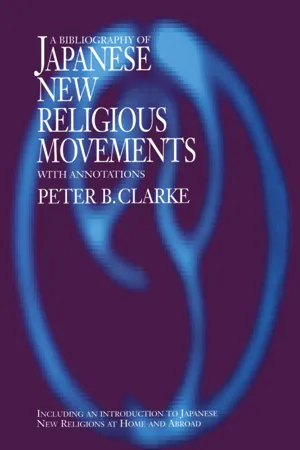
Bibliography of Japanese New Religious Movements
About this book
Containing some 1500 entries, this new bibliography will be widely welcomed for its comprehensive brief, and for the sub-section profiling principal NRMs convering history, beliefs and practices, main publications, braches worldwide and membership.
Information
Japanese New Religions Summaries

This section includes 18 summaries of different Japanese New Religions along with a list of academic and denominational publications relevant to each movement. The publications listed here are also listed in the main bibliography, but repeated for ease of reference.
The following movements have been included:
Agonshū
Byakkō Shinkō Kai
Honmichi
Kōdō Kyōdan
Kōfuku-no-Kagaku
Konkōkyō
Kurozumikyō
Mahikari
Ōmoto
PL Kyōdan
Reiha-no-Hikari
Reiyūkai Kyōdan
Risshō Kōsei Kai
Seichō-no-Ie
Sekai Kyūseikyō
Shinnyoen
Sōka Gakkai
Tenrikyō
Agonshū
Agon derives from the ancient India Sanskrit word Agama meaning ‘come’, conveying a sense of imparted teaching.
History
Agonshū was established in 1978 by Kiriyama Seiyū (1921-), the . current Kancho (leader), although its roots can be said to trace back to an earlier religious group established by Kiriyama in 1954. Kiriyama was born as Tsutsumi Masao but adopted his current name in 1955 after lay ordination in the Shingon Buddhist sect. After a childhood of poverty and several business failures as an adult he spent six months in prison in 1953 for tax offences.
Following his release he attempted to commit suicide and it was during this attempt that he found a copy of the Buddhist text Junteikannonkyō detailing the compassions of the deity Kannon. Kiriyama believed himself to have been saved by Kannon and he established the Kannon Jikeikai (‘Kannon Worshipping Movement’) in 1954. Over the years he began to realize that his earlier misfortunes had been the result of karmic hindrances and in 1970 the deity Kannon was revealed to him in a dream and he was told that his karma had been finally eradicated. The deity instructed him to become a guide for others so that they may also find salvation.
Kiriyama changed the name of the organization to Agonshū in 1978 after reading the Agama Sutras and finding their ‘inner truths’, which he proclaimed were the essence of original Buddhism and spoken by Sakyamuni himself.
Main Beliefs and Practices
Agonshū is one of the Buddhist sects, based on the Agon Sutras which are said to have been originally taught by Buddha to his disciples. The main elements in Agonshū comprise the Shinsei- busshari (true Buddha relic), the sacred casket where an actual fragment of bone from the Buddha and hence the Buddha spirit resides, and the three esoteric shugyō methods of training. The first of these is the Jōbutsu-hō which teaches how to acquire the ethical depth and sensitivity required for spiritual enlightenment so as to enable one to cut free from karma. The second is the Nyoi Hōju-hō, a secret practice performed with the Shinsei-busshari, which gives the ability to achieve happiness and good fortune and the insight to be cut loose from karma (rarely mastered except by Kiriyama Kancho). The third is the Gumonji Sōmei-hō, a high-level technique for creating genius and wisdom.
The busshari became the main object of worship in Agonshū, because it holds the relic of Buddha and is therefore the manifestation of Buddha himself. When Kiriyama was released from his karma and read the Agama Sutras he realized that established Buddhism was not addressing what he saw to be original Buddhism and the original Buddha. From this time, and with the publication of his central text Henshin no genri in 1971, Kiriyama moved towards esoteric Buddhism and claimed to have acquired the five powers of esoteric Buddhism: power of prediction, power of high levels of activity, power to change oneself and one’s environment, development of great physical power and the power to realize one’s and others’ wishes.
Agonshū’s cosmology is based on the central idea that, like the founder’s experience, all of life’s problems and misfortunes are the result of spiritual and karmic hindrances, often inherited from the past and from ancestors. Agonshū members are urged to develop the power of positive thinking and to strive for a happy and positive life. They are also provided with a framework for transforming the suffering of spirits of the dead into Buddhahood (jōbutsu), thereby liberating themselves from karmic forces. It is a cosmology based upon ideas of renewal and salvation, put into action for laypeople through the teaching of meditation and various esoteric activities. Members can obtain a smaller version of the busshari casket which they can pray before in their homes and by doing so release family members from ancestral hindrance. Meitoku Kuyō is a method of training taught by Agonshū which instructs members on how to pray for one’s ancestors and involves the cleansing of karmic influences. The Agama texts are used for the purposes of chanting and everyday ritual though members are not expected to read them all.
Agonshū’s mission is to save the world from crisis and prevent humankind from committing self-destruction. This is based on the idea that humankind has created powerful levels of science and technology beyond its ability to control and which is causing earth pollution and environmental destruction. Agonshū believes that new social rules and ethics must be created through a core ‘religion of wisdom’ to bring about world peace and save the earth from moving towards destruction.
Main Annual Festivals are:
Star Festival | 11 February |
Flower Festival | 8 April (Buddha’s bir... |
Table of contents
- Cover
- Half Title
- Title Page
- Copyright Page
- Table of Contents
- Contributors
- Using the Bibliography
- Introduction: Japanese New Religions Abroad – The Way of the Kami in Foreign Lands
- Main Bibliography
- Japanese New Religions Summaries
- Appendix: Aum Shinrikyō: Brief History and Select Bibliography
Trusted by 375,005 students
Access to over 1.5 million titles for a fair monthly price.
Study more efficiently using our study tools.
Frequently asked questions
Yes, you can cancel anytime from the Subscription tab in your account settings on the Perlego website. Your subscription will stay active until the end of your current billing period. Learn how to cancel your subscription
No, books cannot be downloaded as external files, such as PDFs, for use outside of Perlego. However, you can download books within the Perlego app for offline reading on mobile or tablet. Learn how to download books offline
Perlego offers two plans: Essential and Complete
- Essential is ideal for learners and professionals who enjoy exploring a wide range of subjects. Access the Essential Library with 800,000+ trusted titles and best-sellers across business, personal growth, and the humanities. Includes unlimited reading time and Standard Read Aloud voice.
- Complete: Perfect for advanced learners and researchers needing full, unrestricted access. Unlock 1.5M+ books across hundreds of subjects, including academic and specialized titles. The Complete Plan also includes advanced features like Premium Read Aloud and Research Assistant.
We are an online textbook subscription service, where you can get access to an entire online library for less than the price of a single book per month. With over 1.5 million books across 990+ topics, we’ve got you covered! Learn about our mission
Look out for the read-aloud symbol on your next book to see if you can listen to it. The read-aloud tool reads text aloud for you, highlighting the text as it is being read. You can pause it, speed it up and slow it down. Learn more about Read Aloud
Yes! You can use the Perlego app on both iOS and Android devices to read anytime, anywhere — even offline. Perfect for commutes or when you’re on the go.
Please note we cannot support devices running on iOS 13 and Android 7 or earlier. Learn more about using the app
Please note we cannot support devices running on iOS 13 and Android 7 or earlier. Learn more about using the app
Yes, you can access Bibliography of Japanese New Religious Movements by Peter B Clarke in PDF and/or ePUB format, as well as other popular books in Social Sciences & Ethnic Studies. We have over 1.5 million books available in our catalogue for you to explore.