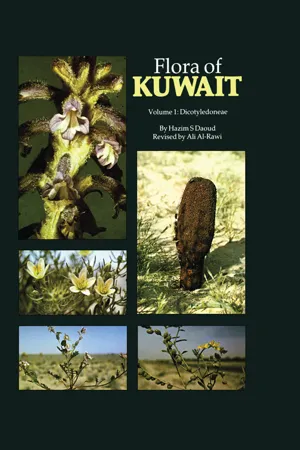
- 256 pages
- English
- ePUB (mobile friendly)
- Available on iOS & Android
eBook - ePub
About this book
First published in 1985. Building on Professor Hazim Daoud's unfinished work due to his sudden death in 1976, Dr Ali Al-Rawi assembles the relevant data to complete this study of Kuwait's desert flowers and plant life. This culmination of field notes, colour transparencies and photographs, stalled by the handover of Daoud's herbarium, represents his work on most of the Dicotyledons with minimal amendments to his original texts.
Information
Description of the families
1 Neuradaceae
Prostrate, annual, woolly herbs. Leaves alternate, simple, pinnately divided or lobed, petiolate, with minute stipules. Flowers bisexual, actinomorphic, solitary and axillary, scattered along the branches, pedicelled. Calyx ovoid with 5 lobes, alternating with bracteoles of epicalyx. Petals 5, slightly exceeding the calyx, inserted with the stamens on the throat of the calyx tube. Stamens 10, in 2 rows. Carpels 5-10, connate at base and adnate to inner wall of calyx tube (hypanthium); ovule 1 in each carpel; styles 10, persistent, indurated. Fruits 10, nut-like, included in the dry, flattened, orbicular, spinose-muricate, tomentose calyx; the calyx persisting after germination of one or more of its seeds. Seeds curved.
1 Neurada L.
Sp. PI. 441 (1753); Gen. PL ed. 5: 199 (1754).
Description the same as for the family.
One species in western Asia, Pakistan, N. Africa, Eritrea and Mali.
1 Neurada procumbens L., Sp. PI. 441 (1753); Boiss., Fl. Orient. 2: 735 (1872) (Plate 1).
Type: ‘Habitat in Aegypto, Arabia’ (Hb. Linn. 606/1!).
Annual, prostrate, woolly-canescent herb, 10-25 cm across. Stems spreading, alternately branched, base often surrounded by the persistent calyx. Leaves alternate, ovate-oblong, obtusely sinuatepinnatifid, 1.0-2.5 cm long, 0.7-1.6 cm wide; stipules minute; petiole 3-15 mm long. Flowers bisexual, actinomorphic, solitary and axillary, scattered along the branches; peduncle 0.5-1.5 cm long. Calyx ovoid, with contracted throat, flat at base, persistent, triangular, 5-lobed; lobes triangular, c. 2 mm long, alternating with the 5 subulate bracteoles of the epicalyx, in fruit, turning into prickles. Petals 5, obovate, c. 3 mm long, whitish-yellow. Stamens 10, in 2 rows, inserted on the throat of the calyx tube. Carpels 10, connate at base and adnate to the calyx tube (hypanthium), tapering into a slightly exserted subulate style, later elongating and becoming persistent; ovules 1 in each carpel; stigma capitate. Fruit: dry, flattened, orbicular, 10-20 mm in diameter, persistent calyx with lateral, stout spines on the side including the ten membranous, nut-like fruits, each nutlet with one seed. Seeds curved, without endosperm; testa membranous.
Flowering: March-April.
Habitat: sandy places.
General distribution: Egypt, Sinai, Palestine, Cyprus, Iraq, Bahrain, Saudi Arabia, Oman and Iran.
Local distribution: Al-Saffaneyyah, Um Al-Ramam, Al-Dbaiyyah, Kathma.
Area: Saharo-Arabian, with extension into the Sudanian region.
Flowering: March-April.
Habitat: sandy places.
General distribution: Egypt, Sinai, Palestine, Cyprus, Iraq, Bahrain, Saudi Arabia, Oman and Iran.
Local distribution: Al-Saffaneyyah, Um Al-Ramam, Al-Dbaiyyah, Kathma.
Area: Saharo-Arabian, with extension into the Sudanian region.
2 Leguminosae
Annual or perennial, erect to procumbent to creeping herbs, or under-shrubs, sometimes spiny. Leaves alternate, petiolate, usually stipulate, 3-or 5-foliolate or imparipinnate of 4-12 pairs of leaflets, rarely simple; leaflets entire or denticulate-serrate above, elliptic to obovate to obtriangular, petiolulate. Flowers bisexual, in axillary or terminal racemes, heads or spikes, rarely solitary, zygomorphic. Calyx 5-toothed or cleft, with sepals more or less united at base, often 2-lipped. Corolla papilionaceous, of 5 distinct or partly united petals, hypogynous, consisting of a standard (outermost petal), two wings (lateral petals), and a keel (two anterior or innermost petals united by their margins). Stamens 10, one free and nine fused by their filaments (diadelphous). Pistil 1; ovary superior, 1-carpelled; style simple; stigma capitate. Fruit usually 1-celled (sometimes 2-celled by extension of dorsal suture), 1-many-seeded pod (legume), dehiscing by 2 valves along the ventral and dorsal sutures, sometimes fruit a many-celled loment with transverse, indehiscent partitions, 1-few-seeded. Seeds mostly without endosperm, smooth or sometimes tuberculate.
A family of 590 genera and 13,200 species found in both temperate and tropical regions.
Key to the genera
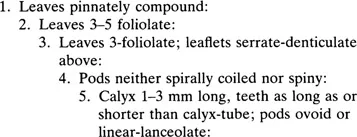
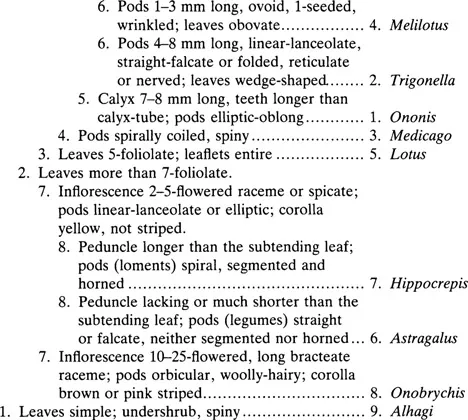
1 Ononis L.
Sp. PI. 716 (1753); Gen. PL ed. 5: 321 (1754).
Glandular-pubescent herbs. Stems decumbent to erect, branched throughout. Leaves alternate, petiolate, stipulate, 3-foliolate or the floral leaves reduced to one leaflet; stipules adnate to the petiole; leaflet elliptic, serrate-denticulate, cuneate at base. Flowers solitary, axillary, pedicelled, arranged in a long, loose, raceme-like, leafy-bracteate inflorescence. Calyx campanulate, with short, pale green tube, and 5-teeth linear-lanceolate, 3-4 times longer than tube. Corolla whitish-pink, a little longer than the persistent calyx. Stamens 10, diadelphous. Ovary stipitate, compressed, oblong, hairy; style filiform; stigma capitate. Pod elliptic-oblong, pubes-cent, dehiscent, included in the calyx, 4-6-seeded. Seeds ovoidsubglobular, light brown, tuberculate.
About 80 species, chiefly in S. Europe, the Mediterranean, N. Africa and S.W. Asia. 1 species in Kuwait.
1 Ononis serrata Forssk., Fl. Aeg.-Arab. 130 (1775); Boiss., Fl. Orient. 2: 63 (1872) (Plates 2 and 3).
Type: ‘Aegypto: Alexandria Ras et-tus Marts 1762’ (Hb. Forssk. No. 402, C!).
Glandular-pubescent herb, 10-30 cm high. Stems decumbent to erect, branched throughout. Leaves 3-foliolate, sparingly pubescent; stipules leaf-like, adnate to the petiole for more than half their length, c. 2.5 mm long, acute; petiole 2-3 mm long, shorter than blade; leaflets elliptic-oblong, cuneate, sharply serrate-denticulate, 7-10 mm long, 3-4 mm wide. The floral leaves simple, 6-8 mm long, (1-) 2.0-3.0 mm wide, elliptic-linear, serrate-denticulate to entire, with stipules adnate to the petiole for more than half their length. Flowers 8-10 mm long, axillary, solitary, pedicellate, crowded into terminal leaf, raceme-like inflorescence, denser toward apex. Calyx 7-8 mm long, campanulate, persistent, pubescent, with 5 equal teeth; teeth 3-4 times longer than the pale green tube, linear-lanceolate. Corolla somewhat longer than calyx, pinkish; standard bluish-purple almost orbicular, with short claw; wings whitish, oblong to obovate; keel whitish, curved. Stamens 10, diadelphous. Ovary compressed, oblong, pubescent, more or less stipitate, many-ovuled; style flat, filiform, curved, glabrous; stigma capitate. Pod 5-6 mm long, erect, compressed, elliptic-oblong, dehis-cent, 2-valved, pubescent, enclosed in the persistent calyx, 4-6-seeded. Seeds c. 1.2 mm long, ovoid-subglobular, light brown, tuberculate.
Flowering: March-April.
Habitat: coarse, sandy, compact soil.
General distribution: Palestine, Cyprus, Turkey, Iraq, Saudi Arabia and Iran.
Local distribution: Failaka, Arefjan, Al-Dbaiyyah, Khiran, Wafra, 6th Ring Road, Al-Atraf, Al-Shuaiba, Al-Liyah, Al-Bahra, Jal-Az-Zor, Al-Mitla’, Manageesh, Al-Ada’ami, Ras Al-Jlayah, Al-Jahra, Kathma, Al-Sulaibiya.
Area: Mediterranean, Saharo-Arabian and adjacent Irano-Turanian.
Glandular-pubescent herb, 10-30 cm high. Stems decumbent to erect, branched throughout. Leaves 3-foliolate, sparingly pubescent; stipules leaf-like, adnate to the petiole for more than half their length, c. 2.5 mm long, acute; petiole 2-3 mm long, shorter than blade; leaflets elliptic-oblong, cuneate, sharply serrate-denticulate, 7-10 mm long, 3-4 mm wide. The floral leaves simple, 6-8 mm long, (1-) 2.0-3.0 mm wide, elliptic-linear, serrate-denticulate to entire, with stipules adnate to the petiole for more than half their length. Flowers 8-10 mm long, axillary, solitary, pedicellate, crowded into terminal leaf, raceme-like inflorescence, denser toward apex. Calyx 7-8 mm long, campanulate, persistent, pubescent, with 5 equal teeth; teeth 3-4 times longer than the pale green tube, linear-lanceolate. Corolla somewhat longer than calyx, pinkish; standard bluish-purple almost orbicular, with short claw; wings whitish, oblong to obovate; keel whitish, curved. Stamens 10, diadelphous. Ovary compressed, oblong, pubescent, more or less stipitate, many-ovuled; style flat, filiform, curved, glabrous; stigma capitate. Pod 5-6 mm long, erect, compressed, elliptic-oblong, dehis-cent, 2-valved, pubescent, enclosed in the persistent calyx, 4-6-seeded. Seeds c. 1.2 mm long, ovoid-subglobular, light brown, tuberculate.
Flowering: March-April.
Habitat: coarse, sandy, compact soil.
General distribution: Palestine, Cyprus, Turkey, Iraq, Saudi Arabia and Iran.
Local distribution: Failaka, Arefjan, Al-Dbaiyyah, Khiran, Wafra, 6th Ring Road, Al-Atraf, Al-Shuaiba, Al-Liyah, Al-Bahra, Jal-Az-Zor, Al-Mitla’, Manageesh, Al-Ada’ami, Ras Al-Jlayah, Al-Jahra, Kathma, Al-Sulaibiya.
Area: Mediterranean, Saharo-Arabian and adjacent Irano-Turanian.
2 Trigonella L.
Sp. PI. 776 (1753); Gen. PI. ed. 5: 338 (1754).
Annual, glabrous or glabrescent herbs. Stems branched from base, usually procumbent or prostrate, leafy. Leaves 3-foliolate, with entire, dentate or incised stipules adnate to the petiole; petiole usually longer than leaflets; leaflets obovate-obtriangular, cuneate, retuse, dentate above, petiolulate. Peduncle almost lacking to nearly as long as the subtending leaf, or longer. Inflorescence axillary, many-flowered, racemose, pedunculate, or few- to many-flowered, sessile or subsessile, umbellate or racemose; pedicels very short, deflexed at fruiting. Calyx campanulate or tubular, 5-toothed. Corolla yellow. Stamens 10, diadelphous. Pods dehiscent or indehiscent, linear, or linear-lanceolate and slightly falcate or folded-flexuous, or slightly oblique-nerved or netted-reticulate, often beaked. Seeds smooth.
About 100 species, chiefly in the eastern Mediterranean region a...
Table of contents
- Cover
- Title
- Copyright
- Contents
- Preface
- Acknowledgments
- Foreword
- Location, climate, topography
- Vegetation
- Classification of the flora of the world
- Class Angiospermae
- Subclass I Dicotyledoneae
- Description of the families
- Index of the families
- Index of botanical names
Trusted by 375,005 students
Access to over 1.5 million titles for a fair monthly price.
Study more efficiently using our study tools.
Frequently asked questions
Yes, you can cancel anytime from the Subscription tab in your account settings on the Perlego website. Your subscription will stay active until the end of your current billing period. Learn how to cancel your subscription
No, books cannot be downloaded as external files, such as PDFs, for use outside of Perlego. However, you can download books within the Perlego app for offline reading on mobile or tablet. Learn how to download books offline
Perlego offers two plans: Essential and Complete
- Essential is ideal for learners and professionals who enjoy exploring a wide range of subjects. Access the Essential Library with 800,000+ trusted titles and best-sellers across business, personal growth, and the humanities. Includes unlimited reading time and Standard Read Aloud voice.
- Complete: Perfect for advanced learners and researchers needing full, unrestricted access. Unlock 1.5M+ books across hundreds of subjects, including academic and specialized titles. The Complete Plan also includes advanced features like Premium Read Aloud and Research Assistant.
We are an online textbook subscription service, where you can get access to an entire online library for less than the price of a single book per month. With over 1.5 million books across 990+ topics, we’ve got you covered! Learn about our mission
Look out for the read-aloud symbol on your next book to see if you can listen to it. The read-aloud tool reads text aloud for you, highlighting the text as it is being read. You can pause it, speed it up and slow it down. Learn more about Read Aloud
Yes! You can use the Perlego app on both iOS and Android devices to read anytime, anywhere — even offline. Perfect for commutes or when you’re on the go.
Please note we cannot support devices running on iOS 13 and Android 7 or earlier. Learn more about using the app
Please note we cannot support devices running on iOS 13 and Android 7 or earlier. Learn more about using the app
Yes, you can access Flora Of Kuwait by Hazim S. Daoud in PDF and/or ePUB format, as well as other popular books in Social Sciences & Anthropology. We have over 1.5 million books available in our catalogue for you to explore.