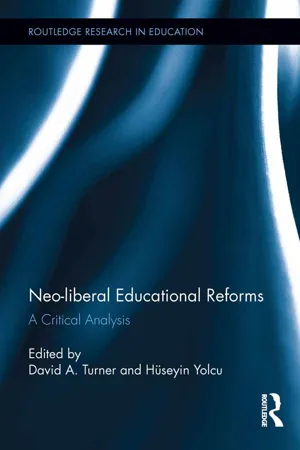
This volume gathers a cast of eminent scholars for a critical and comparitive analysis of how neoliberal education policies have functioned in a range of countries in different stages of economic development. Treating case studies from Europe, Asia, the Americas and the Middle East, the volume shows how globalization operates differently in different societal contexts.
- 230 pages
- English
- ePUB (mobile friendly)
- Available on iOS & Android
eBook - ePub
About this book
Information
1 Neo-liberalism and Public Goods
INTRODUCTION
Neo-liberalism advances the ideology of the market. Markets, it is argued, are the most efficient way of matching supply and demand, and of managing decentralized collective choices in such a way that aggregate demand is met, while moving choices as close as possible to those who actually implement policy, those who actually know what is going on. Intervention in the market can only introduce inefficiencies, and therefore, the role of the government, or of any arbitrary agency that can intervene in the market, should be reduced to an absolute minimum, to prevent “distortion” of the market. Left to its own devices, the “invisible hand” of market theory will ensure that the greatest good of the greatest number of people is achieved.
To understand why this is not a workable solution to any problem, one must understand the nature of public goods. Any sphere of activity which includes public goods, and education is probably the realm where this applies most forcefully, cannot operate purely on market principles. It is not possible to sustain a market in public goods without constant and substantial intervention. Public goods are the Achilles' heel of market theory. Faced with this difficulty, neo-liberal theory must solve the problem of public goods; it must argue that there are no public goods, and that what appear to be public goods are, at least in part, private goods, and can therefore be managed in an unregulated market, or it must argue that appropriate interventions in the form of levies and taxes can make public goods behave as private goods. In the latter case, government intervention should be limited to the measures that allow the market to function.
This chapter presents an abstract and theoretical argument. It first examines the nature of public goods. It then examines the area of education to establish that there are (many) public goods that are relevant to the understanding of educational practice. This is followed by a discussion of neo-liberalism as applied to education, and the measures that are taken to maintain that a free market in education is viable, and an examination of why neo-liberalism is the wrong lens through which to view educational phenomena. The chapter concludes by picking some examples where adopting a neo-liberal framework of analysis has led to educational policies that are at best counterproductive and at worst fundamentally damaging.
PUBLIC GOODS
The term “public good” is a technical term in economics that describes goods that are (a) nonrivalrous and (b) nonexcludable. Nonrivalrous consumption means that if one person consumes the good, another person is not excluded from enjoying it. My enjoyment of watching a film on television is not diminished if, unbeknown to me, somebody else is enjoying watching it from a vantage point in my garden. Nonexcludability means that it is difficult or impossible to exclude an individual from the enjoyment of the public good.
The first thing that needs to be noted is that this very precise definition is quite separate from any approximate idea of being “in the public interest”, “of public benefit” or generally “good for the public”. Although this general idea of public benefit may be linked with the notion of a public good, as will be seen later, it is as well from the outset to establish that a public good is a distinct technical category in economic theory.
A consequence of the two properties of public goods is that the price of any purely public good must be zero. Stiglitz (1995) has argued that knowledge is such a public good. So, for example, if I seek the knowledge of how to bake a sponge cake, I can go to the library and find a cookery book and copy down the recipe. Or I could search the Internet for a suitable recipe. Any commercial provider of cookery lessons needs to compete with that service in order to be attractive in the market place. They must charge me nothing for the knowledge, or they must bundle the knowledge with something which is rivalrous and excludable, and which adds value to the knowledge of how to cook a sponge cake. They could, for example, rent me a space in a teaching kitchen / laboratory, hire me pots and pans and an oven, and charge me for the electricity used by the oven. In short, they could sell me the experience of baking a sponge cake together with the knowledge of how to cook a sponge cake. If they also charged me for the ingredients, I might have the expectation that I could also have the experience of eating the cake.
Being in a classroom is excludable—classrooms have walls and doors. Being in a classroom is rivalrous—if the classroom is full, putting another learner in will involve taking one out first, or at the very least accepting a deterioration in the learning experience. And eating a cake is both rivalrous and excludable, as recorded in the old saying, “You cannot have your cake and eat it, too”. Or perhaps better, “You cannot eat your cake and still have it”. By coupling public goods with private goods, it is possible to make a product that can be sold at a price above zero. But the public good itself cannot be sold in this way.
MARKETS
Markets are a way of ensuring that aggregate demand for a product matches aggregate supply. If demand exceeds supply, then the price rises, choking off demand or encouraging new suppliers to enter the business, until supply and demand match. Conversely, if supply exceeds demand, the price falls, stimulating demand, or encouraging some suppliers to leave the business, until, once again, supply and demand are in equilibrium. Markets have the advantage of being able to match supply and demand at the aggregate level, without requiring either that it should be dictated to specific individuals that they must, or must not, consume a particular product, or that central planning should be able to anticipate the overall demand in advance, so as to be able to meet it through planned production.
Centrally planned economies have had a poor record of achieving what a market seems to be able to achieve with relative ease. And this has led neo-liberals to regard the market mechanism as more than a useful intellectual tool for distributing goods and services; they have come to regard it as a basic principle by which all goods and services should be distributed. This is a fundamental mistake, because, as even this simple description of an ideal market in equilibrium makes clear, a number of assumptions must be made for the market to work.
Quite clearly, a market can function in the required way only if the price of a product rises continuously as the demand for it rises. Similarly, the price of a product must fall continuously as the supply of it increases. And there must be no barriers that prevent a supplier from entering or leaving the market in order to maximize his or her profits. Unfortunately for the doctrine of neo-liberalism, it is not difficult to find instances where these conditions are not met. There are positional goods, where the supply cannot increase to match demand, because only a limited number of people can own them before they lose their value. There are Veblen goods, where the demand actually increases as the price increases. There are high investment costs to enter many markets. And, most importantly for the present discussion, there are public goods. (For a fuller analysis of the implications of viewing education from each of these perspectives, see Turner [2011].) It is impossible to have a market for a product that has a price of zero.
Not all aspects of education are public goods. As Dore (1976) described the “diploma disease”, qualifications are positional goods, which lose their value as more and more people possess them. But knowledge, a central aspect of education, is a public good. One way of understanding this is to see the massive interventions that are needed in order to create a market in knowledge, and thereby to make it attractive to invest in knowledge. A system of patents and copyright is required to protect the private interests of anybody who creates new knowledge. Without such a mechanism there would be no way for inventors and artists to recoup their investment. Through a process of state intervention, patents and copyright artificially turn knowledge into a private good which can be sold for the economic advantage of the creator, who has monopoly rights over his or her product for a limited time. Without such protection, other publishers and manufacturers could exploit that knowledge, and, because they did not have to make any investment, could undercut the price charged by the inventor.
Unlike the knowledge that it contains, a book is a private good. I can “consume” books in other ways than reading them. I like the feel and the touch of books, and I like to be surrounded by them. I also like to be seen surrounded by books, as they convey a sense of who I am to the people who see me with them. If books were a pure public good, then I could leave my books at a coffee shop at the end of my road, so that anybody who wished could read them; their consumption would then be nonrivalrous and nonexcludable.
Although leaving the books in a public place without charge would undermine the ability of the author to recover his or her investment, the amount of damage that can be done in this way is limited by geography. It is not possible that everybody who wants to read a specific book can get to the coffee shop at the end of my road to read it. So access to public goods can be local. However, as Stiglitz (1995) makes clear, knowledge is a universal public good. We are beginning to see some of the implications of this with the development of the Internet, a nonlocal medium that makes it possible to access knowledge wherever it may be, while making the kind of intervention that limits the circulation of a public good very difficult.
PUBLIC GOODS AND GOVERNMENT INTERVENTION
The existence of public goods is problematic for those who argue that free markets are the most efficient way of distributing all goods. Because public goods are nonexcludable, they create the problem of the “free-rider”. There is an incentive not to invest in public goods, because if my neighbour invests in them there is a very good chance that I will benefit from them anyway. If my neighbours invite me to contribute to a scheme for lighting our street, it would probably be best if I contributed very little. The fact that I have been mean might lead to a reduction in the level of lighting by a few per cent, but I should still be able to see my way home on dark nights, and most of the cost will be borne by my neighbours. For obvious reasons, this does not produce a satisfactory result if everybody decides to contribute nothing, but throughout history there have been those who have thought it worthwhile to invest their own private wealth in public goods. As a result, schools for the poor, hospitals, libraries and sponsorship of the arts have benefited from private investment in public goods. Perhaps it is this kind of public-spirited good works that leads to the confusion between the technical sense of public goods and the idea of public benefit in a more general sense.
However, what is clear is that left to private individuals, the amount that will be invested in public goods is less than optimal. Society, as a whole, would benefit from more investment in knowledge, public safety, clean air and fresh water. It is for this reason that government intervention is essential. Government must intervene, either to create an artificial market for a pseudo-private good, as it does when it creates laws to govern the exploitation of intellectual capital, or it must collect taxes and use them to invest in public goods, whether that is education or railways and motorways or other infrastructure projects.
Another kind of government intervention is through licensing schemes, which make it possible for those who have studied a certain body of knowledge to practice. It is obviously desirable that self-taught brain surgeons should not be free to ply their trade, but the process of licensing doctors has the additional effect of enabling doctors to recoup the investment they have made in their education. But what is clear is that, because at least some aspects of knowledge are public goods, no country has yet devised a way of distributing access to knowledge in a way that is not heavily dependent upon the intervention of government. Indeed, it is possible to argue that the distribution and allocation of public goods are one of the core reasons why central government is necessary at all.
The provision of public goods, and among them education, has always been central to the apparatus of the modern state. Historically, education is one of the early responsibilities adopted by the state, and in terms of expenditure it always accounts for a large proportion of government expenditure. This means that education is also public in a second sense, in that it is generally provided from the public purse.
I was going to say that it was impossible to imagine a system of education in which the state is not a major player. That, of course, would be incorrect. Ivan Illich (1971) imagined a world in which there was no state intervention in the distribution of knowledge and access to knowledge. In a system that would perhaps be more easily implemented now, using the Internet, than it could be when he wrote, he envisaged a world in which people studied the knowledge that they wanted to learn, and could identify expert mentors through a system of open interchange. That is to say, he envisaged a system that took into account precisely the features of knowledge as a public good, that the price must be zero, and that novices should be able to find free help to enable them to learn and access complex knowledge.
In all other cases, government intervention has taken the form of management of a market, or pseudo-market, to manipulate the price of access to education. Indeed, from Illich’s perspective, schooling itself was a way of manipulating the market for knowledge, because schooling, unlike knowledge, is rivalrous and excludable; schools have walls, and if one person occupies a seat in a classroom, another cannot.
This brief history of the management of public goods makes clear why public goods present such a difficulty for neo-liberal theory. Neoliberal politicians generally argue for small government—the government should take less of “our money” to spend on “its projects”, as opposed to spending government money (governments, after all, print money, and the existence of money as a universal system of exchange is itself a public good) for our benefit. Neo-liberalism therefore stands directly opposed to the idea of public goods, and the rationale for government which suggests that a central authority is needed to ensure that there is an appropriate level of investment in public goods, given that private investment in public goods, without coercion, will always be suboptimal, because of the free-rider problem.
On the contrary, neo-liberal politicians argue that paying taxes is in some way voluntary, an act of private investment; if we impose taxes at this level, rich individuals and businesses will move elsewhere, and then there will be no revenue from their taxes at all.
WHO SHOULD PAY FOR EDUCATION?
We can now see where this confusion, or dissimulation, about public goods gets us. For any investment it is theoretically possible to calculate a rate of return on that investment. In practice it may be very difficult, because the costs and benefits of an investment, especially a long-term investment like education, may be very difficult to quantify, and there may be technical difficulties in discounting future earnings to account for inflation and other changes in value in the future. Notwithstanding these difficulties, various attempts have been made to estimate the rate of return on investment in education, and on any reckoning, it looks like one of the best investments that a person, or a society, could possibly make.
For example, the OECD calculates the private rate of return on invest-ment in tertiary education to be 12.7% for a man and 11.5% for a woman. There is some variation across the countries considered, with particularly high rates of return in Turkey and Poland, and low rates of return in the Nordic countries, but the rates of return are high compared with almost any other form of investment (OECD, 2011, p. 174, Table 9.3). For the same time, the public rates of return to investment in tertiary education in OECD countries averaged 11.1% for a man and 9.2% for a woman. There was a similar pattern of distribution across countries (OECD, 2011, p. 175, Table 9.4).
In some cases the fact that, in general...
Table of contents
- Cover
- Half Title
- Routledge Research in Education
- Title Page
- Copyright Page
- Table of Contents
- List if Figures
- List of Tables
- Preface
- 1 Neo-liberalism and Public Goods
- 2 Neo-liberalism and English Education
- 3 Neo-liberal Educational Reforms and Social Inequality: Some Insights from France
- 4 The Education Agenda of Turkey: Marketing Education in the Context of Neo-liberal Policies
- 5 Neo-liberal Reforms and Governance in Mexican Higher Education
- 6 The Neo-liberal Reforms of Education in Argentina and Latin America
- 7 The Influence of Neo-liberalism on Japan's Educational Reforms
- 8 The Impacts of Neo-liberalism on Higher Education in China: Issues and Challenges
- 9 Globalization and Neo-liberalism as Educational Policy in Australia
- 10 Environmental Education through Global and Local Lenses: Ecopedagogy and Globalizations in Appalachia, Argentina and Brazil
- 11 The State and Education Policy Change in South Africa: Walking the Tightrope between Choice and Equity
- Contributors
- Index
Trusted by 375,005 students
Access to over 1.5 million titles for a fair monthly price.
Study more efficiently using our study tools.
Frequently asked questions
Yes, you can cancel anytime from the Subscription tab in your account settings on the Perlego website. Your subscription will stay active until the end of your current billing period. Learn how to cancel your subscription
No, books cannot be downloaded as external files, such as PDFs, for use outside of Perlego. However, you can download books within the Perlego app for offline reading on mobile or tablet. Learn how to download books offline
Perlego offers two plans: Essential and Complete
- Essential is ideal for learners and professionals who enjoy exploring a wide range of subjects. Access the Essential Library with 800,000+ trusted titles and best-sellers across business, personal growth, and the humanities. Includes unlimited reading time and Standard Read Aloud voice.
- Complete: Perfect for advanced learners and researchers needing full, unrestricted access. Unlock 1.5M+ books across hundreds of subjects, including academic and specialized titles. The Complete Plan also includes advanced features like Premium Read Aloud and Research Assistant.
We are an online textbook subscription service, where you can get access to an entire online library for less than the price of a single book per month. With over 1.5 million books across 990+ topics, we’ve got you covered! Learn about our mission
Look out for the read-aloud symbol on your next book to see if you can listen to it. The read-aloud tool reads text aloud for you, highlighting the text as it is being read. You can pause it, speed it up and slow it down. Learn more about Read Aloud
Yes! You can use the Perlego app on both iOS and Android devices to read anytime, anywhere — even offline. Perfect for commutes or when you’re on the go.
Please note we cannot support devices running on iOS 13 and Android 7 or earlier. Learn more about using the app
Please note we cannot support devices running on iOS 13 and Android 7 or earlier. Learn more about using the app
Yes, you can access Neo-liberal Educational Reforms by David Turner,Hüseyin Yolcu in PDF and/or ePUB format, as well as other popular books in Education & Education General. We have over 1.5 million books available in our catalogue for you to explore.