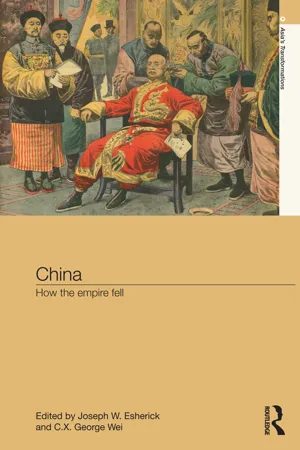
China
  1. 302 pages
  2. English
  3. ePUB (mobile friendly)
  4. Available on iOS & Android
eBook - ePub

About this book

The Qing dynasty was China's last, and it created an empire of unprecedented size and prosperity. However in 1911 the empire collapsed within a few short months, and China embarked on a revolutionary course that lasted through most of the twentieth century. The 1911 Revolution ended two millennia of imperial rule and established the Republic of China, but dissatisfaction with the early republic fuelled further revolutionary movements, each intended to be more thoroughgoing than the last, from the National Revolution of the 1920s, to the Communist Revolution, and finally the Cultural Revolution.

On the centenary of the 1911 Revolution, Chinese scholars debated the causes and significance of the empire's collapse, and this book presents twelve of the most important contributions. Rather than focusing on Sun Yat-sen's relatively weak and divided revolutionary movement, as much previous scholarship has, these studies examine the internal dynamics of political and socio-economic change in China. The chapters reveal how reforms in education, army organization, and constitutional rule created new social forces and political movements that undermined dynastic legitimacy within China and on its frontiers. Through detailed analyses, using new archival, memoir, diary, and newspaper sources, the authors cast new light on the sudden collapse of an empire that many thought was at last embarked on a road to reform and national rejuvenation.

China: How the Empire Fell will be of huge interest to students and scholars of modern Chinese history as well as those of contemporary China.

Frequently asked questions

Yes, you can cancel anytime from the Subscription tab in your account settings on the Perlego website. Your subscription will stay active until the end of your current billing period. Learn how to cancel your subscription.
No, books cannot be downloaded as external files, such as PDFs, for use outside of Perlego. However, you can download books within the Perlego app for offline reading on mobile or tablet. Learn more here.
Perlego offers two plans: Essential and Complete
  • Essential is ideal for learners and professionals who enjoy exploring a wide range of subjects. Access the Essential Library with 800,000+ trusted titles and best-sellers across business, personal growth, and the humanities. Includes unlimited reading time and Standard Read Aloud voice.
  • Complete: Perfect for advanced learners and researchers needing full, unrestricted access. Unlock 1.4M+ books across hundreds of subjects, including academic and specialized titles. The Complete Plan also includes advanced features like Premium Read Aloud and Research Assistant.
Both plans are available with monthly, semester, or annual billing cycles.
We are an online textbook subscription service, where you can get access to an entire online library for less than the price of a single book per month. With over 1 million books across 1000+ topics, we’ve got you covered! Learn more here.
Look out for the read-aloud symbol on your next book to see if you can listen to it. The read-aloud tool reads text aloud for you, highlighting the text as it is being read. You can pause it, speed it up and slow it down. Learn more here.
Yes! You can use the Perlego app on both iOS or Android devices to read anytime, anywhere — even offline. Perfect for commutes or when you’re on the go.
Please note we cannot support devices running on iOS 13 and Android 7 or earlier. Learn more about using the app.
Yes, you can access China by Joseph Esherick, C.X. George Wei, Joseph Esherick,C.X. George Wei, Joseph W. Esherick, C.X. George Wei in PDF and/or ePUB format, as well as other popular books in History & 20th Century History. We have over one million books available in our catalogue for you to explore.

Information

Publisher
Routledge
Year
2013
Print ISBN
9781138120761
eBook ISBN
9781134612222

Table of contents

  1. Cover
  2. Half Title
  3. Title Page
  4. Copyright Page
  5. Table of Contents
  6. Contributors
  7. Biographies
  8. Introduction
  9. Part I: Reform and revolution
  10. Part II: The Sichuan railway crisis: prelude to revolution
  11. Part III: The Hubei reforms and the Wuchang Uprising
  12. Part IV: Qing officials and the revolution
  13. Part V: Yuan Shikai and the 1911 Revolution
  14. Part VI: The revolution and the frontier
  15. Glossary
  16. Index