eBook - ePub
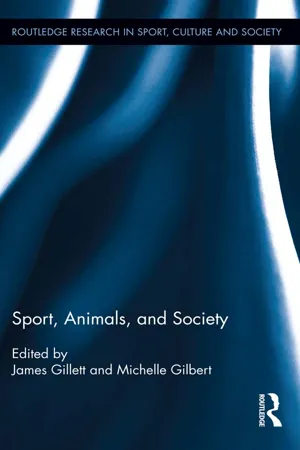
Sport, Animals, and Society
- 294 pages
- English
- ePUB (mobile friendly)
- Available on iOS & Android
eBook - ePub
Sport, Animals, and Society
About this book
This book advances current literature on the role and place of animals in sport and society. It explores different forms of sporting spaces, examines how figures of animals have been used to racialize the human athlete, and encourages the reader to think critically about animal ethics, animals in space, time and place, and the human-animal relationship. The chapters highlight persistent dichotomies in the use of and collaboration with animals for sport, and present strategies for moving forward in the study of interspecies relations.
Information
Sporting Identities of Human and Animal Athletes
11 A Star is Born to Buck
Animal Celebrity and the Marketing of Professional Rodeo
Susan Nance
Although famed “animal athletes” have been commonplace in public life for a century, scholars have yet to theorize and account for the human practice of imagining animal celebrity. Further, we might ask how animal celebrity facilitates the use of animals in commercial sport. Consider the media and human interest once focused on Steamboat and Five Minutes to Midnight (rodeo broncos); Mick the Miller (racing greyhound); Seabiscuit, Secretariat, Barbaro, Zenyatta, and Big Brown (thoroughbred racehorses); Big Ben (show jumping horse); Tornado, Red Rock, Bodacious, and Little Yellow Jacket (bucking bulls). By directing attention to such winning animals, various players—from their owners, trainers, and riders to journalists, venue operators, and souvenir manufacturers—have found ways to prosper by reaching beyond frequent gamblers and industry insiders to earn the admiration (and dollars) of a broader public audience.
Moreover, the phenomenon of animal celebrity requires special consideration since it differs from human celebrity in two important ways. First, and crucially, animals do not know they are famous. They cannot understand the networks of sports organizations, media, sponsorships, and animal managers that make it possible for fans to project their emotional needs onto animals they do not know personally; therefore humans must create animal celebrities without those animals’ knowing cooperation. This takes place when people in varying degrees willfully or accidentally misinterpret those animals’ behaviors in ways that affirm human power and commercial sport competition.1
Second, with the exception of young girls who might play games imagining that they are famous horses, by and large consumers do not wish to be or directly emulate animal celebrities by looking or behaving like them (Fraser & Brown, 2002). At the same time, the desire for individu-ation around a unique personal identity displayed through spending is a key component of modern consumerism, and human celebrities often serve as aspirational models. Hence animal celebrities tend to function as vehicles for identity formation and display only when people aspire to the values the animal’s framed behavior and life seem to represent. Consumers/fans may identify with the owners of the animal celebrity as a way of endorsing the democratic, meritocratic pretensions of professional sport, speculative animal breeding, and by extension their own potential in capitalism. With respect to the sporting animal celebrity, he or she is a being others want to own or at least befriend, since he or she is a symbol of the presumed benevolence of human control over animals and of human economic success.
This chapter defines this phenomenon and explains the function of animal celebrity in mature consumer societies by way of a case study investigation of the marketing of rodeo bulls in the Professional Bull Riders (PBR) tours. Since the 1980s, rodeo people and their industry partners—including bull breeders, trainers, riders, venue managers, and sponsors—have employed aggressive sports marketing and branding practices common in the NFL, NBA, NASCAR, and NHL, while borrowing the practices of selective breeding found in thoroughbred horse and cattle breeding. With the cooperation of fans, rodeo people have thereby created opportunities for people to define their own identities by ascribing human interests to the cattle used in rodeo performances.
Beginning with a detailed definition of animal celebrity as a distinct cultural concept, this chapter explains how rodeo people and fans have collaborated to create a routinized system of celebrity bull identification and promotion. Through special breeding and training of bulls, competitive bucking and animal rankings, marketing that tells biographical stories, merchandise representing particular bulls, and outreach to fans using social media, some “bovine athlete” celebrities have become almost as lucrative as the human competitors who ride them. The chapter concludes by arguing for the ideological function of celebrity rodeo bulls as imagined beings “played” by living animals that help consumers cope with the paradoxically sympathetic and destructive nature of human-animal relationships in mature consumer societies.
ANIMAL CELEBRITY DEFINED
Why is animal celebrity still a puzzle for scholars? Certainly there is a long-standing public interest in noted nonhumans, evident in the nonfic-tion genre of famous animal biography.2 Various scholars have noted this phenomenon in a basic way, seeing it as a construction of media interests who claim animals “enjoy the benefits that are bestowed on all those who work in ‘show business.’”(Molloy, 2001, p. 41) They may also explain it as evidence of broader shifts in urban human attitudes over the last century toward “zoocentrism,” namely “the recognition of animals as full or partial moral subjects” and thus not simply impediments to or raw material for human activities.3 To be clear, most people still harbor decidedly human supremacist attitudes, insisting on the right of humans to exercise the power of life and death over nonhumans and to use them in any way deemed beneficial, which in the western tradition is often referred to as dominionism (Fudge, 2002). Accordingly, Nicole Shukin notes that, as the number of animal bodies being consumed in industrial and market processes has increased over the past two centuries, so have the number of mediated animal figures increased, such that animals function as “simultaneously sign and substance of market life”(Shukin, 2009, pp. 11–12). So, to be precise, human cultures are marked by a kind of ambivalence whereby human attitudes and actions are unsettlingly contradictory: we imagine ourselves as stewards of morally significant nonhuman life by admiring celebrity animals while we materially consume and destroy animals in numbers greater than at any time in history (Berger, 1980).
Academic inquiries into how animal celebrity—as a particular way of perceiving and depicting animals—factors into this modern human contradiction comprise some basic attempts at identifying how zoos use animals to draw emotional responses from the public (Malamud, 2007; Mitman, 2005; Molloy, 2011). For instance, Beardsworth and Bryman’s analyze the Disneyization process at late-twentieth-century zoos and Emmanuel Gouabault, Karine Darbellay, and Annik Dubied discuss animal “starification” by analyzing Knut, the famed Berlin Zoo polar bear cub. These studies show how zoo managers market their institutions by publicizing particular captives as celebrity zoo pets—especially newborn creatures like tigers, polar bears, pandas, or elephants. The public follows the individual progress of those zoo pets on the news or through souvenir purchases and zoo visits. Consumers thereby internalize marketing messages asserting that zoos are kindly refuges for nature in its cutest form by seeing those zoo pets as emotionally compelling symbols of environmental conservation (Beardsworth & Bryman, 2001; Gouabault, Dubied, & Burton-Jeangros, 2011). In both of these studies we find consumers and zoos collaborating to bridge the gap between human desires to protect animals and human activity that endangers them. Still, these authors do not problematize the uniqueness of nonhuman celebrity by reference to the broader literature on human celebrities, nor do they discuss animals in sport.
At the same time, the broader anthropocentric literature on celebrity provides clues in how to understand animal celebrity. Richard Dyer’s classic study of Hollywood stardom begins with an explanation of how members of a given culture “construct out of its own contradictions a consensual ideology that will appear to be valid for all members of society,” and that movie stars function in this way by helping to reconcile paradoxes in society (by, for instance, arguing for equality of opportunity in society while operating from an industry in which personal success is built on happenstance and personal relationships as much as merit) (Dyer, 1979, 2–3). The animal celebrity functions similarly to normalize the contradictions in human-animal relations, serving as a distraction or a coping mechanism for consumers who wish to believe that their spending helps animals. And, as with human celebrities, fans project their emotional needs onto celebrity animals to find comforting endorsements of their existing beliefs.
Thus, in my formulation, the animal celebrity has a number of components: (1) He or she is imagined as a unique named individual with a biography that explains how his or her personality was formed4; (2) he or she is a mediated personality; (3) there is evidence of the livingness of the animal, who is not a biographically static figure (like an icon or animated animal character) but a living being who generates news and experiences change over time or progress toward a goal; (4) hence many people believe they know and even love the animal celebrity, although they will never meet him or her; (5) the animal celebrity is usually a consumer-oriented for-profit entity that earns publicity and/or money for his owners or, at the very least, the media that reports on him or her; and (6) his or her public life has a backstage element. Like all theater, only those aspects of a living animal’s behavior, needs or physicality that serve the cultural labor of seeing the animal as exceptional and meaningful are open to public viewing. For instance, circus elephants appear in the show ring, advertising and the show program unshackled with trunks raised in a “smiling” salute to the viewer, while their chained confinement in darkened box vans for the overnight ride to the next venue is not part of that marketing. Zoos celebrate human care of newborns but do not publicly dwell on why captive animals are so often unable or unwilling to care for their neonates such that human surrogates are necessary.
To be clear, the practice of imagining animal celebrity is not to be mistaken for other important ways of seeing animals that we find in history: as mythical creature and god (Tlingit Raven or ancient Egyptian Horus); as national icon (the “American” bald eagle, or New Zealand’s kiwi bird); as purely fictional character (Black Beauty or Nemo); as a fictional character “played” by a series of live animals (Lassie, Flipper, Shamu). Instead, animal celebrities represent the most acute form of animal interpretation that includes all these other forms and whereby people valorize and become emotionally invested in the lives of distant but living individual animals, beings who are unknowingly required to participate in that public fiction.
Certainly professional rodeo did not originate the practice of inviting the public to see particular creatures as celebrities. Animal celebrity as marketing technique has its roots in the fame of early-nineteenth-century menagerie elephants, whom early showmen advertised to ticket buyers as biographi-cally compelling, named, living individuals (Nance, 2013). With respect to sporting animals, although nineteenth-century sporting men noted winning racehorses, fighting cocks, and greyhounds, they did so on a localized, more colloquial level. As commercial sports became better organized, regulated, capitalized, and publicized by sporting papers like the New York Clipper, Spirit of the Times, National Police Gazette, and city newspapers, male audiences could follow the careers of famed racehorses, whom many admired for their ability to earn money for their owners, riders, and lucky bettors.5 In the rodeo world, the most noted animals were not yet full-blown celebrities but consisted almost entirely of famous bucking horses like Steamboat and Five Minutes to Midnight. Rodeo people and fans would expect them to appear at important rodeos and found their deaths noted in the local press. Yet, since the vast bulk of their lives fell into the backstage realm of animal life, they were not yet known as personalities beyond being explained as fierce adversaries to the cowboy.
THE RANK BULL
From the late-nineteenth-century birth of organized rodeos until the 1950s “golden age,” rodeo organizers and stock contractors traveled from ranch to ranch, scouting bulls drawn from beef or hobby herds in order to purchase bulls for their “bucking string.” Rodeo committees paid a fee to have those bulls and other stock brought in for their rodeo events, including saddle and bareback-riding broncos (also known as rough stock) and wild horses, cows, steers, and calves used in the timed and judged roping and racing events for men, women, and children competitors. Bull riding was a staple at every rodeo and proved to be a big crowd pleaser as the only event in which the stock might attack a cowboy. Even barring that outcome, it was the most injurious to competitors flung to the ground. Owners of bucking bulls usually identified their stock with numbers, although some particularly intimidating “Brahma celebrities,” as one rodeo paper noted in the 1940s, did receive names (Westermeier, 1987, p. 250, n. 1).
Then came Tornado, a bull whose reputation represented a turning point in this universe of figurative animal consumption. His career established the character that most celebrity bulls are taken to play today: the rank bull.6 Tornado’s owners and journalists then and since perpetuated a biography for the bull that was a typically American boy-becomes-a-man-and-a-success story. He was
born sickly and skinny … a lot of people had had no hope of his ever turning out to be much more than potential hamburger. But not his owner, Jim Shoulders … [who] patiently built Tornado up to an eigh-teen-hundred-pound bucking wonder, which he then set loose to wreak havoc on the pro rodeo circuit. (Stratton, 2005, p. 14)
Thereafter Tornado was the most feared bull of the 1960s, like none before him. Over 200 cowboys tried but none could ride him until 1967, when Freckles Brown finally did, “and the crowd went wild!” as one popular account puts it (Woerner, 2001, p. 135). Today the bull is interred with a monument on the grounds of the National Cowboy and Western Heritage Museum (formerly the National Cowboy Hall of Fame).
It occurred to many people in Tornado’s day that rodeo needed stars, both human and nonhuman, to promote the business just as other sports did. Hence Tornado as “rank bull” was a rough template for a standard promotional character in rodeo performance to be played by male cattle. The rank bull is not an unthinking and anonymous herd member, a common rural western perception of cattle as a whole (Lawrence 1982, pp. 169–173, 180). He was and still is believed to be an intelligent (in cattle terms), sentient, motivated individual. Thus he is difficult to ride because he can sense the position of the rider and adapt over time. Before Tornado, rodeo people and journalists described such bulls as “mean,” “mad,” “angry,” “wild,” “furious,” or “ornery,” and, depending upon the speaker, driven to attack any rider thrown from their backs.7 After Tornado, the door was open for elevating famed buckers into celebrities since the rank bull had the capability for emotion, intentionality, and individuality, which came especially from his bucking habits and buck-off record.
Many bulls since have been put in this role, most famously J-31, also known as Bodacious. In the early 1990s, after he developed an explosive bucking style few riders could manage, Bodacious became known...
Table of contents
- Cover Page
- Half Title page
- Series page
- Title Page
- Copyright Page
- Contents
- List of Figures
- Introduction
- Historical and Evolving Dichotomies
- Human and Animal Relations
- Ethics and Violence in Sport
- Sporting Identities of Human and Animal Athletes
- Future Directions
- Contributors
- Index
Trusted by 375,005 students
Access to over 1.5 million titles for a fair monthly price.
Study more efficiently using our study tools.
Frequently asked questions
Yes, you can cancel anytime from the Subscription tab in your account settings on the Perlego website. Your subscription will stay active until the end of your current billing period. Learn how to cancel your subscription
No, books cannot be downloaded as external files, such as PDFs, for use outside of Perlego. However, you can download books within the Perlego app for offline reading on mobile or tablet. Learn how to download books offline
Perlego offers two plans: Essential and Complete
- Essential is ideal for learners and professionals who enjoy exploring a wide range of subjects. Access the Essential Library with 800,000+ trusted titles and best-sellers across business, personal growth, and the humanities. Includes unlimited reading time and Standard Read Aloud voice.
- Complete: Perfect for advanced learners and researchers needing full, unrestricted access. Unlock 1.5M+ books across hundreds of subjects, including academic and specialized titles. The Complete Plan also includes advanced features like Premium Read Aloud and Research Assistant.
We are an online textbook subscription service, where you can get access to an entire online library for less than the price of a single book per month. With over 1.5 million books across 990+ topics, we’ve got you covered! Learn about our mission
Look out for the read-aloud symbol on your next book to see if you can listen to it. The read-aloud tool reads text aloud for you, highlighting the text as it is being read. You can pause it, speed it up and slow it down. Learn more about Read Aloud
Yes! You can use the Perlego app on both iOS and Android devices to read anytime, anywhere — even offline. Perfect for commutes or when you’re on the go.
Please note we cannot support devices running on iOS 13 and Android 7 or earlier. Learn more about using the app
Please note we cannot support devices running on iOS 13 and Android 7 or earlier. Learn more about using the app
Yes, you can access Sport, Animals, and Society by James Gillett, Michelle Gilbert, James Gillett,Michelle Gilbert in PDF and/or ePUB format, as well as other popular books in Social Sciences & Sociology. We have over 1.5 million books available in our catalogue for you to explore.