Originally published in 1994, this important book traces the rise of film propaganda in the 20th Century, discussing specifically how film can be used to manipulate public perception and opinions. Two distinct areas are covered: war propaganda, including feature and documentary films regarding warfare; and civilian propaganda, including films that address a variety of political subjects. Although the focus is American film and American politics, this book offers insights for all those interested in the affect of film on the minds of citizens of any country or state.
eBook - ePub
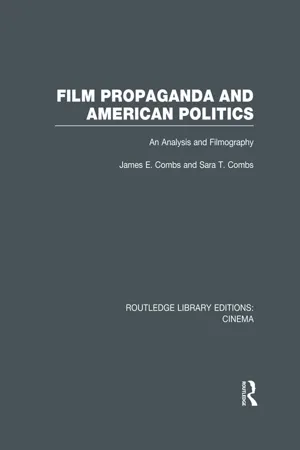
Film Propaganda and American Politics
An Analysis and Filmography
- 224 pages
- English
- ePUB (mobile friendly)
- Available on iOS & Android
eBook - ePub
About this book
Information
Part I
The Story of Film Propaganda
The political importance of film propaganda in the twentieth century stems from the fact that visual imagery was a powerful, central force in political imagination. From virtually the first days of the movies, filmmakers learned that advocative and persuasive messages could be included in cinematic presentations, and that the medium, with its impressive ability to convey dramatic experience, could serve as a vehicle for propaganda. In this first section of the book, the development of film propaganda from its rudimentary beginnings to the present will be recounted and analyzed.
It is no accident that the “story” of film propaganda in the twentieth century is intimately connected with the conduct of warfare. War will likely be seen by future historians as the central historical reality of the twentieth century. In the context of two world wars, the Cold War, and the collapse of Communist governments in the late 1980s, the use of any means available to sway opinion was crucial to the conduct of war. Film, a highly popular and portable medium, became important for virtually every viewpoint and government involved in such struggles. In this part of the book, this importance shall be studied for the enlightenment of students of both film and history.
Chapter One
The Impetus of Wartime: The Political Importance of War Film Propaganda
War played a central role in the politics of the twentieth century, to the point of creating enormous worldwide devastation and threatening nuclear conflagration. The conduct of such large-scale warfare was made possible by several innovations. First, modern societies were characterized by the growth of large-scale organizations able to conduct vast enterprises in a coordinated and efficient manner. Warfare on the scale engaged in during the twentieth century took a great deal of “rationality” in the Weberian sense of bureaucratic administration of organized violence. Second, as the organization that coordinates all others in a society, the State became the sovereign structure that could mobilize the organizational power of corporations, unions, universities, and agriculture in an orchestrated war effort. Third, the State became able as never before to mobilize the populace of the country in support of warfare through mass sacrifice—taxes, deprivations, service, and the lives of both soldiers and civilians.
It became incumbent on the State and allied organizations to prepare public opinion for warfare. This required creating a “war fever” in the period before the outbreak of hostilities, glorifying successes and explaining away failures and dealing with the conclusion of the conflict in victory or defeat. Propagating the correct public education to indoctrinate the populace in the justice and virtue of War required tremendous effort from the organs of public enlightenment. Thus all instruments of mass communication were mobilized to bring both the medium and the artists who knew how to use the medium into the service of the warfare State.
Propaganda, then, became a major project of modern social organizations at War. Warfare as an enterprise required widespread public support, which could not be left to chance. Both public and private channels of communication became crucial to the molding and retaining of public opinion. In the twentieth century, this included the movies. In wars conducted by nation-states, governments relied on their movie industries to cooperate as a propaganda agency. Political authorities came to recognize the importance of movie propaganda in perpetuating the war effort, and in many cases formed a symbiotic relationship between a private industry and public agency in producing and distributing the kinds of supportive films that the government at war required. War, then, has been a great impetus to the development of film propaganda. The official languages of power have become infused with the characteristic features of propaganda: intensification, making the language more fiery and savage; mobilization, calling on all to join the euphoria and bloodthirstiness of the impending fray; and polarization, dividing friend and foe into categories of light and darkness, good and evil, heroics and demonics. Film quickly proved to be highly adaptable to the requirements and aims of propaganda, bringing to the project of war propaganda the visual spectacle and kinetic energy peculiar to the medium. More than mere words or pictures, film could heighten our responses by depicting the war situation in intense terms and images unfolding in a story. Film called people to support and action through inspiring them to become part of the war story. Finally, film could make audiences imagine the enemy as the demonic Other, as the personification of evil. This portrayal became especially powerful when presented in extremely polarized eiconic frames, juxtaposed against depictions of Americans as the repository of virtue and the defender of right.
The propaganda dramatics of a movie gave visual “proof’ to the advocative message that justified war. In this context documentaries made no attempt to be balanced or fair, include the United States as sharing culpability in causing war, or accord the enemy any semblance of humanity or innocence. Fictional films played by the same rules: the “truth” of the story conformed with the propaganda value superimposed upon it.
Filmmaking in these circumstances was not an exercise in the free play of critical creativity but rather the designed play of creative propaganda, which means that the exercise of the critical faculty had to be omitted as the driving feature of the film. War propaganda made a compelling claim on the thrust of a movie, subordinating the usual aesthetic or even commercial considerations in favor of the dominant propaganda aesthetic. The criterion became solely one of propaganda quality and availability devoted to the overriding consideration of winning the war.
Much war propaganda looks dreadful in retrospect, with its simplistic formulas and depictions, easy confidence in the efficacy of violence, and assurance that victory would be imminent, clean, and make a difference. But propaganda art is not meant to be enduring; it is topical, aimed at the moment. Its art is in the immediate responses it can evoke, and the measure of its value is in its ability to define the war situation and evoke a war standpoint A propaganda aesthetic is obviously not art for art’s sake but rather a pragmatic art that propagates expressions of advocacy that resonate with audiences seeking learning.
In the modern world, propaganda became for many people the primary source of learning about big events and processes such as war. No other source seemed as informative or authoritative, and when presented in film, as visually interesting and gripping. The movies offered their unique and compelling visual and “large-screen” perspective, and audiences early on found them a major way of experiencing war. Indeed, it might even be argued that film, or perhaps more expansively visually-based stories communicated through visual media, including television, was the most important and widespread way that non-combatants in the “century of war” did know warfare. Movie knowledge has its parameters and foci, but film could “bring the war home” in ways denied other media. All media transform war into art, but the peculiar features of film make war into film art that is immediate, topical, and visually memorable. The recreations of war on screen allow viewers to see it But it also means that the “authors” of the film can bring to it a perspective of advocacy, making the warshow a vehicle for overt or covert propaganda and reflecting either the private sentiments of the filmmaker or official sentiments which the filmmaker has seen fit to include. Thus as war—both as threat and actuality—became an integral part of twentieth century politics, official propagandists found film to be an important means of getting out the war message.
THE INCEPTION OF FILM AND THE SPANISH-AMERICAN WAR
With these ideas in mind, it is astonishing to recall how quickly the fledgling and itinerant new movie industry responded to its first war crisis, the Spanish-American war of 1898. By this time, there were already rudimentary film companies engaged in fierce competition for audiences intrigued by this new invention. The crisis with Spain gave these enterprising filmmakers an opportunity to visualize their first war. Hitherto, war had been written about, painted and sketched, and photographed. Now for the first time it could become the subject of moving pictures. Despite the limitations of travel and access, the energetic new film industry found clever ways to bring people moving images of war, something they had never seen before. Most people had only known about warfare secondhand, through print and pictures. Audiences had certainly never seen moving images of war which gave them the feeling that they were on the battlefields witnessing the action on the battlefield. With the Spanish-American war, the movies pioneered “invented actuality,” the creation on film of a symbolic reality that represented the movement of warfare. The propaganda potential of an invented actuality is obvious. War on film took on the qualities and direction the filmmaker wished, framing the war for audiences who believed they were seeing some semblance of the actuality of a war event.
In the initial context of the Spanish-American conflict, the new moviemakers were quick to exploit the situation in order to lure people into nickelodeons, tents, or little theatres. It is unlikely that the purveyors of the new medium had any ideological agenda, but they sensed that their potential audiences were thirsting for information about the event This information had to be of a certain kind, namely that which validated their patriotic and vengeful mood. Thus filmmakers were bent on feeding a war fever, simply because this was on people’s minds and therefore they could be induced to pay a nickel to glimpse images of their boys at war. The earliest film propaganda was apparently characterized by little more intent than the desire to make a fast buck. But it was propaganda, no less advocative messages, which delighted and instructed audiences eager to participate vicariously in America’s first imperial war.
These clumsy and brief films drew their advocative status from those who saw them. Filmmakers simply sought footage, real or contrived, that framed the increasingly martial mood and nationalistic self-assertion. If the bellicose spirit of the time was incipient, the screen images, combined with group enthusiasm expressed during showings, helped to direct attitudes. If there were doubts about involvement, they were likely suppressed or converted through the movie experience. In this rudimentary way, the mere existence of films that catered to emerging popular sentiments provided the context of political learning: here is your war. These images were the beginning of America’s long movie experience with warfare, much of which was war propaganda, both pro-war and anti-war.
The desire for “visual newspaper information” thus became the format for compelling immediate visions of the impending situation. After the battleship Maine was sunk in Havana harbor, one enterprising filmmaker found footage of other battleships cruising by and simply relabeled one as the Maine. Other mobile crews made it to Havana in time to film the sunken Maine, and indeed the Edison Company got a film crew to Key West to film Burial of Maine Victims. The Roosevelt Rough Riders were filmed galloping in formation at a military base near Tampa. It is unclear, at this early juncture, how much cooperation was elicited and granted by the War Department or the extent to which any significant officer in the military thought about the propaganda benefits of cooperation with filmmakers. But films that featured the launching of a battleship, cavalry riding at Ft. Meyers, and even staged battle footage with army troops on maneuver suggest that at some level someone saw the uses of allowing film featuring military heroics to be shot and distributed. These first pre-war movies greatly aided the cause of those who wished for a bellicose solution to the crisis. The brief images in these early films contributed to people’s sense that a military action was the only possible one, framing in the screen the existence of a military force showing muscle and suggesting the potential of martial heroics and nationalistic revenge and triumph. There was even a little film entided War Correspondents, staging real newspaper correspondents in a fake race to a cable office to telegraph a story about the war crisis, contributing to the sense of excitement and urgent importance that characterizes war news. Indeed, these films were complemented when shown with graphics of Uncle Sam and the American flag, for which audiences would cheer. However, when pictures were shown of President McKinley, who was reluctant at first to go to war, audiences lustily jeered and hissed. Advertisements for these films blared, “Peace at Any Price! Do We Want It?” The earliest movie audiences saw war movies in an atmosphere of blood in the water.
When war broke out, actual footage of combat in the “splendid little war” was impossible. This inspired filmmakers to fake action, often shamelessly pawning their visual product as the real thing. Battlefield action was filmed at Fort Meade, with titles such as Last Stand, In the Trenches, and Defense of the Flag again apparently with tacit War Department permission and help. It is not clear whether actual troops were used in the staging of warfare. Perhaps the most notable jingoistic film of the war period was J. Stuart Blackton’s Tearing Down die Spanish Flag (1898), a totally staged “docudrama” climaxing with American troops raising the American flag in place of Spanish colors after a battle. After the shot of the hand ripping down Spain’s flag, the title card described it as “the strong hand of America.” In fact, it was director—and Englishman—Blackton’s hand. Another enterprising company filmed naval battles done with miniature ships in a tank, simulating the actual battles between Spanish and American naval vessels. Their ads implied that the viewer was seeing the real thing, shot somehow with “telescopic lens” that captured the action. Such a film was no doubt presented in the hope that people would suspend judgement to the extent that they would exercise some sort of playful “belief” that what they were seeing Was in some sense real even if recreated. It was certainly the first early example of simulated warfare presented on screen as if it were “the real thing,” appealing to audiences’ vicarious desire to “be there” in observation but not in danger. Movie audiences quickly learned that movie viewing offered them safety from the actual scouiges of warring, like Huck Finn wishing to be a pirate without the dangerous parts.
When the Spanish-American War ended with a quick American victory, film exhibitors toured with sixteen-to-twenty film programs. These “wargraphs,” “warscapes,” or “warshows” were collections of the many short films that had been shot and shown piecemeal but which now offered, the ads claimed, a “panorama of the whole war,” with “Thrilling Animated Pictures” of the “Great Cuban War.” The terms are instructive: war on film was a graphic art, a landscape, seascape, or airscape of the action, and a popular show, a deadly conflict with dramatic value.
It is at such gestative stages in the development of a medium that the first glimmerings of the propaganda potential of film may be seen. These early little movies demonstrated that people sought them out for information about war as well as for emotional catharsis. Although data are scant, it must have occurred to a few people connected with the corridors of power or the burgeoning film industry that they now had at their disposal a medium that could literally frame the way Americans could experience a war. Moreover, that they could elicit the public’s support for the war by providing them some glimpse, however phony and misleading, of what the war was about and how it was being conducted. Movies could bring a war “home” to people by transforming it into vicarious experience in which audiences could participate. By delighting audiences with the spectacle of war, the purveyors of film could also instruct, arousing emotion and shaping thought. The subjective states of movie audiences might be altered through the “objective” representations seen and learned from up there on the screen. Imaginative narrative on Him could include a didactic dimension, wherein movie audiences would tolerate or even invite an element of propaganda learning. Propaganda thus early on became an integral part of the movie pragmatic, one of the kinds of messages people are willing and able to gain from their encounter with films. The Spanish-American Films established the habit of expecting propaganda as a legitimate mode of cinematic expression, especially in the context of heightened awareness of important social and political circumstances such as warfare.
THE GREAT WAR
It is with American involvement first in resisting and then accepting entry into World War I that the movies became a full-fledged vehicle of political propaganda. In the interim between the Spanish American and the Great War, the movies developed into an immensely popular and increasingly technically proficient medium. By the time America entered World War I, the movies possessed the considerable power to sustain a narrative over a lengthy amount of film time, meaning that the attention of audiences could be held if the story was strong enough. Too, movie stars had emerged as a social force, with newfound celebrity giving them special status, including the ability to advocate. Thus not only could a narrative line or imagistic bias serve some propaganda purpose but an identifiable star could embody for audiences familiar with them the quintessence of heroics, villainy, or foolery. Both story and star could by this time represent for large numbers of people willing to suspend disbelief a message of advocacy that might have a better chance of “taking.”
At this historical juncture, the movie industry had also developed an acute sense of its social role. For one thing, the marketing of movies had taught moviemakers in the rapidly expanding and succeeding studios now located in Hollywood a good deal about the vagaries and moods of public opinion. Indeed, it was the advent of mass communications—newspapers and magazines, photography, the movies, the phonograph, and later radio and loudspeakers as well as television—that pioneered sensitivity to the desires of audiences in all their fickle interests over time. For mass media to succeed, they had to gain and hold the attention and thus the confidence of large numbers of people who could be counted on to come back again. Public opinion became their study, since their industries depended upon “reading” the public and promoting the right products. A good bit of the impetus for the emergence of a “science” of public opinion originated with the purveyors of mass communication. The promotion of the movies and their stars became one of the first commercial enterprises adept at propaganda. With American entry into the war, the merger of official requirements for the mobilization of public opinion in support of the war and the newfound power of the movies to mold and direct popular sensibilities was...
Table of contents
- Cover Page
- Half Title page
- Title Page
- Copyright Page
- Original Title Page
- Original Copyright Page
- Dedication
- Contents
- Acknowledgments
- Frontmatter
- Introduction: The Political Importance of Film Propaganda in the Twentieth Century
- Part One The Story of Film Propaganda
- Chapter One The Impetus of Wartime: The Political Importance of War Film Propaganda
- Chapter Two The Interwar Years
- Chapter Three Wartime Documentary Films
- Chapter Four The Postwar Agenda
- Film Propaganda in the American Political Process
- Chapter Five Campaign Propaganda: Visualizing the Candidate
- Chapter Six The Expansion of the State
- Chapter Seven Independent Documentaries
- Conclusion
- Selected Bibliography
- Index
Trusted by 375,005 students
Access to over 1.5 million titles for a fair monthly price.
Study more efficiently using our study tools.
Frequently asked questions
Yes, you can cancel anytime from the Subscription tab in your account settings on the Perlego website. Your subscription will stay active until the end of your current billing period. Learn how to cancel your subscription
No, books cannot be downloaded as external files, such as PDFs, for use outside of Perlego. However, you can download books within the Perlego app for offline reading on mobile or tablet. Learn how to download books offline
Perlego offers two plans: Essential and Complete
- Essential is ideal for learners and professionals who enjoy exploring a wide range of subjects. Access the Essential Library with 800,000+ trusted titles and best-sellers across business, personal growth, and the humanities. Includes unlimited reading time and Standard Read Aloud voice.
- Complete: Perfect for advanced learners and researchers needing full, unrestricted access. Unlock 1.5M+ books across hundreds of subjects, including academic and specialized titles. The Complete Plan also includes advanced features like Premium Read Aloud and Research Assistant.
We are an online textbook subscription service, where you can get access to an entire online library for less than the price of a single book per month. With over 1.5 million books across 990+ topics, we’ve got you covered! Learn about our mission
Look out for the read-aloud symbol on your next book to see if you can listen to it. The read-aloud tool reads text aloud for you, highlighting the text as it is being read. You can pause it, speed it up and slow it down. Learn more about Read Aloud
Yes! You can use the Perlego app on both iOS and Android devices to read anytime, anywhere — even offline. Perfect for commutes or when you’re on the go.
Please note we cannot support devices running on iOS 13 and Android 7 or earlier. Learn more about using the app
Please note we cannot support devices running on iOS 13 and Android 7 or earlier. Learn more about using the app
Yes, you can access Film Propaganda and American Politics by James Combs,Sara T. Combs in PDF and/or ePUB format, as well as other popular books in Media & Performing Arts & Film & Video. We have over 1.5 million books available in our catalogue for you to explore.