eBook - ePub
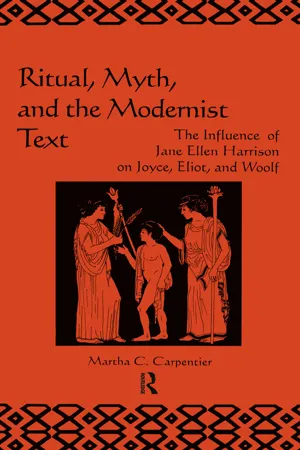
Ritual, Myth and the Modernist Text
The Influence of Jane Ellen Harrison on Joyce, Eliot and Woolf
- 226 pages
- English
- ePUB (mobile friendly)
- Available on iOS & Android
eBook - ePub
Ritual, Myth and the Modernist Text
The Influence of Jane Ellen Harrison on Joyce, Eliot and Woolf
About this book
First Published in 1998. Volume 12 in the Library of Anthropology series. This text traces the influence of Jane Ellen Harrison, a brilliant classicist and one of the 'Cambridge Anthropologists' on Jams Joyce, T.S. Eliot and Virginia Woolf. Decade of critical over-emphasis on Sir James Frazer's influence on modernism have obscured the more important contributions of Harrison, who explored the chthonic Greek matriarchal cults prior to patriarchal Olympianism and originated the 'ritual theory', finding the origins of Greek drama- and ultimately of all art, in religious ritual. Harrison's images of matriarchal divinity and the feminist principles they embodied inspired these modernist writers to envision the young artist reborn as creator through symbolic union with the semiotic body.
Information
1: | INTRODUCTION |
In 1923 two important essays appeared, charting the immense changes taking place in fiction: T.S. Eliot’s review “Ulysses, Order and Myth,” and Virginia Woolf’s “Mr. Bennett and Mrs. Brown.” What were some of these changes? Eliot and Woolf agree that literature must grow out of the writer’s direct, concrete, emotional experience of life, not out of an abstract, conceptual or moral construct imposed on life. In this sense they both saw their generation, the “Georgian” to use Woolf’s nomenclature, as radically opposed to the past, specifically to Victorian and Edwardian attitudes and literary conventions.
Eliot posed himself against Richard Aldington: both were “agreed as to what we want in principle, and agreed to call it classicism,” but they disagreed as to how classicism should be achieved and “as to what contemporary writing exhibits a tendency in that direction.” Eliot then defined a contrast, crucial in its ramifications, between the old orientation toward classicism in literature and the new:
One can be ‘classical’, in a sense, by turning away from nineteenths of the material which lies at hand and selecting only mummified stuff from a museum. … Or one can be classical in tendency by doing the best one can with the material at hand. … And in this material I include the emotions and feelings of the writer himself, which, for that writer, are simply material which he must accept — not virtues to be enlarged or vices to be diminished.
(176–7)
Here Eliot voiced the modernist’s conviction that writing should derive from life itself, “the material at hand,” “the emotions and feelings of the writer,” not from abstractions imposed on life by the writer, such as moral preconceptions — “virtues to be enlarged or vices to be diminished.” Note, however, that Eliot termed this new orientation to life and art “classicism,” thus suggesting that this literary innovation rose out of an equally radical reevaluation of classical literature and myth. No longer did modern writers consider the classics divorced from life, “mummified stuff from a museum;” rather, classical myth had become “living material.”
In his review of Ulysses, Eliot praised Joyce’s method of “manipulating a continuous parallel between contemporaneity and antiquity,” and advocated the substitution of this “mythical method” for traditional “narrative method” as a strategy others should “pursue”, as indeed he himself had done in The Waste Land. But he did not perceive of myth as an artificial construct or frame for the writer to pin his or her experience on. Far beyond merely a fictional strategy, for Eliot, the mythic method provided “a way of controlling, of ordering, of giving a shape and a significance to the immense panorma of futility and anarchy which is contemporary history” (177–8). Myth did not merely supply allegories for modern experience; rather myth, as felt and lived by the modern writer, could provide an antidote to the sterility of modern life.
Eliot attributed this new conception of myth to science. Not only did Joyce’s paralleling with the Odyssey have the “importance of a scientific discovery,” as Eliot noted, but it was made possible by scientific discoveries. Eliot concluded that “psychology … ethnology and The Golden Bough have concurred to make possible what was impossible even a few years ago.” However, these were culminations of earlier scientific innovations and discoveries, announced to the world largely in the year 1871, when Darwin published The Descent of Man, firmly linking his theory of evolution and natural selection to man. The slow triumph of Darwinian evolutionism had made a connection apparent between “primitive” and “civilized” humanity where none had been thought to exist, validating the study of primitive peoples in the new science of anthropology. Anthropology in turn radically altered myth interpretation. Also in 1871, E.B. Tylor published one of the first and most influential handbooks of anthropology, Primitive Culture, opening, along with Robertson Smith and others, the whole world of primitive religion for discussion and study.
Ironically, the evolutionists whom Yeats “detested” for depriving him “of the simple-minded religion of [his] childhood” (“TV” 142–3) opened to his generation a whole new world of religious meaning more suited to their needs than Christianity: the world of primitive folktale, myth, and ritual. The steps by which anthropology became this source of spiritual renewal and potent symbolism were gradual and need to be traced more searchingly than they have been. Overemphasis on the contribution of Sir James Frazer has obscured the subtle progression and the communal nature of this change, and important contributions made by Frazer’s contemporaries have been too long ignored.
Virginia Woolf, like Eliot, felt strongly that her generation must write out of the “living material” of the individual’s subjective experience. In “Mr. Bennett and Mrs. Brown,” she objected to the Edwardian writers because they attempted to create character through “artificial” “literary conventions,” moral visions of what the world ought to be, not what it is (115). For Woolf and the “Georgian writers,” among whom she included Forster, Lawrence, Strachey, Joyce, and Eliot, the purpose of literature was not abstract or moral, but emotional and experiential: “not to preach doctrines, sing songs, or celebrate the glories of the British empire,” but to look at Mrs. Brown “as she is,” sitting “in the corner of the carriage,” and to communicate “human nature,” “life” itself (102, 110). Woolf suggested one reason for this change in literary values: “All human relations have shifted — those between masters and servants, husbands and wives, parents and children. And when human relations change there is at the same time a change in religion, conduct, politics, and literature” (96).
Woolf’s feminism is implicit here: traditional hierarchies have broken down particularly between men and women, either “husbands and wives” or “masters and servants.” This idea is expressed in her metaphors and examples, which all focus on women. The compelling Mrs. Brown is an instance of woman — “very small, very tenacious; at once very frail and very heroic” — demanding to be looked at and understood. To illustrate social change Woolf chose the “character of one’s cook,” at once an example of the breakdown of social hierarchy and of women’s emerging financial independence: “The Victorian cook lived like a leviathan in the lower depths, formidible, silent, obscure, inscrutible; the Georgian cook is a creature of sunshine and fresh air; in and out of the drawing-room, now to borrow the Daily Herald, now to ask advice about a hat.” For an example of the changing roles of husband and wife she chose “the married life of the Carlyles” and asked her readers to “bewail the waste, the futility, for him and for her, of the horrible domestic tradition which made it seemly for a woman of genius to spend her time chasing beetles, scouring saucepans, instead of writing books” (96). To Woolf it was a hallmark of her generation that a wife need no longer sublimate her own “genius” to further her husband’s; she might, like Woolf herself, write her own books.
How was this incipient feminism encouraged by the Georgian generation’s new “classicism”? Woolf offers an enigmatic and revealing clue: “Read the Agamemnon, and see whether, in process of time, your sympathies are not almost entirely with Clytemnestra” (96). The classical literature most revitalized in the Georgian generation was Greek drama, largely due to the translations of Gilbert Murray. From 1904, when his translation of Euripides’ Hippolytus became a box office hit, through the early 30s, one Murray translation after another was staged, with great critical and popular success. Murray’s reinterpretation of Greek drama had been inspired by the new anthropology, largely through the influence of Jane Ellen Harrison, Frazer’s contemporary. Again, for the origins of this movement which resulted in a generation able to reappraise Clytemnestra — a female archetype of primitive violence, sexuality, and power — we must return to the crucial source-year, 1871, when Nietzsche published The Birth of Tragedy.
No classicist, philologist, archeologist, or anthropologist could view Greek drama or myth in the same way after Nietzsche’s startling unearthing of the dark “Dionysian” side of Greek religion. Contrary to common 19th-century idealizations of Hellenism as “clear light and truth and reason and order and symmetry and the harmony of the heavenly bodies and all the supposed Greek virtues” (Harrison, T 395), Nietzsche theorized that the Olympian or “Apollinian” theocracy, symbolized principally by the rationalist Apollo, represented only half the Hellenic ethos; the other half was expressed through the more primitive, often violent worship of Dionysus. For Nietzsche the Dionysian Greek was no rationalist, but passionately “intoxicated” by religion, in its earliest form comprised of “festivals centered in extravagant sexual licentiousness …, [a] horrible mixture of sensuality and cruelty which has always seemed to me to be the real ‘witches’ brew …” (Nietzsche 33, 39). Later, after “reconciliation” between the two cults, “dually-minded revelers” expressed themselves in “song and pantomime … and the Dionysian music [that] in particular incited awe and terror” (40).
Nietzsche termed the ancient festivals a “witches’ brew” with more accuracy than he realized, since archaeological research had not yet established the primacy of matriarchal goddesses behind Dionysian fertility rituals. He could see that in the “Dionysian orgies of the Greeks,” “nature for the first time attains her artistic jubilee,” but for Nietzsche both the Apollinian and Dionysian principles were dominated by male archetypes; no goddesses or heroines figure in his conception of Hellenic religion. Briefly, this attitude is revealed by his strange prejudice against Euripides, whose plays are dominated by powerful female archetypes. This prejudice is especially odd since Euripides’ Bacchae had always been the primary source for information about Dionysian rites. Further, Nietzsche did not discuss Aeschylus’ Oresteian trilogy in the Birth, again odd because these plays, beginning with Clytemnestra’s murder of Agamemnon and culminating in the matriarchal Eumenides’ demand for revenge, tell the story of the penultimate confrontation between the old Dionysian religion and the new Olympian or Apollinian religion. Nietzsche focused instead on Aeschylus’ Prometheus, since Prometheus was his ideal Dionysian hero, presenting a view of early Greek religion as dominated by male archetype as the later.
It remained for a later generation to discover that “the Great Mother is prior to the masculine divinities,” that even Dionysus was a later cult fused with earlier mysteries and rituals dominated by goddess-worship (Harrison, T ix). The power of matriarchal goddesses in pre-Olympian Greek religion — Artemis, Demeter, Persephone and others — began to emerge in Frazer’s Golden Bough, primarily in Part V, “Spirits of the Corn and of the Wild,” vols. i and ii. However, Frazer did not consciously pursue the status of women in early Greek religion; rather his pursuit of the male archetype, the “Dying God,” led him to discover that at the basis of ritual sacrifice lay fertility cults, and at the basis of fertility cults stood powerful primitive mother-goddesses, which he then delineated as his purposes required.
The study of Hellenic matriarchal goddesses was pursued more vigorously by Jane Ellen Harrison, an archaeologist and classicist who once described herself as a “disciple of Nietzsche,” but who researched Dionysian ritual with a scientific exactitude undreamt of by him (T viii). In her first major work, the Prolegomena to the Study of Greek Religion (1903) — which, according to Gilbert Murray, “transformed the whole approach to the study of Greek religion” (JEH 11) — Harrison explained the differences between “chthonic” matriarchal rituals and Homeric patriarchal rituals, then explored the meaning of matriarchal rituals at seasonal festivals, and described “The Making of a Goddess,” the genesis of Hellenic female archetypes of witch, mother and maid, and tripartite goddesses such as the Erinyes and the Charites. On Crete, the cradle of Greek religion, Harrison explored exciting new archaeological discoveries which revealed to her the primacy of Dionysian worship, “the ancient ritual of the Mother and the Son which long preceded the worship of the Olympians” (R 71). In Themis (1912), her second major work, Harrison linked Dionysian rituals — “dromenon” or “things done” — and the Dionysian dithyramb or song and pantomime, with the beginnings of Greek drama, forming the “ritual theory” with Gilbert Murray. As she wrote in her slim volume of Reminiscences, “Art in some sense springs out of Religion; and … between them is a connecting link, a bridge, and that bridge is ritual. On that bridge, emotionally, I halt” (84). Her scholarship provided a new understanding of the powerful female archetypes so prevalent in primitive Greek ritual and drama, leading to a younger generation of writers whose “sympathies” could be “almost entirely with Clytemnestra” — mother, lover, powerful queen, and vengeful witch.
The prominence of women in modernist literature is extraordinary. Think merely of Mrs. Wilcox, Margaret and Helen in Forster’s Howards End, Gudrun and Ursula in Lawrence’s Women in Love, Mrs. Ramsay and Lily in To the Lighthouse, and Molly in Ulysses, to name only the most obvious. I do not think it is too rash to assert that female archetypes assume a force in the writing of the Georgian generation that they have rarely known at any time before or since. By “female archetypes” I mean women rendered as symbols of power, both creative and destructive. And, since archetypal images are universal and unchanging, female archetypes appearing in these modern works bear many of the qualities and functions of the three traditional archetypal female forms found in myth: Earth-mother, witch, and virgin (or, more precisely, maiden). Through a greater understanding of their qualities and functions in Greek myth and drama, we can better understand their qualities and functions in modernist literature. For writers like Joyce and Eliot, who consciously employed the “mythic method,” the comparative methodology of myth criticism is the best way to fully appreciate the meaning of these archetypal figures.
At the same time that female archetypes began to loom large in the literary imagery of this period, the female ethos or principle they represent began to permeate many works with a sense of renewal and hope. As feminist cultural critiques from Simone DeBeauvoir to Hélène Cixous have made clear, the female principle in Western culture has been traditionally embodied in Nature, the male principle in God; the female in Earth, the male in Heaven, in a hierarchical relation that has long devalued women: “This opposition to woman cuts endlessly across all the oppositions that order culture. It’s the classic opposition, dualist and hierarchical. Man/Woman automatically means great/small, superior/inferior … means high or low, means Nature/History, means transformation/inertia” (Cixous, 44). The manifold series of oppositions that this gender dichotomy has traditionally ratified can be found in “every theory of culture, every theory of society, the whole conglomeration of symbolic systems … everything that’s organized as discourse, art, religion, the family, language,” but it is particularly dominant in Western culture because of the binaristic Platonic origins of Christian theology, reflected in all Western cultural artifacts until very recently (44). The female principle is material, the male abstract; the female emotional and sexual, the male rational; the female experiential, the male cognitive; the female mutable, the male eternal; the female amoral, the male moral; the female collective, the male individualistic; the female undifferentiating, the male hierarchical, etc. Nature, the ultimate female principle, is indifferent; she creates and destroys regardless of the moral behavior of the individual. For the female principle to dominate in the Judeo-Christian world vision meant utter disaster: the domination of chaos, the dissolution of order, the invalidation of morality, the alienation of man from God, an existence rendered meaningless because physical life, without the spiritual promise of eternity, ends only in death.
In the creative vision of the Georgian writers, however, the dominance of the female principle — the ‘“amoral fertilisable untrustworthy engaging shrewd limited prudent indifferent Weib,’” to use Joyce’s words — does not represent disaster but salvation (Ellmann 517). The world of primitive myth and ritual opened to the modernists through anthropology showed that, contrary to Christianity, eternity in primitive matriarchal religion was envisioned through regeneration, through sexuality. Suddenly, Earth could provide a fruitful alternative to Heaven, with its now vitiated patriarchal vision of eternity through the salvation of individual souls, and through moral rectitude. For Georgian writers, particularly Forster, Joyce, Lawrence and Woolf, life gains meaning through physical realities that recur eternally, year after year, which they appropriately symbolized in the female archetype. Such fecundity is embodied, for instance, in Mrs. Ramsay, and vividly contrasted with the desiccation of her husband, the Apollinian philosopher who needs her life desperately when his abstractions leave him lost and empty:
It was sympathy he wanted, to be assured of his genius, first of all, and then to be taken within the circle of life, warmed and soothed, to have his senses restored to him, his barrenness made fertile, and all the rooms of the house made full of life — the drawing-room; behind the drawing-room the kitchen; above the kitchen the bedrooms; and beyond them the nurseries; they must be furnished, they must be filled with life.
(59)
Mrs. Ramsay dies, yet she lives on eternally in her children, who may be said to include every other character in the book, even the old house itself. Her role as life-giver is clearly symbolized when she calms her daughter’s fear of death by wrapping a green shawl around the ox skull hanging on the wall, where it stays long after her own death. Similarly, Forster’s Mrs. Wilcox, though dead, hovers over the characters as a living immanent spirit of the female principle — regeneration through the material “realities” of house, tree, field, child that transmit the human spirit from generation to generation. As Margaret tells Helen:
“Except Mrs. Wilcox, dearest, no one understands our little movements.”
“Because in death — I agree.”
“Not quite. I feel that you and I and Henry are only fragments of that woman’s mind. She knows everything. She is everything. She is the house, and the tree that leans over it. … I cannot believe that such knowledge as hers will perish with knowledge such as mine. She knew about realities.”
(313)
The process of change toward female archetypes began with Darwin, whose theory of adaptation — natural selection brought on by the struggle for survival — re-throned Nature over God as the pre-eminent force in humanity’s survival and development. Darwinian evolution projects a world that is not static, as in the biblical version of order brought out of chaos by divine will at a certain point in time. Rather, it is a dynamic, anarchic process, Nature’s “blind-law,” with “death the constant penalty for a species’ lack of successful adaptation” (Ruse 167). And, natural selection works through sexual regeneration. While Darwin did not understand Mendelian genetics, he did perceive that “sexual selection has played an important part in differentiating the races of man,” and Part II of The Descent of Man is devoted to examining secondary sexual characteristics and sexual select...
Table of contents
- Cover
- Half Title
- Title Page
- Copyright Page
- Dedication
- Contents
- Introduction to the Series
- Acknowledgments
- 1 Introduction
- 2 The “Anthropological Method” of Myth Interpretation: E. B. Tylor and Andrew Lang
- 3 Myth and Magic: Frazer, Harrison, and the “Ritual Theory”
- 4 Eleusis at Ithaca: Mother, Maid, and Witch in James Joyce’s Ulysses
- 5 Sweeney and the Matricidal Dance: The Evolution of T. S. Eliot’s Drama
- 6 Orestes in the Drawing-Room: Mother, Maid, and Witch in T. S. Eliot’s The Family Reunion
- 7 Themis in To the Lighthouse: Jane Ellen Harrison and Virginia Woolf
- Endnotes
- Works Cited
- Index
Trusted by 375,005 students
Access to over 1.5 million titles for a fair monthly price.
Study more efficiently using our study tools.
Frequently asked questions
Yes, you can cancel anytime from the Subscription tab in your account settings on the Perlego website. Your subscription will stay active until the end of your current billing period. Learn how to cancel your subscription
No, books cannot be downloaded as external files, such as PDFs, for use outside of Perlego. However, you can download books within the Perlego app for offline reading on mobile or tablet. Learn how to download books offline
Perlego offers two plans: Essential and Complete
- Essential is ideal for learners and professionals who enjoy exploring a wide range of subjects. Access the Essential Library with 800,000+ trusted titles and best-sellers across business, personal growth, and the humanities. Includes unlimited reading time and Standard Read Aloud voice.
- Complete: Perfect for advanced learners and researchers needing full, unrestricted access. Unlock 1.5M+ books across hundreds of subjects, including academic and specialized titles. The Complete Plan also includes advanced features like Premium Read Aloud and Research Assistant.
We are an online textbook subscription service, where you can get access to an entire online library for less than the price of a single book per month. With over 1.5 million books across 990+ topics, we’ve got you covered! Learn about our mission
Look out for the read-aloud symbol on your next book to see if you can listen to it. The read-aloud tool reads text aloud for you, highlighting the text as it is being read. You can pause it, speed it up and slow it down. Learn more about Read Aloud
Yes! You can use the Perlego app on both iOS and Android devices to read anytime, anywhere — even offline. Perfect for commutes or when you’re on the go.
Please note we cannot support devices running on iOS 13 and Android 7 or earlier. Learn more about using the app
Please note we cannot support devices running on iOS 13 and Android 7 or earlier. Learn more about using the app
Yes, you can access Ritual, Myth and the Modernist Text by Martha Carpentier in PDF and/or ePUB format, as well as other popular books in Social Sciences & Anthropology. We have over 1.5 million books available in our catalogue for you to explore.