- 214 pages
- English
- ePUB (mobile friendly)
- Available on iOS & Android
eBook - ePub
About this book
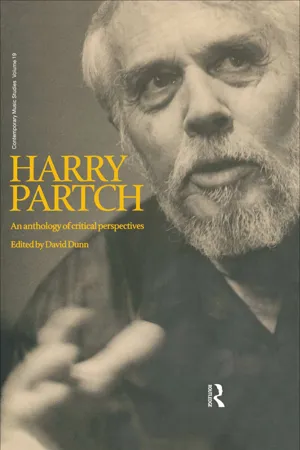
This anthology of writings about the American experimental composer Harry Partch is the most comprehensive collection of commentaries about the composer and his work ever assembled. Eleven major figures of contemporary music voice their views on Partch (1901-1974) and his radical contributions to twentieth-century music. These include composers and theorists who worked closely with him and important comments from his contemporaries and musical inheritors.
Information
Part I
SOUND–MAGIC
1
THE RHYTHMIC MOTIVATIONS OF CASTOR AND POLLUX AND EVEN WILD HORSES
Harry Partch
“Do you write classical or popular?” This is a frequent question, when I say I am a composer. We can be amused by the oversimplification, yet it indicates—among simple people—a profound feeling of a basic difference. Yes, a dichotomy—and in my opinion an annoyingly unhealthy one too. The generally unspoken contempt of the one for the other is palpable, even though one may hear: “Some of my best friends are jazz musicians,” or “Ditto-ditto-ditto—play in the symphony.”
When I answer the simple question with a stumbling “Neither, I write my own music,” I directly convey my status as a rebel, but also indirectly admit that I am groping around for something human to hang onto. I don’t like to be alone either. Spiritually—that is, by the standard of serious probing into the history and esthetics of music, and also by the standard of belief which goes its way with little hope or expectation of financial reward—I belong to the “classicals.” Yet by the touchstone of human needs of this age I find myself looking upon the “populars” across the gully with frank admiration. O, I am critical—of technique of composition, performance, and concept. I can single out, almost never, a single composition or performance that I would like to hold onto for the rest of my life, in the way that I like to hold onto a certain Brahms trio. Nevertheless, the essence of the sum total adds up to strength.
What is the difference? The “classicals” carry on the tradition—if not the spirit—of musical insight, of a profound and subtle nature. The moods, the messages, run the various gamuts of intellect and emotion. The trouble with this is that the whole profession tends to become rarefied, to become something only for those in the know. And when the cognoscenti constitute the general staff of a culture, as they do in serious music in this country, it is time for those who think for themselves to start a revolution, or get out.
Let’s talk about the disease itself. The disease is a loss of contact with this time and this place. The preoccupation with musical Europe of preceding ages by the “classicals” effectively blinds them to anything so mundane as this time and place. And in describing the situation in these terms it becomes fairly easy to highlight the differences between the two cultures, co-existing on two sides of a chasm.
By my own definition of the “classical” attitude, it would seem that this side of the chasm has everything, yet there is at least one quality that is singularly lacking—a quality which spontaneously gains acceptance because it fills a need of this time and place, and it will be profitable to leave the subject of the degradation of values by the industrial era to the political economists and the social scientists, at least for the present. Let us be realists, yes—even optimists, in that we must and will proceed with what we have—a situation that exists, rather than lapse into an enchanted dream about a world where music critics get salaries paid to them for writing sense.
I spoke of one singular quality the “populars” have (if I seem to confound “popular,” “Dixieland,” “jazz,” “progressive jazz,” it is because of the recognition—in my simple mind—of the fact that they are all on the same side of the gully). I do not refer to the limited harmonies they use, which are infinitely boring, nor to the average subject-matter—God forbid! nor to the delivery of words, which is often fresh, often natural, often human, even in moans, nor even to the instrumentation and individual performance on instruments, which is frequently exciting. For the particular purpose of the point I am making, and of the motivations behind Castor and Pollux and Even Wild Horses I refer to the potentialities of its rhythms, and its only half-conscious attitude towards its rhythms.
One is attracted to what stimulates his imagination, his spirit of adventure, his inherent creative desire—something we all have in common. As I have said—the harmonies suggest no possibility for development, the themes seldom, and the factor of the delivery of words in Even Wild Horses (Castor and Pollux involves no text) is a minor one. The rhythmic practices of the “populars” are the crux. After I have sat through a couple of hours with a good band in a night club, these are a source of both fascination and annoyance. Fascination because the music tends to fulfill a basic need—of both the naive and the sophisticated; annoyance because it goes endlessly on its way, with a strict, limited bong-bong-bong, almost always without retard or acceleration, almost always without subtle nuance or elaboration (except within the framework of that steady bong-bong), and almost always with the tawdriest kind of melodic utterance, however intriguing the instrumentation and delivery may be.
We can analyze these factors further. The steady, undeviating beat is a feature of all or nearly all primitive musical cultures. It sometimes proceeds for hours, to the point of stupid hypnosis—and stupid is to my mind the adjective. Yet within the frame of a limited objective, perhaps even this—this that annoys my susceptibilities so greatly—is one of the sources of the strength I seek! I am at least willing, in Castor and Pollux, so to postulate. Further, with “classical” music in mind, the matter of accents within the timed bong-bong is a different factor. In a sense, the flinging of every tone into the air in a time relation to another tone flung into the air is an accent. Some are stronger than others, and, when the percussive department is considered, the comparison between the strong and the weak (not called accents at all) is very striking.
A percussive sound is one in which the tonal envelope is initially wide, a sudden impact, which quickly—or slowly—diminishes, and, obviously, the rhythmic character of popular music is primarily determined by its percussion—only secondarily by its various winds (unless they are used in a percussive manner).
The expectation of a regular (or implied) beat in nearly all “classical” music, old or contemporary, frequently becomes, in “popular” music, an expectation of an accent only halfway through the beat, or one-third or two-thirds through the beat, or one-fourth or three-fourths, or even two-fifths or three-fifths through the beat—this last not notated but strongly felt. Much of the time these fractional “accents” are part of a running pattern—not always accented. This essay is no primer of the African musical influence, but it must contain a simple statement of African musical character, and at least mention in passing that of the “inferior” peoples of Europe, particularly the gypsies. That the African sense of rhythmic subtlety has degenerated, in the course of its evolution from tribal ceremony to Cuban ritual to Hollywood night club, requires no laboring, it seems to me. Its history is of little present concern to me, because I see in its developed forms—rumba, conga, samba—seeds for stimulating expansion and strength. And I like to build at least somewhat on the cognition of those around me. Even those who don’t like rumbas, congas, sambas, have this cognition; they can’t avoid it. This, then, becomes the rhythmic motivation behind Even Wild Horses. I will put back, if I can, the nuance and subtlety that the trans-atlantic crossing and two or three centuries have dissipated. Yes, and more, too—the insight and profundity of our European tradition in “classical” music.
I realize that I am not the first to undertake this kind of hybrid realization—or revitalization. Again, I am uninterested in history. Right here I am only concerned with this effort, to bring the attitudes I admire—the serious “classical” attitudes, both in music and dance (I call both Castor and Pollux and Even Wild Horses dance music)—into some rapport with an obvious need of this time and place, with what is to my mind admirable and strong. Yes, it has been done before, but it has never been done in a scale different from that used in popular music, nor with a strong and varied percussion department of new instruments, not one of which is to be found in a night club, and—frankly—more like those on the banks of the Congo (or in a Balinese temple) than on the Harlem River.
Because I use a 43-tone-to-the-octave scale, and because I use new instruments, which I myself have built, the sounds and harmonies of the two dance compositions under discussion are—I think—uniquely my own. Only the rhythms suggest—I repeat, suggest—some recognition of present-day musical experience. I imagine that any dogmatic drummer who is a technical master of rumba, conga, and samba, would like to make me the central figure of an auto-da-fé, with my own Bass Marimba supplying the faggots, for my effrontery in using these names for this music.
So be it. Having efficiently antagonized “classical” musicians for thirty years, why should I leave undemolished the other possible bridges leading out of my lonely isolation? Still, I really do not expect this result; I wish that most “seriously” trained musicians had the open-mindedness toward new techniques that I have frequently found in jazz musicians.
But to get back to the first of the rhythmic elements, the one I questioningly admire, the steady—or steadily implied—bong-bong-bong. In Castor and Pollux, I preserved this steady beat for 16 minutes with the intention of making it sufficiently varied and interesting in subsidiary rhythm and beat (it is in alternate measures of 4 and 5 beats, and 3 and 4 beats), and by melodic and harmonic elaboration and contrapuntal accumulation, that it would not only be bearable but—if my postulate is correct—give it a strength it would not otherwise possess. Castor and Pollux is entirely percussive—even plucked strings are essentially so, although the Kithara tone dies slowly—and Even Wild Horses is mostly percussive; the only singing tones are by the Adapted Viola and Chromelodeon. Even the voice in musical speech should be mostly percussive.
In order to effect the kind of sum total of the parts—rhythmic and tonal—that I envisioned—enauralized—for Castor and Pollux, it was necessary to repeat phrases frequently, which in the playing of the pairs of instruments may seem musically pointless. Yet this helps in gaining familiarity with the themes, and on each second hearing—in the sum total—the juxtapositions cause each single repetition to be heard under entirely different musical conditions (the steady beat excepted). The work is constituted, in a sense, of a series of coincidences, of carefully calculated, musical “do...
Table of contents
- Cover
- Half Title
- Series Page
- Title Page
- Copyright Page
- Table of Contents
- Introduction to the Series
- Acknowledgments
- List of Plates
- Preface
- Introduction: Reflections, Memories and Other Voices
- Part One: Sound–Magic
- Part Two: Visual Beauty
- Part Three: Experience–Ritual
- Notes on Contributors
- Index
- Contents of the accompanying CD
Trusted by 375,005 students
Access to over 1.5 million titles for a fair monthly price.
Study more efficiently using our study tools.
Frequently asked questions
Yes, you can cancel anytime from the Subscription tab in your account settings on the Perlego website. Your subscription will stay active until the end of your current billing period. Learn how to cancel your subscription
No, books cannot be downloaded as external files, such as PDFs, for use outside of Perlego. However, you can download books within the Perlego app for offline reading on mobile or tablet. Learn how to download books offline
We are an online textbook subscription service, where you can get access to an entire online library for less than the price of a single book per month. With over 1.5 million books across 990+ topics, we’ve got you covered! Learn about our mission
Look out for the read-aloud symbol on your next book to see if you can listen to it. The read-aloud tool reads text aloud for you, highlighting the text as it is being read. You can pause it, speed it up and slow it down. Learn more about Read Aloud
Yes! You can use the Perlego app on both iOS and Android devices to read anytime, anywhere — even offline. Perfect for commutes or when you’re on the go.
Please note we cannot support devices running on iOS 13 and Android 7 or earlier. Learn more about using the app
Please note we cannot support devices running on iOS 13 and Android 7 or earlier. Learn more about using the app
Yes, you can access Harry Partch by David Dunn in PDF and/or ePUB format, as well as other popular books in Medios de comunicación y artes escénicas & Música. We have over 1.5 million books available in our catalogue for you to explore.