- 230 pages
- English
- ePUB (mobile friendly)
- Available on iOS & Android
eBook - ePub
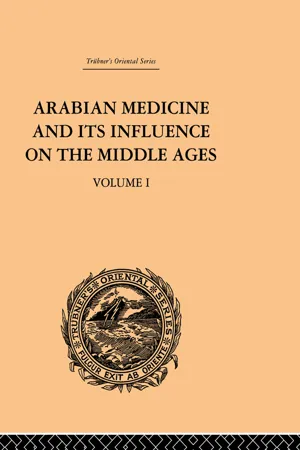
Arabian Medicine and its Influence on the Middle Ages: Volume I
About this book
This is Volume II of six in the Arabic History and Culture collection. Originally published in 1926, this text is volume one of Arabian Medicine and its Influence on the Middle Ages and attempts to place before the reader the origin and development of Arabian Medicine and its subsequent cultivation among the Arabistae of the Latin west. The latter half of this volume is on Mediaeval Medicine, which is but a modification of Arabian Medicine as understood by the scholastics who based their systems on what are shown to be indifferent Latin versions of the Arabic writings of Islam, which in turn were versions of ~he Syriac translations of the Greek texts.
Information
Chapter I
Greek Medicine in its Relation to the Arabians
The ultimate destinies of Greek Medicine both East and West, will be discussed in subsequent chapters. The Medical Science of the Ancient Greeks, which gives both Modem European Medicine and that of the Mediaeval Arabians its best ideals, underwent a metamorphosis at the hands of the Syriac and Arabic scholars of the East, and in order to arrive at a correct estimation of Arabian Medicine and its influence on the Latin West, it will be necessary briefly to review Greek Medicine. Arabian Medicine was really Greek Medicine, modified by the dictates of religion, climate, and racial characteristics, and rehabilitated in Arabic script. As will be pointed out later, Arabian Medicine acquired much from the East, for Indian professors of medicine were resident at Baghdad during the reign of the Caliph Hārūnu’r-Rashīd; but the ultimate foundations of the medicine of the Arabic scholars of Islam were the medical writings of the “classical period”, and those Greek authors whose works were eventually translated into Arabic during the “Golden Age” of Arabian Culture 750– 850) may now be discussed.
Greek Medicine, as indicated by the MSS, extant, begins in the “Age of Pericles” (561–430), and its dominating figure is HIPPOCRATES (c. 460–360), Hewas born at Cos, and was a member of the family of Asclepiadæ. Both Plato (Protagoras, p. 283; Phædrus, p, 211) and Aristotle refer to him as “the eminent medical authority”, His works need not be considered in detail here. A man of the highest integrity and purest morality, we expect and find that the grand characteristic of Hippocratic Medicine, despite the calmunies of Andreas, was the high conception of the status and duties of the physician. This characteristic is beautifully illustrated in his attitude on “professional secrecy” in the celebrated “Oath of Hippocrates”, which rendered into English, reads as follows: “Whatever things I shall see or hear in the course of practice or apart from practice relating to human life, which are not fitting to be proclaimed outside the house, I shall keep to myself, considering such things to be not matters for conversation.” (ἄ δ’ ἄν ἐν θεραπείῃ ἢἴδω ἢ ἀκούσω, ἢ καὶ ἂνευ θεραπείης κατὰ βίον ἀνθρώπων ἄμὴχρή ποτε ἐκκαλέεσθαι ἔξω διγήσομαι ἄρρητα ἠγεύμενος εἶναι τὰ τσιαῦα) The next grand trait was the skill and balance with which the medical tools available during his day were used: in this we recognize the true Greek σωϕρoσὐνη. The next grand characteristic of Hippocratic medicine was that he advocated clinical observation by which alone success in medicine was possible. These points in the Hippocratic system of medicine led to all that was best, both in Arabian, Mediaeval, and Modern Medicine.
According to the Hippocratic System, it must be noted that theory occupied a not unimportant place, for the humoral theory of disease, which has dominated medical thought ever since his day, is said to have originated with Hippocrates: it is doubtful whether this doctrine was fully expounded by Hippocrates, though it is regarded as belonging to his system. The ‘humoral theory’, which was developed some five hundred years later by Galen, held that the body contains four humors, i.e. blood, phlegm, and black and yellow bile, and that disease was due to an irregular or improper distribution of these.
The part played by the humors in acute diseases was, that in the first stage they were “crude”, in the second they passed through a process of digestion or “coction” (a theory widely adopted in the Arabian School), and in the third they were expelled from the body by “resolution” or “crisis The practitioner was to foresee the symptoms with precision.
That the last Hippocratic doctrine was deeply impressed on Arabian Medicine is seen in the Liber Continens of Rhazes, in which he gives a prognosis with much precision. Rhazes writes: “I thereupon informed him that the feverish symptoms would not recur, and so it was.” (This work is in Arabic manuscript in the Bodleian Library. Marsh, 156 ff., 237, 239b–245b.
Of the eighty-seven treatises that constitute what came to be termed the “Hippocratic Collection”, only a portion of which can be accepted as genuine works of Hippocrates (see Adam’s “Genuine Works of Hippocrates”, Sydenham Society, i, 27, 28), we may mention a few: Rhazes (of the Eastern Caliphate) made use of the following:––“De humoribus,” “De diæta,” and “De morbis”,
The “Hippocratic Collection” was largely translated into Arabic between the years A.D. 750–850. The following is an approximately complete list of the Hippocratic works translated into Arabic: De aëre, aquis, et locis; Prognostioon; De diæta (regimme) aσutorum; De morbis popularibus, I-VII; Aphorismi; De natura hominis; De octimestri partu; De genitura; De septimanis; Præceptiones; Epistula ad Thessalum; Testamentum; Prognostica (De indiciis mortis); De pustulis et aposteniatibus significantibus mortem; De situ regionum et dispositione anni temporum; Opera varia; and Excerpta varia.
Hippocrates was known as Ibukrat or Bukrat in Arabian Literature.
The next great figure among the Greeks, that towered prominently in Arabian Medicine, was ARISTOTLE (384–322 B.C.). of Stagira. A pupil of Plato for about twenty years, he diverged from his master in the realms of metaphysics. Of his early writings but a fragment remain. The material available points to Aristotle not having published his matured philosophical system during his own lifetime.
Though not a physician, he gave to both Arabian and European Medicine the beginnings of biology and the use of ‘formal logic’ as an instrument of precision: he foreshadowed the doctrine of evolution in his remarks on racial characteristics in their relation to climate.
A large number of works have been ascribed to him, but though some of them were spurious, we may accept the following as genuine. We will omit those that are not of direct interest to us. The following list is that of extant works which embody the System of Aristotle, which made a deep impression on Arabian Medicine and Philosophy: Categoriæ; De interpretatione; Analytica Priora; Analytica Posteriora; Topica; Sophistici Elenchi; the first five of these works on Logic were later grouped together as the Organon. His works on natural science include the following: Physica Auscultatio; De cælo; De generatione et corruptione; De anima; De sensu et sensili; De memoria et reminiscentia; De insomniis; De respiratione; De spiritu; Historia animalium; De partibus aninalium; De animalium generatione; and a work on physiognomy and the sympathy of body and soul, entitled Φvσιoγvωμovικά (Physiognomonica), which, however, is not considered a genuine work of Aristotle.
In the East, Aristotle was translated into Syriac by Sergius of Ras al-‘Ayn (d. 536), and in the eighth and ninth centuries Johannitius, who was also known as Ḥunayn ibn Isḥāq (d, 873), and his staff of translators, carried over, among the principal medical and philosophical writings of the Greeks, the works of Aristotle from the language of the Syrians into Arabic, the language of learned Islam.
The influence of Aristotle on the Arabians, or to be precise, the small group of Arabic speaking philosophers in the Empire of Islam, who were constantly under the suspicion of the masses of the Mahomedans, is nothing more or less than a continuation of the history of Aristotelianism. Prior to the rise of the Arabians as a Power, Aristotelianism had passed through the monastic schools of Asia Minor and had become tinged with the Eastern Platonism that prevailed there up to the time of Mahomet: with the efflorescence of Islam as an intellectual power, it came in contact with the few but intrepid Arabian thinkers. Aristotle represented to the Arabic scholars a summary of Greek Philosophy, and it is owing to the Arabians that Aristotle assumed a paramount place in the mode of thought among the physician-philosophers of Islam, and through them, among the Medical Scholastics of Europe. That Aristotle was diligently studied in England in the fourteenth century is shown by Chaucer (c. 1340–1400) in the Prologue to the Canterbury Tales, lines 293–5, which describe the leanings of a Clerk of Oxenford.
For him was lever have at his beddes heed
Twenty bokes, clad in blak or reed,
Of Aristotle and his philosophye.1
The great effect of Aristotelianism among the Arabians was the tendency to break away from orthodoxy, while closely adhering to the Arabic text of Aristotle: this latter movement culminated in the Kitab-al-Kullyyat and and Commentaries on Aristotle of Averroës (1126–98) of Cordova.
After the destruction of Corinth in 146 B.C., Greek Medicine migrated to Rome where beyond the magnificent sanitation of the architect Vitruvius, Græco–Roman Medicine presents us with a period of stagnation. The physicians of Rome in the main came from the East and Alexandria. Alexandrian Medicine, of which our principal source is Celsus,2 more than compensated for the lack of progress in the West, by the development of its anatomical school in the five centuries that intervened between Hippocrates and Galen. With the name of CLAUDIUS GALEN (131–210), the period of “practical anatomy” of ancient times conies to a close. Galen, who studied at Alexandria, migrated to Rome, where he became physician to the Emperor Commodus, and acquired a great reputation. His anatomical knowledge which came to represent to the Arabians a summary of Greek Medicine, must be regarded as the accumulated anatomical knowledge up to his time.3 Numerous works on anatomy have been ascribed to him, but owing to the fact that he studied under several teachers, the written works of Galen are probably not all based on personal research. Of Galen’s works the following were translated into Arabic: Ars Medica; De elementis secundum Hippocratem; De temperamentis; De facultatibus naturalibus;4 De Anatomicis administrationibus; De venarum arteriarumque dissectione; De nervorum dissectione; De iuvamentis membrorum libri X; De bono habitu; De atra bile; De optima corporis nostri constitulione; De sanitate tuenda libri VI; De alimentorum facultatibus libri III; De dijferentiis morborum; De morborum causis; De symptomatum differentiis; De symptomatum causis libri III; De differentiis febrium libri II; De marcore; De tumoribus prætor naturam; De inæquali intemperie; De locis affectis libri VI; De pulsuum differentiis libri IV; De dignoscendis pulsibus libri IV; De causis pulsuum libri IV; De præsagitione ex pulsibus libri IV; De crisibus libri III; De diebus decretoriis libri III; Methodi medendi libri XIV; De Glauconem de medendi methodo libri II; Puero epileptico consilium; De simplicium medicamentorum temperamentis facultatibus libri XI; De compositione medicamentorum secundum locos libri X; De compositione medicamentorum per genera libri VII; De antidotis libri II; De theriaca ad Pisonem liber; Introductio sive medicus; Galeni in Hippoσratis de natura hominis lib. commmentarii II; In Hippocratis librum de acutorum victu commentarii IV; In Hippocratis epidemiarum librum primum commentarii VI; Hippocratis aphorismi et Galeni in eos commentarii VII; In Hippocratis prognosticum commentarii III; De musculorum dissectione; Præsagitio omnino vera expertaque; De anatomia; De arte medica; De urinis; Remedia; De clysteribus et colica; Diagnostica; De cura icteri; De medicamentis expertis; In Hippocratem De septenario numero; De morte subita; De secretis feminarum et virorum; De nominibus medicinalibus; De prohibenda sepultura; Laterculi librorum Galeni antiqui; and Opera Varia.5
From the preceding it will be seen that his works were an encyclopædia of the medical teaching not only of the anatomical school of Alexandria, but of Greek Medicine as a whole.
Galen elab...
Table of contents
- Cover
- Half Title
- Title Page
- Copyright Page
- Original Title Page
- Table of Contents
- Preface by the Author
- Prefatory Note
- Chapter I. Greek Medicine in its Relation to the Arabians
- Chapter II. Arabic (Medical) MSS.
- Chapter III. The Historiography of Islam, with special reference to the development of Arabic Medical and Philosophical Literature
- Chapter IV. Arabic Medical Writers and their Works (The Eastern Caliphate)
- Chapter V. Arabic Medical Writers and their Works (The Western Caliphate)
- Chapter VI. The Age of Early Arabian Rumours in the West
- Chapter VII. The Tide of Arabism in the Intellectual Currents of Mediaeval Europe
- Chapter VIII. The Latin Translators and the College at Toledo
- Chapter IX. The Transmutors and the Arabist Dominancy in Latin Europe
- Chapter X. The Experimenters and the Effect of their Work on Arabist Tradition in Europe
- Chapter XI. Hellenism and Arabism in the Fifteenth and Sixteenth Centuries
- Chapter XII. A Review of European Literture and the Medical Curricula of European Universities in the Later Middle Ages
- Concluding Paragraph
Trusted by 375,005 students
Access to over 1.5 million titles for a fair monthly price.
Study more efficiently using our study tools.
Frequently asked questions
Yes, you can cancel anytime from the Subscription tab in your account settings on the Perlego website. Your subscription will stay active until the end of your current billing period. Learn how to cancel your subscription
No, books cannot be downloaded as external files, such as PDFs, for use outside of Perlego. However, you can download books within the Perlego app for offline reading on mobile or tablet. Learn how to download books offline
Perlego offers two plans: Essential and Complete
- Essential is ideal for learners and professionals who enjoy exploring a wide range of subjects. Access the Essential Library with 800,000+ trusted titles and best-sellers across business, personal growth, and the humanities. Includes unlimited reading time and Standard Read Aloud voice.
- Complete: Perfect for advanced learners and researchers needing full, unrestricted access. Unlock 1.5M+ books across hundreds of subjects, including academic and specialized titles. The Complete Plan also includes advanced features like Premium Read Aloud and Research Assistant.
We are an online textbook subscription service, where you can get access to an entire online library for less than the price of a single book per month. With over 1.5 million books across 990+ topics, we’ve got you covered! Learn about our mission
Look out for the read-aloud symbol on your next book to see if you can listen to it. The read-aloud tool reads text aloud for you, highlighting the text as it is being read. You can pause it, speed it up and slow it down. Learn more about Read Aloud
Yes! You can use the Perlego app on both iOS and Android devices to read anytime, anywhere — even offline. Perfect for commutes or when you’re on the go.
Please note we cannot support devices running on iOS 13 and Android 7 or earlier. Learn more about using the app
Please note we cannot support devices running on iOS 13 and Android 7 or earlier. Learn more about using the app
Yes, you can access Arabian Medicine and its Influence on the Middle Ages: Volume I by Donald Campbell in PDF and/or ePUB format, as well as other popular books in Social Sciences & Ethnic Studies. We have over 1.5 million books available in our catalogue for you to explore.