eBook - ePub
Everyday Forms of Peasant Res Cb
Everyday Forms Res Asia
- 156 pages
- English
- ePUB (mobile friendly)
- Available on iOS & Android
eBook - ePub
Everyday Forms of Peasant Res Cb
Everyday Forms Res Asia
About this book
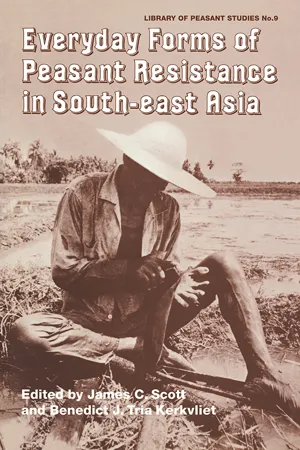
First published in 1987. This is volume 9 of the libray of peasant studies series. The contributors focus on a vast and relatively unexplored middle-ground of peasant politics between passivity and open, collective defiance. The general rubric for these phenomena is 'everyday resistance' - a term that is self-consciously homely.
Trusted by 375,005 students
Access to over 1.5 million titles for a fair monthly price.
Study more efficiently using our study tools.
Information
Everyday Forms of Peasant Resistance
I. The Unwritten History of Resistance
The argument which follows originated in a growing dissatisfaction with much of the recent work – my own as well as that of others – on the subject of peasant rebellion and revolution. It is only too apparent that the inordinate attention to large-scale peasant insurrection was, in North America at least, stimulated by the Vietnam war and something of a left-wing academic romance with wars of national liberation. In this case interest and source material were mutually reinforcing. For the historical and archival records were richest at precisely those moments when the peasantry came to pose a threat to the state and to the existing international order.1 At other times, which is to say most of the time, the peasantry appeared in the historical record not so much as historical actors but as more or less anonymous contributors to statistics on conscription, taxes, labour migration, land holdings, and crops production.
The fact is that, for all their importance when they do occur, peasant rebellions, let alone peasant ‘revolutions’, are few and far between. Not only are the circumstances which favour large-scale peasant uprising comparatively rare, but when they do appear, the revolts which develop are nearly always crushed unceremoniously. To be sure, even a failed revolt may achieve something: a few concessions from the state or landlords, a brief respite from new and painful relations of production2 and, not least, a memory of resistance and courage that may lie in wait for the future. Such gains, however, are uncertain, while the carnage, the repression, and the demoralization of defeat are all too certain and real.
In a larger sense one might say that the historiography of class struggle has been systematically distorted in a state-centric direction. The events that claim attention are the events to which the state and ruling classes accord most attention in their archives. Thus, for example, a small and futile rebellion claims an attention all out of proportion to its impact on class relations while unheralded acts of flight, sabotage, theft which may have far greater impact are rarely noticed. The small rebellion may have a symbolic importance for its violence and for its revolutionary aims but for most subordinate classes historically such rare episodes were of less moment than the quiet, unremitting guerrilla warfare that took place day-in and day-out. It is perhaps only in the study of slavery that such forms of resistance are given due attention, and that is clearly because there have been relatively few slave rebellions (in the antebellum South at any rate) to whet the historian’s appetite. It is also worth recalling as well that even at those extraordinary historical moments when a peasant-backed revolution actually succeeds in taking power, the results are, at the very best, a mixed blessing for the peasantry. Whatever else the revolution may achieve, it almost always creates a more coercive and hegemonic state apparatus – one that is often able to batten itself on the rural population like no other before it. All too frequently the peasantry finds itself in the ironic position of having helped to power a ruling group whose plans for industrialisation, taxation, and collectivisation are very much at odds with the goals for which peasants had imagined they were fighting.3
A history of the peasantry which only focused on uprisings would be much like a history of factory workers devoted entirely to major strikes and riots. Important and diagnostic though these exceptional events may be, they tell us little about the most durable arena of class conflict and resistance: the vital, day-to-day struggle on the factory floor over the pace of work, over leisure, wages, autonomy, privileges, and respect. For workers operating, by definition, at a structural disadvantage and subject to repression, such forms of quotidian struggle may be the only option available. Resistance of this kind does not throw up the manifestos, demonstrations, and pitched battles that normally compel attention, but vital territory is being won and lost here too. For the peasantry, scattered across the countryside and facing even more imposing obstacles to organised, collective action, everyday forms of resistance would seem particularly important.
For all these reasons it occurred to me that the emphasis on peasant rebellion was misplaced. Instead, it seemed far more germane to understand what we might call everyday forms of peasant resistance – the prosaic but constant struggle between the peasantry and those who seek to extract labour, food, taxes, rents, and interest from them. Most of the forms this struggle takes stop well short of collective outright defiance. Here I have in mind the ordinary weapons of relatively powerless groups: footdragging, dissimulation, false-compliance, pilfering, feigned ignorance, slander, arson, sabotage, and so forth. These Brechtian forms of class struggle have certain features in common. They require little or no co-ordination or planning; they often represent a form of individual self-help; and they typically avoid any direct symbolic confrontation with authority or with elite norms. To understand these commonplace forms of resistance is to understand what much of the peasantry does ‘between revolts’ to defend its interests as best it can.
It would be a grave mistake, as it is with peasant rebellions, overly to romanticise these ‘weapons of the weak’. They are unlikely to do more than marginally affect the various forms of exploitation which peasants confront. Furthermore, the peasantry has no monopoly on these weapons, as anyone who has observed officials and landlords resisting and disrupting state policies which are to their disadvantage can easily attest.
On the other hand, such Brechtian (or Schweikian) modes of resistance are not trivial. Desertion and evasion of conscription and of corvée labour have undoubtedly limited the imperial aspirations of many a monarch in South-east Asia4 or, for that matter, in Europe. The process, and its potential impact is nowhere better captured than in R.C. Cobb’s account of draft resistance and desertion in post-revolutionary France and under the early Empire.
From the year V to the year VII, there are increasingly frequent reports, from a variety of Departments … of every conscript from a given canton having returned home and living there unmolested. Better still, many of them did not return home; they had never left it in the first place … In the year VII too the severed fingers of right hands – the commonest form of self-mutilation – begin to witness statistically to the strength of what might be described as a vast movement of collective complicity, involving the family, the parish, the local authorities, whole cantons.
Even the Empire, with a vastly more numerous and reliable rural police, did not succeed in more than
temporarily slowing down the speed of the hemorrhage which … from 1812, once more reached catastrophic proportions. There could have been no more eloquent referendum on the universal unpopularity of an oppressive regime; and there is no more encouraging spectacle for a historian than a people that has decided it will no longer fight and that, without fuss, returns home … the common people, at least in this respect, had their fair share in bringing down France’s most appalling regime.5
In a similar fashion, flight and evasion of taxes have classically curbed the ambition and reach of Third World states – whether pre-colonial, colonial, or independent. Small wonder that such a large share of the tax receipts of Third World states is collected in the form of levies on imports and exports; the pattern is, in no small measure, a tribute to the tax resistance capacities of their subjects. Even a casual reading of the literature on rural ‘development’ yields a rich harvest of unpopular government schemes and programmes which have been nibbled to extinction by the passive resistance of the peasantry.6 On some occasions this resistance has become active, even violent. More often, however, it takes the form of passive non-compliance, subtle sabotage, evasion and deception. The persistent efforts of the colonial government in Malaya to discourage the peasantry from growing rubber which would compete with the plantation sector for land and markets is a case in point.7 Various restrictions schemes and land use laws were tried from 1922 until 1928 and again in the 1930s with only modest results because of massive peasant resistance. The efforts of peasants in self-styled socialist states to prevent and then to mitigate, or even undo, unpopular forms of collective agriculture represent a striking example of the defensive techniques available to a beleagured peasantry. Again the struggle is marked less by massive and defiant confrontations than by a quiet evasion that is equally massive and often far more effective.
The style of resistance in question is perhaps best described by contrasting paired forms of resistance, each aimed at much the same goal, the first of which is ‘everyday’ resistance in our meaning and the second the more open, direct confrontations that typically dominate the study of resistance. In one sphere lies the quiet, piecemeal process by which peasant ‘squatters’ have often encroached on plantation and state forest lands; in the other a public invasion of property that openly challenges property relations. In one sphere lies a process of gradual military desertion; in the other an open mutiny aiming at eliminating or replacing officers. In one sphere lies the pilfering of public or private grain stores; in the other an open attack on markets or granaries aiming at the redistribution of the food supply.
Such techniques of resistance are well adapted to the particular characteristics of the peasantry. Being a diverse class of ‘low classness’, geographically distributed, often lacking the discipline and leadership that would encourage opposition of a more organised sort, the peasantry is best suited to extended guerrilla-style campaigns of attrition which require little or no co-ordination. Their individual acts of footdragging and evasion, reinforced often by a venerable popular culture of resistance, and multiplied many-thousand fold may, in the end, make an utter shambles of the policies dreamed up by their would-be superiors in the capital. The state may respond in a variety of ways. Policies may be recast in line with more realistic expectations. They may be retained but reinforced with positive incentives aimed at encouraging voluntary compliance. And, of course, the state may simply choose to employ more coercion. Whatever the response, we must not miss the fact that the action of the peasantry has thus changed or narrowed the policy options available. It is in this fashion, and not through revolts, let alone legal political pressure, that the peasantry has classically made its political presence felt. Thus any history or theory of peasant politics which attempts to do justice to the peasantry as an historical actor must necessarily come to grips with what I have chosen to call ‘everyday forms of resistance’. For this reason alone it is important both to document and to bring some conceptual order to this seeming welter of human activity.
Everyday forms of resistance make no headlines. Just as millions of anthozoan polyps create, willy-nilly, a coral reef, so do thousands upon thousands of individual acts of insubordination and evasion create a political or economic barrier reef of their own. There is rarely any dramatic confrontation, any moment that is particularly newsworthy. And whenever, to pursue the simile, the ship of state runs aground on such a reef, attention is typically directed to the shipwreck itself and not to the vast aggregation of petty acts which made it possible. It is very rare that the perpetrators of these petty acts seek to call attention to themselves. Their safety lies in their anonymity. It is also extremely rare that officials of the state wish to publicise the insubordination.8 To do so would be to admit that their policy is unpopular and, above all, to expose the tenuousness of their authority in the countryside – neither of which the sovereign state finds in its interest.9 The nature of the acts themselves and the self-interested muteness of the antagonists thus conspire to create a kind of complicitous silence which all but expunges everyday forms of resistance from the historical record.
History and social science, written by an intelligentsia using written records which are also created largely by literate officials, is simply not well equipped to uncover the silent and anonymous forms of class struggle which typify the peasantry.10 In this case, its practitioners implicitly join the conspiracy of the participants who are themselves, as it were, sworn to secrecy. Collectively, this unlikely cabal contributes to a stereotype of the peasantry, enshrined in both literature and in history, as a class which alternates between long periods of abject passivity and brief, violent, and futile explosions of rage.
He had centuries of fear and submission behind him, his shoulders had become hardened to blows, his soul so crushed that he did not recognise his own degradation. You could beat him and starve him and rob him of everything, year in, year out, before he would abandon his caution and stupidity, his mind filled with all sorts of muddled ideas which he could not properly understand; and this went on until a culmination of injustice and suffering flung him at his master’s throat like some infuriated domestic animal who had been subjected to too many thrashings [Zola, 1980: 91].
There is a grain of truth in Zola’s view, but only a grain. It is true that the ‘onstage’ behaviour of peasants during times of quiescence yields a picture of submission, fear, and caution. By contrast, peasant insurrections seem like visceral reactions of blind fury. What is missing from the account of ‘normal’ passivity is the slow, grinding, quiet struggle over rents, crops, labour, and taxes in which submission and stupidity is often no more than a pose – a necessary tactic. What is missing from the picture of the periodic ‘explosions’ is the underlying vision of justice which informs them and their specific goals and targets which are often quite rational indeed. The ‘explosions’ themselves are frequently a sign that the ‘normal’ and largely covert forms of class struggle are failing or have reached a crisis point. Such declarations of open war, with their mortal risks, normally come only after a protracted struggle on different terrain.
II. Two Diagnositc Examples
In the interest of pursuing the analytical issues raised by everyday forms of resistance, I offer a brief description of two examples, among many encountered in the course of field research in a Malaysian rice-farming village from 1978 to 1980. One involved an attempt by women transplanting groups to boycott landowners who had first hired combine-harvesters to replace hand labour. The second was a pattern of anonymous thefts of harvested paddy which appeared to be increasing in frequency. Each of these two activities had the characteristic features of everyday resistance. Neither the boycott, as we shall see, nor the thefts presented any public or symbolic challenge to the legitimacy of the production and property arrangements being resisted. Neither required any formal organisation and, in the case of the thefts of paddy, most of the activity was carried on individually at night. Perhaps the most important characteristic of these and many other such activities in the village is that, strictly speaking, they had no authors who would publicly take responsibility for them.
Background
Before examining the two proposed examples of resistance more closely, a brief sketch of the village in question and its recent economic history should help to situate this account. The village, which we shall call Sedaka, is a community of some 74 households (352 people) located on the Muda Plain in the state of Kedah, Malaysia. The Muda region has been, since the fo...
Table of contents
- Cover
- Half Title
- Title Page
- Copyright Page
- Table of Contents
- Introduction
- Everyday Forms of Peasant Resistance
- Patrolling the Middle-Ground: Methodological Perspectives on ‘Everyday Peasant Resistance’
- Everyday Resistance, Socialist Revolution and Rural Development: The Vietnamese Case
- From Footdragging to Flight: The Evasive History of Peasant Avoidance Protest in South and South-east Asia
- Tenants’ Non-Violent Resistance to Landowner Claims in a Central Luzon Village
- Everyday Resistance to Injustice in a Philippine Village
- Plantation Politics and Protest on Sumatra’s Coast
- Seminar: Everyday Forms of Peasant Resistance (A Poem)
Frequently asked questions
Yes, you can cancel anytime from the Subscription tab in your account settings on the Perlego website. Your subscription will stay active until the end of your current billing period. Learn how to cancel your subscription
No, books cannot be downloaded as external files, such as PDFs, for use outside of Perlego. However, you can download books within the Perlego app for offline reading on mobile or tablet. Learn how to download books offline
Perlego offers two plans: Essential and Complete
- Essential is ideal for learners and professionals who enjoy exploring a wide range of subjects. Access the Essential Library with 800,000+ trusted titles and best-sellers across business, personal growth, and the humanities. Includes unlimited reading time and Standard Read Aloud voice.
- Complete: Perfect for advanced learners and researchers needing full, unrestricted access. Unlock 1.5M+ books across hundreds of subjects, including academic and specialized titles. The Complete Plan also includes advanced features like Premium Read Aloud and Research Assistant.
We are an online textbook subscription service, where you can get access to an entire online library for less than the price of a single book per month. With over 1.5 million books across 990+ topics, we’ve got you covered! Learn about our mission
Look out for the read-aloud symbol on your next book to see if you can listen to it. The read-aloud tool reads text aloud for you, highlighting the text as it is being read. You can pause it, speed it up and slow it down. Learn more about Read Aloud
Yes! You can use the Perlego app on both iOS and Android devices to read anytime, anywhere — even offline. Perfect for commutes or when you’re on the go.
Please note we cannot support devices running on iOS 13 and Android 7 or earlier. Learn more about using the app
Please note we cannot support devices running on iOS 13 and Android 7 or earlier. Learn more about using the app
Yes, you can access Everyday Forms of Peasant Res Cb by James C. Scott, Benedict J. Tria Kerkvliet, James Scott,Benedict Tria Kerkvliet,James C Scott,Benedict J. Tria Kerkvliet, James C Scott, Benedict J Tria Kerkvliet in PDF and/or ePUB format, as well as other popular books in History & Military & Maritime History. We have over 1.5 million books available in our catalogue for you to explore.