- 940 pages
- English
- PDF
- Available on iOS & Android
eBook - PDF
About this book
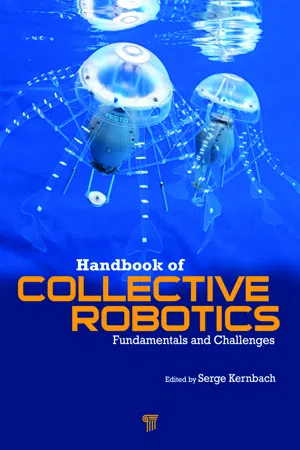
This book is devoted to mechatronic, chemical, bacteriological, biological, and hybrid systems, utilizing cooperative, networked, swarm, self-organizing, evolutionary and bio-inspired design principles and targeting underwater, ground, air, and space applications. It addresses issues such as open-ended evolution, self-replication, self-development,
Information
Table of contents
- Front Cover
- Contents
- Preface
- Chapter 1: Introduction to Collective Robotics: Reliability, Flexibility, and Scalability
- PART I: FUNDAMENTALS I. MIDDLE-SIZE AND NETWORKED SYSTEMS
- Chapter 2: The Swarm-Bot Experience: Strength and Mobility through Physical Cooperation
- Chapter 3: Architectures and Control of Networked Robotic Systems
- Chapter 4: Cooperative Robotics in Robocup Soccer is Not Just Playing a Game
- Chapter 5: Evolving Collective Control, Cooperation, and Distributed Cognition
- Chapter 6: Reliability and Fault Tolerance in Collective Robot Systems
- Chapter 7: Collective Reconfigurable Systems: Fundamentals of Self-Reconfiguration Planning
- PART II: FUNDAMENTALS II. LARGE-SCALE AND SWARM SYSTEMS
- Chapter 8: Self-Organized Robotic Systems: Large-Scale Experiments in Aggregation and Self-Assembly Using Miniature Robots
- Chapter 9: Biomimetic and Bioinspired Design of Collective Systems
- Chapter 10: Improving the Scalability of Collective Systems
- Chapter 11: Collective Foraging: Cleaning, Energy Harvesting, and Trophallaxis
- Chapter 12: Individual, Social, and Evolutionary Adaptation in Collective Systems
- Chapter 13: Replicators: From Molecules to Organisms
- PART III: CHALLENGES
- Chapter 14: Developmental Collective Robotics: Advantages and Challenges of Unbounded Self-Development
- Chapter 15: A General Methodology for the Control of Mixed Natural-Artificial Societies
- Chapter 16: Underwater Robot Swarms: Challenges and Opportunities
- Chapter 17: Aerial Collective Systems
- Chapter 18: Collective Systems in Space and for Planetary Explorations
- Chapter 19: Nanorobotics: A Perspective
- Chapter 20: Minimalistic Large-Scale Microrobotic Systems
- Chapter 21: Chemical Swarm Robots
- Chapter 22: Performing Collective Tasks with Flagellated Bacteria Acting as Natural and Hybrid Microrobots
- Bibliography
- Back Cover
Trusted by 375,005 students
Access to over 1.5 million titles for a fair monthly price.
Study more efficiently using our study tools.
Frequently asked questions
Yes, you can cancel anytime from the Subscription tab in your account settings on the Perlego website. Your subscription will stay active until the end of your current billing period. Learn how to cancel your subscription
No, books cannot be downloaded as external files, such as PDFs, for use outside of Perlego. However, you can download books within the Perlego app for offline reading on mobile or tablet. Learn how to download books offline
Perlego offers two plans: Essential and Complete
- Essential is ideal for learners and professionals who enjoy exploring a wide range of subjects. Access the Essential Library with 800,000+ trusted titles and best-sellers across business, personal growth, and the humanities. Includes unlimited reading time and Standard Read Aloud voice.
- Complete: Perfect for advanced learners and researchers needing full, unrestricted access. Unlock 1.5M+ books across hundreds of subjects, including academic and specialized titles. The Complete Plan also includes advanced features like Premium Read Aloud and Research Assistant.
We are an online textbook subscription service, where you can get access to an entire online library for less than the price of a single book per month. With over 1.5 million books across 990+ topics, we’ve got you covered! Learn about our mission
Look out for the read-aloud symbol on your next book to see if you can listen to it. The read-aloud tool reads text aloud for you, highlighting the text as it is being read. You can pause it, speed it up and slow it down. Learn more about Read Aloud
Yes! You can use the Perlego app on both iOS and Android devices to read anytime, anywhere — even offline. Perfect for commutes or when you’re on the go.
Please note we cannot support devices running on iOS 13 and Android 7 or earlier. Learn more about using the app
Please note we cannot support devices running on iOS 13 and Android 7 or earlier. Learn more about using the app
Yes, you can access Handbook of Collective Robotics by Serge Kernbach in PDF and/or ePUB format, as well as other popular books in Computer Science & Software Development. We have over 1.5 million books available in our catalogue for you to explore.