Although green innovation and technology is not new, so far very limited information is available regarding the diversified approaches for green technologies and engineering. This book highlights the challenges and opportunities, offering a roadmap for using various approaches in the most cost effective way.
The book discusses the interrelationship between a circular economy and green technologies. It presents the dimensions of green innovations and illustrates the challenges of industrialization, especially in terms of material synthesis and utilized processes. It covers the current environmental and health challenges of societies and describes the role of stakeholders in developing sustainable societies and industries.
This book provides a line of approach to core and interdisciplinary students, academicians, research scientists, and various industry personnel to present their ideas of green innovations with a common vision of sustainable development of community and industries in mind.
Features
Discusses the interrelationship between a circular economy and green technologies
Presents the dimensions of green innovations
Illustrates the challenges of industrialization, especially in terms of material synthesis and utilized processes
Covers the current environmental and health challenges of societies
Offers the identification and role of stakeholders in the sustainable development of societies and industries
1.3 Carbon Capture and Storage by Novel Composites
1.3.1 Recent Research on Composite Materials-Based CO2 Capture
1.3.2 Concrete Mortar Materials for Capturing CO2
1.3.2.1 Mechanism and Case Studies of CO2 Entrapment by Concrete Mortar Materials
1.3.3 Nanomaterials for Carbon Capture and Sequestration
1.3.4 Biochar: Novel Adsorbent for Carbon Capture
1.4 Cost Benefit Analysis of Composite Materials and C Capture
1.5 Conclusions and Future Scope
References
1.1 Introduction
The growing issue of the catastrophic effects of global warming in various regions in the world is contradictory, with the incapability of many countries to reduce the net emissions of greenhouse gases (GHGs) at the prescribed rate as committed to the Kyoto Protocol, which describes the mechanism of reducing carbon (C) emissions by decreasing the concentration of GHGs. These gases can be removed from the atmosphere by sequestrating them in several sinks. C capture or C sequestration is the process through which atmospheric carbon dioxide (CO2) is removed from the atmosphere and stored in soil or other systems, and is generally accepted as the most promising technique for climate change mitigation (Smith et al., 2008).
Soil performs a significant role in maintaining a balanced global C cycle as it is the potential source of GHGs (Jedli et al., 2017). However, soil C sequestration is a relatively slow process in order to meet the requirements of the C removal process in the atmosphere and to mitigate the problems of climate change and global warming. The large size of the soil C pool not only makes it a potential buffer against rising atmospheric CO2, but also makes it difficult to measure changes against the existing background. The main points of CO2 capture and storage include effectiveness, capacity of material to sequestrate a large quantity of CO2, stability and cost. Considering the geological sequestration technique, it sequestrates large quantities of CO2 at high cost and low economic value, and results in environmentally adverse effects on few occasions. The ocean, which is considered as the major sink for C, has been studied extensively to promote the process of C sequestration. Researchers have shown the potential to store CO2 at a depth of 3000 m in the ocean as stable hydrates (Sarv, 1999). Herzog and Adams (1999) also investigated the different forms of C that were sequestered in the ocean after direct injection in liquid state at a depth of 300 m and at a temperature of 8°C. Different types of composite materials, metal-organic framework, nanotechnology-based sponges, membranes and fibrous materials are some of the products being employed for the carbon capture process in recent times (Amutha Rani et al., 2008). In this chapter, we will review the state-of-the-art scenario of utilization of composite materials and novel products that are used to capture atmospheric CO2.
1.2 Climate Change and Present Scenario
The earth’s climate is subject to altered patterns owing to the intense anthropogenic activities that modify the composition of the atmosphere chemically by the build-up of GHGs, mainly CO2, methane (CH4) and nitrous oxide (N2O). The global atmospheric concentration of CO2, CH4 and N2O has shown an elevation from their levels of the preindustrial era of about 280 to 387 µmol mol−1, 0.715 to 1.774 µmol mol−1 and 0.270 to 0.319 µmol mol−1, respectively (IPCC, 2007). It is also presumed that elevated concentrations of GHGs would be likely to accelerate the rate of climate change in the future. Climatologists have also predicted that the mean global surface temperature could rise by 1.4–5.8°C with significant variations from region to region by the end of the 21st century (IPCC, 2007). The IPCC has come up with policies to limit the warming to below 1.5°C as well to restrict the concentration of atmospheric GHGs at the level of 589 million tonnes.
1.2.1 Global Carbon Pools and Their Relationship with Climate Change
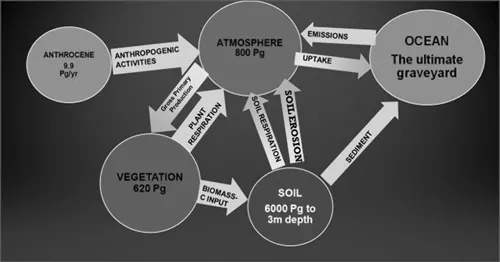
Carbon is the most important element that influences the climate and its changes. The terrestrial C cycle is presented in Figure 1.1. Soil organic C represents the largest reservoir in interaction with the atmosphere and is estimated at about 6000 pg to 3 m depth. Inorganic C represents around 1700 pg, but it is captured in more stable forms. The vegetation (620 pg) and the atmosphere (800 pg) store considerably less C than soils. There is a need to understand the biochemical mechanisms regulating C exchanges between the land, oceans and atmosphere and how these exchanges will respond to climate change through climate ecosystem feedback (Heimann and Reichstein, 2008). A slight alteration in the exchange process might result in significant changes in C emissions in the atmosphere rather than its storage in the ecosystem. The basic processes underlying the C cycle are the ‘sources’ and ‘sinks’. The higher the number of ‘sinks’, the greater the rate of C sequestration. Terrestrial ecosystems play a major role in such climate change feedbacks because they release and absorb GHGs while storing large quantities of C in living vegetation and soils, thereby acting as a significant global C sink. The influence of climate change on the soil C sink remains a major area of uncertainty, especially as there is scope for warming-induced liberation of CO2 from soil to atmosphere due to enhanced microbial decomposition of soil organic matter (Friedlingstein et al., 2006). Therefore, it is important to research novel processes or materials that result in sequestration of C.
FIGURE 1.1 Status of global carbon sinks and associated processes.
1.2.2 Carbon Capture Technology and Its Cutting-Edge Status
Carbon sequestration is a process for capturing and storing atmospheric CO2 in oceans, soil, vegetation or geological formations (or in natural ecosystems) to mitigate climate change. It is a process to slow down the accumulation of GHGs in the atmosphere and in the marine environment. The Intergovernmental Panel on Climate Change (IPCC) has implemented the C capture and storage (CCS) technique which they have estimated to capture approximately 80–90% of CO2 with CCS applied to power plants compared to the plants without. Various forms exist for the permanent storage of CO2 including gaseous storage in deep geological formations and solid storage when CO2 is reacted with metal oxides to form carbonates. Geological sequestration has been a major focus for a long time but currently, due to its disadvantages, researchers are shifting towards other alternatives. C sequestration can be categorized in different forms, e.g. based on biological, geological and chemical processes. All these processes comprise various advantages and limitations.
1.2.2.1 Biological Carbon Sequestration
Biological C sequestration is a natural phenomenon or a technique to balance the global C cycle. Harris et al. (2018) viewed how plants capture CO2 for photosynthesis from biogenic C emissions, how it is used in respiration and stored in biomass, and how it is stored through sequestration in soil as a long-term process. On the other hand, Kell (2012) argued that genetically engineered trees can tackle climate change by temporarily trapping atmospheric CO2 in vegetation through the enhanced efficiency of photosynthesis. Relatively large volumes of C are sequestered at low cost, protecting and improving soil structure, water resources, biodiversity, habitat and mitigating climate change in an easier way.
1.2.2.2 Geological Carbon Sequestration
The geological carbon sequestration technique is explained as capturing CO2 from the exhaust of fossil fuel power plants and other major sources to prevent its release into the atmosphere and contributing to gl...
Table of contents
Cover
Half-Title
Series
Title
Copyright
Contents
Preface
Editors
Contributors
PART I Process Augmentation of Green Technologies
PART II Sustainable Approaches in Engineering
Index
Trusted by 375,005 students
Access to over 1.5 million titles for a fair monthly price.
Study more efficiently using our study tools.
Frequently asked questions
Yes, you can cancel anytime from the Subscription tab in your account settings on the Perlego website. Your subscription will stay active until the end of your current billing period. Learn how to cancel your subscription
No, books cannot be downloaded as external files, such as PDFs, for use outside of Perlego. However, you can download books within the Perlego app for offline reading on mobile or tablet. Learn how to download books offline
Perlego offers two plans: Essential and Complete
Essential is ideal for learners and professionals who enjoy exploring a wide range of subjects. Access the Essential Library with 800,000+ trusted titles and best-sellers across business, personal growth, and the humanities. Includes unlimited reading time and Standard Read Aloud voice.
Complete: Perfect for advanced learners and researchers needing full, unrestricted access. Unlock 1.5M+ books across hundreds of subjects, including academic and specialized titles. The Complete Plan also includes advanced features like Premium Read Aloud and Research Assistant.
Both plans are available with monthly, semester, or annual billing cycles.
We are an online textbook subscription service, where you can get access to an entire online library for less than the price of a single book per month. With over 1.5 million books across 990+ topics, we’ve got you covered! Learn about our mission
Look out for the read-aloud symbol on your next book to see if you can listen to it. The read-aloud tool reads text aloud for you, highlighting the text as it is being read. You can pause it, speed it up and slow it down. Learn more about Read Aloud
Yes! You can use the Perlego app on both iOS and Android devices to read anytime, anywhere — even offline. Perfect for commutes or when you’re on the go. Please note we cannot support devices running on iOS 13 and Android 7 or earlier. Learn more about using the app
Yes, you can access Green Innovation, Sustainable Development, and Circular Economy by Nitin Kumar Singh, Siddhartha Pandey, Himanshu Sharma, Sunkulp Goel, Nitin Kumar Singh,Siddhartha Pandey,Himanshu Sharma,Sunkulp Goel in PDF and/or ePUB format, as well as other popular books in Economics & Sustainability in Business. We have over 1.5 million books available in our catalogue for you to explore.