In this book, Hackett introduces the traditional usage of the mapping sentence within quantitative research, reviews its philosophical underpinnings, and proposes the "declarative mapping sentence" as an instrument and approach to qualitative scholarship.
With a helpful glossary and a range of illustrative tables, Hackett takes the reader through a straightforward introduction to mapping sentences and their construction, before discussing declarative mapping sentences and possible future research directions. This innovative direction for social research provides a flexible structure for research domain, and it allows qualitative research results to be uniformly sorted.
Declarative Mapping Sentences in Qualitative Research will be essential reading for researchers, academics, and postgraduate students in the fields of qualitative psychology and psychological methods, as well as philosophical psychology and social science research methods.
The mapping sentence is at the heart of the facet theory approach to social research, as it provides a flexible and adaptable descriptive framework through which to understand a research domain (Borg, 1977; Borg and Shye, 1995; Hackett, 2014a). In this first chapter, I provide information about mapping sentences as they have traditionally been used in quantitative facet-theory-based research. In order that the mapping sentence may be better understood, I also provide brief details of the facet theory approach to research. I suggest the need for, and usefulness of, the notion of the mapping sentence within a quantitative research context. Through the use of a mapping sentence as a flexible template to design and analyse research, the results that such research produces address both specific and contextualised research questions whilst yielding comparable results. I therefore start this book by considering the meta-theory from which the traditional mapping sentence is derived: facet theory.
Introduction
The wind really could blow bitingly across Cardigan Bay, the dampness of the Irish Sea adding to the bitter chill and forming a breeze that was able to somehow slice its way through layers of clothes and induce shivers in even the most warm-blooded person. This was what DCI Tom Mathias was thinking about as he walked along the edge of the sand dunes at Ynyslas. He had driven into the nature reserve and parked his car on the beach, which was also the car park for visitors to the reserve and the dunes area in general. There were few cars parked there on a day like today, but there were some hardy souls who were wrapped up and braving the conditions. In the summer, there would be throngs of holiday makers on the beach, but today, the golden sands were practically deserted.
The body was lying on the sand at a point near where the rivers Dyfi and Leri met and formed a flat spit of sand that reached out towards the opposite banks of the estuary and the town of Aberdyfi. “Bora da, Mari, felly beth sydd gyda ni?” Tom shouted to his DI, as he attempted to be heard over the sound of the wind.
“We had better keep it in English, as Bob here doesn’t speak Welsh”. Bob was a pathologist who was new to the area.
“Sorry, Bob. So what have we got here then, Mari?”
“It looks like a birdwatcher; he has binoculars and a telescope, and he’s dressed as if he was a soldier going to war – you know how they dress out here in combat kit so the birds won’t see them. His optics are those really expensive Swarovski brand. You know they cost thousands. He seems to have been alone out here, as there are only his footprints near his body, but the thing is he’s been strangled with the strap of his binoculars by the look of it”.
“I’ll have to confirm that later”, said Bob, “but that’s what it looks like”.
“And the body has been here how long?” Tom asked.
“I’d say something less than an hour given the body temperature and the bitter conditions”, Bob replied with a furrowed brow and a worried look. He was new to the job, and he hadn’t as yet developed a thick skin to death.
“And do we have any witnesses?”
Mari looked at Tom and raised an eyebrow as if to say, “We should be so lucky.”
“Not one, and I found the body”, she said, “as I was out here taking my usual morning walk”.
“I had forgotten you live in Borth, Mari”.
“Yes, that’s why we were able to get here so quickly. I called Bob directly ”.
“Any idea who he is?” Tom asked.
“That is a little unusual, Tom. He doesn’t appear to be carrying any identification and has no car keys on him. He could have caught the train though”.
“And the tide doesn’t come this far up the shore, so any footprints would still be here”.
“Unless the wind managed to get rid of them”, reflected Mari.
Tom stood back from the other two and looked at the body. So, he thought, we have a birdwatcher with no identification and no car keys, alone and dead on the sand. His binoculars and telescope are top end and are still with him. There are no footprints, but these may have been blown away. He’s only been dead for an hour, and we have no witnesses. “Let’s get a cordon put up and take in about ten metres around the body. Get the numbers of the cars in the car park and run a check on who they belong to. It’s a long shot, but do a house-to-house along the route from the station in Borth. See if anybody saw him on his way out here”.
I imagine that quite a few academics, when they are involved in a research project, think of themselves as detectives who are attempting to solve a particularly difficult and intricate case, in the manner of Tom Mathies, the fictional character from the S4C television series Y Gwyll, in the preceding example that I dreamt up. Perhaps the detective metaphor works best with the studious detective, such as Tom, rather than the fast-car-driving, gun-toting Los Angeles cop, although there are perhaps some academics who harbour such a fantasy. However, the detective metaphor works best with the clichéd private sleuths: Sherlock Holmes and Watson, Hercules Poirot, and Miss Marple, who jump to mind as investigators who were methodical and thorough in their thinking and investigative activities. Clear thinking and thorough planning are at the roots and heart of research that employs a declarative mapping sentence. In this book, I will be emphasising and illustrating how by using a well-structured approach to asking questions and conducting research, in a manner that is similar to the way of a good detective, researchers are able to conduct investigations that clearly address their research questions and hypotheses and which yield reliable and trustworthy findings.
What Is Facet Theory
I start this book by clearly stating that this book is about how research is conducted in the social sciences and the humanities, with a focus upon one specific approach to this type of research, namely facet theory. More precisely, my writing is largely concerned with the main component of all facet theory research, the mapping sentence, with my interest concentrated upon one form of mapping sentence, the declarative mapping sentence. Much has been written about facet theory, but this is the first book-length consideration of the mapping sentence dissociated from facet theory. In this first chapter, I will begin by providing some information about facet theory and the mapping sentence.
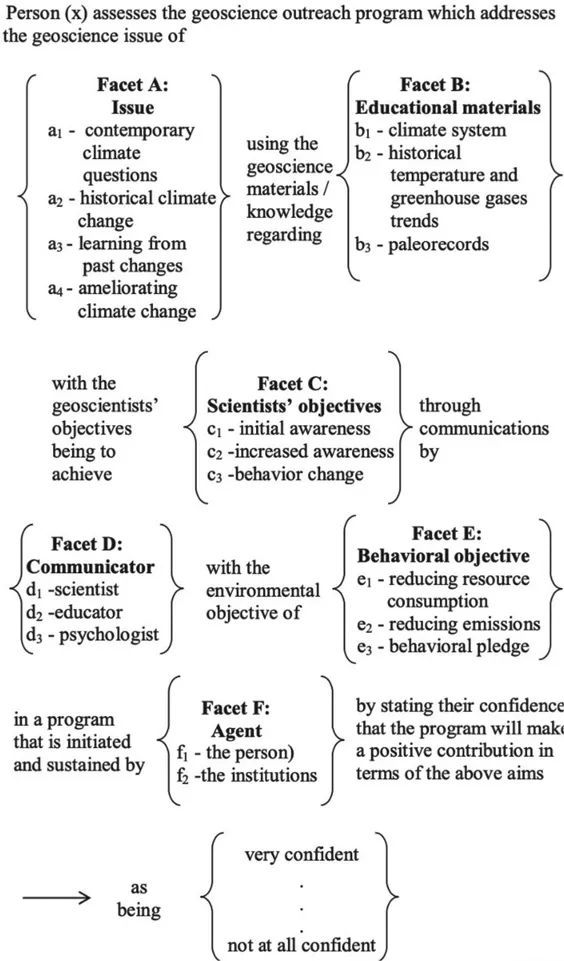
Within the social sciences, facet theory is an approach to research that encompasses research design, data analysis, and theory construction (Guttman, 1959; Borg and Shye, 1995; Tziner, 1987; Hackett, 2014a). Within facet theory, a facet may be understood as being a discretely identifiable aspect of a research area that is under investigation and that may be used to describe or classify this domain. The notion that a domain of interest may be usefully disassembled into pertinent sub-areas in order to facilitate an exploration of the domain is cardinal to the approach. The way in which a domain is described and understood in terms of its components is through the development of a mapping sentence, which constitutes a mereology1 for a specified research area. The mapping sentence is a framework that allows the proposition of, and investigation into, both the research area’s theoretical and its meaningful structure. Furthermore, the mapping sentence facilitates the planning of research designs and the selection of the important sub-areas or variables that will frame later investigations. The mapping sentence also facilitates the development of the hypotheses or research questions that the research will investigate. In Figure 1.1 is an example of a mapping sentence from Hackett et al. (2011). I will not perform a detailed exploration of this mapping sentence at this point, and I will provide just basic details about this immediately in the following. It is my intention in including this illustration to enable readers who are new to mapping sentences to have an example to refer to as they continue reading.
Figure 1.1 Mapping Sentence for the Design, Implementation, and Monitoring of a Program by Geoscientists to Raise Environmental Awareness (Hackett et al., 2011, p. 222)
In Figure 1.1, the mapping sentence describes the definition for a tool to assess the effectiveness of an educational programme that attempts to raise environmental awareness. In this mapping sentence, there are six content facets (facets that define the components that need to be incorporated in an assessment tool), along with a range facet that specifies that any assessment that is made using tools derived from the mapping sentence design will be in terms of the level of confidence those who are implementing the educational programme have that the educational objectives will be met. Finally, the individual completing the assessment tool is specified by the (x) in the opening of the mapping sentence.
Having introduced readers to the mapping sentence, I will now consider the theoretical basis of the mapping sentence.
The Philosophy of Facet Theory
When a research situation involves multiple variables, the facet theory approach may be an appropriate approach to guide the investigation of such a complex existence. Moreover, when using a facet theory approach, the researcher discovers that facet theory plays a significant role at all points of the research process, from designing the project through to analysing and interpreting the data that has arisen from the study’s data-gathering procedures and the development or refinement of theories associated with the findings.2 In fact, the single most pervasive and perhaps most important aspect of research that falls under the facet theory umbrella is the philosophical conceptions that underlie the research: Central to all forms of facet theory enquiries is what may be thought of as a facet theory philosophy. This philosophical stance embodies the belief that research should be explicit, systematic, and undertaken within clearly stated hypotheses that are interrogated directly by the research that is conducted by the scholar. Because of the multifarious nature of facet theory conceptions of behavioural and experiential domains, facet theory hypotheses incorporate not only the multiple variables that are of interest but also statements of the hypothesised structured inter-relationships between the specified variables. These are therefore structural hypotheses and are stated in the form of a mapping sentence.
Facet theory has a widely embracing nature, and if a researcher chooses to use this approach in his or her research, he or she must assume an outlook towards the research subject that embraces a recognition of the complexity of the research situation and the necessity to design research questions and employ analyses that implicate the concurrent effects of multiple variables. Within a facet theory approach, research instruments which investigate the multiple combined effects of variables within a specific area of life are designed. Subsequent to carrying out the research, analyses are conducted that allow the identification of the roles of multiple variables (that are called facets) within the specified life area. The facets are sub-divided into elements that constitute the meaningful variations that are possible within a facet.
For some philosophers, such as William of Ockham and Thomas Hobbes, the only universal aspects of the world are names, where such philosophers understand names to be “a sort of Ariadne’s thread to guide us through the labyrinth of sense-impressions” (Mintz, 1962, p. 24). On this understanding, names are the outcomes of reasoning. Moreover, analytical knowledge may arise from arranging and manipulating names in the form of propositions and definitions rooted in our sense-based experiences, which provides greater understanding than sensory information alone. Thus, words are seen as cardinal to our development of knowledge. The mapping sentence is a collection of words that are...
Table of contents
Cover
Half Title
Series Page
Title Page
Copyright Page
Dedication Page
Contents
Acknowledgements
List of Figures and Tables
Preface
Editor’s Introduction
1 Introduction to Mapping Sentences
2 Constructing a Mapping Sentence
3 Declarative Mapping Sentences
4 Conclusion and Future Research
Glossary
Index
Trusted by 375,005 students
Access to over 1.5 million titles for a fair monthly price.
Study more efficiently using our study tools.
Frequently asked questions
Yes, you can cancel anytime from the Subscription tab in your account settings on the Perlego website. Your subscription will stay active until the end of your current billing period. Learn how to cancel your subscription
No, books cannot be downloaded as external files, such as PDFs, for use outside of Perlego. However, you can download books within the Perlego app for offline reading on mobile or tablet. Learn how to download books offline
Perlego offers two plans: Essential and Complete
Essential is ideal for learners and professionals who enjoy exploring a wide range of subjects. Access the Essential Library with 800,000+ trusted titles and best-sellers across business, personal growth, and the humanities. Includes unlimited reading time and Standard Read Aloud voice.
Complete: Perfect for advanced learners and researchers needing full, unrestricted access. Unlock 1.5M+ books across hundreds of subjects, including academic and specialized titles. The Complete Plan also includes advanced features like Premium Read Aloud and Research Assistant.
Both plans are available with monthly, semester, or annual billing cycles.
We are an online textbook subscription service, where you can get access to an entire online library for less than the price of a single book per month. With over 1.5 million books across 990+ topics, we’ve got you covered! Learn about our mission
Look out for the read-aloud symbol on your next book to see if you can listen to it. The read-aloud tool reads text aloud for you, highlighting the text as it is being read. You can pause it, speed it up and slow it down. Learn more about Read Aloud
Yes! You can use the Perlego app on both iOS and Android devices to read anytime, anywhere — even offline. Perfect for commutes or when you’re on the go. Please note we cannot support devices running on iOS 13 and Android 7 or earlier. Learn more about using the app
Yes, you can access Declarative Mapping Sentences in Qualitative Research by Paul M. W. Hackett in PDF and/or ePUB format, as well as other popular books in Medicina & Teoria, pratica e riferimenti medici. We have over 1.5 million books available in our catalogue for you to explore.