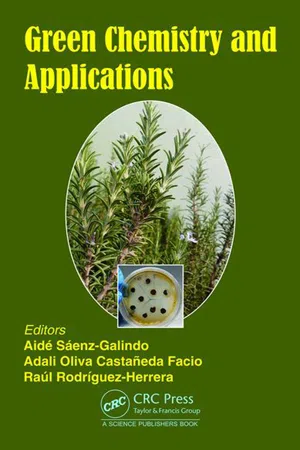
Green chemistry is a work tool that can be applied in different areas such as medicine, materials, polymers, food, organic chemistry, etc., since it was propounded in the early 2000s. It has become a viable alternative for care, remediation and protection of the environment and has been implemented worldwide. In this book the twelve principles of green chemistry are presented in a simple way, with examples of the applications of green chemistry in numerous areas showcasing it as an ideal alternative for environmental care. It also provides information on current research being implemented at the pilot plant and industrial level. The book demonstrates the importance of the use of renewable raw materials, the use of catalysis and the implementation of alternative energy sources such as the use of microwaves and ultrasound in different separation and chemical processes.
eBook - ePub
Green Chemistry and Applications
- 292 pages
- English
- ePUB (mobile friendly)
- Available on iOS & Android
eBook - ePub
About this book
Information
Chapter 1
Introduction
Facultad de Ciencias Químicas. Universidad Autónoma de Coahuila. Blvd-Venustiano Carranza s/n Colonia República, Saltillo, Coahuila, Mexico. CP. 25290.
In the last century, environmental quality has deteriorated because of deforestation, illegal hunting and fishing, pollution, overpopulation and excessive use of fossil fuel materials, among other causes. Due of these reasons, there is a need to find alternatives that will lead to conservation and environmental sustainability. Development of fossil fuel processing has generated a watershed in modern chemical industry. Inspite of the different benefits and applications of exploitation of fossil fuel, a great amount of pollution associated with the use or dump of products, suproducts and residues derived from these materials, has promoted the emergence of new philosophies such as green chemistry, which has great relevance in terms of design of products and processes in order to reduce generation of toxic substances in addition to increasing the efficiency of material resources and energy. Use of cleaner technologies which reduce consumption of materials and increase use of renewable resources are excellent alternatives to preserve the environment.
The technical and scientific progress that has been made to obtain chemical products and the enormous productivity of the chemical industry have allowed elaboration of compounds and materials that intervene in our lives and that are valued by all of us, however, over the years, procurement of these products has been done without taking into account the negative consequences in different aspects of human life, and the environment, because of production of non-biodegradable materials, release of pollutants and toxic substances, generating contaminants. Because of these reasons, the challenge to change the current trend is of a very broad scope, due to society having to be satisfied with different materials for transportation, electrical, food, pharmaceutical, metallurgical, chemical and agricultural industry, among others, and that each of these industries contribute to the emission and generation of chemical contaminants. For example, Sulfur Oxides (SOx), Nitrogen Oxides (NOx), carbon monoxide (CO) emitted into the atmosphere, originate due to production of electrical energy from coal combustion. Another industry that generates contamination is one that focuses on plastics, where waste from or as plastic products can be easily seen in the environment. In addition, residues of pesticides used in agriculture can be found in river systems or even in groundwater generating a serious contamination problem. Some other types of contaminants are hydrocarbons, aerosols, halogen, arsenic, heavy metals, among others.
In the 50’s, industry waste and residues were released directly to the environment, however, this situation changed, thanks to the warning given with the book “Silent Spring “written by Rachel Carson in 1962, where with an indepth investigation and a long term vision, the author managed to capture the consequences of an accelerated technological advance in the search to control unwanted species in agriculture, using synthetic pesticides, without taking into account their effect on human health, animals and the environment. It could be said that this study played a very important role for the start of the environmental movement, since after the publication of this book a commission was appointed to regulate the use of pesticides and later led to creating the Environmental Protection Agency (EPA), resulting in the declaration of laws on environmental protection worldwide. However, until 1987, the United Nations World Commission on Environment and Development influenced by the 1980 “World Conservation Strategy” of the International Union for Conservation of Nature (IUCN), published the report on principles of sustainable development as “development that meets the needs of the present without compromising the ability of future generations to meet their own needs.” Since the founding of the Environmental Protection Agency in 1990, it seeks to avoid the generation of pollutants through legislation, making clear that, there must be a social, economic and environmental balance and that economic growth, rational use of natural resources and environment are related to each other. This is how new concepts for the creation of products and chemical processes advance, preventing pollution instead of seeking a remedy to it, giving rise to green chemistry, developed by Paul Anastas and John Warner in 1997, who proposed to eliminate pollution from its origin.
Green chemistry bases its principles on the development of technology and innovation, also on continuous improvement to match environmental goals such as the financial ones of modern industries. The approaches of green chemistry are based on a protocol consisting of 12 basic principles that can be applied in various fields such as the chemical industry, pharmaceutical, agriculture and medicine among others.
The principles of green chemistry are listed below:
- Prevention: It is more useful to avoid or reduce waste production than to treat or clean after it has been created.
- Atom Economy: Synthetic methods should maximize incorporation of each material used in the process.
- Less Hazardous Chemical Syntheses: It consists of developing processes that generate minimal toxicity and environmental impact.
- Designing Safer Chemicals: Chemical products should be designed with minimal toxicity.
- Safer Solvents and Auxiliaries: The auxiliary substances of the chemical processes (solvents, buffers, separation additives, among others), must be innocuous and should be reduced to a minimum.
- Design for Energy Efficiency: Energy requirements should be recognized for their environmental and economical impacts and should be minimized. Synthetic methods should be conducted at room temperature and pressure.
- Use of Renewable Feedstocks: The starting materials used in a process, should proceed from renewable sources, insofar as it is economically and technically feasible.
- Reduce Derivatives: The synthesis must be designed with the minimum use of group protectors to avoid extra steps and reduce waste.
- Catalysis: Catalytic reagents (as selective as possible) are superior to stoichiometric reagents.
- Design for Degradation: Chemical products should be designed so that at the end of their function they break down into innocuous degradation products and do not remain in the environment.
- Real-time Analysis for Pollution Prevention: Analytical methodologies need to be further developed to allow for real-time, in-process monitoring and control prior to formation of hazardous substances.
- Inherently Safer Chemistry for Accident Prevention: Design chemical processes, using methods and substances that reduce accidents (emissions, explosions, fires, among others), and minimize the damage when an accident occurs.
Each of the last principles will be discussed extensively in this book’s different chapters, showing concrete examples. The chapters provide recent and interesting information by bringing together experts in multiple disciplines of green chemistry, describing a variety of topics in various fields of research also offering vanguard references. The Prevention Chapter focuses on preventing waste because it is more favorable to man and the environment and, ultimately, less costly than the treatment and destruction of waste once it has arisen. It is also more suitable than the treatment of waste and destruction.
The prevention of waste is more favorable and less expensive for the environment and human beings. In the Atom Economy chapter, several examples of reactions are shown to maximize the use of raw materials and minimize the production of waste. On the other hand, the use of palm oil and the different processes for obtaining biomass are explained extensively in the chapter on Less Hazardous Chemical Syntheses. In addition, this chapter mentions the applications of Pyroligneous acid which is one of the byproducts obtained from palm oil and that can be used for different applications on health and agriculture. Another essential point in the relationship between structure, activity and toxicity of chemical substances to make them safer is analyzed in the chapter Designing Safer Chemicals, where they also discuss some rules established through different mechanisms to design safer substances and chemicals.
Principle 5 deals with Safer Solvents and Auxiliaries, and is the key aspect that is presented in the chapter Use of the green chemistry for the extraction of bioactive compounds from vegetable sources, where the use of plant materials as solvents is discussed, as they contain biologically active substances. The chapter on Design for Energy Efficiency emphasizes the use of alternative energy such as ultrasound and microwaves for synthesis of new materials. The chapters Use of renewable feedstocks and Use of renewable feedstocks: The recovery of high value molecules from waste of renewable feedstocks: soybean hull are based on principle 7 of green chemistry. They mention the importance of adding value to agricultural residues and waste, due to the high value molecules that these materials contain. In the chapter Reduce Derivatives, there are some strategies to reduce the formation of waste during the synthesis by analyzing alternative approaches. It is possible to obtain compounds with high yields, cleaner and faster reactions with the use of catalysts, which is described in the chapter on Catalysis, besides, the importance of the stereochemistry of the catalysts in the organic reactions is explained in detail.
On the other hand, environmental pollution due to use of pesticides is shown in the chapter Design for Degradation, where it is explained that this type of contamination is remedied by different methods, however the method of biodegradation through the use of microorganisms, which eliminate pesticides from the environment is an effective method compared to others. In addition, it has been proposed to produce less hazardous materials and reduce waste as a solution to pollution prevention as established in the chapter Real-Time Analysis for Pollution Prevention, making it clear that real-time monitoring of processes can reduce waste.
Finally, the chapter, Green Precipitation with Polysaccharide as a Tool for Enzyme Recovery, refers to principle 12 “Inherently safer chemistry for accident prevention” shows that the isolation and purification of enzymes extracted from natural sources by precipitation with polysaccharide, will reflect economic savings and benefits to the environment.
Chapter 2
Atom Economy
1 Department of Chemistry/Nanoscience, Kannur University, Swami Anandha Theertha Campus, Payyannur, Edat P.O., Kerala-670 327, India.
2 Centre for Nano and Materials Science, Jain University, Jakkasandra, Ramanagaram, Karnataka, India.
INTRODUCTION
The concept of atom economy was developed by Barry M. Trost in 1991. Organic synthesis requires multiple reagents, facilitating agents and solvents to obtain the desired product. At the end of the reaction everything except for the desired product and reagents that can be recycled, like solvents and catalysts, will end up as wastes, mostly hazardous wastes. Conceptually, if the desired product contains all the atoms making up the reagents there will be no waste generated. The concept of atom economy can be used to identify synthetic methodologies that will retain the maximum number of atoms from the reactants in the final product and thereby reduce wastage. The atom economy concept allows quantification of the efficiency of a reaction with respect to the number of atoms transferred from the reactants to the final desired product (Trost, 1995; Trost, 2002). The concept of atom economy can be applied to every synthesis and be used to define new pollution prevention benchmarks (Cann and Dickneider, 2004; Song et al., 2004). Atom economy calculation, broadly presents a measure of the greenness of a chemical reaction. The commonly used indicator for efficiency of a reaction in organic synthesis is the percentage yield, which neglects mass flow (Cann and Dickneider, 2004). A synthetic chemist records the yield of a particular reaction as percentage yield. The percentage yield can be calculated as
A yield above 90% is considered good.
From the abo...
Table of contents
- Cover
- Title Page
- Copyright Page
- Preface
- Acknowledgments
- Contents
- 1. Introduction
- 2. Atom Economy
- 3. Prevention
- 4. Less Hazardous Chemical Synthesis from Palm Oil Biomass
- 5. Designing Safer Chemicals
- 6. Use of Green Chemistry for Extraction of Bioactive Compounds from Vegetal Sources
- 7. Design for Energy Efficiency
- 8. Section A: Use of Renewable Feedstocks: The recovery of high value molecules from waste of renewable feedstocks: Soybean Hull
- 9. Section B: Uses of Renewable Feedstocks
- 10. Reduce Derivatives
- 11. Catalysis
- 12. Biodegradation of Pesticides
- 13. Real-time Analysis for Pollution Prevention
- 14. Inherent Safer Chemistry for Accident Prevention
- 15. Green Precipitation with Polysaccharide as a Tool for Enzyme Recovery
- 16. Conclusions
- Index
Trusted by 375,005 students
Access to over 1.5 million titles for a fair monthly price.
Study more efficiently using our study tools.
Frequently asked questions
Yes, you can cancel anytime from the Subscription tab in your account settings on the Perlego website. Your subscription will stay active until the end of your current billing period. Learn how to cancel your subscription
No, books cannot be downloaded as external files, such as PDFs, for use outside of Perlego. However, you can download books within the Perlego app for offline reading on mobile or tablet. Learn how to download books offline
Perlego offers two plans: Essential and Complete
- Essential is ideal for learners and professionals who enjoy exploring a wide range of subjects. Access the Essential Library with 800,000+ trusted titles and best-sellers across business, personal growth, and the humanities. Includes unlimited reading time and Standard Read Aloud voice.
- Complete: Perfect for advanced learners and researchers needing full, unrestricted access. Unlock 1.5M+ books across hundreds of subjects, including academic and specialized titles. The Complete Plan also includes advanced features like Premium Read Aloud and Research Assistant.
We are an online textbook subscription service, where you can get access to an entire online library for less than the price of a single book per month. With over 1.5 million books across 990+ topics, we’ve got you covered! Learn about our mission
Look out for the read-aloud symbol on your next book to see if you can listen to it. The read-aloud tool reads text aloud for you, highlighting the text as it is being read. You can pause it, speed it up and slow it down. Learn more about Read Aloud
Yes! You can use the Perlego app on both iOS and Android devices to read anytime, anywhere — even offline. Perfect for commutes or when you’re on the go.
Please note we cannot support devices running on iOS 13 and Android 7 or earlier. Learn more about using the app
Please note we cannot support devices running on iOS 13 and Android 7 or earlier. Learn more about using the app
Yes, you can access Green Chemistry and Applications by Aide Sáenz-Galindo, Adali Facio, Raul Rodriguez-Herrera, Aide Sáenz-Galindo,Adali Facio,Raul Rodriguez-Herrera, Aide Sáenz-Galindo, Adali Oliva Castañeda Facio, Raul Rodriguez-Herrera in PDF and/or ePUB format, as well as other popular books in Physical Sciences & Sustainability in Business. We have over 1.5 million books available in our catalogue for you to explore.