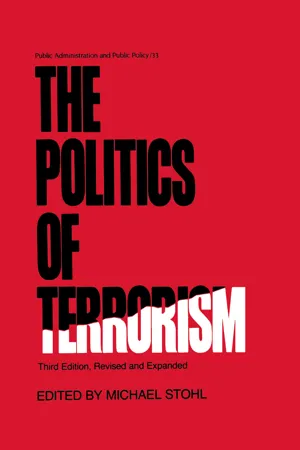
- 672 pages
- English
- ePUB (mobile friendly)
- Available on iOS & Android
eBook - ePub
The Politics of Terrorism, Third Edition,
About this book
This book provides the reader with an introduction to the concept and practice of terrorism embedded within a firm understanding of politics and social structure. It explores the major theories, typologies, strategies, ideologies, practices, and responses to contemporary political terrorism.
Information
Part I
Theoretical Approaches to the Study of Political Terrorism
1
Some Characteristics of Political Terrorism in the 1960s
Ted Robert Gurr
Center for Comparative Politics University of Colorado, Boulder
Political terrorism is a distinctive revolutionary strategy in which sustained campaigns of violent action are directed against highly visible public targets. It is a relatively new strategy, one that has been resorted to especially by alienated, youthful members of the middle classes, and it has been increasing rapidly throughout the world. It is a particularly threatening form of political violence, both because of its destructiveness and its potential revolutionary consequences. It has a pronounced international dimension as well, whereby revolutionary terrorists rely on substantial support from similarly disposed groups and nations elsewhere.
The statements in the preceding paragraph are part of conventional wisdom about political terrorism. Most officials and ordinary people in Western societies would agree to them, and quite a few experts as well. So would most writers who have advocated political terrorism as a revolutionary strategy. Almost all the assertions can be found in Carlos Marighella’s widely read “Minimanual of the Urban Guerrilla,” for example. The only difficulty with this catechism is that not one of its elements is supported by the empirical evidence of the recent past. Some of the assertions are true of specific movements; as generalizations, however, all are false. The irony is that this particular fantasy of the revolutionary Left has been accepted as an ominous political reality by everyone else.
The mythic proportions of political terrorism have a substructure of reality. Political bombings, kidnappings, and assassinations are real and frequent occurrences. We can plot their incidence over time and among countries, categorize their targets, identify the kinds of groups that perpetrate them, and say something about their motives. But when this is done systematically, as I have for eighty-seven countries in the decade from 1961 to 1970, a rather different picture of “terrorist activity” emerges. The typical terrorist campaign was conducted by tiny groups and was short-lived. Their public motives were not notably different from those of groups using other unconventional methods of political action. More specifically, the perpetrators of terrorist activities seemed more often motivated by hostility toward particular policies and political figures than by revolutionary aspirations. Their actions were more often a social nuisance than a serious threat to life and property, more often a security problem than an imminent revolution. In fact one cannot identify even one unambiguous instance in the last 18 years of a campaign of political terrorism that led directly or indirectly to revolutionary change of the kind championed by the Left.
Not all the conclusions that follow from an empirical survey of political terrorism are as iconoclastic as these. It was evident, even in the 1960s, that campaigns of political terrorism were becoming more common in the more prosperous European and Latin American democracies. They also were more persistent in these countries, but less deadly than in the poorer, nondemocratic countries of the Third World. The powerful authoritarian countries, the Communist ones in particular, have remained largely free of terrorist activities. In the conclusion to this chapter some inferences are drawn about the structural characteristics of countries that seem most conducive to political terrorism. The first task, though, is to review some evidence and interpretations of trends and patterns in political terrorism on a global scale, relying mainly on the 1961–1970 data mentioned above.
This study has two limitations. It is restricted to terrorist actions and campaigns carried out by internal groups; thus it does not include the international terrorist acts by various Palestinian groups that began in 1967. The second is that its empirical generalizations cannot be proved to apply to terrorism in the 1970s. They should be taken as hypotheses, ones that have a solid basis in “contemporary history,” against which to evaluate more impressionistic evidence about the immediate present.
Definitions and Data
Intrinsically, terrorism is a state of mind. Political terrorism, presumably, is the state of mind of political actors who are paralyzed by the threat of unpredictable attack. No one has ever attempted to document systematically the existence of such a state of mind in beseiged officials or activists, few of whom would admit to it in any case. So by default the concept has come to be employed to characterize the kinds of actions that are assumed to induce “terrorism.” The circularity of this definition is obvious. Those who feel threatened by political violence dramatize the imputed intentions of their assailants by labeling them political terrorists. Governments are among those accused of using such tactics as a means of controlling their subjects. Neither Idi Amin of Uganda nor the new rulers of Cambodia, both of whom rule by terror, would be flattered by the label. The tactics are more widely used by groups opposing governments, but they are much more likely to call themselves “revolutionaries” than “terrorists,” and only some of them justify their choice of tactics by reference to an explicit theory of terrorism.1
This chapter surveys the use of “terrorist” tactics by private groups for political purposes. The interpretative problems are sidestepped by using an empirical definition of this kind of “political terrorism” that makes no a priori assumptions about what effects the users hope to accomplish by their actions or about how their would-be victims react. The definition has three objective elements. The first is that destructive violence is used, by stealth rather than in open combat. Explosives and incendiary devices are the archetypical weapons of political terrorism, but there are others, including sniping, kidnapping, hijacking, biological agents, and atomic devices, the latter two thus far feared rather than used.
The second element in the definition is that some, at least, of the principal targets are political ones. Political targets include public buildings, political figures and groups, and the military and police. Terroristic acts often are aimed at private targets as well, sometimes for dramatic effects, sometimes because of their political associations, sometimes simply because rebels have many axes to grind.
The third definitional element is that these actions be carried out by groups operating clandestinely and sporadically. This restriction is needed to distinguish the practitioners of terrorism from armed bands of rebels and revolutionaries who operate more or less continuously from areas that they control at least in part. In practice the distinction is not always easy to apply because rebels sometimes use both kinds of tactics. Generally, though, we have excluded from the data all instances of “terrorist” activity that, as in South Vietnam for example, were an intrinsic part of an ongoing movement of armed revolution.
All three elements must be present for an act or set of actions to be considered “political terrorism” in the context of this study.2 The groups responsible for such actions are called “terrorists” here, but without assuming that they would describe their actions or aims in the language of terrorism.
Data on the world-wide incidence of political terrorism, as defined here, were collected by me and my assistants for the decade of the 1960s as part of a larger study in which information was systematically gathered on all instances of civil strife reported in major news sources. The procedures and sources have been described elsewhere.3 Because “event counts” are in bad repute in studies of conflict behavior,4 it should be emphasized that this study was not concerned with events per se, but with identifying the who, what, when, where, why, and how of manifest political conflict. For terrorism, for example, our efforts were aimed at isolating “campaigns” or waves of actions that could be ascribed to particular groups. For each such campaign, as for all instances of open conflict, information was recorded on the identity and motives of the participants; their numbers and organization; the targets and duration of action; the government’s retaliatory response, if any; the number and identity of casualties; and the presence and nature of external support—all insofar as the information could be found in news and supplementary sources.
This study includes an analysis of the data on political terrorism identified in the larger study, beginning with an enumeration of the events and continuing with an analysis of their other properties. The reader must understand that these data are not a complete or wholly representative portrait of political terrorism in the decade of the 1960s because of the selective nature of journalistic reporting and the fact that not all countries were surveyed. These two limitations need explanation before the data are examined.
First, the information in journalistic sources gives most emphasis to the larger and more dramatic campaigns of terrorism. It is reasonable to assume that virtually all campaigns that lasted for more than 6 months, or that involved repeated attacks on national political targets, are represented in these data. Isolated instances of bombing and assassination, especially those in out-of-the-way places, are only “sampled” by the press. Readers are asked to assume, as we do, that these data provide a sketch—not a precisely accurate portrayal—of the more serious episodes of political terrorism in the 1960s. They should be reminded too that for the purpose of a global mapping of terrorism, or any common kind of conflict, there are no open alternatives to relying on journalistic accounts. Systematic information of this sort simply is not regularly compiled and made available to scholars by the governments of the world, by the United Nations, or by any private group.5 Broad surveys are not an alternative to in-depth studies of particular terrorist campaigns and countries, but they are an essential complement to them.
The second limitation on the data is that they refer only to eighty-seven political entities in a world that now has nearly twice that many autonomous states. The smallest and least developed countries of Africa and Asia are excluded and so is China, not because they are unimportant but because news about them is so sparse, or so controlled, that it is unreliable even for our general purposes. The eighty-seven countries nonetheless have some 90 percent of the world’s population aside from China. Virtually all of Europe and both Americ...
Table of contents
- Cover
- Half Title
- Series Page
- Title Page
- Copyright Page
- Preface to the Third Edition
- Preface to the Second Edition
- Preface to the First Edition
- Table of Contents
- Contributors
- Introduction Demystifying Terrorism: The Myths and Realities of Contemporary Political Terrorism
- Part I Theoretical Approaches to the Study of Political Terrorism
- Part II The Practice of Political Terrorism
- Index
Trusted by 375,005 students
Access to over 1.5 million titles for a fair monthly price.
Study more efficiently using our study tools.
Frequently asked questions
Yes, you can cancel anytime from the Subscription tab in your account settings on the Perlego website. Your subscription will stay active until the end of your current billing period. Learn how to cancel your subscription
No, books cannot be downloaded as external files, such as PDFs, for use outside of Perlego. However, you can download books within the Perlego app for offline reading on mobile or tablet. Learn how to download books offline
Perlego offers two plans: Essential and Complete
- Essential is ideal for learners and professionals who enjoy exploring a wide range of subjects. Access the Essential Library with 800,000+ trusted titles and best-sellers across business, personal growth, and the humanities. Includes unlimited reading time and Standard Read Aloud voice.
- Complete: Perfect for advanced learners and researchers needing full, unrestricted access. Unlock 1.5M+ books across hundreds of subjects, including academic and specialized titles. The Complete Plan also includes advanced features like Premium Read Aloud and Research Assistant.
We are an online textbook subscription service, where you can get access to an entire online library for less than the price of a single book per month. With over 1.5 million books across 990+ topics, we’ve got you covered! Learn about our mission
Look out for the read-aloud symbol on your next book to see if you can listen to it. The read-aloud tool reads text aloud for you, highlighting the text as it is being read. You can pause it, speed it up and slow it down. Learn more about Read Aloud
Yes! You can use the Perlego app on both iOS and Android devices to read anytime, anywhere — even offline. Perfect for commutes or when you’re on the go.
Please note we cannot support devices running on iOS 13 and Android 7 or earlier. Learn more about using the app
Please note we cannot support devices running on iOS 13 and Android 7 or earlier. Learn more about using the app
Yes, you can access The Politics of Terrorism, Third Edition, by Michael Stohl,Stohl in PDF and/or ePUB format, as well as other popular books in Politics & International Relations & Business General. We have over 1.5 million books available in our catalogue for you to explore.