Soft Computing Applications and Techniques in Healthcare
eBook - ePub

Soft Computing Applications and Techniques in Healthcare

  1. 260 pages
  2. English
  3. ePUB (mobile friendly)
  4. Available on iOS & Android
eBook - ePub

Soft Computing Applications and Techniques in Healthcare

About this book

This book provides insights into contemporary issues and challenges in soft computing applications and techniques in healthcare. It will be a useful guide to identify, categorise and assess the role of different soft computing techniques for disease, diagnosis and prediction due to technological advancements.

The book explores applications in soft computing and covers empirical properties of artificial neural network (ANN), evolutionary computing, fuzzy logic and statistical techniques. It presents basic and advanced concepts to help beginners and industry professionals get up to speed on the latest developments in soft computing and healthcare systems. It incorporates the latest methodologies and challenges facing soft computing, examines descriptive, predictive and social network techniques and discusses analytics tools and their role in providing effective solutions for science and technology.

The primary users for the book include researchers, academicians, postgraduate students, specialists and practitioners.

Dr. Ashish Mishra is a professor in the Department of Computer Science and Engineering, Gyan Ganga Institute of Technology and Sciences, Jabalpur, Madhya Pradesh, India. He has contributed in organising the INSPIRE Science Internship Camp. He is a member of the Institute of Electrical and Electronics Engineers and is a life member of the Computer Society of India. His research interests include the Internet of Things, data mining, cloud computing, image processing and knowledge-based systems. He holds nine patents in Intellectual Property, India. He has authored four books in the areas of data mining, image processing and LaTex.

Dr. G. Suseendran is an assistant professor, Department of Information Technology, School of Computing Sciences, Vels Institute of Science, Technology & Advanced Studies (VISTAS), Chennai, Tamil Nadu, India. His research interests include ad-hoc networks, the Internet of Things, data mining, cloud computing, image processing, knowledge-based systems, and Web information exploration. He has published more than 75 research papers in various international journals such as Science Citation Index, Springer Book Chapter, Scopus, IEEE Access and UGC-referred journals.

Prof. Trung-Nghia Phung is an associate professor and Head of Academic Affairs, Thai Nguyen University of Information and Communication Technology (ICTU). He has published more than 60 research papers. His main research interest lies in the field of speech, audio, and biomedical signal processing. He serves as a technical committee program member, track chair, session chair, and reviewer of many international conferences and journals. He was a co-Chair of the International Conference on Advances in Information and Communication Technology 2016 (ICTA 2016) and a Session Chair of the 4th International Conference on Information System Design and Intelligent Applications (INDIA 2017).
Frequently asked questions

Yes, you can cancel anytime from the Subscription tab in your account settings on the Perlego website. Your subscription will stay active until the end of your current billing period. Learn how to cancel your subscription.
No, books cannot be downloaded as external files, such as PDFs, for use outside of Perlego. However, you can download books within the Perlego app for offline reading on mobile or tablet. Learn more here.
Perlego offers two plans: Essential and Complete
  • Essential is ideal for learners and professionals who enjoy exploring a wide range of subjects. Access the Essential Library with 800,000+ trusted titles and best-sellers across business, personal growth, and the humanities. Includes unlimited reading time and Standard Read Aloud voice.
  • Complete: Perfect for advanced learners and researchers needing full, unrestricted access. Unlock 1.4M+ books across hundreds of subjects, including academic and specialized titles. The Complete Plan also includes advanced features like Premium Read Aloud and Research Assistant.
Both plans are available with monthly, semester, or annual billing cycles.
We are an online textbook subscription service, where you can get access to an entire online library for less than the price of a single book per month. With over 1 million books across 1000+ topics, we’ve got you covered! Learn more here.
Look out for the read-aloud symbol on your next book to see if you can listen to it. The read-aloud tool reads text aloud for you, highlighting the text as it is being read. You can pause it, speed it up and slow it down. Learn more here.
Yes! You can use the Perlego app on both iOS or Android devices to read anytime, anywhere — even offline. Perfect for commutes or when you’re on the go.
Please note we cannot support devices running on iOS 13 and Android 7 or earlier. Learn more about using the app.
Yes, you can access Soft Computing Applications and Techniques in Healthcare by Ashish Mishra, G. Suseendran, Trung-Nghia Phung, Ashish Mishra,G. Suseendran,Trung-Nghia Phung in PDF and/or ePUB format, as well as other popular books in Computer Science & Statistics for Business & Economics. We have over one million books available in our catalogue for you to explore.
1
Analytical Approach to Genetics of Cancer Therapeutics through Machine Learning
Ritu Shukla1, Mansi Gyanchandani1, Rahul Sahu2 and Priyank Jain1
1Maulana Azad National Institute of Technology Bhopal, Madhya Pradesh, India
2Department of Computer Science and Engineering Lakshmi Narain College of Technology Bhopal, Madhya Pradesh, India
Contents
  • 1.1 Introduction
  • 1.2 Literature Review
  • 1.3 Data Collection and Processing
  • 1.4 Classification and Model Evaluation
    • 1.4.1 K-Nearest Neighbours
    • 1.4.2 Support Vector Machine
    • 1.4.3 Kernels in Support Vector Machine
    • 1.4.4 ADABoost
    • 1.4.5 Random Forest
  • 1.5 Logistic Regression
    • 1.5.1 Naive Bayes
  • 1.6 Results
  • 1.7 Conclusion
  • References

1.1 Introduction

With the rapid increase in cancer, the survival rate has also increased due to the development and advancement of new technologies, surgeries and therapies [1]. These therapies include radiotherapy, chemotherapy and so on. Still, every patient response to treatment is different [2].
Earlier cancer detection techniques include computerised axial tomography (CAT or CT) scans and magnetic resonance imaging (MRI) scans. However, they provided much less information about the progression of cancer. Many approaches have been used to find treatment so that the patient can survive. Machine learning (ML) is one of the methods still used for gene expression [35] as well as for cancer prediction. Moreover, the accurate prediction of disease can be done by machine learning algorithms.
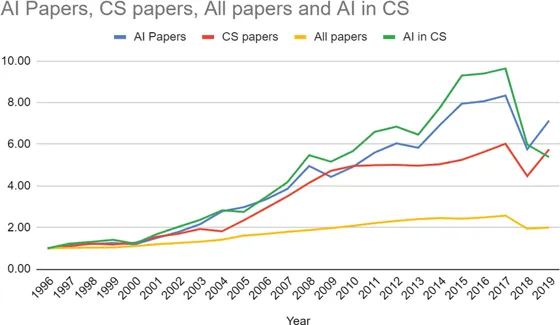
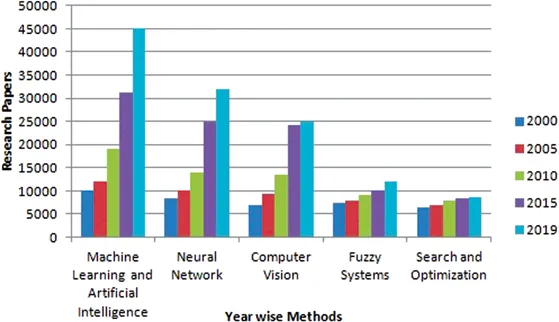
With the current trend from generalised medicine to personalised medicine, ML techniques can be used for cancer prediction and prognosis. The types of data and ML methods used would increase overall performance. Several studies have been done for early cancer diagnosis [611]. The rate at which research is conducted with artificial intelligence (AI) has increased rapidly over the last two decades, as shown in Figures 1.1 and 1.2. Figure 1.2 shows that the major research area is now machine learning.
FIGURE 1.1
FIGURE 1.1 The growth of annual publications.
FIGURE 1.2
FIGURE 1.2 Scope of machine learning as a major research area has increased over the last few years.
The accuracy of prediction of cancer has been improved by 15% to 20% over last few years [12].
ML modelling, specifically in AI, has a history in cancer research and practical implementation. A large portion of these works use ML techniques to show the progression of cancer and to recognise information used later in a classification scheme primarily concerning malignant growth, recurrence and survival [13]. Still, ML models suffer from low sensitivity for detecting early-stage cancer and differentiating benign and malignant tumors. Estimation, prediction classification and similar tasks are the major objectives of ML techniques. In particular, ML techniques are commonly used to assign data items into different predefined classes. Misclassification occurs when training and generalisation errors occur. A good classification model should accurately classify all the instances and fit the training set well. This chapter compares various ML algorithms in different aspects to determine which algorithm is best suited for which dataset.

1.2 Literature Review

The use of various ML models in malignant growth research encompasses an tremendous range of applications. Various models dependent on support vector machine (SVM) technology applied to malignant growth forecast issues have been in use for several decades. Different models to predict cancer development and their results have been utilised in several studies. Today data science and bioinformatics commonly use ML-driven models with a wide scope of applications. Studies mostly include classifying, identifying, detecting and distinguishing tumors, predicting cancer and so on.
Breast cancer survival time prediction studies based on ML models occupy a significant part of the contemporary research in this area. There are several studies considering the effect of an ensemble of ML techniques to predict the survival time in breast cancer. Their techniques show better accuracy on their breast cancer dataset compared to previous results [14]. Many papers concern various issues in applying ML algorithms for breast cancer prediction. Researchers experiment on breast cancer datasets [15] using C5 algorithm and achieved 93% accuracy of prediction cancer survivability. Other studies were focused on the comparative analysis of classifiers such as DTs (J48), radial basis function (RBF) neural networks, SVM-RBF kernel and simple classification and regression tree (CART) to find the best classifier. Proper validation is required for the evaluation of the ML algorithms. Performance and accuracy can be achieved by proper validation of ML algorithms. Cross-validation, in particular, is a commonly used method. This method is very suitable for ML-based modelling and is used for training and for testing the datasets [16].
The author [17] received 98.80% and 96.63% accuracies using SVM classification on two different datasets. The ML algorithms Logistic Regression, Naive Bayes, SVM, K-Nearest Neighbours (KNN) comparative study was done by author [13] and was programmed in...

Table of contents

  1. Cover
  2. Half Title
  3. Series Page
  4. Title Page
  5. Copyright Page
  6. Contents
  7. Preface
  8. Acknowledgements
  9. Editors
  10. Contributors
  11. Chapter 1 Analytical Approach to Genetics of Cancer Therapeutics through Machine Learning
  12. Chapter 2 A Study on Behaviour of Neural Gas on Images and Artificial Neural Network in Healthcare
  13. Chapter 3 A New Approach for Parkinson’s Disease Imaging Diagnosis Using Digitized Spiral Drawing
  14. Chapter 4 Modelling and Analysis for Cancer Model with Caputo to Atangana-Baleanu Derivative
  15. Chapter 5 Selection of Hospital Using Integrated Fuzzy AHP and Fuzzy TOPSIS Method
  16. Chapter 6 Computation of Threshold Rate for the Spread of HIV in a Mobile Heterosexual Population and Its Implication for SIR Model in Healthcare
  17. Chapter 7 Application of Soft Computing Techniques to Heart Sound Classification: A Review of the Decade
  18. Chapter 8 Fuzzy Systems in Medicine and Healthcare: Need, Challenges and Applications
  19. Chapter 9 Appliance of Machine Learning Algorithms in Prudent Clinical Decision-Making Systems in the Healthcare Industry
  20. Chapter 10 Technique of Receiving Data from Medical Devices to Create Electronic Medical Records Database
  21. Chapter 11 Universal Health Database in India: Emergence, Feasibility and Multiplier Effects
  22. Chapter 12 Cluster Analysis of Breast Cancer Data Using Modified BP-RBFN
  23. Index