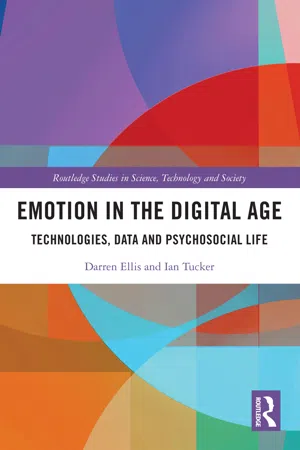
Emotion in the Digital Age examines how emotion is understood, researched and experienced in relation to practices of digitisation and datafication said to constitute a digital age. The overarching concern of the book is with how emotion operates in, through, and with digital technologies. The digital landscape is vast, and as such, the authors focus on four key areas of digital practice: artificial intelligence, social media, mental health, and surveillance. Interrogating each area shows how emotion is commodified, symbolised, shared and experienced, and as such operates in multiple dimensions. This includes tracing the emotional impact of early mass media (e.g. cinema) through to efforts to programme AI agents with skills in emotional communication (e.g. mental health chatbots). This timely study offers theoretical, empirical and practical insight regarding the ways that digitisation is changing knowledge and experience of emotion and affective life. Crucially, this involves both the multiple versions of digital technologies designed to engage with emotion (e.g. emotional-AI) through to the broader emotional impact of living in digitally saturated environments. The authors argue that this constitutes a psycho-social way of being in which digital technologies and emotion operate as key dimensions of the ways we simultaneously relate to ourselves as individual subjects and to others as part of collectives. As such, Emotion in the Digital Age will prove important reading for students and researchers in emotion studies, psychology, science and technology studies, sociology, and related fields.
eBook - ePub
Emotion in the Digital Age
Technologies, Data and Psychosocial Life
- 134 pages
- English
- ePUB (mobile friendly)
- Available on iOS & Android
eBook - ePub
About this book
Information
1 Emotion in the digital age
Why emotion, why digital?
Digitised emotion almost seems contradictory. Can emotion be simulated through digits? The cold binary codes of zeros and ones may appear in tune to the logic of cognition in the mind, but can they emulate the emotional affairs of the heart? Claims that emotional activity can be captured, identified, recognised, and potentially simulated digitally have become increasingly prevalent (Fry, 2019; McStay, 2016; 2018). Additionally, not only are we imbuing digital technologies with emotion, but technologies are emotionally engaging us, as digitality has exponentially increased. Throughout this book, we plot some of the ways these relationships are forming. To these ends, the book draws together relevant philosophies, theories, and models of emotion to detail some of the ways that processes categorised as emotion are being mobilised by digital technologies. We start with processual, relational, and psychosocial approaches to think about the emergence of emotion and affective life through relations between bodies, collectives and technologies. Our approach is necessarily selective given the reach of digitality into all areas of life. We focus of four areas of significance to the study of emotion in a digital age: Emotion-related artificial intelligence, social media, digital mental health, and surveillance.
Discussion of the impacts of digital technologies often focuses on their technical capabilities rather than the underlying social and psychological processes. Moreover, it is often what this means for future life that is discussed; a portrayal of a future digital life acts as the meaning framework for considering digital technologies in the present. Digital technologies are often judged in terms of their potential, from providing more tailored shopping experience through behavioural economics to more automated work environments. However, analysing life in a digital age through the concept of emotion allows for more breadth and depth of digital activity to be explored, which allows for a sense of psychological life to feature. This is important because 1) The human is often used as a category to critique digitality – with the latter deemed to be some kind of threat to and/or enhancement of the former; 2) where digital activity is related to human activity, it often includes a definition of a pre-existing individual in mind. Focusing on emotion allows us to draw upon a range of theory, from the social sciences, philosophy, and broader scientific theory and practice, to interrogate the emergence of digital life. Avoiding a reductionist approach that locates emotional activity solely at the level of the physiological is important to draw out the limits and borders of digital life. Our approach is to address emotion as encompassing and transcending psychological, social, and physiological categories. Moreover, it is not something to be set against other categories of psychological life, which has often been the case historically – such as the distinction between emotion and rationality, or, more recently, emotion and cognition (England, 2019). Such categories are not bounded distinct entities, but rather, can be thought of as co-constituting elements of psychological life. Emotions are rarely felt in isolation from beliefs, memories, perceptions, attitudes, etc. Indeed, our whole psychological life is infused with emotion, which is inherently related to social and historical context, both individually and collectively.
The scope of this book is broad, and we will not succeed in covering all areas pertaining to emotion in a digital age. The saturation of our social worlds with digital technologies means that there are very few areas of everyday life that are not, or cannot, be mediated by technology. There are the emotional relationships we develop with personal technologies, such as mobile phones, computers, and fitness trackers. There are the emotional relations made possible by the internet, which include new forms of communication (e.g., online forums), as well as new practices that can elicit emotional responses (e.g., becoming frustrated with online tailored advertising). There is the breed of new technologies that claim to be able to identify, label, and potentially manipulate emotion. Technological advances have made it possible to process facial expressions and capture physiological responses, leading to claims that such activity brings emotion into the reach of the digital. Finally, although not exhaustively, there is the development of robots and virtual agents that are designed to interact emotionally. Each one of these areas is worthy of a book in itself. Our analysis is selective, focusing on areas we argue are key issues for life in a digital age, namely emotion-related artificial intelligence, social media, digital mental health, and surveillance. We will see that these areas intersect, and as such, are not discrete domains, but rather, operate as prominent arenas in which emotion is at stake in relation to digitisation and datafication.
A word on terminology
The terms emotion and affect are often presented together and used inter-changeably. Sometimes, this is acknowledged, with a reason provided (or not!). Part of the issue is how to articulate their use without providing a clear definition of each. In this book, we aim to use the terms as they are deployed by those we discuss. Where this is not possible, we will state so. In the sections in which we discuss the emotional and/or affective implications of a digital technology (e.g., when it is not explicitly designed to relate to emotion/affect, but we claim it does), we will provide a definition. We fully acknowledge existing theory that frames affect in terms of processes that impact upon individual and social life in ways that are presented as non-cognitive and/or non-conscious, for instance, in psychoanalysis, critical media studies, and philosophy. Many of these feature in the field of affect studies that has emerged strongly in the last 15–20 years (Ahmed, 2004; Ash, 2015; Clough, 2007; Gregg & Seigworth, 2009; Leys, 2017; Thrift, 2008). There is also prominent use of affect in relation to affective neuroscience, which emphasises neurological activity, for example, in relation to mood disorders (e.g., depression and anxiety) as well as a broader set of psychological activity (Davidson et al., 2002; Panksepp, 2010; Stein, 2003). The prominence of neurological activity in such accounts means that questions of cognition and/or consciousness do not commonly feature.
Whilst affect has featured in approaches that emphasise non-cognitive and non-conscious approaches (Wetherell, 2012), emotion has often been used in accounts that emphasise the importance of culture and language in the development of meaningful experiences that can be categorised in emotional terms (e.g., fear, love, and anger) (Harré, 1986). Emotional categories have been thought of as being culturally-specific references used when discussing and representing our feelings, for instance, the use of emojis as visual representations of feeling. The term emotion has more cultural currency than affect, as well as being core to mainstream psychological models. Such models have garnered increased prominence through their central role in the development of computerised attempts to capture and categorise physiological expressions as different kinds of emotion, for instance, the widespread use of universalist models of a basic set of emotions in artificial intelligence- (AI) based technologies (e.g., facial expression recognition).
This book considers emotion and affect as core concepts to understand life in a digital age. They form part of the overall psycho-social operation of experience, not just discrete psychological forms operating psycho-biologically “within” people. Throughout the book, we argue that there is more at stake, emotionally, than is often considered. For instance, emotion is not just operating at the level of facial expression but is a more fundamental part of how we orient to ourselves and our environments. Emotion and affect are important parts of the ways we experience the world, both in relation to ourselves as individuals and to others. As our lives increasingly operate in and through digital practices, and processes of datafication therein, the dimensions of emotion and affect through which we engage and feel our ways through the world are mediated by digital and data practices. Emotion and affect are implicated in terms of the relations we have with digital and data practices, as well as being a core design aim of the technology (e.g., affective computing). This requires an expanded analytic unit, which goes beyond focusing on the impact of the functional aim of emotion-related technologies.
We recognise the lack of a universally agreed definition for either emotion or affect. We also note important attempts to frame processes associated with emotion and affect through other concepts, such as feeling, e.g. Cromby (2015). However, we are reluctant to rely on an alternative concept to describe the psychological and social processes associated with existing concepts of emotion and affect. Creating an additional concept is likely to create as many problems as solutions and can end up subject to the same accusations of essentialising as theories of emotion and affect. As such, we follow the tradition of using both terms. In places, we will use affective life as a generic term (e.g., when not discussing specific emotional and/or affective activity) (Greco & Stenner, 2008; Despret, 2004). We will not follow other non-essentialist attempts in terms of only using affect (as a way of avoiding the reductionist baggage of mainstream psychological theory), as much of what we discuss concerns major psychological models. We also do not want to exclude the value of emphasising the role of cultural practices in the formation and maintenance of emotion categories (i.e., the impact of language and meaning in definitions of emotion). The scope is broad, but one which we hope draws sufficient and valuable attention to developing theoretical and empirical understandings of emotion and affective processes in a digital age.
Computation and emotion
The advent of computation catalysed much thinking about the potential for technologies to intersect with psychological processes. In the first fifty years of computation, this mostly focused on intelligence and then more discrete categories of cognition (Wilson, 2010). This is primarily due to the dominance of the information processing model of psychology that emerged in line with increased computation in the mid-20th century. Mainstream psychology claimed that minds work like computers, processing sensory information to form thoughts, perceptions, and memories (Varela, Thompson, & Rosch, 1991). Cognitive psychology has modelled emotion, but not to the same extent as the so-called “mental processes” of intelligence, perception, attention, and language processing. These were deemed more readily explainable in computational terms and fit into the historical prioritisation of rationalist thought over emotional feeling (Ellis & Tucker, 2015). This is not to suggest that emotion has never featured in computer science, as early attempts used a therapeutic context as the basis for exploring the potential for technologies to mimic human communication. For instance, Weizenbaum’s Eliza programme used natural language processing to recreate a patient-doctor consultation (Weizenbaum, 1984). To Weizenbaum’s surprise, the computer science field came to suggest that Eliza could create emotional responses of support for users. Whether this was by design or not, the programme has been influential in the growing field of digital mental health (which we will discuss in more detail in Chapter Five). The emergence of a designated field of “Affective Computing” has become one of the most prominent areas focused on emotion and technology (Calvo et al., 2015; Picard, 2000). Heavily influenced by psychological theory regarding universal emotional expression, multiple emotion recognition experiments have emerged since the mid-1980s and continue apace. Affective computing is concerned with emotion as expressed at an individual physiological level and the potential for digital technologies to identify and categorise such activity. Such work is deemed to have significant potential to inform industry practices, such as in commerce, as well as governments, in terms of national security (Bullington, 2005). Large scale generation of data from individuals has led to concerns regarding control and use of data. In recent years, data generation about emotional and affective life has increased significantly, in a variety of sectors, from advertising to health sectors (McStay, 2018). Emotion-related technologies have been studied mainly in the physical sciences (e.g., computer sciences), which have focused on the technical advances being made. A social scientific analysis is important for two reasons; 1) to evaluate how emotion theories are used in, and by, the physical sciences in relation to new technological attempts to define and manipulate emotion; and 2) to highlight some of the broader social and psychological implications of living in societies in which digital technologies are increasingly powerful social agents.
Life at the intersection of emotion, affect, and digitisation
Why call the present a digital age? Firstly, it is important to note that throughout the book we often use the term a digital age, despite the book’s title being Emotion in the Digital Age. These are similar terms, but we are keen to avoid essentialising the current time as the defining digital epoch, as there may well be others in the future that take new directions and consequently present new challenges. As such, we often use a digital age¸in addition to the title’s the digital age (which was the publisher’s preference). In terms of the aims of the book, we use the term ...
Table of contents
- Cover
- Endorsements
- Half-Title
- Series
- Title
- Copyright
- Dedication
- Contents
- Acknowledgements
- 1 Emotion in the digital age
- 2 The history and emergence of emotion-technology relations
- 3 Artificial intelligence and emotion
- 4 Social media and emotion
- 5 Digital mental health
- 6 Surveillance and emotion
- 7 Digital futures and emotion
- Index
Trusted by 375,005 students
Access to over 1.5 million titles for a fair monthly price.
Study more efficiently using our study tools.
Frequently asked questions
Yes, you can cancel anytime from the Subscription tab in your account settings on the Perlego website. Your subscription will stay active until the end of your current billing period. Learn how to cancel your subscription
No, books cannot be downloaded as external files, such as PDFs, for use outside of Perlego. However, you can download books within the Perlego app for offline reading on mobile or tablet. Learn how to download books offline
Perlego offers two plans: Essential and Complete
- Essential is ideal for learners and professionals who enjoy exploring a wide range of subjects. Access the Essential Library with 800,000+ trusted titles and best-sellers across business, personal growth, and the humanities. Includes unlimited reading time and Standard Read Aloud voice.
- Complete: Perfect for advanced learners and researchers needing full, unrestricted access. Unlock 1.5M+ books across hundreds of subjects, including academic and specialized titles. The Complete Plan also includes advanced features like Premium Read Aloud and Research Assistant.
We are an online textbook subscription service, where you can get access to an entire online library for less than the price of a single book per month. With over 1.5 million books across 990+ topics, we’ve got you covered! Learn about our mission
Look out for the read-aloud symbol on your next book to see if you can listen to it. The read-aloud tool reads text aloud for you, highlighting the text as it is being read. You can pause it, speed it up and slow it down. Learn more about Read Aloud
Yes! You can use the Perlego app on both iOS and Android devices to read anytime, anywhere — even offline. Perfect for commutes or when you’re on the go.
Please note we cannot support devices running on iOS 13 and Android 7 or earlier. Learn more about using the app
Please note we cannot support devices running on iOS 13 and Android 7 or earlier. Learn more about using the app
Yes, you can access Emotion in the Digital Age by Darren Ellis,Ian Tucker in PDF and/or ePUB format, as well as other popular books in Social Sciences & Emotions in Psychology. We have over 1.5 million books available in our catalogue for you to explore.