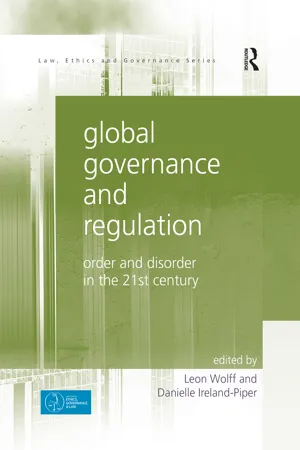
With a diverse group of contributors from law, business and the social sciences, this book explores the line not only between order and disorder in global affairs, but also chaos and control, continuity and change, the core and the margins. The key themes include: global crises and the role of international law, norms and institutions; the challenge of pluralism to regulatory clarity; and critical assessments of taken-for-granted systems and values such as capitalism, centralised government, de-militarisation and the separation of powers. The book divides into two key parts. The first part, `Conceptions', considers the diverse way in which order/disorder can be conceived in global governance and regulation. The second part, `Case Studies', groups chapters around five topic areas: citizens, capitalism, conflict, crime and courts. The authors here build on the themes presented in the first part by embedding them within specific areas of international regulation, such as international criminal law, maritime law or finance regulation; jurisdictions and regions, such as Australia, Canada, China, Japan and South Asia; and subject-matter, such as water resources, citizenship, statelessness and public interest litigation. This blend of contemporary subject-matter, empirical studies, multi-disciplinary perspectives and academic theories provides a comprehensive analysis to current and emerging debates in the broader global community. In utilizing interdisciplinary studies to draw out common issues and alternative solutions, the book will appeal to a wide readership among academics and policy-makers.
- 280 pages
- English
- ePUB (mobile friendly)
- Available on iOS & Android
eBook - ePub
Order and Disorder in the 21st Century
1 Introduction
Global Order/Disorder
Leon Wolff and Danielle Ireland-Piper
This book interrogates the relationship between order/disorder in global affairs. We use a slash (/) to separate these two concepts exactly for the reasons writing stylists loathe it. As Garner complains, the slash is “unfit” for formal writing “because it is inherently ambiguous: its function may be conjunctive <secretary/treasurer> or disjunctive <a buy/sell decision>” (Garner, 2002, p. 50). We agree – but that is our point. Order and disorder, as our contributing authors make clear, may be conjunctive, disjunctive or possibly something in between. The slash, here, is not an “abomination” of style (Garner, 2002, p. 50); it is a precise illustration of the complexity of their conceptual interaction.
For example, are order and disorder antonyms, representing contrasting poles in global governance and regulation, opposite extremes between structural integrity and disassembled rubble? Or are they more like neighbours, linking arms in partnership (albeit not always happily) as the world confronts inevitable change and navigates itself through the challenges? Or, more radically, are they one and the same – within order, there is disorder; within disorder, there is order – like a stained-glass window that may be viewed either as a single piece of art or as multiple fragments of coloured pieces? In normative terms, too, is order the ideal, disorder the nightmare? Or is order a false god, and disorder the surprising friend? Or should we strip away all normative presumptions and analyse them dispassionately for the role they place in shaping our world?
Linked to such complexities is the relationship between governance/regulation, the two intellectual tools scholars and poli cy-makers used to make sense of the world and fashion a better one. We also use a slash to divide them because, like order/disorder, they are distinct but overlap. If order/disorder describe the state of the world, governance and regulation refer to the processes by which the world enters that state or the tools by which it can be altered (eg, Trubek & Trubek, 2006; Kingsford Smith, 2012). Although different disciplines vest different intellectual meanings and functions to each (see Wolff, Preface), they are united in their goals. Together, they target the order/disorder dichotomy. Together, they observe the intersecting interests of global stakeholders – from nation-states, regional groupings and transnational businesses to NGOs and individual citizens. And together, they seek to coordinate the competing claims, harmonize the differences and curb the tensions (eg, Chhotray & Stoker, 2008, pp. 3–6). From law and policy to diplomacy and economic incentives, they deploy a range of resources to deliver their aims (Parker, Scott, Lacey & Braithwaite, 2004, p. 1). But, just as views on order/disorder vary as to the shape of the world, so, too, do views on the techniques required for coordinating and aligning stakeholder interests. Internationalists, for example, talk of universalism and relativism (eg, Gaubatz and MacArthur, 2001). Comparativists observe convergence and divergence (eg, Fauvarque-Cosson, 2001; Hansmann and Kraakman, 2001; Nottage and Wolff, 2005). Transnationalists speak of “unity in diversity” (cf Ang, 2014). Globalization scholars speak of regulatory structures and their failings (Darian-Smith, 2000).
Little wonder, then, as Kennedy (2008, p. 828) observes, the global system is such a “mystery”:
How does it all work, how do all the pieces fit together? How is public power exercised, where are the levers, who are the authorities, how do they relate to one another? Are the worlds of politics, markets and cultural influence held together in a tight structure or is it all more loose and haphazard? Are there more than one global order – how much, in the end, is simply chaos, how much the work of an invisible hand?
The purpose of this collection of essays is to shed light on this mystery. Our approach to this task is unity/diversity. Once again, we deploy the slash (/). This is because we asked our authors to address a single theme: global order/disorder. Yet, at the same time, to generate a rich interdisciplinary dialogue, we drew on intellectual and professional expertise of a diverse group of contributors, whose chapters canvass a plurality of case studies, normative positions, background experiences and disciplinary traditions. The surprise – as symbolized by the slash – is that conceptions of global/order and perspectives on governance/regulation do not fall neatly in disciplinary piles. This is the richness that comes from interdisciplinary conversation. As Berman (2012, p. 57) suggests, “instead of insisting on a single set of authoritative norms, we can direct our attention to a more comprehensive investigation of how best to mediate the hybrid spaces where normative systems and communities overlap and clash”.
Interdisciplinary approaches to complex global issues, of course, require little defence. After all, if national borders no longer constrain global issues, so too disciplinary borders should not trap scholarship addressing these problems (eg, Beck, 2016). Yet, as Joyner (2006, p. 248) observes in the context of International Law and International Relations, there is sometimes a reluctance to acknowledge alternative disciplinary frameworks:
Academicians who study either international law or international politics share a dirty little secret: both groups know that the presence of international law is critical for international relations to occur, and both know that the practice of international politics is essential for international law to evolve and function. But each is reluctant to admit the necessity of the other.
This book, however, is not so reluctant.
As such, it is like a symphony: there is single musical idea, a richness of orchestration, occasional harmony and the cymbal-like clash of dissent and the drum-roll of disagreement. Consider, for example, the different disciplinary backgrounds and professional experiences of our authors, the ensemble of instruments they bring to ensure orchestral lushness in expressing the book’s themes. Many of our contributors hail from the discipline of law (Baumfield, Bedford, Bird, Bonin, Cassimatis, Crowe, Gautam, Ghori, Guilfoyle, Guo, Ireland-Piper, Massingham, O’Leary, Parsons, Wolff). Others come from the social sciences, including international relations (Davis) and international business (Abbas, Falarti). In many cases, however, our contributors dip into interdisciplinary waters to make out their arguments: for example, political theory and social activism (Bird, Chapter 4), resource management and regulation (Baumfield, Chapter 9), financial governance and law (Parsons, Chapter 10), social conflict and international law (Guo & Gautam, Chapter 7; Falarati & Abbas, Chapter 12; O’Leary, Chapter 14; Ghori, Chapter 16), Asian Studies and law (Wolff, Chapter 8) and theology and jurisprudence (Crowe, Chapter 3). The interdisciplinary training of many of our authors – Ireland-Piper, for example, has dual qualifications in law and international relations; Gautam, in law, political science and business – ensures that the book engages in cross-disciplinary dialogue.
Further, diverse topics and case studies provide the musical notation – and, therefore, melodic interest – on the symphony’s score. Part I addresses larger conceptions of global order/disorder. Thus, Cassimatis (Chapter 2) evaluates the successes of international law-yering despite the challenges of a troubled world. Crowe (Chapter 3) tracks the philosophical history of law and its enduring dream of order. Bird (Chaper 4) explores the anarchist challenge to the political orthodoxy of democracy. Davis (Chapter 5) laments the decline of Western normative influence in international relations. Part II then delves into specific case studies. These cover citizenship-stripping through State “abuse” of extra-territorial jurisdiction (Ireland-Piper, Chapter 6); statelessness of the Rohingya Muslim minority in Myanmar and Bangladesh (Guo & Gautam, Chapter 7); life-long employment as mistaken exemplar of Japanese “progressive capitalism” (Wolff, Chapter 8); water regulation (Baumfi eld, Chapter 9) in Australia and the United Kingdom; continuing institutional fragility in the world’s financial architecture despite the lessons of the Global Financial Crisis (Parsons, Chapter 10); maritime disputes and the robustness of international dispute resolution mechanisms (Guilfoyle, Chapter 11); the militarization of India and Pakistan and the implications for South Asian stability (Abbas and Falarti, Chapter 12); the social costs of regional conflict and whether international humanitarian law and international criminal law can provide better solutions to minimize these costs (Massingham, Chapter 13; O’Leary, Chapter 14); the role of public interest litigation in protecting against executive over-reach (Bonin & Bedford, Chapter 15); and an evaluation of the establishment of military courts as a temporary solution to the enduring problem of domestic terrorism in Pakistan (Ghori, Chapter 16).
This book project, however, is no mere intellectual exercise. It has real-world implications. As Annan (2002) points out, in an increasingly globalized and inter-connected world, “problems [are] without passports”. For Weiss (2014, p. 1), the “urgent global problems” are “climate change, weapons of mass destructions (WMDs), terrorism, atrocities, financial volatilities, pandemics, and the list goes on”. This book addresses many on Weiss’s list: militarization and global conflict (Chapters 12, 13 and 14), the scourge of terrorism (Chapter 16) and global finance (Chapter 10). The book also explores other problems. For example, Guo and Gautam (Chapter 7) report on the plight of the Rohingya people, stateless in Myanmar, rejected as refugees by Bangladesh – a human tragedy under-reported in the Western media (New Matilda, 2015).
1. General themes
Our authors construct the order/disorder divide in three distinct ways. The most common is to define ‘order’ and ‘disorder’ in adversarial terms. For some, for example, ‘order’ represents a well-functioning and neatly structured system or configuration – such as a rules-based international relations order (Davis, Chapter 4), a stable financial system comprising complementary domestic financial institutions (Parsons, Chapter 10) or an effective treaty-based international dispute resolution system (Guilfoyle, Chapter 11). The antonym ‘disorder’, then, refers to instability or threats to structural integrity – such as the increasing assertiveness of China on the global stage and its disregard of certain international norms and rules (Davis, Chapter 4); incomplete and inconsistent reforms to domestic financial institutions and regulators in the world’s major economies (Parsons, Chapter 10); and litigation by smaller States that could test the support of the treaty-based regime by larger, more powerful, States (Guilfoyle, Chapter 11). For others, ‘order’ is a metaphor for peace, mutual respect, social justice and appropriate exercise of legal powers. ‘Disorder’, on the other hand, refers to problems of world conflict (Cassimatis, Chapter 2; O’Leary, Chapter 14); humanitarian crises (Massingham, Chapter 13); domestic terrorism (Ghori, Chapter 16); statelessness (Guo & Gautam, Chapter 7) or abuse of the State’s powers in exercise of its extra-territorial jurisdiction (Ireland-Piper, Chapter 6) or its executive policy-making and decision-making powers (Bonin & Bedford, Chapter 15). Yet another approach is to conceive of ‘order’ in terms of regulatory uniformity and coherence and ‘disorder’ as regulatory diversity – this is the contrast Baumfield (Chapter 9) builds into her comparative analysis of water regulation in Australia and comparator jurisdictions.
A second construct perceives ‘order’ and ‘disorder’ as inter-connected and complementary. Unlike a see-saw, ‘order’ and ‘disorder’ do not move in opposite directions but function together like links in a chain. Like a see-saw, however, they can achieve an equilibrium, with both ‘order’ and ‘disorder’ balancing one another through the tension of their equal forces. Falarti and Abbas (Chapter 12), for example, make the provocative case that mutual nuclear capability by neighbours India and Pakistan, made possible by military aid, is evidence of “good” regional governance. Although increasing militarization might suggest regional ‘disorder’, applying the first construct of order/disorder, the authors contend that it has actually brought stability and improved economic ties to South Asia. Likewise, Ghori (Chapter 16), in another challenging piece, offers a partial defence of the use of military courts in Pakistan to prosecute non-military personnel for terrorism-related crimes. Ghor i acknowledges that this use of military courts to try such offences may offend the separation of powers doctrine and, in turn, suggest systemic dysfunction. However, he supports their temporary use because Pakistan’s traditional law enforcement and judicial institutions have failed to protect the country against the evils of domestic terrorism. In both these chapters, what might appear as ‘disorder’ – regional armament and non-judicial tribunals – achieve the effect of balanced ‘order’.
A t...
Table of contents
- Cover
- Half Title
- Series Page
- Title Page
- Copyright Page
- Table of Contents
- List of figures and tables
- List of contributors
- Preface
- Acknowledgements
- 1 Introduction: Global Order/Disorder
- PART I Conceptions
- PART II Case Studies
- Index
Trusted by 375,005 students
Access to over 1.5 million titles for a fair monthly price.
Study more efficiently using our study tools.
Frequently asked questions
Yes, you can cancel anytime from the Subscription tab in your account settings on the Perlego website. Your subscription will stay active until the end of your current billing period. Learn how to cancel your subscription
No, books cannot be downloaded as external files, such as PDFs, for use outside of Perlego. However, you can download books within the Perlego app for offline reading on mobile or tablet. Learn how to download books offline
Perlego offers two plans: Essential and Complete
- Essential is ideal for learners and professionals who enjoy exploring a wide range of subjects. Access the Essential Library with 800,000+ trusted titles and best-sellers across business, personal growth, and the humanities. Includes unlimited reading time and Standard Read Aloud voice.
- Complete: Perfect for advanced learners and researchers needing full, unrestricted access. Unlock 1.5M+ books across hundreds of subjects, including academic and specialized titles. The Complete Plan also includes advanced features like Premium Read Aloud and Research Assistant.
We are an online textbook subscription service, where you can get access to an entire online library for less than the price of a single book per month. With over 1.5 million books across 990+ topics, we’ve got you covered! Learn about our mission
Look out for the read-aloud symbol on your next book to see if you can listen to it. The read-aloud tool reads text aloud for you, highlighting the text as it is being read. You can pause it, speed it up and slow it down. Learn more about Read Aloud
Yes! You can use the Perlego app on both iOS and Android devices to read anytime, anywhere — even offline. Perfect for commutes or when you’re on the go.
Please note we cannot support devices running on iOS 13 and Android 7 or earlier. Learn more about using the app
Please note we cannot support devices running on iOS 13 and Android 7 or earlier. Learn more about using the app
Yes, you can access Order and Disorder in the 21st Century by Danielle Ireland-Piper,Leon Wolff in PDF and/or ePUB format, as well as other popular books in Law & Civil Rights in Law. We have over 1.5 million books available in our catalogue for you to explore.