eBook - ePub
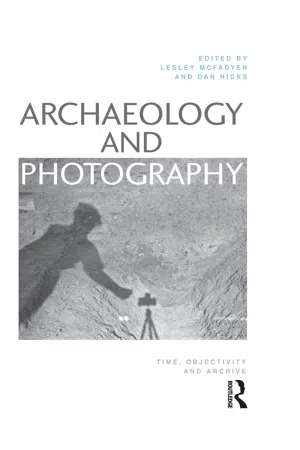
Archaeology and Photography
Time, Objectivity and Archive
- 264 pages
- English
- ePUB (mobile friendly)
- Available on iOS & Android
eBook - ePub
Archaeology and Photography
Time, Objectivity and Archive
About this book
Does a photograph freeze a moment of time? What does it mean to treat a photographic image as an artefact? In the visual culture of the 21st century, do new digital and social forms change the status of photography as archival or objective – or are they revealing something more fundamental about photography's longstanding relationships with time and knowledge?Archaeology and Photography imagines a new kind of Visual Archaeology that tackles these questions. The book reassesses the central place of Photography as an archaeological method, and re-wires our cross-disciplinary conceptions of time, objectivity and archives, from the History of Art to the History of Science.Through twelve new wide-ranging and challenging studies from an emerging generation of archaeological thinkers, Archaeology and Photography introduces new approaches to historical photographs in museums and to contemporaryphotographic practice in the field. The book re-frames the relationship between Photography and Archaeology, past and present, as more than a metaphor or an analogy – but a shared vision.Archaeology and Photography calls for a change in how we think about photography and time. It argues that new archaeological accounts of duration and presence can replace older conceptions of the photograph as a snapshot orremnant received in the present. The book challenges us to imagine Photography, like Archaeology, not as a representation of the past and the reception of traces in the present but as an ongoing transformation of objectivity and archive.Archaeology and Photography will prove indispensable to students, researchers and practitioners in History, Photography, Art, Archaeology, Anthropology, Science and Technology Studies and Museum and Heritage Studies.
Information
1
INTRODUCTION: FROM ARCHAEOGRAPHY TO PHOTOLOGY
Lesley McFadyen and Dan Hicks
To press the shutter release is to capture a moment in time. A photograph represents an instant witnessed through the camera lens. It’s a fragment of time; a visual remnant; ‘a strange stasis, the essence of a stoppage’, as Roland Barthes put it (ça-a-été ) (Barthes 1980: 142, 176).1 Before you know it, this freeze- frame begins to behave like an object. It fits into your jacket pocket, your wallet; it slips between the pages of a book. (The archivist even monitors levels of humidity, temperature and light for the stability of these mummified remains, removes steel paper clips and sticky tape.) An optical residue; this collected or preserved experience bursts into the contemporary, flashes up. To point a camera is to make some kind of punctuation. The photograph, as a retrospective image, somehow projects elements that ‘rise out from the scene like an arrow and come to pierce’ the viewer. It makes ‘a little hole, a small clip’ (Barthes 1980: 48–49)2 – more than just a paper- cut from the photocopier. And the analogy follows effortlessly: this optical sherd that digs into the skin of those who look into the past, this beam in the eye, is like an archaeological artefact, a mechanical trace that reproduces the near past, a present absence – and thus a conundrum of simultaneity. Such a ‘photographic paradox’ must surely (Barthes again) lie in the nature of its content:
What is the content of the photographic message? What does the photograph transmit? By definition, the scene itself, literal reality. From the object to its image there is certainly a reduction – in proportion, in perspective and in colour. But at no time is this reduction a transformation (in the mathematical sense of the term).
BARTHES 1961: 1283
Archaeology and Photography ‘emerged at the same time and under the same interests in the modern world of the first half of the nineteenth century’ (Shanks 2016). We have only to recall the earliest photographs, like Roger Fenton’s 1857 ‘Gallery of Antiquities’ at the British Museum, for example (Figure 1.1), to see the point. Photography and Archaeology hold in common certain concerns: with objectivity, with a detached and hegemonic modernist viewing of the world, with the visual as evidence, with the stoppage of time for the sake of the monumental. And thus, with some kind of multiplication of time wrought by these ‘two devices of western modernity’ (Hamilakis, Anagnostopoulos and Ifantidis 2009: 285). Archaeology and Photography: these twin machines of indexicality cast a deictic light across the contours of ruins. The archaeologist’s trowel whirrs with the prosthetic gesture of a Polaroid camera, sticking out its flat palm which is a photographic print. The archaeo- photographer holds a chunk of the past in their hand and then, through some trick of reverse chiromancy, reads the vivid and inexorable detail of its unique markings – to predict the past. In these ways and

Figure 1.1 Gallery of Antiquities, British Museum by Roger Fenton, 1857. Albumen print from collodion- on-glass negative, 1857 (Royal Photographic Society, National Media Museum, Science and Society Picture Library).
more, Archaeology and Photography are united in the common endeavour of the representation of history. As if each photograph were a relic, and each pot sherd a snapshot, and each tick of the camera a snap of the clock.
Such – the position in italics above – has been the orthodoxy with which our theme, Archaeology and Photography, came to be established as a trope in the archaeo- theory of fin de siècle Representational Archaeology. It is an orthodoxy that this book aims to invert. We are thinking beyond the dogma of the contemporary past, the absent present, the sheer artefactualism of a superficial symbolism, bolstered here and there through partial readings of the work of Roland Barthes, which has reduced each side of this pairing to an analogy for the other. Michael Shanks even repurposed Jim Deetz’s neologism, Archaeography, to express the idea of some post- disciplinary hybridity in the interpretation of the past. Whereas in most areas of cultural studies during the 1980s, Photography came to represent not so much a technical or cultural practice but a theoretical metaphor, in Archaeology it has come to index the methodological fetishization of the artefact as a trace (cf. Krauss 1999: 290; Dubois 2016) – a foundational analogy for the idea that Archaeology represents the past in the present. As if Archaeology and Photography were some version of classical reception studies for visual and material culture – as if trapped inside Fenton’s Gallery of Antiquities forever.
This book experiments with some alternative accounts of observation and participation in Archaeology and Photography. It understands modern technologies and modes of thought as objects of archaeological enquiry, resources for the future not just hegemonies from the past (cf. Hicks and Beaudry 2006; Hicks 2016). It seeks to problematize the artefactualist- presentist assertion of the Representational Archaeology that our discipline works with mere nonhuman ruins and remnants of past moments that are received and interpreted in the symmetry of a contemporary moment (see Shanks 1992; Hamilakis 2008; Bohrer 2011; Hamilakis and Ifantidis 2013, 2016; Carabott et al. 2015; cf. Hicks 2003). It understands Archaeology as a visual medium, in which things are discovered and made visible, not just socially constructed or and culturally represented. Rather than reducing Archaeology and Photography to analogies to each other, collapsing one into a metaphor for the other, playing the mirror games of object and subject, of past and present as signifier and signified, we explore some of the different ways in which Archaeology and Photography can live together, and can intervene in the world.
Three main themes are at stake. In each case, we explore how to imagine alternatives to the Representational Archaeology. First, the different approaches to Objectivity assembled here start to question Barthes’ assertion that the passage from object to image is ‘at no time a transformation’, imagining the human past and its material evidence as far more contingent (Hicks 2010; Hicks and Beaudry 2010). Second, the question of the Archive is framed not in comparative terms, where archaeological remnants are understood to be photographic in quality, but in terms of coexistence and mutual identification of these two methods where archaeological knowledge is unstable (Hicks 2013) – as if, as Bergson put it for science and philosophy, they were ‘meant to implement each other’ (Bergson 1965 [1922]: 5). And third, a close examination of Time in Archaeology and Photography questions ideas of perceptions of short moments of time in the instant and the snapshot, and thus problematizes any notion of constellations of these as ‘multi- temporality’ (cf. Hicks 2016). If the camera is ‘a clock for seeing’, as Barthes has it (1980: 33), then we might take the time to listen to ‘the living sound of the wood’ beyond the instant, in the swing, one tick after another.
A generation ago, when the idea of Archaeology and Photography emerged in the avant-garde ‘post- processual’ work, it was a metaphor for the sociology of archaeological knowledge. The metaphor has since developed into a dominant trope in the archaeo- theory of the Representational Archaeology. Photography represented one vehicle, with the veneer of French theory, now Foucauldian, now Barthesian, through which this sociological critique of the archaeological construction of knowledge of the past in the present could be developed:
Photographs in archaeological texts usually offer either pictorial atmosphere or act as documentary witnesses. The witness says ‘I was there’; the photo says ‘Look and see’. But looking is not innocent. The eye of the camera, the look with perspective is often the gaze of surveillance, the one-way look. .. It belongs with an attitude which would take the past, appropriate the past, pin it down. Mug shots of the past. Inventories. The atmosphere shot may also speak of the restrained immediacy or spectacle of tourism. The act of looking goes with the meanings it finds. Surveillance finds objects to control.
SHANKS 1992: 145-6
This was an explicitly 'critical' sociocultural approach to the knowledge practices of Archaeology as a discipline:
Photographs are often taken for granted in archaeology. They are treated as technical aids, helping to record or identify features and objects, or they may provide illustrative ambience, landscape backdrop, evocations of setting. There is little or no questioning of conventional uses of photography. Archaeological photographs are treated as transparent windows to what they are meant to represent. I aim to inspect this apparent clarity. Taking direction from cultural studies. .. and from the sociology of knowledge. .. my perspective is one of critique, looking within cultural works to reveal sedimented meanings which serve particular interests: it is a negative outlook, aiming, through rational scrutiny, to unveil and debunk neat systems of method and thought, on the grounds that they are always inadequate to reality.
SHANKS 1997: 73
Gradually over the past quarter of a century, this constructivist position has hardened. For example: ‘A successful account of the past,’ it is suggested, ‘is not so much a measure of accordance between the way things were and our archaeological account, as it is a personal and social achievement.’ (Shanks 2007: 589-90, 591). The metaphor of the photograph and the artefact as traces of the past has become ‘the ontology of the past – that it did happen’ (Shanks 2007: 591-2). Archaeology is redefined as ‘a field of archaeological work performed upon the material past that persists into the present, involving (media) representations made of the remains of the past’ (Shanks and Witmore 2012), reduced to the study of the remains of the past in the present in ‘a conjunctive moment of past/present’ (Shanks and Svabo 2013: 100). Archaeology is reduced, in other words, to a subfield of classical reception studies dealing with material culture rather than texts (cf. Hicks 2010). The influence of this work has been felt across studies of the archaeological record (Lucas 2012; Carabott et al. 2015; Doane 2003: 1; Bohrer 2011: 9).
There are doubtless many problems with how archaeological photography has been practised: the formulaic manner in which photographs are set up and taken on an archaeological site, again and again, serving to flatten out the past through a particular form of visualism (cf. Guha 2002; Lyons et al. 2005; Morgan 2016), the monumentalization of sites where the ‘clutter’ of the archaeological process and the human lives that occupied the space within the frame are cleaned up and erased before the shutter is opened (Hamilakis 2008; Bohrer 2011; Hamilakis and Ifantidis 2013, 2016), the objectification of fieldworkers who are included in the frame (Knight 2000; Baird 2011; Riggs 2016), to name but a few. But attempts to develop alternative photographic practices in archaeology, from ‘photo documentaries of theatres of excavation’ (Shanks 1992: 184) or ‘photo- essays’ (Hamilakis and Ifantidis 2013, 2016) to the myriad photographic forms of collaboration between Art and Archaeology, have been of varied success. Such work does not help, and can actively distract from, the problems and the potential of that immense ongoing project of quotidian archaeological prac...
Table of contents
- Cover
- Half Title
- Title Page
- Copyright Page
- Dedication
- Contents
- List of Illustrations
- Notes on Contributors
- Preface
- 1 Introduction: From archaeography to photology
- 2 The transformation of visual archaeology (part one)
- 3 'At any given moment': Duration in archaeology and photography
- 4 Exposing archaeology: Time in archaeological photographs
- 5 Parafictions: A polaroid archaeology
- 6 Archaeology, photography and poetics
- 7 Duration and representation in archaeology and photography
- 8 Photographing buildings
- 9 Photographing graffiti
- 10 Photography, archaeology and visual repatriation
- 11 The aerial imagination
- 12 The transformation of visual archaeology (part two)
- Index
Trusted by 375,005 students
Access to over 1.5 million titles for a fair monthly price.
Study more efficiently using our study tools.
Frequently asked questions
Yes, you can cancel anytime from the Subscription tab in your account settings on the Perlego website. Your subscription will stay active until the end of your current billing period. Learn how to cancel your subscription
No, books cannot be downloaded as external files, such as PDFs, for use outside of Perlego. However, you can download books within the Perlego app for offline reading on mobile or tablet. Learn how to download books offline
We are an online textbook subscription service, where you can get access to an entire online library for less than the price of a single book per month. With over 1.5 million books across 990+ topics, we’ve got you covered! Learn about our mission
Look out for the read-aloud symbol on your next book to see if you can listen to it. The read-aloud tool reads text aloud for you, highlighting the text as it is being read. You can pause it, speed it up and slow it down. Learn more about Read Aloud
Yes! You can use the Perlego app on both iOS and Android devices to read anytime, anywhere — even offline. Perfect for commutes or when you’re on the go.
Please note we cannot support devices running on iOS 13 and Android 7 or earlier. Learn more about using the app
Please note we cannot support devices running on iOS 13 and Android 7 or earlier. Learn more about using the app
Yes, you can access Archaeology and Photography by Lesley McFadyen, Dan Hicks, Lesley McFadyen,Dan Hicks in PDF and/or ePUB format, as well as other popular books in Art & Photography. We have over 1.5 million books available in our catalogue for you to explore.