- 336 pages
- English
- ePUB (mobile friendly)
- Available on iOS & Android
eBook - ePub
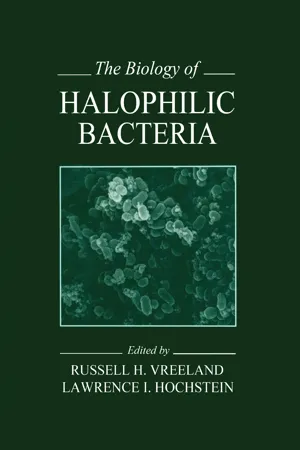
The Biology of Halophilic Bacteria
About this book
A book for anyone interested in halophilic bacteria
The Biology of Halophilic Bacteria presents detailed information regarding methods for working with halophilic bacteria. Helpful hints for performing various tests and assays in high salts are given, and information about data presentation and analysis is provided as well. The book will be useful to molecular biologists, biochemists, ecologists, and others interested in halophilic bacteria.
Information
Chapter
1
Introduction to Saline Environments
Francisco Rodriguez-Valera
Departamento de Genética Molecular y Microbiología Universidad de Alicante Alicante. Spain
1. INTRODUCTION TO SALINE ENVIRONMENTS
This book is concerned with microorganisms adapted to life in an extreme environment containing inorganic salts so highly soluble in water that high concentrations can be reached. This is an important environmental factor on Earth; we have only to consider that there are 4.29 × 10¹⁶ tons of dissolved salts in the waters of the ocean (Ronov, 1968) to realize the importance. Moreover, over the history of the planet, these salts have been precipitated and deposited, forming evaporite rocks amounting to 2% of the sedimentary rock of the continents (Kirkland and Evans, 1981). So many of the environments on our planet challenge their inhabitants with the presence of inorganic salts of differing chemical nature, but sodium chloride (NaCl; common table salt) is normally the most abundant. Thus, most organisms are able to deal with moderate concentrations of salts dissolved in the water surrounding them. Obviously, all marine organisms can endure, and very often require, the salinity of the ocean, which is remarkably constant around the world and is close to 3.5%* of total salts. What happens, however, when the salts exceed these limits? A domain is entered in which salinity plays a dominant role in determining the biota present. The environment becomes extreme and inhibitory for the majority of organisms, so that a highly specialized microflora develops having a physiology favored by the presence of high concentrations of salts, mostly NaCl. These organisms are the halophiles. This chapter considers the saline environments, their special characteristics and how they interact with halophilic microorganisms. As stated, hypersaline environments are extreme environments, so the chapter begins by analyzing the concept of extreme environments and extremophiles.
2. EXTREME ENVIRONMENTS
A simple definition of extreme environments is that they are unfavorable, or even lethal, to most living organisms. “Most” is emphasized because organisms exist that are specifically geared to a life in extreme environmental conditions. These organisms, recently named extremophiles, not only tolerate but prefer or even require extreme conditions for their development. Brock (1979) devised a more precise definition, based on taxonomic criteria: “environments in which species diversity is low, and some taxonomic groups are missing”. Low taxonomic diversity is a feature common to all extreme environments. Usually a gradient can be found, diversity decreasing as conditions become more extreme (Rodriguez-Valera, 1988). These extremely simple ecosystems are ideal to study, and the development of models of theoretical ecology, nutrient cycling, and trophic chains can be very simple.
What conditions make an environment extreme? Almost any factor affecting biological processes can be responsible for creating extreme environments. Life is widely distributed on the Earth’s surface (hydrosphere and atmosphere); however, certain conditions are required in order to perform the physiological processes that are essential conditions for the maintainance of a stable ecosystem. One oft-recognized condition is the existence of liquid water. This does not imply that the temperature range for life is between 0° and 100°C. Cells can accumulate solutes and lower the freezing point several degrees. At the other extreme, pressure can keep water liquid at very high temperatures, as happens in deep ocean hydrothermal vents. Brock (1979) hypothesized that life is possible over the whole range of temperatures where water remains in liquid form, but recent evidence indicates that the range is probably much narrower (White, 1984; McMeekin and Franzmann, 1988).
Another basic condition for life is the existence of a source of biologically utilizable energy and nutrients for the building of biomass. The Earth’s environments that meet these conditions are diverse, however, most have the following characteristics: intermediate temperatures, neutral pH, pressure of only a few atmospheres, abundant oxygen, and the salinity of fresh- or seawater. These are what could be called “normal conditions” in the sense that they are very common in the biosphere. It is, therefore, quite understandable that the evolution of most organisms has caused them to live in these conditions and to be affected negatively by important deviations from these values.
It is obvious that life processes are strongly affected by the environment; the macromolecules essential to life, as well as the chemical reactions occurring in biological processes, are in general rather sensitive to physicochemical parameters. It is also true that living cells have ways of creating an intracellular environment that can be very different from the milieu outside. However, the capacity of cells to control physical parameters such as temperature, pressure, or radiation is very limited in all but highly evolved multicellular organisms. Moreover, certain essential structures and enzymes (e.g., cell envelopes or transport systems) must be exposed. As a result, every organism has its own optimum, maximum, and minimum environmental conditions for life. The response in microorganisms is usually measured by growth, which is simple to quantify. The growth range is useful because it shows the set of environments in which the organism can play an active role. Growth response and survival are also extremely diverse in microorganisms, and the growth range of organisms isolated from different environments often do not overlap. For example, the temperature range for growth of bacteria from thermal and cold environments can be as much as 100°C apart, The shape of the response curve can also vary from wide to narrow, with a steep slope and narrow maximum or with a relatively homogeneous, rather flat response.
This diversity reflects the plasticity of life. Enzymes, membranes, and nucleic acids can be adapted to fulfill their functions under very different conditions. When the nature growth range of one organism moves into an environment apart from the conditions preferred by most others (an environmental extreme), the organism becomes an extremophile. Most extremophiles become confined to extreme environments because the adaptation process is usually accompanied by a loss of the capacity to grow in normal conditions.
What kind of evolutionary trend can drive an organism to become an extremophile? There may be different answers to this question. First, we have to consider that the predominant conditions on Earth have changed throughout its history. What is extreme now could have been normal in the Archaean, and organisms that evolved in those times could still thrive, utilizing pockets of primitive conditions remaining on the planet. It has been speculated that one extremophilic group (the archaebacteria) (Woese, 1977) belongs to this type. All the archaebacteria inhabit environments which can be considered extreme in some aspects — thermal, hypersaline, or anaerobic — and they are also the most extreme of extremophiles, the most thermophilic, halophilic, and oxygen-sensitive organisms. Also, their extremophilic physiology is of a type that it is difficult to explain as having evolved from a “normophilic” ancestor.
Another type of extremophile is the kind that has evolved from an organism living in a normal environment, or perhaps a more moderate one. It seems logical that such extremophiles would develop the simplest physiological mechanisms of resistance, or those requiring the minimum amount of change of genetic information (Yancey et al., 1982), producing less specialization.
As stated by Brock (1979), “only extreme environments able to serve as sites for long-term evolution, will allow the development of complex mechanisms of adaptation to their conditions”. I would add that the long term would also allow relatively more different species (phylogenetic lines) to adapt. Obviously, there is also an effect inherent to each specific environmental factor, and the degree to which it disturbs biological processes, on the amount of time required for evolution to produce an organism adapted to the specific set of conditions.
In summary, we can imagine an infinite number of extreme environments, since almost any factor will influence biological processes. Only those that are present in nature in some abundance, however, will be of biological interest and will have produced specialized extremophiles.
3. TYPES OF SALINE ENVIRONMENTS
There are two major types of biologically important environments in which the salt factor will interact with the microbial populations, soil and water. Soils containing >0.2% soluble salts are considered saline (Kaurichev, 1980). They are very common around the world, particularly (although by no means exclusively) in arid regions. Many plants are adapted to develop under these conditions (globally termed halophytes). The range of salinities that can be found in soils is very wide and a complex microflora develops over most of this range (Quesada et al., 1982); however, the existing information about halophilic soil microflora is very fragmentary.
Saline waters are much better known. Besides the ocean proper, there are many waters with a salinity similar to that of seawater. Both coastal systems, such as salt marshes, and some saline lakes far from any coast can be included. Lakes are considered saline if they have >0.3% salinity (De Dekker, 1983). Very few halophilic organisms are found in this type of water. Hypersaline waters are those containing salt concentrations notably higher than those of seawater (Edgerton and Brimblecome, 1981). Since both the concentrations of salts and their nature can vary, such hypersaline systems can be classified according to different criteria.
There are two major factors to consider; the first is the origin and the nature of the salts. Many hypersaline bodies of water arise from the evaporation of seawater, and such aquatic environments are called thalassohaline (from the Greek thalasso, the sea). In a strict sense thalassohaline waters are those related by origin to the sea, the most typical example being a coastal lagoon fed by seawater. Nevertheless, the term is normally used to refer to any hypersaline water body in which salts are present in roughly the same proportions as those found in seawater (Brock, 1979; Williams, 1981). This loose delimitation includes many environments with salts originating from mineral deposits, but where chemical compositions are similar to those of brines produced by the concentration of seawater. In this sense the term can include all chloride-sulfate waters (see below). For instance, the Great Salt Lake, located nearly 1000 km from the Pacific Coast is thalassohaline. From an ecological point of view, the concept of thalassic waters is consistent because the organisms and ecological interactions seem to be similar in all such environments.
Other hypersaline waters derive from the dissolution of salts of continental origin. Many of these lack some of the components found in seawater salts, or contain different predominant ions, varying notably from the proportions in seawater. These are called athalassohaline waters. The composition of athalassohaline waters depends on many factors (discussed later), which are accordingly very diverse, although some biological or chemical patterns are more common than others. In the most common types special populations of organisms with specific adaptations can be found. In others, due to their special characteristics a normal thalassic microflora is present, though diversity is often restricted.
The second factor to consider when classifying hypersaline waters is the salt concentration. The lower limit to which the term hypersaline can be applied is not clear, and different authors apply different arbitrary limits ranging from 3 to 12% salinity (Post et al., 1983; Por, 1980). One argument which has often been used is that in hypersaline waters the high concentration of salts is the prime factor in the drastic reduction of species diversity (Por, 1980). In other works, a limit is located at around 10 to 12% salinity, below which other environmental factors predominate in determining the populations of organisms; above it the salinity factor becomes the major determinant and the biota found is similar regardless of geographical location. This 10 to 12% range is sometimes called mesosaline (Kirkland and Evans, 1981). For thalassohaline, there is also an upper limit of concentration that can be established at around 35%. Here, NaCl starts precipitating copiously and the proportions of salts start shifting rapidly to a magnesium preponderance. However, the concentrations at which NaCl precipitates also marks the upper limit of resistance of all biological forms (Javor, 1983).
4. ORIGIN, DISTRIBUTION, AND ABUNDANCE OF TYPES
As previously mentioned, the distribution and abundance of a specific type of extreme environment is very important for the degree of specialization of the biota. If one type of environment is common in the biosphere, has a wide geographical distribution, and possesses a certain constancy in its characteristics throughout geological periods, one can presume that a long and complex evolutionary process could have taken place. In the case of hypersalinity it is clear that the above considerations ap...
Table of contents
- Cover
- Title Page
- Copyright Page
- Introduction
- The Editors
- Table of Contents
- Chapter 1 Introduction to Saline Environments
- Chapter 2 Ecology of Extremely Halophilic Microorganisms
- Chapter 3 Ecology of Moderately Halophilic Bacteria
- Chapter 4 Growth and Nutrition of Halophilic Bacteria
- Chapter 5 Taxonomy of Halophilic Bacteria
- Chapter 6 Lipids of Extreme Halophiles
- Chapter 7 Lipids of Halophilic and Halotolerant Microorganisms
- Chapter 8 Osmotic Adaptation in Halophilic and Halotolerant Microorganisms
- Chapter 9 The Molecular Biology of Halophilic Archaebacteria
- Chapter 10 Bioenergetics and Transport in Extreme Halophiles
- Index
Trusted by 375,005 students
Access to over 1.5 million titles for a fair monthly price.
Study more efficiently using our study tools.
Frequently asked questions
Yes, you can cancel anytime from the Subscription tab in your account settings on the Perlego website. Your subscription will stay active until the end of your current billing period. Learn how to cancel your subscription
No, books cannot be downloaded as external files, such as PDFs, for use outside of Perlego. However, you can download books within the Perlego app for offline reading on mobile or tablet. Learn how to download books offline
Perlego offers two plans: Essential and Complete
- Essential is ideal for learners and professionals who enjoy exploring a wide range of subjects. Access the Essential Library with 800,000+ trusted titles and best-sellers across business, personal growth, and the humanities. Includes unlimited reading time and Standard Read Aloud voice.
- Complete: Perfect for advanced learners and researchers needing full, unrestricted access. Unlock 1.5M+ books across hundreds of subjects, including academic and specialized titles. The Complete Plan also includes advanced features like Premium Read Aloud and Research Assistant.
We are an online textbook subscription service, where you can get access to an entire online library for less than the price of a single book per month. With over 1.5 million books across 990+ topics, we’ve got you covered! Learn about our mission
Look out for the read-aloud symbol on your next book to see if you can listen to it. The read-aloud tool reads text aloud for you, highlighting the text as it is being read. You can pause it, speed it up and slow it down. Learn more about Read Aloud
Yes! You can use the Perlego app on both iOS and Android devices to read anytime, anywhere — even offline. Perfect for commutes or when you’re on the go.
Please note we cannot support devices running on iOS 13 and Android 7 or earlier. Learn more about using the app
Please note we cannot support devices running on iOS 13 and Android 7 or earlier. Learn more about using the app
Yes, you can access The Biology of Halophilic Bacteria by Russell H. Vreeland,Lawrence I. Hochstein in PDF and/or ePUB format, as well as other popular books in Biological Sciences & Ecology. We have over 1.5 million books available in our catalogue for you to explore.