- 550 pages
- English
- ePUB (mobile friendly)
- Available on iOS & Android
eBook - ePub
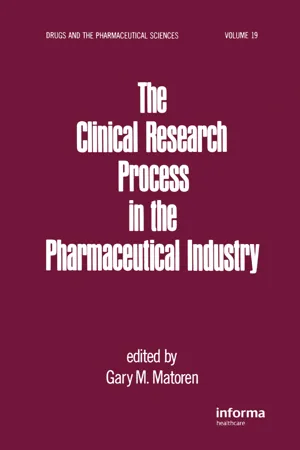
The Clinical Research Process in the Pharmaceutical Industry
About this book
This book examines the sequence of events and methodology in the industrial clinical research process; a reference for multidisciplinary personnel. It is the conceptual framework involving the philosophical, economic, political, historical, regulatory, planning, and marketing aspects of the process.
Information
1
Pharmogenology: The Industrial New Drug Development Process
E. S. Neiss and T. A. Boyd Revlon Health Care Group Tuckahoe, New York
- I. Pharmogeny
- II. Market Planning
- III. Drugs Are Chemicals
- IV. Prioritization
- V. Screening
- VI. Lead Following
- VII. Feedback
- VIII. Resources
- IX. The Chemist
- X. The Preclinical Trail
- XI. The Biologist
- XII. The Pharmaceutical Scientist
- XIII. Biopharmaceutics
- XIV. Drug Safety Evaluations
- A. Acute toxicology
- B. Chronic toxicology
- C. Reproduction studies
- XV. The Clinical Trial
- A. The area team
- B. The "First In Man" committee
- C. Phase I clinical studies
- D. Phase II clinical studies
- E. Phase III clinical studies
- XVI. Project Management
- XVII. The Product
- References
I. Pharmogeny
The era of drug discovery, development, and application to patient care of these past 50 years has had profound, positive effects on humanity. This era is shared by rapid advancement in communications, transportation, agriculture, and other technological changes, of which all cannot be held in the same esteem as the salutary contributions of the pharmaceutical industry.
Economic forces together with growing regulatory requirements have so modulated the talented efforts of industrial pharmaceutical scientists that a special system or process of drug research and development has evolved. This chapter and much of this book deals with pharmogeny, the genesis or origin of drug products. As such, this text is one of pharmogenology, the study of the process involved in the genesis of new drug products. It is not surprising that these neologisms have not yet attained complete acceptance, as they violate a basic principle of English, namely, that all roots of a word should derive from the same language. However, perhaps violation of tradition in this case makes these terms even more appropriate—for, in fact, what is referred to as pharmogenology is a great mélange of sciences and technologies and represents a unique interdisciplinary amalgam of scientific efforts that may well deserve to be designated by a word which is itself a hybrid.
Patients who benefit from a drug encounter a dosage form and recognize it only as a medicine prescribed by their physician. The medical consumer has become accustomed to having a wide variety of medicines available to treat the signs and symptoms of their diseases. These drug products are the basis for a business called the pharmaceutical industry.
As in all other aspects of commerce, drug products must compete for the customers' attention and selection. For the pharmaceutical industry, the physician is the customer. Those drugs that meet the needs and wants of the physician who acts on behalf of patients will be prescribed and purchased and so achieve an increasing market share and become economic successes. Those drug products that do not satisfy the needs of the physician and patient will soon lose their market share. Since the aim of business is to continue to attract and progressively satisfy more customers, it behooves the pharmaceutical company to clearly identify its targets both qualitatively and quantitatively.
II. Market Planning
It may come as a surprise to some readers to find that this overview of the industrial new drug development process begins by first addressing the concept of market planning. This may be related to the misperception generally shared by the public that a better product, or one with new attributes, will automatically compete successfully with available products with lesser attributes.
Without proper promotion and marketing this does not usually happen. In medicine, where the busy and preoccupied physician is the customer, it is often quite difficult to convince him to change prescribing habits from that with which he is comfortable and confident. Indeed success of a new drug product is much more likely if it is the first such product available for a given indication. When this is not the case, market research can indicate where a need exists for new drug products which better meet the patient's needs and better satisfy the physician's wants with respect to the benefits provided by the product and the risks attendant to it (1).
Market research groups have a variety of techniques of market analysis which help to define those therapeutic areas in which more effective or safer drugs are needed. This identification is really the first step in the industrial new drug development process. While several pharmaceutical companies may recognize similar opportunities, the history of the firm, its present drug product profile and mix, the nature of its sales force and technical representatives, and corporate strategic planning all contribute holistically to the selection of the areas to which research and development (R&D) resources should be applied.
If, however, R&D is to produce totally novel or unique modes of therapy, it is less appropriate to defer to market analysis for direction. This is because market research tends to be historic in nature and can measure only the existing markets and the trends seen in them. Medically oriented industrial research personnel sire in a better position to recognize therapeutic discontinuities, heterogeneity of disease states requiring more specific therapeutics, and opportunities for drug product applications that are innovative. Once such an innovative approach is identified, an in-depth market analysis should be done to attempt to assess the concept's commercial feasibility.
A spirit of joint enterprise and a mutual appreciation of the roles and capabilities between the R&D community and the marketing community is essential if potential new drugs are to be translated into articles of therapeutic commerce. In the well-managed pharmaceutical company, such collaboration will allow both for the generation of new drug products in response to technical market analyses and for a major commitment to new and unique approaches to disease. For instance, market analysis of the agents used to treat glaucoma might not have predicted the major success of timolol maleate solution, and the sales of therapeutics for peptic ulcer might not have identified a billion dollar market following the introduction of cimetidine hydrochloride.
Just as market planning groups must be staunch advocates of their proposals based on sound analytical techniques, so also the industrial scientists and managers must champion their novel approaches or goals if major advances are to be realized. In the end, the enthusiasm of both groups must be aroused and all within the pharmaceutical company must be persuaded of the soundness of the direction chosen. As the research process moves forward and as Chemical Lead Compounds advance to Biological Lead Compounds, thence to Clinical Candidates, Investigational New Drugs (INDs), and finally to an approved drug product for commerce, the challenge of convincing the physician-customer that a better drug product is now available is prodigious and equal in effort to all of that which preceded it in its development.
The final step in the industrial new drug development process is to convince the medical community to prescribe the new medication for the patients for whom it is intended. This difficult task is eased if the marketing organization has participated in the drug development process from the beginning.
III. Drugs are Chemicals
A well-organized and operated R&D community can usually attain the desired goals of a carefully constructed marketing plan. Providing they are reasonable goals, it is not really a question of whether these goals will be attained but rather when. The journey for a new drug from the chemist's bench to the physician's prescription pad is one that requires some 10 years and presently costs about $70 million. Of each 10,000 compounds synthesized by the scientists in the search for totally new drug products, only one has the biological, pharmaceutical, and clinical attributes to survive all the way to the marketplace (2).
The drug development process is a terribly expensive one; its costs inexorably increase as governments require progressively more preclinical and clinical studies to assure the safety of new drugs. There is no such thing as a totally safe drug. Drugs are chemicals that manifest desirable biological and therapeutic attributes, but they also have concomitant and attendant undesirable attributes, designated "side effects" or "toxicity."
A good drug has a favorable ratio of benefit (or therapeutic effect) to risk (or adverse effect) for the desired clinical situation. A drug is a highly sophisticated instrument which can be used correctly and effectively, or poorly and with adversity. Greater increases in testing will not make these potent chemicals safer. Only their proper use by well-informed clinicians who monitor their patients' responses to them can provide reasonable safety. Unfortunately, the rare and unanticipated anomalous adverse effects usually could not have been discovered even by excessively large batteries of premarketing studies and testing. Their discovery remains in the domain of postmarketing surveillance by a vigilant medical community and epidemiologists (3). Despite these facts, governments continue to require growing numbers of extensive and expensive preclinical and clinical studies in an attempt to diminish risks attendant to new drug development. This has resulted in the extraordinary costs of basic research and subsequent development which are comparatively greater in the pharmaceutical industry than in other technologically oriented businesses. An obvious tenet of a research-based pharmaceutical company is that it must make sufficient profits to pay for R&D and other costs of business. This is accomplished by the introduction into therapeutic commerce of a continuum of profitable new drug products.
IV. Prioritization
Applied or directed science requires targets that are clearly identified and of sufficient temporal longevity. Unclear or ephemeral or moving targets are counterproductive and demoralizing to the R&D organization. The planning function of a company must have its positions and recommendations carefully analyzed and critiqued by the company executive body. The endorsed or revised plans and positions are subsequently communicated fully and clearly to the R&D management. Failure to do this has led to inappropriate allocation of R&D resources in some companies with much loss of time and productivity.
When the process of industrial drug development is optimal, a committee to interface the marketing management and R&D management regularly addresses the corporate drug product needs and opportunities in a clear and precise manner. That body should be convened several times yearly to address expectations or required changes in priorities as a function of changes in business or findings of the R&D programs. The existence of such a mechanism is an important component of the industrial drug development process, as the committee provides the needed direction for optimal resource utilization by R&D management. The prioritization and program review process does not preclude innovation or creativity by the R&D community. It does, however, specify where that community should be heading. How R&D gets there—and explicitly how to define "there"—is a task given to the research community. For instance, if a market planning group and the company executive management stated their desire for a new drug approach to the pro...
Table of contents
- Cover
- Half Title
- Series Page
- Title Page
- Copyright Page
- Dedication Page
- Foreword
- Preface
- Acknowledgments
- Contributors
- Contents
- Introduction
- 1 Pharmogenology: The Industrial New Drug Development Process
- 2 Research Planning and Development Perspectives
- 3 Historical Review
- 4 Legal and Ethical Problems in Clinical Research
- 5 Social Psychological Implications of Clinical Research
- 6 Clinical Project Coordination
- 7 The Protocol and Case Report Form
- 8 Clinical Data Management and Statistical Design in the Clinical Research Process
- 9 Document Preparation
- 10 Clinical Pharmacology
- 11 Clinical Research
- 12 The Monitoring Process
- 13 Drug Safety Evaluation and implications for Clinical Investigation
- 14 Special Considerations of Drug Disposition
- 15 Product Development
- 16 Over-the-Counter Drug Research
- 17 Postmarketing Surveillance of Drugs
- 18 Research Quality Assurance
- 19 Role of Contract Research Organizations
- 20 Drug Regulatory Affairs
- 21 Relationship of Marketing to Clinical Research
- 22 Impact of the Pharmaceutical Industry on Health Care and Health Care Economics
- 23 Role of the FDA in the Clinical Research Process
- 24 Clinical Pharmacy and Its Relationship to Clinical Research
- 25 Career Opportunities in Industrial Clinical Research
- 26 Recent Trends: The Impact of the Environment on Research Strategies and Productivity
- 27 A Futuristic View
- Index
Trusted by 375,005 students
Access to over 1.5 million titles for a fair monthly price.
Study more efficiently using our study tools.
Frequently asked questions
Yes, you can cancel anytime from the Subscription tab in your account settings on the Perlego website. Your subscription will stay active until the end of your current billing period. Learn how to cancel your subscription
No, books cannot be downloaded as external files, such as PDFs, for use outside of Perlego. However, you can download books within the Perlego app for offline reading on mobile or tablet. Learn how to download books offline
Perlego offers two plans: Essential and Complete
- Essential is ideal for learners and professionals who enjoy exploring a wide range of subjects. Access the Essential Library with 800,000+ trusted titles and best-sellers across business, personal growth, and the humanities. Includes unlimited reading time and Standard Read Aloud voice.
- Complete: Perfect for advanced learners and researchers needing full, unrestricted access. Unlock 1.5M+ books across hundreds of subjects, including academic and specialized titles. The Complete Plan also includes advanced features like Premium Read Aloud and Research Assistant.
We are an online textbook subscription service, where you can get access to an entire online library for less than the price of a single book per month. With over 1.5 million books across 990+ topics, we’ve got you covered! Learn about our mission
Look out for the read-aloud symbol on your next book to see if you can listen to it. The read-aloud tool reads text aloud for you, highlighting the text as it is being read. You can pause it, speed it up and slow it down. Learn more about Read Aloud
Yes! You can use the Perlego app on both iOS and Android devices to read anytime, anywhere — even offline. Perfect for commutes or when you’re on the go.
Please note we cannot support devices running on iOS 13 and Android 7 or earlier. Learn more about using the app
Please note we cannot support devices running on iOS 13 and Android 7 or earlier. Learn more about using the app
Yes, you can access The Clinical Research Process in the Pharmaceutical Industry by Gary M. Matoren in PDF and/or ePUB format, as well as other popular books in Medicine & Pharmaceutical, Biotechnology & Healthcare Industry. We have over 1.5 million books available in our catalogue for you to explore.