Agile, DevOps and Cloud Computing with Microsoft Azure
eBook - ePub

Agile, DevOps and Cloud Computing with Microsoft Azure

Hands-On DevOps practices implementation using Azure DevOps

  1. English
  2. ePUB (mobile friendly)
  3. Available on iOS & Android
eBook - ePub

Agile, DevOps and Cloud Computing with Microsoft Azure

Hands-On DevOps practices implementation using Azure DevOps

About this book

A step-by-step guide to understand Agile, Scrum, DevOps and Cloud Computing using Azure DevOps and Microsoft Azure Cloud Key Features

  • Learn how to do Continuous Planning in Azure DevOps
  • Learn the basics of Continuous Code Inspection and importance of Code Quality
  • Learn how continuous integration can make a difference in the application life cycle
  • Create and configure Cloud resources using Platform as a Service Model
  • Learn how to perform continuous integration using the YAML script and continuous delivery pipeline using a release pipeline
  • Learn how to configure monitoring for Platform as a Service resources


Description
Agile development and implementation of Scrum methodologies require quick delivery of applications. Manual activities to manage application lifecycle management are no longer sufficient. This book will cover the DevOps practices implementation that helps to achieve speed for faster time to market using transformation in culture using people, processes, and tools.
This book discusses the definition of Cloud computing and the benefits of Cloud Service Models. You will understand how Agile, DevOps practices implementation and Cloud computing can be utilized effectively to transform the culture of an organization.
The main objective of this book is to demonstrate continuous practices of the DevOps culture using Microsoft Azure DevOps and Microsoft Azure Cloud. You will learn how to track features, user stories, backlogs, dashboards, and burndown charts. You will also learn how to create and manage repositories. This book gives an overview of Microsoft Azure Cloud and Azure App Services and a brief description of virtual machines and App Services. It summarizes Build and Release definitions available in Microsoft Azure DevOps and explains how to configure Pipelines and create end-to-end automation pipelines. What You Will Learn
By the end of the book, you will get an overview of Agile, Scrum, DevOps and Continuous Practices such as Continuous Integration, Continuous Delivery, Cloud Computing, and Continuous Code Inspection. You will learn how all these practices can be utilized in real-life scenarios with the sample applications. This book will provide detailed insights into Microsoft Azure Cloud, especially Platform as a Service Model. A step-by-step implementation guide of continuous practices of DevOps will help beginners to get started with. Who This Book is For

  • DevOps Evangelists, DevOps Engineers, Technical Specialists, Technical Architects, and Cloud Experts
  • Basic knowledge of application development and deployment, Cloud computing, and DevOps practices
  • Beginners

  • Table of Contents
    1. An overview of Agile
    2. Need for DevOps
    3. An overview of Cloud Computing
    4. Azure Boards
    5. Azure Repos
    6. Microsoft Azure Cloud
    7. Microsoft Azure Cloud: IaaS and PaaS
    8. Azure Pipelines: Continuous Integration and Continuous Delivery
    9. Azure Pipelines Implementation About the Author
    Mitesh Soni is an avid learner with 10 years of experience in the IT industry. He is an SCJP, SCWCD, and VCP. He is IBM Urbancode- and IBM Bluemix-certified, and is also a Certified Jenkins Engineer. He loves DevOps and cloud computing, and he also has an interest in programming in Java. He finds design patterns fascinating and believes that a picture is worth a thousand words. He occasionally contributes to clean-clouds and etutorials world websites. He loves to play with his kids, fiddle with his camera, and take photographs at Indroda Park.

Frequently asked questions

Yes, you can cancel anytime from the Subscription tab in your account settings on the Perlego website. Your subscription will stay active until the end of your current billing period. Learn how to cancel your subscription.
At the moment all of our mobile-responsive ePub books are available to download via the app. Most of our PDFs are also available to download and we're working on making the final remaining ones downloadable now. Learn more here.
Perlego offers two plans: Essential and Complete
  • Essential is ideal for learners and professionals who enjoy exploring a wide range of subjects. Access the Essential Library with 800,000+ trusted titles and best-sellers across business, personal growth, and the humanities. Includes unlimited reading time and Standard Read Aloud voice.
  • Complete: Perfect for advanced learners and researchers needing full, unrestricted access. Unlock 1.4M+ books across hundreds of subjects, including academic and specialized titles. The Complete Plan also includes advanced features like Premium Read Aloud and Research Assistant.
Both plans are available with monthly, semester, or annual billing cycles.
We are an online textbook subscription service, where you can get access to an entire online library for less than the price of a single book per month. With over 1 million books across 1000+ topics, we’ve got you covered! Learn more here.
Look out for the read-aloud symbol on your next book to see if you can listen to it. The read-aloud tool reads text aloud for you, highlighting the text as it is being read. You can pause it, speed it up and slow it down. Learn more here.
Yes! You can use the Perlego app on both iOS or Android devices to read anytime, anywhere — even offline. Perfect for commutes or when you’re on the go.
Please note we cannot support devices running on iOS 13 and Android 7 or earlier. Learn more about using the app.
Yes, you can access Agile, DevOps and Cloud Computing with Microsoft Azure by Mitesh Soni in PDF and/or ePUB format, as well as other popular books in Computer Science & Cloud Computing. We have over one million books available in our catalogue for you to explore.

CHAPTER 1

Overview of Agile and Scrum Framework

Agile is an idea or a philosophy. Every organization want to become Agile. They want to adopt Agile principles to achieve better quality and faster time to market. However, for Agile to make sense, it is important to understand the traditional waterfall model approach, and understand its challenges. I will share my experiences whenever it is relevant. The important thing to consider here is that I have tried to map a lot of concepts with Azure DevOps dashboard mapping for better visualization. In this book, I am focusing on Azure DevOps, however, the book will also cover Agile, Scrum, cloud computing, DevOps, and the continuous practices of DevOps.

Structure

In this chapter, we will cover the following topics:
  • Waterfall model
  • Agile way of software development
  • Scrum
  • The Scrum Team
  • Product Backlog
  • Scrum events
  • Certified Scrum Master (CSM) Certification
  • How Agile/Scrum Framework brings culture change?

Objective

The aim of this chapter is to explain the details of the Waterfall model, Agile values, and principles, and provide details on how Agile has changed the game for organizations in their approaches.

Waterfall model

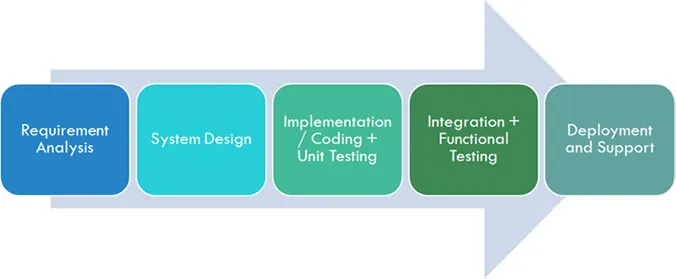
The Waterfall model was one of the most popular models to develop software before Agile arrived. It is simple and easy to understand. Waterfall model is a linear and sequential model where each phase in Software Development Life Cycle (SDLC) starts when the previous one is completed. There are different phases in the Waterfall model as described in the following diagram:
Figure 1.1: Waterfall model
The Waterfall model is extremely useful when all the requirements are clear and well defined. Organizations know exactly what needs to be implemented. Technology and market are not dynamic; all skilled resources are available to implement all the features.
However, we know that reality is different. Tom Clancy has rightly said, The difference between fiction and reality? Fiction has to make sense. At times, based on market situation, technology evaluation, and competition, the reality is far different than what Waterfall model can cope up with. Let’s understand what are the challenges in the Waterfall approach. The following are the challenges faced by the Waterfall model:
  • Product or application is available only after entire lifecycle is completed.
  • It results into surprises or a shock if requirements are not understood correctly.
Figure 1.2: Expectations vs. Reality
  • Customers or end users have no say once a phase starts.
  • No mechanism to integrate and adopt continuous feedback from the customers.
  • Very difficult to accommodate changes even if market scenario requires them.
The above-mentioned challenges of waterfall model made way for Agile values and principles, as well as frameworks that implement those values and principles.

Agile way of software development

Agile is an idea or a philosophy. First time ever, Divide and Rule policy is helping businesses never like before. Divide the feature implementation in different phases, take continuous feedback from the customer, and rule over customer’s heart and mind. Agile brings pace to development and delivery, while DevOps practices make sure that the pace is maintained, and hence it complements Agile. Consider Agile as an engine of a train while DevOps practices or continuous practices or automation as a smooth track.
The Agile Manifesto was created in 2001 to find better approaches to build software or application. The Agile Manifesto includes four values and twelve principles. It helps to integrate new cultures in application development process. The main objective is to have a high quality package with faster time to market.

Values

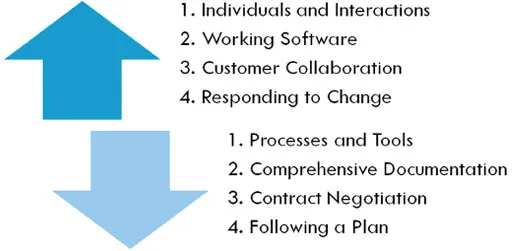
There are four values according to Agile Manifesto:
Figure 1.3: Agile values
Let’s understand the most important of all values, which is explained as follows:
  • Individuals and interactions over processes and tools: People or professionals are more important in the process of transforming existing cultures. Processes and Tools are important but not more than people. People across the level drive the organizations and hence they are more important to bring the change. With respect to culture change, interaction within project teams, across different locations in the same business unit, and within different business units of an organization are important.
  • Working software over comprehensive documentation: Traditionally, software development process includes many types of documentation such as requirements documentation, UI design documentation, architecture design documentation, technical documentation, quality assurance documentation, user documentation, and so on. Effective documentation with development process is an additional work. Agile inspires a change where it manages documentation in the form of epics, user stories, tasks, and so on. Agile supports minimum yet sufficient documentation, and hence the focus remains on working software.
  • Customer collaboration over contract negotiation: Customer collaboration at every stage of application development not only helps to gain customer confidence, but also helps to build a high-quality application according to customer expectations. Continuous feedback helps in faster time to market. It avoids unnecessary delays.
  • Responding to change over following a plan: Change is constant. Improvement is impossible without change. In the Waterfall model, it is very difficult to inject change due to ...

Table of contents

  1. Cover Page
  2. Title Page
  3. Copyright Page
  4. Dedication
  5. About the Author
  6. About the Reviewer
  7. Acknowledgement
  8. Preface
  9. Errata
  10. Table of Contents
  11. 1. Overview of Agile and Scrum Framework
  12. 2. DevOps Culture and Continuous Practices
  13. 3. Overview of Cloud Computing and Containers
  14. 4. Azure Boards
  15. 5. Azure Repos
  16. 6. Microsoft Azure Cloud
  17. 7. Microsoft Azure Cloud–Iaas and PaaS
  18. 8. Azure DevOps - Continuous Integration
  19. 9. Azure DevOps –Continuous Delivery
  20. 10. Multi-stage Pipelines in Azure DevOps
  21. Index