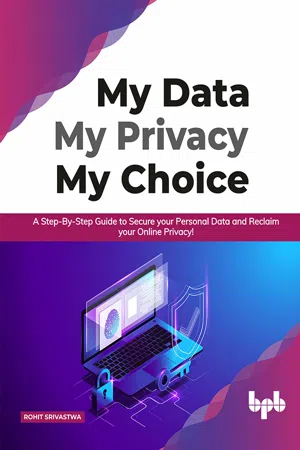
Learn to secure your personal data & reclaim your online privacy! Key Features
Understand your cyber risk exposure by calculating your Privacy Score™
Improve your Privacy Score with easy-to-follow recommendations
Different recommendations for different levels of expertise – YOUR choice!
An 'interactive' book with inline QR code references for further learning!
Instantly applicable recommendations that show immediate results!
Gamification of recommended actions to incentivize best practice behaviors
Quantifiable* improvement by the end of the book!
Description This book intends to be a comprehensive step-by-step guide on how to take control of all your digital footprints on the internet. You will begin with a quick analysis that will calculate your current Privacy Score. The aim of this book is to improve this Privacy Score by the end of the book. By the end of this book, you will have ensured that the information being leaked by your phone, your desktop, your browser, and your internet connection is minimal-to-none. All your online accounts for email, social networks, banking, shopping, etc. will be made secure and (almost) impervious to attackers. You will have complete control over all of your personal information that is available in public view. Your personal information belongs to you and you alone. It should never ever be available for anyone else to see without your knowledge and without your explicit permission. What will you learn ? How to safeguard your privacy online ? How to secure your personal data & keep it private ? How to prevent your devices from leaking your private info ? How to prevent various websites & services from 'spying' on you ? How to 'lock down' your social media profiles ? How to identify threats to your privacy and what counter-measures to take Who this book is for Anyone who values their digital security and privacy and wishes to 'lock down' their personal data will find this book useful. Corporate IT departments can use this as a reference book to design data security practices and training modules for employees. Table of Contents 1. Prologue 2. Internet and Privacy 3. Android Devices 4. Apple iPhones 5. Smartphone Apps 6. Smart Devices & IoT 7. Desktops – Operating Systems 8. Desktops – Software Applications 9. Desktops – Browsers 10. Services - Email 11. Software-as-a-Service (SaaS) 12. Networks: Connectivity, & Internet 13. Operational Security (OPSEC) 14. Epilogue 15. Bonus Chapter: Useful Tips and Tricks About the Author Rohit Srivastwa is a well-known Security Evangelist with extensive experience in Cyber Security, Enterprise Security, Secure Digital Transformation, and Cyber warfare. He founded India's first-ever hackers' conference and community named "ClubHack".." A serial entrepreneur, his most recent startup was acquired by QuickHeal Technology Ltd in 2016. His LinkedIn Profile: https://linkedin.com/in/rohit11
Hello, there! Before you dive into the rest of this book, I’d like to ask you to do something.
Take your smartphone, open the scanner app (or the camera app, if it supports QR code scanning) and scan the QR code that is printed on this page.
Open the link that is presented to you on your screen and follow the instructions on the page.
Alternatively, open the browser app on your phone and visit the following webpage:
https://leaktest.privacy.clinic
Now, you must have received a short alphanumeric code from the website. Note it down here:
This alphanumeric code will come in handy in future chapters. Note it here before you forget it!
When you are done, turn the page, and start your journey!
Before we begin…
We -- as in, you and me -- are going to make a few assumptions about what it means to ensure the security and privacy of your data by enumerating the following rules of data-sharing:
If the data is not encrypted and not in your control, then it is neither secure nor private. Storing your data unencrypted on remote servers is like keeping your data in an open book. Finding ways to access this data is the very definition of what hackers do day in and day out. For example, most of the leaks catalogued by services like HIBP (Have I Been Pwned), dehashed, and more.
If the data is in your control, but you can’t encrypt it, then it might be private but it is not secure. A person with physical (or even digital) access to your data can still access it without your knowledge or permission. For example, plain-text passwords stored in browsers, or worse, in an Excel file on someone’s PC!
If the data is encrypted, but not in your control, then it might be secure but it is not private. No matter how well it is encrypted, assume that an adversary already has access to it or might eventually have access to it. The toughest encryptions can (and will) be eventually broken, leaving you exposed to all kinds of potential attacks. For example, data stored on remote servers.
Only when your data is encrypted and in your control is when we can assume that your data is completely secure and private.
Two things to note:
You can never achieve 100% security and privacy of your data. The field of information security and privacy is always changing, with new vulnerabilities being discovered and new exploits being revealed every single day.
You can achieve close to 100% security and privacy of your data if you really want. However, this will require a LOT of technical know-how and expertise. You will also have to make many, MANY sacrifices along the way.
Don’t get me wrong, I am NOT saying that security and privacy on the internet is an impossible goal! On the contrary, I’m saying that you do not have to trade ALL of your comfort for the privacy and security of your data!
The comfortability of data-sharing is a broad spectrum. It ranges all the way from people who are comfortable sharing all kinds of data with any third parties, to people who are uncomfortable sharing any kinds of data with all third parties. You can trade none of it or trade it all away, if you want – the choice is entirely up to you!
Who should read this book?
Everyone. Regardless of whether you are simply curious about privacy as a concept or have just begun your journey into securing your digital footprint, or you are a veteran of masking your presence online, this book will help you achieve the level of digital invisibility that you’ll feel comfortable with.
I’ve attempted to keep this book as conversational as possible. While subsequent chapters will enumerate the potential risks associated with various devices, services, and many more, I will also enumerate ways to remove, reduce, or mitigate these risks.
Our endeavor throughout this book has been to provide insight into how your data is being shared with third parties—often without your consent—and what you can do to mitigate or, failing that, obfuscate it.
How to read this book?
I’ve tried creating this book as an interactive piece to work with. That means, at times, I will provide a QR code alongside the content. The QR code is meant for you to scan and read, watch, or do something on the internet and then return to the book. Think of these as the book-equivalent of hyperlinks that are meant to guide you to additional resources on the topic.
This book is meant to be a textbook and a workbook both—I highly recommend keeping your devices nearby while reading this book. As you progress through this book, you may identify some scenarios are directly applicable to you, while others may be irrelevant.
I will be providing you with various recommendations pertinent to the subject matter that is being discussed. Consider each recommendation carefully and choose whichever recommendation suits you best, that is, perform the tasks as instructed, immediately, on your phone, tablet, laptop, or online. Not every recommendation might apply to your specific scenario but some (or maybe, most) things will definitely apply. Choosing NOT to act on them would be a very bad idea.
I’ve also included a scoring system in the book to help you monitor your progress, as you read. This scoring system is based on the expertise and effort required to follow the aforementioned recommendations. You’ll find these recommendations neatly tucked under a separate heading called #RohitRecommends.
What is #Rohit Recommends?
At the end of each chapter, I have presented several recommendations categorized neatly into four categories: Basic, Intermediate, Advanced, and Expert.
The recommendations under each of these levels are (mostly) progressive, that is, you’ll (probably) have to fulfill the recommendations under the Basic level, before following the Intermediate recommendations. Each recommendation level is assigned a score, based on the amount of effort required to perform the tasks mentioned in the recommendation. In some cases, you might find only a single level of recommendation—that’s probably because there isn’t much else to recommend in that context!
Basic
Who: This level is intended for people who are curious about the privacy and/or security of their data and would like to have a clearer picture of how sharing (or not sharing) of this data might affect their digital experiences.
What: At this level, we will primarily gather information that will help you understand the security and/or privacy issues associated with the subject under consideration. In some cases, I may even recommend a few simple actions that you can take (almost) immediately, without significantly hindering your usage habits or your overall digital experience.
Example: If you are a heavy Facebook user who needs to continue using Facebook, I would recommend opening your Facebook settings and clicking on each option in the side bar, one-by-one, and turning off all the options that result in oversharing of your data.
Intermediate
Who: This level is meant for people who are concerned about their data being shared without their active consent and want to take steps to mitigate it—provided it doesn’t interfere with their daily experiences with digital devices.
What: At this level, we will utilize the information gained in the Basic level AND provide you with options that will help stem the leakage of your personal data. At times, I might even recommend tweaking a few system settings, a little bit. A rudimentary knowledge of computers and a superficial understanding of how the internet works would be considered an added bonus at this level.
Example: To continue the previous example, I’d recommend using a third-party app to access the Facebook service—preferably one that is more privacy-aware than the default app such as Simple Pro or Phoenix. We’d also recommend installing an ad-blocker on your device (that is, smartphone or computer) to further reduce giving away your details to unsecured third parties.
Advanced
Who: This level is meant for people who guard their privacy fiercely and would like greater control over their data. It requires a broader understanding about computers, (maybe) some bit of programming, and a more-than-superficial understanding of how the internet works.
What: At this level, we might require you to put your security and privacy concerns before everything else. A willingness to change long-standing habits and the ability to adapt to new situations and experiences will be very useful at this level.
Example: To continue the Facebook example, we recommend deleting the native Facebook app altogether and recommend that you use a privacy-aware browser—both on the desktop or mobile—for all of your Facebooking needs.
Expert
Who: This level is aimed at a very specific subset of people in society – people for whom maintaining privacy is a necessity, rather than a curiosity. Celebrities, law enforcement officers, soldiers, people enlisted in sensitive jobs such as the defense sector (that is, the army, navy, air-force, and many more) or people working in various intelligence services might want to consider this level.
What: At this level, you are expected to have significant knowledge of the subject matter under consideration and deep knowledge of the alternatives. I strongly recommend acquiring the services of a trusted person who can assist you with the same. A deep knowledge of computer systems, software programming (primarily working with APIs, web applications, and such), and a very good understanding of how the internet works is highly recommended.
Example: To continue the running example, we’d recommend that you stop using Facebook in its entirety. Instead, we would suggest that you utilize alternative methods of communication to reach out to your Facebook audience.
I strongly recommend that you consult with an expert (or experts) before attempting any of the Expert recommendations presented anywhere in this book....
Table of contents
Cover Page
Title Page
Copyright Page
Dedication
Foreword
Testimonials
About the Author
Acknowledgement
Preface
Errata
Table of Contents
Section 1: Introduction
Section 2: Devices
Trusted by 375,005 students
Access to over 1.5 million titles for a fair monthly price.
Study more efficiently using our study tools.
Frequently asked questions
Yes, you can cancel anytime from the Subscription tab in your account settings on the Perlego website. Your subscription will stay active until the end of your current billing period. Learn how to cancel your subscription
No, books cannot be downloaded as external files, such as PDFs, for use outside of Perlego. However, you can download books within the Perlego app for offline reading on mobile or tablet. Learn how to download books offline
Perlego offers two plans: Essential and Complete
Essential is ideal for learners and professionals who enjoy exploring a wide range of subjects. Access the Essential Library with 800,000+ trusted titles and best-sellers across business, personal growth, and the humanities. Includes unlimited reading time and Standard Read Aloud voice.
Complete: Perfect for advanced learners and researchers needing full, unrestricted access. Unlock 1.5M+ books across hundreds of subjects, including academic and specialized titles. The Complete Plan also includes advanced features like Premium Read Aloud and Research Assistant.
Both plans are available with monthly, semester, or annual billing cycles.
We are an online textbook subscription service, where you can get access to an entire online library for less than the price of a single book per month. With over 1.5 million books across 990+ topics, we’ve got you covered! Learn about our mission
Look out for the read-aloud symbol on your next book to see if you can listen to it. The read-aloud tool reads text aloud for you, highlighting the text as it is being read. You can pause it, speed it up and slow it down. Learn more about Read Aloud
Yes! You can use the Perlego app on both iOS and Android devices to read anytime, anywhere — even offline. Perfect for commutes or when you’re on the go. Please note we cannot support devices running on iOS 13 and Android 7 or earlier. Learn more about using the app
Yes, you can access My Data My Privacy My Choice by Rohit Srivastwa in PDF and/or ePUB format, as well as other popular books in Computer Science & Cyber Security. We have over 1.5 million books available in our catalogue for you to explore.