Know Data science with numpy, pandas, scipy, sklearn Key Features
Questions related to core/basic Python, Excel, basic and advanced statistics are included
Book will prove to be a companion whenever you want to go for an interview
Simple to use words have been used in the answers for the questions to help ease of remembering
Description "Data science and Machine learning interview questions using Python, " a book which is a true companion of people aspiring for data science and machine learning, and it provides answers to most asked questions in an easy to remember and presentable form.Book mainly intended to be used as last-minute revision, before the interview, as all the important concepts and various terminologies have been given in a very simple and understandable format. Many examples have been provided so that the same can be used while giving answers in an interview.The book is divided into six chapters, which starts with the Data Science Basic Questions and Terms then covers the questions related to Python Programming, Numpy, Pandas, Scipy, and its Applications, then at the last covers Matplotlib and Statistics with Excel Sheet. What will you learn
You can learn the basic concept and terms related to Data Science, python programming
You will get to learn how to program in python, basics of Numpy
You will get familiarity with the questions asked in an interview related to Pandas and learn the concepts of Scipy, Matplotib, and Statistics with Excel Sheet
Who this book is for The book is mainly intended to help people represent their answer in a sensible way to the interviewer. The answers have been carefully rendered in a way to make things quite simple and yet represent the seriousness and complexity of the matter. Since data science is incomplete without mathematics, we have also included a part of the book dedicated to statistics. Table of Contents 1. Data Science Basic Questions and Terms 2. Python Programming Questions 3. Numpy Interview Questions 4. Pandas Interview Questions 5. Scipy and its Applications 6. Matplotlib Samples to Remember 7. Statistics with Excel Sheet About the Author Vishwanathan has twenty years of hard code experience in the software industry spanning across many multinational companies and domains. Playing with data to derive meaningful insights has been his domain, and that is what took him towards data science and machine learning.
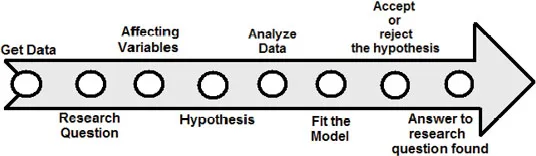
Research question, is the annual temperature in India rising?
Variable of interest from the above data set ANNUAL.
Hypothesis: Temperature is rising.
Analyze data from the above data set.
Fit the model.
Hypothesis accepted or rejected.
Q2: Explain variable and different types of variables?
Ans: Anything which keeps on changing is called variable. Variables are of different type and below are the following:
Dependant/Outcome: A variable being affected, for example annual temperature in above example.
Independent/Predictor: A variable affecting the outcome for e.g. deforestation, pollution, and so on in above example.
Q3: Explain Categorical measurement?
Ans: Categorical measurement contains categories i.e. distinct entities. Example of categories of life on earth is plants, animals, and so on.
Q4: Explain Binary variables?
Ans: Binary variables are those in which only two classes exist, like live or dead male or female on or off.
Q5: Explain Nominal measurement?
Ans: Nominal measurements are there more than two classes. Such categories can be numbers too.
Q6: Explain Ordinal variable?
Ans: These are nominal variables which have logical order. Examples include team ranks in cricket or football, merit list of students appearing for grade students.
Q7: Explain Continuous variables?
Ans: These are variables which can take can any value on the measurement scale example includes pitch of voice which can take any possible value within the range.
Q8: Explain Discrete variables?
Ans: These are variables which can take fixed values in range. For example, number of customers in a bank.
Q9: Is it possible to convert continuous values to discrete and vice versa?
Ans: Yes, based upon the motive of study, it is possible to convert discrete values to continuous and vice versa for example, Level of water in tank can take any value in the range and as such a continuous variable.
But we can approximate the same to three different levels like empty, full, or half empty and this now becomes discrete in nature.
Q10: What are interval variables?
Ans: These are variables which are grouped on interval. Example is age can be divided in range like 10-20, 20-30 and so on and, person with particular age would be placed in one of the above groups. When intervals are equal, they represent difference in equal property being measured.
Q11: What are ratio variables?
Ans: This is sub type of interval variables where ratio of scales is used for measurement.
For Example Water representation in chemistry is H2O which represent two molecules of hydrogen and one molecule of oxygen. Thus, the ratio of elements is 2: 1.
Q12: What are Univariate and Bivariate variables?
Ans:Univariate variable: When the variable under consideration is only one then it is called univariate variable study.
Bivariate variable: Involves study of relationship between two variables.
Q13: What is measurement error?
Ans: The discrepancy between the measured value and actual value in terms of number is called measurement error.
For Example While buying fruits from a vendor in kilograms, if we wanted 1 kilogram of fruits and the vendor’s weighing machine showed 1 kilogram when we brought the same. After checking the same in another machine, if the measured value shows 0.1 kilogram less than expected then this difference is what we call as measurement error.
Q14: Explain Validity?
Ans: Validity implies whether an instrument measures what it is supposed to measure.
Q15: Explain Reliability?
Ans: Reliability implies whether the instrument gives consistent result across different conditions.
For example, if we test the same value twice on the same entity then the results from the instrument should remain same if it has to be reliable. Such tests are known as test-retest.
Q16: What are the different ways to test hypotheses?
Ans: There are two ways in which hypotheses can be tested:
Correlational research
This is also known as cross-sectional research
This involves observing the natural pattern or occurrence to test
Original occurrences are not manipulated
Experimental research
We select the variables of interest
Then we manipulate some aspect of the environment
Observe the effect on selected variable
Q17: Explain the different types of variation?
Ans: There are two types in variation explained as follows:
Systematic variation:
Introduced by experimenter
The participants are tested under different conditions and the difference in condition is i...
Table of contents
Cover Page
Title Page
Copyright Page
Dedication
About the Author
Preface
Foreword
Table of Contents
1. Data Science Basic Questions and Terms
2. Python Programming Questions
3. Numpy Interview Questions
4. Pandas Interview Questions
5. Scipy and its Applications
6. Matplotlib Samples to Remember
7. Statistics with Excel Sheet
Trusted by 375,005 students
Access to over 1.5 million titles for a fair monthly price.
Study more efficiently using our study tools.
Frequently asked questions
Yes, you can cancel anytime from the Subscription tab in your account settings on the Perlego website. Your subscription will stay active until the end of your current billing period. Learn how to cancel your subscription
No, books cannot be downloaded as external files, such as PDFs, for use outside of Perlego. However, you can download books within the Perlego app for offline reading on mobile or tablet. Learn how to download books offline
Perlego offers two plans: Essential and Complete
Essential is ideal for learners and professionals who enjoy exploring a wide range of subjects. Access the Essential Library with 800,000+ trusted titles and best-sellers across business, personal growth, and the humanities. Includes unlimited reading time and Standard Read Aloud voice.
Complete: Perfect for advanced learners and researchers needing full, unrestricted access. Unlock 1.5M+ books across hundreds of subjects, including academic and specialized titles. The Complete Plan also includes advanced features like Premium Read Aloud and Research Assistant.
Both plans are available with monthly, semester, or annual billing cycles.
We are an online textbook subscription service, where you can get access to an entire online library for less than the price of a single book per month. With over 1.5 million books across 990+ topics, we’ve got you covered! Learn about our mission
Look out for the read-aloud symbol on your next book to see if you can listen to it. The read-aloud tool reads text aloud for you, highlighting the text as it is being read. You can pause it, speed it up and slow it down. Learn more about Read Aloud
Yes! You can use the Perlego app on both iOS and Android devices to read anytime, anywhere — even offline. Perfect for commutes or when you’re on the go. Please note we cannot support devices running on iOS 13 and Android 7 or earlier. Learn more about using the app
Yes, you can access Data Science and Machine Learning Interview Questions Using Python by Vishwanathan Narayanan in PDF and/or ePUB format, as well as other popular books in Computer Science & Programming in Python. We have over 1.5 million books available in our catalogue for you to explore.