Computational Fluid Dynamics for Incompressible Flows
eBook - ePub

Computational Fluid Dynamics for Incompressible Flows

  1. 392 pages
  2. English
  3. ePUB (mobile friendly)
  4. Available on iOS & Android
eBook - ePub

Computational Fluid Dynamics for Incompressible Flows

About this book

This textbook covers fundamental and advanced concepts of computational fluid dynamics, a powerful and essential tool for fluid flow analysis. It discusses various governing equations used in the field, their derivations, and the physical and mathematical significance of partial differential equations and the boundary conditions. It covers fundamental concepts of finite difference and finite volume methods for diffusion, convection-diffusion problems both for cartesian and non-orthogonal grids. The solution of algebraic equations arising due to finite difference and finite volume discretization are highlighted using direct and iterative methods. Pedagogical features including solved problems and unsolved exercises are interspersed throughout the text for better understanding. The textbook is primarily written for senior undergraduate and graduate students in the field of mechanical engineering and aerospace engineering, for a course on computational fluid dynamics and heat transfer. The textbook will be accompanied by teaching resources including a solution manual for the instructors.


  • Written clearly and with sufficient foundational background to strengthen fundamental knowledge of the topic.


  • Offers a detailed discussion of both finite difference and finite volume methods.


  • Discusses various higher-order bounded convective schemes, TVD discretisation schemes based on the flux limiter essential for a general purpose CFD computation.


  • Discusses algorithms connected with pressure-linked equations for incompressible flow.


  • Covers turbulence modelling like k-?, k-?, SST k-?, Reynolds Stress Transport models.


  • A separate chapter on best practice guidelines is included to help CFD practitioners.
Frequently asked questions

Yes, you can cancel anytime from the Subscription tab in your account settings on the Perlego website. Your subscription will stay active until the end of your current billing period. Learn how to cancel your subscription.
At the moment all of our mobile-responsive ePub books are available to download via the app. Most of our PDFs are also available to download and we're working on making the final remaining ones downloadable now. Learn more here.
Perlego offers two plans: Essential and Complete
  • Essential is ideal for learners and professionals who enjoy exploring a wide range of subjects. Access the Essential Library with 800,000+ trusted titles and best-sellers across business, personal growth, and the humanities. Includes unlimited reading time and Standard Read Aloud voice.
  • Complete: Perfect for advanced learners and researchers needing full, unrestricted access. Unlock 1.4M+ books across hundreds of subjects, including academic and specialized titles. The Complete Plan also includes advanced features like Premium Read Aloud and Research Assistant.
Both plans are available with monthly, semester, or annual billing cycles.
We are an online textbook subscription service, where you can get access to an entire online library for less than the price of a single book per month. With over 1 million books across 1000+ topics, we’ve got you covered! Learn more here.
Look out for the read-aloud symbol on your next book to see if you can listen to it. The read-aloud tool reads text aloud for you, highlighting the text as it is being read. You can pause it, speed it up and slow it down. Learn more here.
Yes! You can use the Perlego app on both iOS or Android devices to read anytime, anywhere — even offline. Perfect for commutes or when you’re on the go.
Please note we cannot support devices running on iOS 13 and Android 7 or earlier. Learn more about using the app.
Yes, you can access Computational Fluid Dynamics for Incompressible Flows by D.G. Roychowdhury in PDF and/or ePUB format, as well as other popular books in Naturwissenschaften & Strömungsmechanik. We have over one million books available in our catalogue for you to explore.

Information

Publisher
CRC Press
Year
2020
eBook ISBN
9781000096378

1 Overview of CFD

1.1 Introduction

‘Computational fluid dynamics’ (CFD) is the science or art of solving problems involving fluid flow using computers and numerical techniques.
Industrial flow is often complex and involves intricate geometries in heat exchangers, turbomachinery, aircraft, electrical and electronic components, meteorology, biomedical engineering, nuclear reactor, etc. In practical situations, the flow is generally three dimensional and turbulent. Also, the governing equations involving fluid flow are non-linear. Hence, obtaining analytical solutions is impossible, although analytical solutions are available for simplified cases (like pipe flow, etc.) that are obtained after various degrees of assumptions. These very useful techniques lack universal applications; we shall see that turbulent flows are not amenable to analytical solutions. In earlier days, designers used various correlations derived from experiments for designing components. However, experiments normally provide global parameters like drag, lift, pressure drop and heat transfer coefficients. A basic understanding of the local details of flow and transport phenomena is essential for optimal design performance of equipment. If we want to obtain any local flow parameters, various sophisticated instruments are necessary, making the method very costly and, in some cases, altering the flow phenomena. Also, not all flow parameters can be simulated in the same setup.
CFD simulations can provide insight into a system’s detailed flow behavior and help the designer arrive at an optimum design based on the “virtual” performance analysis. With the increase of computational power, better solution algorithm and reduced cost of the computer, the cost of “virtual prototyping” has decreased with the use of CFD. Now, various aspects of flow field and transport phenomena, which are not amenable to direct experimental technique, can be studied in greater detail by CFD. However, one should remember that CFD cannot replace the experimental technique completely. Only through CFD analysis we can find the parameter important for a flow situation in a component such as pump and design the experiment accordingly. Hence, both CFD and experiments are complementary, and whatever we are designing by CFD analysis must be validated through experiment.
As mentioned earlier, with the increase of computational power and reduced cost of computers, CFD has become very popular and powerful in the design stage for fluid flow analysis of the components. CFD has already been successfully applied to various fields of engineering and medicine. The range of applications is wide and encompasses many different fluid phenomena.

1.2 Basic Principles of CFD

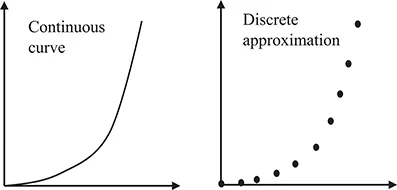
Fluid dynamics is governed by the conservation of mass, momentum, energy and any constituents normally expressed in terms of partial differential equations (PDEs), which are continuously varying functions. Equations can be expressed in differential or integral form (explained henceforth). We normally approximate PDEs at a finite number of points, a process called discretization. In this process, we get a set of equations known as difference equations (DEs). By discretization, we convert the PDE to difference equations. This is shown in Figure 1.1.
Figure 1.1 Continuous vs discrete curve.
The basic process of any CFD simulation
  • The Governing Equation, normally represented by PDE and related to field variables (u, v, w, p, …) that are continuous varying functions, is discretized or approximated by their values at a finite number of points called nodes.
  • By this process, we get discrete equation, which is known as difference equation (DE), for each node. Differential or integral equations, which are continuous functions, are converted into a set of algebraic equations consisting of each node by the discretization process.
  • The system of algebraic equations thus obtained is solved to obtain values at the nodes.

1.3 What Does a CFD Algorithm Do?

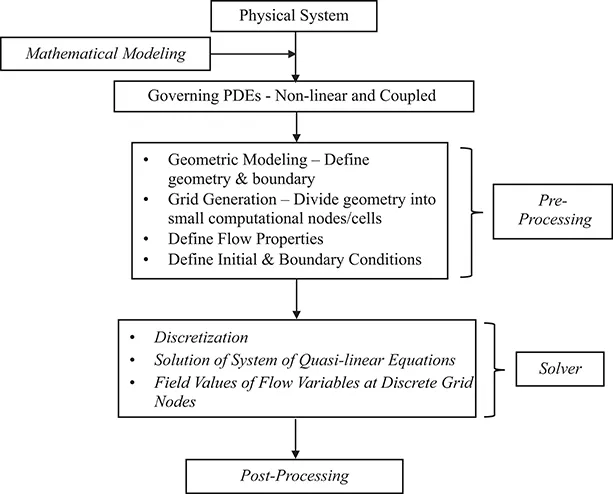
Many commercial general-purpose CFD programs are available (e.g. Fluent, CFX, Star-CD, FLOW-3D and Phoenics). Some very specialized programs are also available (e.g. simulating combustion in engines, electronic cooling systems, etc.). All the commercial codes are user friendly and have pre-processing, solver and post-processing modules. OpenFoam is an open-source program and can handle most CFD problems. However, this code is not as user friendly as commercial codes. In solving a problem using CFD, many steps must be defined, as illustrated in Figure 1.2.
Figure 1.2 CFD Process.

1.4 Stages of a CFD Analysis

A complete CFD analysis consists of:
  • pre-processing;
  • solving;
  • post-processing.
In Figure 1.2, we saw that the solver plays the most important part in the CFD process; in this course, we shall be focusing our attention on the solving process. However, we shall see that pre-processing and post-processing play important roles in CFD. In commercial CFD codes, pre-processing and post-processing are integral, and its user-friendly GUI helps the user to operate the codes effortlessly.

1.4.1 Pre-Processor

The pre-processor is a user-friendly interface that provides problem inputs in a form suitable for the flow solver.
A CFD pre-processor provides a
  • Definition of the geometry of the computational domain,
  • Grid generation or meshing (i.e. subdivision of computation domain into a finite number of non-overlapping sub-domains),
  • Choice of time step sizes for unsteady problems,
  • Choice of mathematical models for different physical complexities,
  • Definition of fluid properties and
  • Specification of boundary and initial conditions.
In commercial CFD packages, developing geometry and grid generation for simpler geometry is possible. However, for complex geometries, the geometry can be developed in dedicated CAD software like CATIA and PRO-E, and the geometry can be imported in commercial CFD packages or other dedicated software for generating quality grids.

1.4.2 Solver

Numerical solution of the governing equations consists of the
  • Discretization and
  • Solution of algebraic equations.
In commercial CFD codes, the solver is a “black box” (i.e. the user has no idea what is going on inside the solver). However, unless the user is familiar with the discretization process, it will be very difficult for him/her to supply the proper input data for solving the cases and interpreting the output data. Hence, proper understanding of the discretization is required.

1.4.3 Post-Processor

The first objective in post-processing is to analyse the quality of the solution. Is the solution independent of the grid size, the convergence criterion and the numerical schemes? Have the proper turbulence model and boundary conditions been chosen, and is the solution strongly dependent on those choices?
Normally, output from the solver is a set of flow parameters (u, v, w, p, …) corresponding to each point of t...

Table of contents

  1. Cover
  2. Half Title
  3. Title Page
  4. Copyright Page
  5. Dedication
  6. Table of Contents
  7. Preface
  8. Acknowledgements
  9. Chapter 1. Overview of CFD
  10. Chapter 2. Governing Equations and Classification of PDE
  11. Chapter 3. Finite Difference Method: Fundamentals
  12. Chapter 4. Finite Difference Method: Application
  13. Chapter 5. Finite Volume Method
  14. Chapter 6. Solution of Incompressible Navier-Stokes Equations
  15. Chapter 7. Finite Volume Method for Complex Geometries
  16. Chapter 8. Solution of Algebraic Equations
  17. Chapter 9. Turbulence Modeling
  18. Chapter 10. Grid Generation
  19. Chapter 11. Best Practice Guidelines in CFD
  20. Appendix 1: Area and Volume Calculation
  21. Appendix 2: Transformation of Governing Equations to Generalized Curvilinear Coordinates
  22. Appendix 3: Review of Vector Calculus
  23. Appendix 4: Case Studies
  24. References
  25. Index