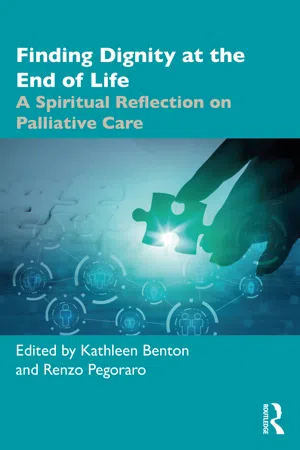
Finding Dignity at the End of Life discusses the need for palliative care as a human right and explores a whole-person methodology for use in treatment.
The book examines the concept of palliative care as a holistic human right from the perspective of multiple aspects of faith, ideology, culture, and nationality. Integrating a humanities-based approach, chapters provide detailed discussions of spirituality, suffering, and healing from scholars from around the world. Within each chapter, the authors address a different cultural and religious focus by examining how this topic relates to questions of inherent dignity, both ethically and theologically, and how different spiritual lenses may inform our interpretation of medical outcomes.
Mental health practitioners, allied professionals, and theologians will find this a useful and reflective guide to palliative care and its connection to faith, spirituality, and culture.
Defining Death Through Individual-Level Determinants
Denisha Allicock, Kathleen Benton, and Sara Plaspohl
This chapter serves as an introduction to the reader, highlighting the common thread among all individuals – despite their rooted or inherited belief system – that throughout disease, there is a universal need to find purpose and peace as a component of comfort, alluding to treatment. Further, the reader will see how the greater the organizational and community influences on a patient, the more likely they are to struggle with a personal or surrogate dilemma of choice in clinical care decisions.
As mentioned by the authors in the preface, patient beliefs must be understood to reflect and offer soul-seeking peace. A social ecological model is utilized to contextualize the theoretical framework of various reflections on palliative care. This model is based on work by theorists including Urie Bronfenbrenner (1977, 1979) and McLeroy, Bibeau, Steckler, and Glanz (1988), all of whom propose that behavior is shaped due to multiple levels of influence. There are five major levels of influence: intrapersonal, interpersonal, institutional, community, and public policy.
The innermost level of this layered approach includes intrapersonal/individual factors such as knowledge, attitudes, behavior, self-concept, skill, and developmental history, incorporating characteristics such as the individual’s age, gender, sexual orientation, racial/ethnic identity, religious identity, and health literacy.
Moving outward, the next level of the ecological approach includes interpersonal/social groups. These groups may be formal networks such as co-workers, advisors, and supervisors or informal collections of family, friends, club/organization members, neighbors, and church members. These groups provide basic support systems for the individual.
The third level in this model includes institutional/organizational factors such as formal and informal rules and regulations. Examples may include policies and procedures for various clinical providers such as hospitals, nursing homes, physician offices, and hospice organizations.
The next level pertains to community factors characterized by relationships among organizations and institutions within defined boundaries. Formal groups such as businesses, community leaders, civic organizations, public health organizations, and care providers interact in various ways to serve the overall needs of the local community.
The outermost level of a social ecological model includes public policy. Local, state, and national jurisdictions maintain an array of laws and policies that define and guide the overall environment and behavior of the people at the various levels of governance.
The first section of this book focuses on the innermost core of the social ecological model (intrapersonal/individual factors), offering case studies and descriptions of people based upon geography and religion, highlighting similarities and differences among these populations with regard to how each views palliative care. Each patient is a unique and complex blend of knowledge, attitudes, behavior, self-concept, skills, and developmental history, influenced significantly by an array of personal traits. Many of these traits are demographic variables that are predetermined at birth, including age, gender, and racial/ethnic identity (see Table 1.1). Other factors such as sexual orientation, religious identity, and health literacy are more controllable by personal preferences and choice. Although the focus will be on intrapersonal/individual factors, the reader will quickly realize how the other levels in the model influence and interact with the innermost core factors of patients as they consider and receive palliative care. It will be evident how the patient’s social network of family and friends, physical environment, and cultural values/norms within their community influence their beliefs and choices.
Table 1.1Socio-Ecological Factors.
Chapter
Palliative Care Perspective
Application of Social Ecological Characteristics
Chapter 2: Finding Dignity at the End-of-Life Through Palliative Care, Everywhere: A Spiritual Reflection on a Clinical Area
Location-Based: Thailand perspective
Age, gender, ethnic identity, religious identity, knowledge, behavior, family, attitudes, health literacy, developmental history
Chapter 3: Cultural Factors Enriching Palliative Care in the Middle East
Location-Based: Middle Eastern perspective
Age, gender, ethnic identity, religious identity, health literacy, family
Chapter 4: A Jewish Understanding of Palliative Care: Reclaiming the Health Process
Religion-Based: Jewish perspective
Religious identity, health literacy, family
Chapter 5: Palliative Care: A Hindu Perspective
Religion-Based: Hindu perspective
Religious identity, health literacy, family
Chapter 6: Palliative Care: A Christian Perspective
Religion-Based: Christian perspective
Religious identity, health literacy, family
Chapter 7: A Nontraditional Spirituality Perspective on Palliative Care
Religion is a set of beliefs, feelings, dogmas, and practices that define the relations between a human being and sacred divinity. It may be defined by practices, traditions, virtue/faith, or a unity in a community who share the same faith, such as a church. There is large variation in the rites, doctrines, and practices across the world. In fact, 89 percent of worldwide populations report an alignment with religion, and 75 percent consider this group very important to life decisions (VanderWeele, Balboni, & Koh, 2017).
Spirituality can be an ambiguous term but reflects what ultimate meaning and values there are in one’s life, who one is, and what life is about. It does not imply a definitive higher power or omnipotent being but rather a deep sense of defining life.
Dignity is a subjective term, defined differently for each individual and rooted in a sense of feeling of worth. For some, it is independence. For others, it is the ability to communicate. Still for others, it is something indefinable but inherent in the soul’s view of the self. Pain can remove dignity for some, while the lack of ability to communicate can remove it from others.
The soulful purpose of life, in whatever form, plays an important role in many people’s lives. Subsequently, as individuals are near the end of life, they draw from their religious or spiritual connection to make decisions. A study of patients with lung cancer noted that faith was the second most important factor influencing treatment decisions (Phelps et al., 2009).
Palliative care is discussed here as the common solution and a necessary variable to achieve dignity, despite whatever religious or spiritual affiliation the patient has, if any. An artful and holistic discussion of pain, boundaries to aggressive care, and necessary elements for individual quality of life, the specialty of palliation aims to bring humanity back to the forefront of artful healing.
Unfortunately, policy, payers, and insurance are interwoven into the right for this care. Emergent care does not include a dying right for palliation or comfort. It remains an unexplained anomaly that patients who are terminally ill can access artificial support and continued, unlimited resuscitation that will likely be futile. However, a patient who needs symptom control, regular assessment of factors affecting quality of life, and an artful conversation may have a difficult time having it paid for under a government or private payer system.
It is the right of the human to have all these needs met, the right to have soul-seeking peace when illness and disease overtake the physiological being? – these are public health inherent rights, and thus the struggle itself is as multilayered and as complex as the palliative patient.
It is not uncommon to find that in many healthcare consortiums, systems, and the literature itself, ethics is aligned with palliative care (Krouse, Easson, & Angelos, 2003). Each reflects on issues of choice/autonomy and best interest at the end of life; thus, they are commonly interwoven. In a new study looking at ethical consults, the variable for spiritual or religious affiliation was examined as the core definition for association with the ethics consult population. Between 2014 and 2018, a total of 630 patients were referred to the Clinical Ethics and Palliative Care Committee. The patient data contained several demographic questions and medical histories. These questions included items on gender, age in years, race, marital status, primary language, religious association, ZIP code, vent status, do not resuscitate status, pre-plan, and insurance. The majority of the patients were religious (69 percent, n = 469), while 31 percent (n = 211) were nonreligious. A faith background was the most common alignment among all analyzed ethics consults over the four years.
In this environment, an ethics consult is defined by a dilemma involved with clinical treatment decisions. It can be called by any member of the team, including family, though most were triggered by the involved physician. Reasons for a consult included many variables; thus, variation is evident throughout this set of four-year data. However, most of the cases involved critically ill, and potentially terminally ill, patients alluding to the ethical issues surrounding a decision about treatment in the final phase of illness or life. For the purpose of the data analysis, the description of the characteristics was aggregated by religious association. These data were computed as percentages of the total number of cases for each year with a combined summative frequency. In summary, the data showed that patients who were religious tended to struggle to die with dignity compared to patients who were not associated with religious preference. This led to asking the question: Is a strong belief system a catalyst to difficult decision-making at the end of life?
The simple variable of being part of an organization with some moral life teachings aligned the patients with the ethical dilemma of one choice or another. It did not matter the tradition or nontradition, however one may define it. The variable that mattered in four years of ethics consult data was simply the presence of religion in the patient’s demographic. Very close to 100 percent of the patients examined over four years of data declared some tradition on their face sheet at the hospital.
Table 1.2Religious Preference of Patients.
Frequency
Percent
Religion preference
469
69.0
None/unknown religious
211
31.0
Total
680
100.0
An ethical dilemma, put simply, was warranted when the clinical staff disagreed with the family or the patient on what clinical steps should be taken next before the decision was made. If the physician is making a decision for long-term life support or resuscitation, the menu list of what end of life can look like is presented on a platter for the patient/family to decide. And suddenly conflict occurs. Literature supports the claim that those with religion have a more difficult time making logical, scientifically driven end-of-life decisions (Romain & Sprung, 2014). Whether there is the fear of judgment from a higher power or the steady patience for a “miracle” to occur may be two of many considerations. In anecdotal conversations with people, a focus-group question of what would be expected shows that people assume those with a religion would embrace the end of life in a more spiritual, hopeful, and life-eternal perspective. However, research says otherwise. Those with no tie to tradition or religion, in fact, account for fewer ethical dilemmas than the former, at least during the four years of data previously – thus proving that the actual moral tradition, belief system, or habits of praise and worship matter not. It is instead the tie to something higher than the self that leads to conflict at the end and a pull to artificial supports and away from allowing a natural death to occur. The data in this chapter show that ethical issues in medicine could be reflective of an alignment with a cultural or religious boundary. Exploring different perspectives surrounding the struggle with an acceptance for palliation and what is allowable within the confines of a person’s moral compass lead to the same interpersonal struggles.
Medicine is disjointed. Differences are found in the way a specialist chooses to treat an illness and in the inability of those specialists to communicate with one another. Spiritual healing even among different value systems requires a more similar protocol for all. It may not be the same because two patients are simply members of the same area of faith. It may not be the same because one has, or lacks, belief. Within each belief system, there are divisions among divisions, and no one person can align with any single other person. Thus, the best we can do as healthcare givers is to understand some existential version of those beliefs and support our patients in their walk. The best that all caregivers can do is to embody holistic care.
The continuum of care shown in Figure 1.1 portrays a line with the extremes of care at each end, euthanasia-like comfort at one end and aggressive care at the other, noting that the biggest area is the gray; the gray explores that there is no final decision that can be made for or against a belief system in the face of disease. Interpretation, personal beliefs, burden, and level of suffering must all be considered in placing a patient on this continuum. Though state, federal, and universal policies aim to address the ex...
Table of contents
Cover
Half Title
Title
Copyright
Contents
List of Tables and Figures
About the Contributors
Preface
Part 1 Religion, Spirituality, and Palliative Care
Part 2 Palliative Care and Practice
Part 3 New Direction on Palliative Care
Index
Trusted by 375,005 students
Access to over 1.5 million titles for a fair monthly price.
Study more efficiently using our study tools.
Frequently asked questions
Yes, you can cancel anytime from the Subscription tab in your account settings on the Perlego website. Your subscription will stay active until the end of your current billing period. Learn how to cancel your subscription
No, books cannot be downloaded as external files, such as PDFs, for use outside of Perlego. However, you can download books within the Perlego app for offline reading on mobile or tablet. Learn how to download books offline
Perlego offers two plans: Essential and Complete
Essential is ideal for learners and professionals who enjoy exploring a wide range of subjects. Access the Essential Library with 800,000+ trusted titles and best-sellers across business, personal growth, and the humanities. Includes unlimited reading time and Standard Read Aloud voice.
Complete: Perfect for advanced learners and researchers needing full, unrestricted access. Unlock 1.5M+ books across hundreds of subjects, including academic and specialized titles. The Complete Plan also includes advanced features like Premium Read Aloud and Research Assistant.
Both plans are available with monthly, semester, or annual billing cycles.
We are an online textbook subscription service, where you can get access to an entire online library for less than the price of a single book per month. With over 1.5 million books across 990+ topics, we’ve got you covered! Learn about our mission
Look out for the read-aloud symbol on your next book to see if you can listen to it. The read-aloud tool reads text aloud for you, highlighting the text as it is being read. You can pause it, speed it up and slow it down. Learn more about Read Aloud
Yes! You can use the Perlego app on both iOS and Android devices to read anytime, anywhere — even offline. Perfect for commutes or when you’re on the go. Please note we cannot support devices running on iOS 13 and Android 7 or earlier. Learn more about using the app
Yes, you can access Finding Dignity at the End of Life by Kathleen D. Benton, Renzo Pegoraro, Kathleen D. Benton,Renzo Pegoraro in PDF and/or ePUB format, as well as other popular books in Psychology & Medical Theory, Practice & Reference. We have over 1.5 million books available in our catalogue for you to explore.