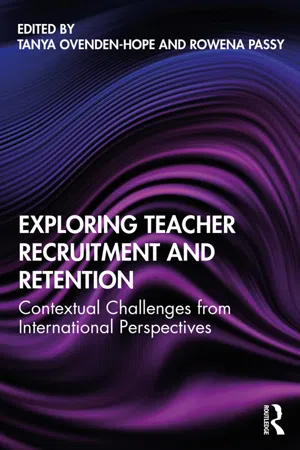
This thought-provoking collection examines the challenge of teacher shortages that is of international concern. It presents multiple perspectives, and explores the commonalities and differences in approaches from around the world to understand possible solutions for the current teacher workforce crisis.
Acknowledging that solutions to attract and retain teachers vary by country, region and in some cases locality, the contributors scrutinise a range of workforce planning interventions at local and government level, including financial incentives and early career support.
The book draws on different perspectives to understand a range of problems that negatively affect teacher recruitment and retention, unpicking key challenges, including links between the disadvantages of location and access to teachers for coastal and rural schools, rising pupil numbers, declining school budgets and the role of professional learning in raising teacher status.
Abundant in critiques, research-informed positions and context-specific discussions about the impact of teacher workforce supply and shortages, this book will be valuable reading for teacher educators, educational leaders, education policy makers and academics in the field.
PART I Perspectives on teacher recruitment and retention in England
1 SHORTAGES, WHAT SHORTAGES? EXPLORING SCHOOL WORKFORCE SUPPLY IN ENGLAND
John Howson
Shortages, what shortages?
In December 1970, I received a phone call from the headteacher of a local comprehensive school asking me if I wanted a temporary job until the summer teaching at the school: he had two vacancies to fill, one in science and the other in design and technology. I did not find the phone call at all unusual. Throughout the mid-1960s in England, when I was in the Sixth Form, it was quite common for some of those who remained for a third year in the Sixth Form (in order to take the Oxford and Cambridge University entrance examinations at the end of the autumn term) to take up teaching posts after Christmas when these Oxbridge examinations were over, always filling teaching vacancies in local secondary modern schools.
This was my introduction to teaching, and also to the issue of staff shortages. Schools struggled to recruit teachers for the demographic upturn experienced during the early 1970s in the secondary sector. In addition, there was a demand for extra teachers as a result of the government finally extending the school leaving age in 1972 to 16 from 15, where it had been since the late 1940s. This rise in the leaving age, long foreshadowed as an objective from the time of the passing of the 1944 Education Act, followed the delay in implementation forced upon the previous Labour government by the economic crisis of late 1967.
Teacher supply did not feature as an issue after the mid-1970s, when the school population returned to more usual levels, until the mid-1980s, except in one respect. The move to create a largely comprehensive secondary school system meant a move away from class teachers to a subject teacher staffing model in the secondary sector, even in the remaining secondary modern schools. Despite demands for the employment of more subject specialists at secondary education level, the class teacher model remained, as it still does, the dominant means of learning in the primary school sector (the term elementary school disappeared in England following the 1944 Education Act that introduced a break at the age of 11 between primary and secondary schooling).
Throughout the period under discussion, the formal starting age for schooling in England remained the term after a pupil’s fifth birthday. However, in the twenty-first century, with the growing understanding of the importance of the early years in education, many children entered the schooling system at an earlier age, often through nursery provision.
Teacher training and teacher distribution: challenges and potential solutions
There had already been demands in the 1960s, especially by the teacher associations, that all teachers needed to be trained to teach. Hiring anyone, whether a graduate or not, was not for many a satisfactory way of staffing schools funded by the state. As early as 1963, John Newsom’s report, entitled ‘Half our Future’, reflected government thinking of the time:
In the primary and secondary modern schools teaching methods and techniques, with all the specialized knowledge that lies behind them, are as essential as mastery of subject matter. The prospect of these schools staffed to an increasing extent by untrained graduates is, in our view, intolerable.
(Ministry of Education, 1963, p. 105)
The demand to employ more teachers with specific subject knowledge and training created many challenges for governments over the following half-century. By the late 1980s, a teacher supply problem had once again emerged. The then House of Commons Education, Science and Arts Select Committee was moved to undertake an investigation into ‘the supply of teachers for the 1990s’ (House of Commons, 1989). As the then Assistant Master and Mistresses Association put it in their evidence to the Select Committee, ‘We consider that some geographical shortages, especially in inner cities, reflect, in addition to low general availability of teachers, the collective view of the poor reputation of schools in certain areas’ (HC, 1989, Minutes of Evidence p. 126).
Thus, by the late 1980s, the twin themes of the sufficiency of teachers and their distribution in an increasingly market-based education system were already being acknowledged. This was to be a recurring theme addressed by House of Commons Select Committees in various reports over the next 30 years.
One solution, suggested to the House of Commons Select Committee by the Secretary of State, Sir Keith Joseph, was the idea of school-based training (HC, 1989, Q649). This introduced the third of the important themes of the decades, the question of how teachers should be trained. Over the next 30 years, these various themes were rarely out of the spotlight of Select Committees and the educational community.
In the early 1990s, the government created the Teacher Training Agency (TTA) as an arm’s-length organisation with a remit to oversee teacher training, as well as recruitment into the profession. Operating as it did in a market-based system, the TTA had little or no involvement in where new recruits would work, and thus a system was created that rewarded high-quality training programmes, even if they were not in areas where teachers were needed. The issue of matching teachers to the vacancies was seen as a problem for the market and not for the state. This produced a potentially wasteful misuse of resources, with teachers unable to find work in some areas but schools unable to recruit teachers elsewhere.
By the time of the economic recession in the United Kingdom between the end of the 1980s and the mid-1990s, and despite the concerns of MPs in their 1989 report (HC, 1989), recruitment into teaching had improved, and vacancy rates recorded by schools reduced accordingly. There were three years in the early 1990s when the training target for mathematics teachers set by government’s internal Teacher Supply Model (TSM) that determined the number of teacher training places required each year was not only met, but exceeded. Table 1.1 shows vacancy rates in secondary schools over a ten-year period from 1986 to 1996 as a percentage of the teaching workforce in England.
TABLE 1.1 Vacancy rates in secondary schools 1986/96 as a percentage of the teaching force in work
Year
Vacancy
Percentage
1986
1.1
1987
1.2
1988
1.0
1989
1.3
1990
1.5
1991
1.1
1992
0.5
1993
0.3
1994
0.4
1995
0.3
1996
0.3
Source: Department for Education and Science, 1986, 1987, 1988, 1989, 1990, 1991; Department of Education, 1992, 1993, 1994, 1995; Department for Education and Employment [DfEE], 1996.
In the period after the changes contained in the Education Reform Act of 1988 came into force, which included the introduction of local management of schools, and with budgets transferred from local authority control to headteachers and governing bodies, teacher vacancy rates in the secondary sector declined. The growth in the early 1990s of public sector higher education, following the conversion of the polytechnics and later the colleges of higher education into degree-awarding universities in their own right, may have helped provide a supply of new graduates for whom teaching looked like an attractive career option. This appears particularly true for the increasing number of the new female graduates at that time (Graduate Teacher Training Registry [GTTR], 1991, 1992, 1993, 1994, 1995, 1996).
The Labour government won the general election in May 1997, just as the tide was turning away from a positive flow in the supply of teachers. In the summer of 1996, I provided evidence to another House of Commons Select Committee inquiry into teacher recruitment, and as a mark of concern I advised the Select Committee that:
The history of teacher training in England and Wales during the past thirty years has been one of alternating periods of ‘feast’ and ‘famine’. Periods of shortage have been followed by times of teacher unemployment. The current position is one where a period of relative over-supply may be being replaced by a period of significant shortage towards the end of the century unless prompt action is taken by those responsible for the overall control of the teaching profession.
(HC, 1996, p. 8)
And so teacher supply was to continue lurching from periods of surplus numbers to shortages during the next two decades as the remainder of this chapter helps to demonstrate.
Falling postgraduate numbers and supply shortages
Although teaching remained the career of choice for many graduates, as it always had been and remains so to this day, applications to postgraduate teacher training fell in key subjects between the 1996/97 entry round and those applying to start courses in 1998/99, illustrated in Table 1.2.
TABLE 1.2 Applications to secondary postgraduate teacher training courses in England 1996/97 to 1998/99 (selected subjects)
The number of teacher training places at this time was controlled by the government department at Westminster responsible for schools (Department for Education and Employment, Department of Education, Department for Children, Schools and Families, or Department for Education, depending upon the title in use at the time), and distributed through the Teacher Training Agency to most course providers. The overall level of allocations provided the benchmark by which the success or otherwise of recruitment onto teacher preparation courses could be measured. This measurement of success is still used in England to the present day.
Four subjects were responsible for the majority of the unfilled places in both years shown in Table 1.3. Across the two years, these subjects accounted for 7,930 of the 8,770 unfilled places, or some 90 per cent of unfilled places.
TABLE 1.3 Unfilled places on ITT higher education courses 1997/98 to 1998/99 (selected subjects)
Subject
1997/98
1998/99
Total unfilled places
Mathematics
830
1,080
1,910
Sciences (all)
520
820
1,340
Languages (all)
920
720
1,640
Technology (all)
1,200
1,840
3,040
Total from above four subjects
3,470
4,460
7,930
All Secondary applications
3,740
5,030
8,770
Source: GTTR, 1997, 1998, 1999 (England only).
In the 1980s, it had been the custom in some years for governments to add back in to the following years’ targets any shortfall in recruitment to training courses from a previous year, presumably in the hope that recruitment might have improved. This practice was abandoned in the late 1990s, possibly because it was creating some unachievable targets. There is, after all, no point in recruiting too many trainees on to teacher preparation courses, since each year every school has to be fully staffed, even if, as noted at the beginning of this chapter, the mix of staff is ...
Table of contents
Cover
Half Title
Title Page
Copyright Page
Contents
List of illustrations
About the editors
Acknowledgements
List of contributors
Introduction
Part I Perspectives on teacher recruitment and retention in England
Part II Perspectives on teacher recruitment and retention internationally
Afterword
Index
Trusted by 375,005 students
Access to over 1.5 million titles for a fair monthly price.
Study more efficiently using our study tools.
Frequently asked questions
Yes, you can cancel anytime from the Subscription tab in your account settings on the Perlego website. Your subscription will stay active until the end of your current billing period. Learn how to cancel your subscription
No, books cannot be downloaded as external files, such as PDFs, for use outside of Perlego. However, you can download books within the Perlego app for offline reading on mobile or tablet. Learn how to download books offline
Perlego offers two plans: Essential and Complete
Essential is ideal for learners and professionals who enjoy exploring a wide range of subjects. Access the Essential Library with 800,000+ trusted titles and best-sellers across business, personal growth, and the humanities. Includes unlimited reading time and Standard Read Aloud voice.
Complete: Perfect for advanced learners and researchers needing full, unrestricted access. Unlock 1.5M+ books across hundreds of subjects, including academic and specialized titles. The Complete Plan also includes advanced features like Premium Read Aloud and Research Assistant.
Both plans are available with monthly, semester, or annual billing cycles.
We are an online textbook subscription service, where you can get access to an entire online library for less than the price of a single book per month. With over 1.5 million books across 990+ topics, we’ve got you covered! Learn about our mission
Look out for the read-aloud symbol on your next book to see if you can listen to it. The read-aloud tool reads text aloud for you, highlighting the text as it is being read. You can pause it, speed it up and slow it down. Learn more about Read Aloud
Yes! You can use the Perlego app on both iOS and Android devices to read anytime, anywhere — even offline. Perfect for commutes or when you’re on the go. Please note we cannot support devices running on iOS 13 and Android 7 or earlier. Learn more about using the app
Yes, you can access Exploring Teacher Recruitment and Retention by Tanya Ovenden-Hope, Rowena Passy, Tanya Ovenden-Hope,Rowena Passy in PDF and/or ePUB format, as well as other popular books in Education & Education General. We have over 1.5 million books available in our catalogue for you to explore.