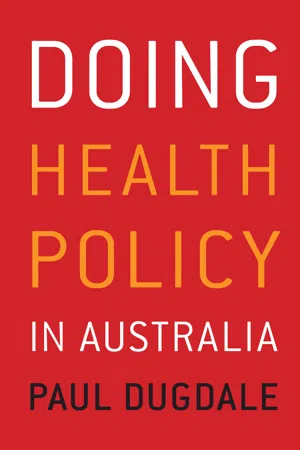
Paul Dugdale argues that Australia's health policy scene is in rude health, with regular debates about major reform and a steady stream of minor reforms. What motivates these debates and reforms? How can nine governments, and scores of professional associations, charities and businesses interact effectively without a master plan? Why are some health policy changes met with widespread enthusiasm and others enormous resistance?
Dugdale traces the history of the economic and social forces which have shaped Australia's health system. He examines the thinking of government as it is expressed through contemporary health policy, and the roles of the key players including hospitals, the medical profession and health departments. He also discusses major current concerns including Indigenous health, health finance, the medical labour market, health protection and safety issues.
With its insider's perspective on the health system and policy debates, Doing Health Policy in Australia is essential reading for health professionals working in management and policy roles.
Paul Dugdale's account of health policy in Australia is engaging, philosophical, reflective and socially informed. - Professor Stephen Leeder, University of Sydney
A distinctive addition to the pantheon of Australian books on health policy, weaving together social theory, history and philosophy with reflective commentaries on the Australian health system and health policy, and on being an activist within the policy-making world. It challenges convention and standard expectations. - Professor Vivian Lin, La Trobe University
- 248 pages
- English
- ePUB (mobile friendly)
- Available on iOS & Android
eBook - ePub
Doing Health Policy in Australia
About this book
Information
1. THE HEALTH POLICY SCENE
A VIGOROUS CURIOSITY
Health policy is a big field. Most newspapers carry a story on it in every edition. Around one in ten people work in health, and one in every ten dollars spent in Australia is spent on health—the majority of it public money. During their working life, perhaps the majority of people who work in the health sector, and a good percentage of people who work in government policy more generally, will participate in formal health policy discussions. Most will draw on their own experience and general ideas of what should happen. Some will represent the experience and ideas of colleagues with whom they have discussed the issue. A small minority will participate as skilled policy analysts.
Much of the content of this book has been driven by curiosity about how the health system works. Dr Sid Sax’s classic book on Australian health policy in the Medibank era, A Strife of Interests (Sax 1984), took its title from the late nineteenth century definition of politics in Ambrose Bierce’s satirical Devil’s Dictionary (Bierce 1967). Sax’s basic proposition was that health policy could be understood as the playing out of the various interests involved, which could be seen by looking behind the masquerade of principles with which they disguised themselves. As Sax’s life as a reformer and his published work demonstrate, curiosity about what drives reform of the health system finds more than the strife of interests. Personal or collective self-interest, the pursuit of freedom and happiness, public acclaim, humanism and the ethos of science all play a part. Curiously, humanitarian concern is perhaps the highest common factor amongst the variable self-interests in the equation (this alone justifies some suspicion about the nature of humanism). But humanitarian concerns don’t seem to play a big part in setting the agenda for debate—in how some part or other of the health system becomes perceived as needing to be reformed, or change in some other part is considered off limits. Nor do they explain why some things can be done with widespread support and enthusiasm, and other things can only be done against enormous resistance.
There is also a curiosity about why the health system is the way it is, about the history of institutions and administrative arrangements that structure it. In particular, there is a curiosity about the history of the involvement of the state in health and reflection on the role of health in the constitution of the modern state. This is a curiosity about what is at the heart of various calls for reform, which can often be nutted out by careful thinking about what that aspect of the health system really does or what is really at stake in a reform proposal.
Australia’s vigorous health policy scene is in rude health. To describe someone as being ‘in rude health’ gives an idea of inner vitality and strength, a capacity for doing hard work and taking vigorous pleasures, of robustness and a capacity to withstand the slings and arrows a broad exposure to life brings. We don’t think of rude health as arising from careful dieting, a detailed exercise regime, regular medical surveillance and judicious choice of medications (preventive or otherwise). Rude health arises in some sense from the play of wildness in a suitable environment, rather than from judicious discipline and a detailed prescription. The health policy scene is like the talented school kid from a big country town offered a scholarship by the Australian Institute of Sport, rather than the sculpted athlete on the Olympic podium after long years of preparation.
The heterogeneity and vigour of health policy has been a longstanding feature of Australian civil society, and probably reflects the nature of our democratic-welfare-capitalist society on the one hand and the overall importance of health and health care on the other. The health systems that reflect our health policy have a few rough edges—perhaps quite a few—but mostly seem to work pretty well. Health outcomes for most of Australia’s population are excellent, and health system performance is pretty good when measured in terms of value for money, quality of care and the match of health services with need. All of this can be improved on, of course, and there is a keen sense of this in health policy circles.
The health policy scene is vigorously populated by nine federal, state and territory governments, and scores of professional associations, charities and lobby groups. There are around 150 health and biotechnology companies listed on the Australian Stock Exchange. There is certainly no master plan, no readily identifiable dominant force in health policy since the relatively brief period during the making of Medicare by the federal government over 20 years ago. There has been a constant stream of reforms pursued at regional, state and national levels, some of which have created change and some not. New policy technologies and new programs turn up frequently and are only very occasionally self-evidently bad. Health policy-making is certainly somewhat unruly and debate is usually vigorous.
This book draws on social theory and history to explain some of the dynamics of the contemporary Australian health system. My hope in writing it is that it will be helpful for people working actively on reform of the health system, or studying to prepare themselves to work in health policy, management and reform. The sheer size of the health system, and its complexity, make it a difficult field to have a clear enough view to provide sound management, sensible policy and useful reform. One response to this complexity is to accumulate more and more knowledge about the system and its effects. While this is clearly a sensible approach, it is also important to think carefully about just what health is, what the health system is for, what its dynamics and tensions are and about the features of successful reform. This book addresses these types of questions. It draws on philosophical thought, political theory and the history of our current health system to reflect on why the health system is the way it is and on the sorts of strategies that work for managing and reforming it.
Many of my colleagues in the policy scene, if they read this book—and many of them read surprisingly broadly—will, I expect, find themselves arguing with my analysis on various topics. One of the key qualities of the policy generalist is that they are prepared to put down what they think or what they have gleaned about topics with which they are not overly familiar. In this book, I have written about things on which I have been involved in policy debate over the years—some more deeply than others, but each enough to offer some reflections on. I have little experience in Indigenous health policy, and so co-authored that chapter with Kerry Arabena, whose Indigenous health experience and analytical skills are highly sought after in the Australian policy scene.
Some sections of the book emphasise the history of how we came to take for granted the things that form the backdrop to a set of policy debates; other sections emphasise the detailed policy logic of a particular topic— perhaps relatively minor, but that illustrates the anxieties of the time. Much of the argument is presented in a fairly simple way, as opposed to the refined argument found in the peer-reviewed journals of the academy. I gloss over many things in an attempt to sketch some of the broad, muscular lines of argument. In a sense, it is the style of argument you might expect given my background as a health policy generalist in a big country town, having worked for governments of both persuasions.
This introductory chapter provides a summary of the main themes and an overview of each chapter in the book. The next two chapters discuss the nature of health and health policy. Chapters 4 and 5 discuss the history over the last few hundred years of three major features of the present health system: the medical profession; the hospital; and public health, in the sense of health protection and health promotion. The next two chapters are case studies of major reform efforts in the Australian health system, namely the creation of Medicare and the focus on safety and quality. The chapter on doing Indigenous health policy perhaps exhibits some frustration that successful major reform is yet to come. The chapter on health protection outlines some of the successes and challenges of mainstream public health practice. The book finishes with some reflections on consumer consultation and the ethics of policy activism within the health system.
In some ways, the question ‘What is health?’ has an intuitive answer that comes easily from the particular circumstance in which it is asked. However, like many of the other great questions—consider ‘What is truth?’—the more deeply one thinks about it the less satisfactory the particular answers seem, and the best general answers come not as a precise, definitive statement but as part of a rich dialogue about the subject.
Chapter 2 takes this later tack in a definitional discussion of the nature of health. This chapter explains what we mean by health in everyday language and in what we call the health care system. It concludes with a discussion showing how population health can be situated at the centre of the development of contemporary society.
The United Nations has defined ‘health’ in the World Health Organization’s constitution as follows: ‘Health is a state of complete physical, mental and social well-being and not merely the absence of disease or infirmity’ (WHO 1946). However, the actual meaning of both the term ‘health’ and the WHO definition remain enigmatic. This is more than a problem of language and more than a problem of historical context in the sense that only that which has no history is truly definable (Nietzsche 1969, p. 80).
Much health policy debate turns on the fact that health is always somewhat enigmatic: there is something about understanding it that always sits beyond clear conceptual grasp. Recognition of the enigmatic nature of health can help our analysis of the different perspectives that health professionals, their patients and the patients’ carers all bring to specific episodes of health care provision, advice-giving or personal action for health. It also brings some insight into the endless innovation in health technology, systems of care and personal motivations directed towards being healthy or becoming healthier that characterise the health field. Furthermore, it helps us avoid errors that can result from using simplistic formulations of the meaning of health in designing health outcome measures in scientific studies.
HUMANISM AND HEALTH
Turning from a conceptual to an historical lens, health in society can be understood as the notion underpinning the development of the various health disciplines and systems in modernity (roughly the last 2000 years). Each of the disciplines of health—surgery, nursing, physiotherapy, public health and so on—has sought to create a field of science and a field of practice directed towards the betterment of Man. A glance at the historical idealism of the nineteenth century helps us understand the disciplinary structure of the health system as an historical expression of the notion of progress through knowledge, a concrete expression of the grand nineteenth century humanistic project suggested by the enlightenment of a hundred years earlier.
While this humanist perspective is still a common and powerful motivator of scientific, practical and policy endeavour in the health field, it is also helpful to come to grips with a broader analysis that gets outside of our desire to help or make progress and goes beyond the health field to show how population health can be situated at the centre of a broader social analysis. In this view, the issues that arise from the biological expansion of human populations are the central political and economic issues faced by modern societies in the medium- and long-term perspective. While this is just one scaffolding in the marketplace of social analysis, it is naturally suited to analysing health policy. I hope readers will find it provides some common ground across the seemingly disparate topics covered in subsequent chapters.
If the definition of health presents such a range of problems, it is not surprising that the idea of health policy also presents difficulties. However, it may be that the more enigmatic of these difficulties arise from the nature of health, and that the nature of policy relating to it can be analysed in a relatively straightforward way, using the analytical tools of (and subject to the limitations of) political and social theory. Whatever health itself may be, what is commonly called the health system is one of the great social machines of contemporary society. It is large and busy, with many moving parts, and it operates with a great deal of momentum. Many of those involved in it tinker with their parts and occasionally cooperate (perhaps unwittingly) in major changes. While health professionals and their patients are the main actors within the health machine, governments have the lead role in stewardship of the health system on behalf of the public.
Chapter 3 discusses general issues of health stewardship and public policy. It begins by considering what types of things the health departments of the Commonwealth, state and territory governments do, and examines the relationship between policy and research. It then provides a high-level overview of public sector funding for health and looks at how this is assembled with professional expertise and management structures to form the health system.
The activities of health departments in most western democracies are fundamentally related to the powers and responsibilities of the elected government—in Australia’s case, the cabinet, including the health minister. Duly elected cabinet ministers are given executive commissions by the head of state—the state governors and the Governor-General—to operate the machinery of state. Health departments are the part of the machinery that works directly with the ministers for health to conceive and execute government policy. To do this, they formulate policy advice and execute government direction. Taking a somewhat simplistic view, the fields of policy action include: the structure of health systems and services; the regulation of health care activities; and health care financing by state treasuries and other means. Of course, these three fields interact—for example, in the heavy regulation of private insurance for health care.
Policy has a complex relationship to research. Contemporary policymakers prefer to make policy based on sound research; publicly supported research is under pressure to contribute to the public good; and health systems strive to provide care supported by research. Yet the gulf remains between the world of the researcher and the world of the policy-maker or health service manager. There is no talking in the library and there are no books in the boardroom: research is an isolating activity whereas policy and management are subject to myriad pressures and demands. In such a context, it is useful to map out two major agendas: the major tasks facing health policy-makers and managers in relation to supporting and responding to health and medical research in Australia; and the way health and health systems researchers can support and be responsive to the reform efforts of health policy-makers and managers. These agendas have differences and overlaps. Research and stewardship align on some things and are unavoidably at odds on others. Understanding the relations between the two fields in a pragmatic way may help researchers avoid moralistic posturing and increase their contribution to research translation, relieve the exasperation of policy-makers and managers about the inadequacy of research, and perhaps even assist in their stewardship of the health research effort itself.
The chapter then turns to public financing of the health sector, which comprises around 10 per cent of total domestic economic activity in Australia. It encompasses many activities, institutions, agencies and companies. To make sense of this, it is useful to consider health systems as an assemblage of three main things: management, financing and expertise. These three things are knitted together at all levels of the health system and throughout our health services. Successful health care reform is always about creating new conjunctions of these three things, whether it be the revitalisation of a meandering community health service or the wholesale restructure of a state’s regional health services.
This chapter begins an analysis of freedom in health policy that is developed in subsequent chapters. This ranges across classical economic ideas about freedom to practise linked to requirements for training and free markets with their limitations in health financing, to neo-liberal strategies such as publicly financed incentives for private medical practice and the politics of freedom that can be seen in the design and introduction of Medicare.
Chapter 4 recognises that almost all aspects of health stewardship require a dynamic understanding of the medical labour market. It provides a brief history of the development of licensing medical practitioners and other health professionals, and discusses how this licensing is controlled. It goes on to examine some of the major dynamics at play within the market for professional medical services by considering some of the incentives that influence doctors.
The government of medical practice couples the pastoral care relationship doctors have with their patients to the relationship between the state and a powerful group of its professional citizens. Legislatures in Australia started making laws in the late nineteenth century to register medical practitioners and to restrict the practice of medicine by others or to subordinate their practice to registered medical practitioners. This has been interpreted variously as a successful campaign for medical dominance or a classic example of liberal government through the creation of a self-governing sphere of civil society. Both these perspectives have currency within contemporary policy debates.
While financial incentives clearly affect the activities of doctors, this is powerfully modulated by the professional norms and organisational structures within which doctors work. This can clearly be seen in the operation of the Practice Incentives Program, a suite of incentives for general practitioners introduced around the turn of the millennium through the Memorandum of Understanding struck...
Table of contents
- Cover
- Title Page
- Copyright Page
- Contents
- Acknowledgments
- 1 The health policy scene
- 2 What is health?
- 3 Health policy
- 4 Governing doctors
- 5 Public hospitals and public health
- 6 The making of Medicare
- 7 Quality and safety
- 8 Doing Indigenous health policy
- 9 Health protection
- 10 Health policy activism
- Bibliography
- Index
Trusted by 375,005 students
Access to over 1.5 million titles for a fair monthly price.
Study more efficiently using our study tools.
Frequently asked questions
Yes, you can cancel anytime from the Subscription tab in your account settings on the Perlego website. Your subscription will stay active until the end of your current billing period. Learn how to cancel your subscription
No, books cannot be downloaded as external files, such as PDFs, for use outside of Perlego. However, you can download books within the Perlego app for offline reading on mobile or tablet. Learn how to download books offline
Perlego offers two plans: Essential and Complete
- Essential is ideal for learners and professionals who enjoy exploring a wide range of subjects. Access the Essential Library with 800,000+ trusted titles and best-sellers across business, personal growth, and the humanities. Includes unlimited reading time and Standard Read Aloud voice.
- Complete: Perfect for advanced learners and researchers needing full, unrestricted access. Unlock 1.5M+ books across hundreds of subjects, including academic and specialized titles. The Complete Plan also includes advanced features like Premium Read Aloud and Research Assistant.
We are an online textbook subscription service, where you can get access to an entire online library for less than the price of a single book per month. With over 1.5 million books across 990+ topics, we’ve got you covered! Learn about our mission
Look out for the read-aloud symbol on your next book to see if you can listen to it. The read-aloud tool reads text aloud for you, highlighting the text as it is being read. You can pause it, speed it up and slow it down. Learn more about Read Aloud
Yes! You can use the Perlego app on both iOS and Android devices to read anytime, anywhere — even offline. Perfect for commutes or when you’re on the go.
Please note we cannot support devices running on iOS 13 and Android 7 or earlier. Learn more about using the app
Please note we cannot support devices running on iOS 13 and Android 7 or earlier. Learn more about using the app
Yes, you can access Doing Health Policy in Australia by Paul Dugdale in PDF and/or ePUB format, as well as other popular books in Medicina & Atención sanitaria. We have over 1.5 million books available in our catalogue for you to explore.