- 256 pages
- English
- ePUB (mobile friendly)
- Available on iOS & Android
eBook - ePub
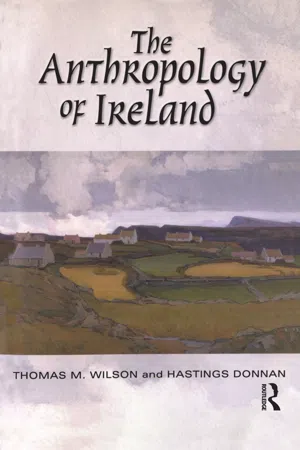
The Anthropology of Ireland
About this book
Where and what is Ireland?--What are the identities of the people of Ireland?--How has European Union membership shaped Irish people's lives and interests?--How global is local Ireland?This book argues that such questions can be answered only by understanding everyday aspects of Irish culture and identity. Such understanding is achieved by paying close attention to what people in Ireland themselves say about the radical changes in their lives in the context of wider global transformation. As notions of sex, religion, and politics are radically reworked in an Ireland being re-imagined in ways inconceivable just a generation ago, anthropologists have been at the forefront of recording the results. The first comprehensive book-length introduction to anthropological research on the island as a whole, The Anthropology of Ireland considers the changing place in a changing Ireland of religion, sex, sport, race, dance, young people, the Travellers, St Patrick's Day and much more.
Information
–1–
Anthropology Ireland
Identity, Voice and Invention
If Ireland had never existed, the English would have invented it.
Declan Kiberd (1995: 9)
Who invented Ireland? This is the question with which Declan Kiberd (1995) begins his analysis of the cultural roots and transformations of Ireland and the Irish. Kiberd quickly considers three answers to the question: Ireland was invented by the Irish, by the English, and by the peoples of the Irish diaspora, in an exile that is the ‘nursery of nationality’ (1995: 1–2). All of these peoples helped to name and identify the place, its territory, its landscape, but they also contributed to the idea of Ireland, to its many and changing manifestations, in ways which simultaneously invented ‘the Irish’, and their ‘society’ and ‘culture’.
Historical and contemporary inventions of Ireland, the Irish and Irish culture and identity are all of critical significance to anthropologists, and have been since modern anthropology was born in the nineteenth century. Ireland was one of the first sites in the development of modern social anthropology worldwide, based as it was on the experimental and evolving notions of ethnography, which began to take shape in the 1890s, and which culminated in the so-called ‘Malinowskian’ model of anthropological fieldwork that dominated the discipline for most of the twentieth century. Ireland was also the location of a first attempt to marry the theoretical and methodological tenets of British social anthropology to those of American cultural anthropology, in ethnographic studies done in the West of Ireland in the 1930s. Thus, Ireland historically has been important as a site of research, but also as a domain of, if not also a trope in, significant leaps forward in anthropological thought. At least, that is how it was until the 1980s, when both Ireland and its anthropologies changed, in processes of reinvention that still impel us today. Anthropology, like Ireland and the Irish, is also an invention, an intellectual construction and professional body of scholars and research that adapts to fashion and historical forces as much and as quickly as other social and cultural entities. As such, it is also proper to ask: who invented the anthropology of Ireland?
There are many answers to this question too. The anthropology of Ireland has been moulded by multiple local and global forces. Among them are the developing intellectual and academic traditions and concerns of both American cultural anthropology and British social anthropology. But the anthropology of Ireland is also the product of local forces, developments in Ireland in universities and other centres of learning, and also in wider and sometimes dissident intellectual, scientific and technological domains. As we shall see in the pages that follow, the anthropology of Ireland has often been seen to be driven by scholarly interests and scientific paradigms with origins in Britain and the United States, particularly in the years leading up to and just after the Second World War. But by the 1970s this anthropology was directed and invigorated as much (if not more so) by internal intellectual change, both in the Republic of Ireland and in Northern Ireland,1 as it ever had been by external forces. These alterations in anthropology within Ireland were reflections of social, economic and political change throughout the island, but they also mirrored changes that were transforming anthropology worldwide. These transformations in the method, practice, theory and professionalism of anthropology had a quick impact in anthropology in Ireland, and on the anthropologists who travelled to Ireland to conduct research. The growing theorizing of postcolonialism, postnationalism, post-modernity, transnationalism and globalization, beyond anthropology as well as within it, was leading all of the social sciences and humanities to re-think their approaches to identity and culture, which had long been prime areas of investigation for anthropologists.
In our view, the anthropology of Ireland has much to offer anthropologies elsewhere, and has contributed much to the intellectual and professional development of anthropology in the United Kingdom, in the United States and beyond. It has been a global anthropology, since its inception, and has figured prominently in much comparative anthropological research. These roles are not surprising, because of the global and comparative nature of anthropology as a professional discipline and an intellectual pursuit. But this global reach of the anthropology of Ireland is also due to Ireland’s role in world society, economy and culture, a role that took on dramatic if not epic proportions as a result of the mass migrations of the mid-nineteenth century which resulted from the Great Famines. Ireland’s global character has continued and been born anew since then, in ways including but not limited to the Irish diaspora, which in many countries across the globe has had a major impact on national politics (for example, in the ethnic politics of Irish-Americans in the United States); the rise and impact of the Celtic Tiger; the role of Ireland in almost all United Nations (UN) peace-keeping missions since the end of the Second World War; and Ireland’s successes as a member of the European Union (EU).
In this book we recognize and address many aspects of Global Ireland, but we also recognize that the bulk of the anthropology we summarize and proffer here is in relation to the anthropology that has been conducted, debated, transformed and created in Ireland itself, on the island of Ireland. In this book, our Ireland is in the first instance a geographic Ireland. We accept that contemporary Ireland, the Irish and Irishness were invented in a global space, and that the anthropology of Ireland is incomplete without a consideration of the anthropology of the Irish, worldwide. Nevertheless, in these pages we primarily focus on what in the past has been seen to be, and what today constitutes, the anthropology of the island of Ireland.
The book has three principal overlapping themes. Taken together, we intend that these themes will provide both a historical and a contemporary record of anthropological ideas and practices in Ireland, about Ireland and its peoples. We also examine these themes in order to provide windows on Irish life for students of anthropology elsewhere, to enable the anthropology of Ireland to be framed in ways which will allow productive comparison. Through both of these engagements, with Ireland and with anthropology, we hope to offer the opportunity to non-anthropologists, in Ireland and beyond, to see how anthropologists have constructed Irish society and culture, in what we call ‘Anthropology Ireland’, and in so doing have contributed to a distinct discourse on Ireland which both sets Anthropology Ireland off from other scholarly and intellectual pursuits, and contributes to widespread consideration of the increasing importance of the notions of culture and identity to the economics, politics and societies of Ireland. Not all of these themes are addressed directly in each chapter that follows, but all implicitly inform each chapter’s main and secondary concerns. Thus, this book is about the following:
1. It is about the anthropology of Ireland, in contemporary and historical form. It provides an overview of the history of anthropology in Ireland and a history of the anthropology about Ireland. It does so through a focus on the concerns, practices, theories, methods and professional evolution of social anthropology, which has historically been the arena of British scholars (including those of the Commonwealth and the post-empire, as well as many continental European countries), and of cultural anthropology, which developed principally in North America. But this focus is not in aid of presenting a critique of these major anthropological schools of thought, by using Ireland as a prism. Rather, we seek to use the frames provided by a historical perspective on these two world anthropological domains in order to elucidate the changing shape of the anthropology of Ireland and of things and people Irish, especially in terms of how that anthropology developed and changed in Ireland. We do not present an exhaustive and definitive review of all of the anthropological research that has been conducted in Ireland over the last century, nor do we summarize all of the major anthropological publications that have resulted. On the contrary, we explore certain continuities and discontinuities that we trace in the history of the anthropology of Ireland, in order to set the scene for our review of more contemporary trends and concerns in anthropology as it is practised and received in Ireland today. We also use this emphasis on Ireland to touch briefly upon some of the ways in which the anthropology of Ireland has had an impact at home and abroad.
In this approach we also seek to examine how the history of the anthropology of Ireland has changed in line with transformations in Irish society, polity and economy, in both the North and South, though these have not been the only, and sometimes not even the principal, motors of the changing nature of Ireland’s anthropology. The history of the anthropology of Ireland is also a product of the changing anthropological fads and fashions that shape intellectual and professional concerns and that have fundamentally transformed anthropology over the last century. From structural-functionalism to world-systems perspectives, and to the interpretive and multi-sited approaches of today, worldwide anthropological transformations have been transformative in Ireland’s anthropology as well. The roots of this external professional influence are clear: most anthropologists who have conducted research in Ireland did not come from there originally, and most were trained in universities where the major theoretical developments of the day were the inspirations for novel research designs and professional advancement.
2. This book is about how Ireland has been constructed in anthropological writing and professional practice. It is about how anthropologists have contributed in their own distinctive ways to ‘Writing Ireland’, where writing about Ireland is about inventing Ireland in a manner that distinguishes the Ireland of anthropology from those Irelands constructed by other academic disciplines, and from those invented and reproduced in political institutions and other social bodies. This anthropological narrative of Ireland and its peoples and customs is distinctive in at least two ways: anthropologists generally ask different questions from those asked by other scholars, and they often ask them of people who are seldom the prime subjects of research outside of anthropology. This ‘bottom-up’ approach to people, ideas, behaviours, institutions, places and spaces is not the sole domain of anthropology, but, due to the field’s reliance on ethnography as the principal framework for the collection and analysis of data, anthropology has relied on longer case studies of people who are often seen to be peripheral, or at least less significant, to the research designs of our cognate disciplines. This has changed mightily in the last two decades, but for most of the twentieth century, and even into this century, anthropology has been known best as the science of culture, where culture is seen as the combination of values, actions and structures that order social life. And to anthropologists culture is to be found, and found to be significant, in all levels and locations of society.
3. As we have just suggested, both the historical and contemporary anthropology of Ireland have been fashioned, in varying ways and to varying degrees, by international and global anthropologies. In this book we seek to contribute to the continuing importance of comparison and the exploration of diversity and difference, which remain at the heart of anthropology. We thus strive to present, within the confines of a short book, something of the richness of research experience and ethnographic writing that have characterized the anthropology of Ireland since its origins. Inevitably, we have had to be selective, and there has not always been space to present as fully as we might have wished the ethnographic material that constitutes Anthropology Ireland. Nevertheless, we set out in the pages that follow many of the ethnographic case studies conducted in Ireland that have been the bases for clear and consistent contributions to anthropological theorizing for almost a century, in ways that have often brought world anthropological attention to the island. The breadth and depth of anthropological practice in Ireland today stand as exemplars of how empiricism, comparative social science, sensitivity to the ethics and politics of field-work, and provocative theorizing can all contribute to anthropology’s increasing role as a creative and applied enterprise. Thus we seek to open up some windows on Irish life for the students and practitioners of anthropology elsewhere, to help locate the anthropology of Ireland within broader global frames.
One thing has become clear to us in the preparation and writing of this book. Over the last century, and most certainly today, there has been no single anthropological template that has driven or structured whatever might be seen to be the anthropology of Ireland. The theoretical and methodological models that have informed the various and overlapping, even sometimes successive, anthropologies that have investigated Ireland, and helped to define it in academic and intellectual ways, but often also in political and policy ways, have been in dialectical relationships with each other. These feedback relations have resulted in often contested versions of what Ireland is all about, of who the Irish are (or, most often, who the people of a locality are, and how that does or does not tell us something about the larger social entities of which they are presumably a part, such as the ‘nation’ or the ‘church’), and of what they do in various events, institutions and seasons. Throughout all of this construction of Ireland and the Irish, though, the anthropologists who have crafted what we are calling the anthropology of Ireland have most often seen it within wider international and global contexts. This remains true today, when the anthropology of Ireland increasingly seeks to address matters of immediate concern in the lives of Irish people, often by contributing to the creation, implementation and critique of social, economic and cultural policy, but in ways which may also speak to anthropology globally. Yet to achieve what might be possible, at home and abroad, the anthropologists of Ireland, and the anthropologists in Ireland, must clarify their anthropological identities and voices.
A Quiet Anthropology
As late as the early 1990s, anthropologists were facing certain questions of professional identity due to the generally accepted notions in Ireland of the discipline of anthropology (Wilson 1994a). While it may be too strong to assert that this was an ‘identity crisis’, it certainly was a malingering residue of years, generations even, of fostering the notion that anthropology was the academic discipline that studied primitive peoples in faraway exotic places. As the generally accepted story went, anthropologists did not study ‘at home’; that was the domain in social science reserved for sociology, or perhaps politics and geography. But this stereotype of anthropological interest and practice – which often involved mythic imaginings of pith helmet, mosquito netting and long and solitary treks into the bush–was not just the product of popular media and other forms of non-academic culture. Some anthropologists were complicit in this view, in large part as they attempted to carve out or maintain a professional niche for themselves,2 and there were those in the UK, the US and beyond who continued to foster the view that anthropology is about the study of non-Western ‘primitive’ peoples, despite the almost universal professional anthropological agreement that all peoples, in all societies, are the subject domain of the field.
As we shall see in the next chapter, Ireland had been one of the first sites for the ethnographic study of a modern nation, in field studies conducted in County Clare in the 1930s which helped to redirect the course of world anthropology to the study of rural communities in the developed Western and Northern hemispheres. But this important achievement, which put Ireland on the map for anthropologists training everywhere in the world, seemed to have only a minor impact on the popular consciousness of anthropology in Ireland. In the early 1990s it was still clear that ‘anthropologists have not been very successful in removing stereotypes, making anthropology more popular … or making it relevant to decision-makers in the public and private sectors’ (Wilson 1994a: 4).
If this was not an identity crisis, it was certainly a public relations problem, a case of not being heard, or perhaps not saying enough, clearly and loudly, to be heard. This was the case despite the public academic debate that developed in the 1970s, and which carried over into the Irish media, about the past and future directions of the anthropology of Ireland. By that time it had become obvious that an important and seemingly irreparable division had developed within Irish anthropology, between those who concluded that Irish rural culture and communities were in almost irreversible decline, and those who believed that such communities were representative of a long and vital history of the Irish people and their traditions and culture (this debate is discussed in chapter two). This professional difference of opinion was about the veritable core of a modern Ireland and its relationship with its past, as well as its reconstructions within the free-flowing conditions of ...
Table of contents
- Cover
- Half Title
- Title Page
- Copyright Page
- Dedication Page
- Contents
- List of Figures
- Acknowledgements
- Preface
- 1 Anthropology Ireland: Identity, Voice and Invention
- 2 Locating the Anthropology of Ireland
- 3 Controlling Bodies
- 4 Ireland’s ‘Other(ing)’ Economies
- 5 Re-presenting ‘Irishness’
- 6 Frontier Tales and the Politics of Emplacement
- 7 Transnational and Global Ireland
- 8 Ethnographic Experience and Engagement in the Anthropology of Ireland
- Notes
- References
- Index
Trusted by 375,005 students
Access to over 1.5 million titles for a fair monthly price.
Study more efficiently using our study tools.
Frequently asked questions
Yes, you can cancel anytime from the Subscription tab in your account settings on the Perlego website. Your subscription will stay active until the end of your current billing period. Learn how to cancel your subscription
No, books cannot be downloaded as external files, such as PDFs, for use outside of Perlego. However, you can download books within the Perlego app for offline reading on mobile or tablet. Learn how to download books offline
Perlego offers two plans: Essential and Complete
- Essential is ideal for learners and professionals who enjoy exploring a wide range of subjects. Access the Essential Library with 800,000+ trusted titles and best-sellers across business, personal growth, and the humanities. Includes unlimited reading time and Standard Read Aloud voice.
- Complete: Perfect for advanced learners and researchers needing full, unrestricted access. Unlock 1.5M+ books across hundreds of subjects, including academic and specialized titles. The Complete Plan also includes advanced features like Premium Read Aloud and Research Assistant.
We are an online textbook subscription service, where you can get access to an entire online library for less than the price of a single book per month. With over 1.5 million books across 990+ topics, we’ve got you covered! Learn about our mission
Look out for the read-aloud symbol on your next book to see if you can listen to it. The read-aloud tool reads text aloud for you, highlighting the text as it is being read. You can pause it, speed it up and slow it down. Learn more about Read Aloud
Yes! You can use the Perlego app on both iOS and Android devices to read anytime, anywhere — even offline. Perfect for commutes or when you’re on the go.
Please note we cannot support devices running on iOS 13 and Android 7 or earlier. Learn more about using the app
Please note we cannot support devices running on iOS 13 and Android 7 or earlier. Learn more about using the app
Yes, you can access The Anthropology of Ireland by Hastings Donnan,Thomas M. Wilson in PDF and/or ePUB format, as well as other popular books in Social Sciences & Irish History. We have over 1.5 million books available in our catalogue for you to explore.