An innovative and exciting approach to the study of Australian politics that is guaranteed to spark students' interest.' Professor Carol Johnson, University of Adelaide
Powerscape is an engaging study of power relationships in the Australian political system and the community at large.' Alex Karolis, Public Administration Today
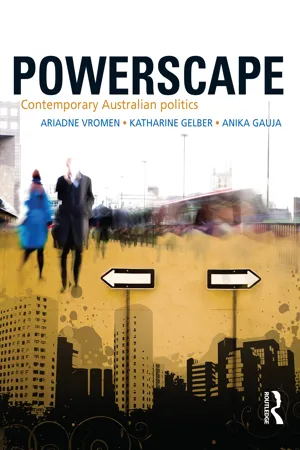
Powerscape is an introduction to Australian politics designed for today's students. It outlines the core political institutions and processes, and also analyses contemporary political issues and debates.
Powerscape tells the story of a dynamic political system, and of high levels of public engagement. Despite the prevailing view that political participation in the 21st century in many liberal-democracies is subdued, this book reveals complex interactions with political processes by a wide range of players.
Organised in three parts: power and democracy, political actors, and policy processes, Powerscape systematically investigates the role of power in political life. Each chapter is introduced by a snapshot', a detailed example based on a current issue or recent event.
With extended analysis of the change of government at the 2007 federal election, this second edition has been fully updated. It includes new examples, and new chapters on political institutions and policy-making.
- 480 pages
- English
- ePUB (mobile friendly)
- Available on iOS & Android
eBook - ePub
About this book
Information
Part I
Power and Democracy
CHAPTER 1
POWER AND POLITICS

This chapter presents the study of politics as the study of power, and more specifically relationships of power between people, groups and institutions. It recognises that the study of politics is the study of situations of relative inequalities of power, and that power is an essentially contested concept. We present a three-dimensional view of power that informs the analysis in the rest of the book.
Topics covered in this chapter include:
- the study of politics is essentially the study of relationships of power
- power is ubiquitous, but intangible and hard to measure
- a three-dimensional view of power enables more complex interactions to be analysed and understood
- power can be present in capacity or exercise; thus it can be overt or covert, conscious or unconscious, and individual or collective.
SNAPSHOT The Australian Prime Minister: leading the power game?
The Prime Minister is regarded as the most powerful political leader in Australia. As the leader of the elected government and the highest representative of the people, he or she (in December 2007 Australia had its first female Prime Minister when newly elected Deputy Prime Minister Julia Gillard took on the role of Acting Prime Minister for three days) is called upon to play a variety of leadership roles.
Within days of being sworn into office on 3 December 2007, Prime Minister Kevin Rudd declared:
the government has a plan to move Australia forward by boosting long-term productivity growth for the future. The Government has a plan to tackle Australia's future challenges and I want to begin implementing that plan as soon as possible ... I do not under-estimate the degree of difficulty involved in this ambitious agenda. But the time has come now to roll our sleeves up and get to work. (Rudd 2007a)
Then on the opening day of the new parliament on 12 February 2008, the traditional owners of Australia were honoured and for the first time ever a welcome to country was performed by first Australians (Rudd 2008a).
On the next day, the first sitting day of the new parliament, the Prime Minister apologised to indigenous people for the Stolen Generation and made commitments to reduce disadvantage faced by indigenous communities within the next five to ten years (Rudd 2008b). The apology was an historic occasion.
In these statements and actions, the Prime Minister has acknowledged that he is a political leader who exercises discretion in decision-making and exerts individual political power. The job of Prime Minister involves leading public debate, changing laws and regulations, representing Australia, giving speeches and media interviews, and addressing the community. In doing these things the Prime Minister recognises that he or she is expected to develop policy that gives expression to the people's values and aspirations. Since Kevin Rudd is now leading the first national Labor government for more than a decade, he feels lie has a mandate for change. He will also be continuously lobbied and pressured by other members of government, parliamentarians, the media and the general public.
How far is the Prime Minister able to exercise independent leadership, and how much is he affected by other players, issues and ideas within the Australian political system? How does the Prime Minister respond to competing demands and still retain the role of a political leader?
To understand the Prime Minister's role, we can examine three arenas within which contestation over power takes place. These are:
- the formal, institutional arena of decision-making within parliament
- the broader political context within which decisions are made about what issues need to be brought to parliament and in what form, and
- the full range of competing ideas and values championed by the Prime Minister and others within Australian politics when trying to have their voice heard.
The first arena influencing the Prime Minister is the formal institutional arena within which he operates and makes decisions. The Prime Minister makes formal decisions within the parliamentary system as the leader of the political party that forms government. In this formal sense the Prime Minister's power to make decisions is clear. He leads the putting of proposals to parliament for a vote. It is easy to see when the Prime Minister has achieved his intention and when he has not, by looking at whether his party's proposals are passed by the parliament. But this does not tell us the whole story about how the Prime Minister operates within the Australian political system.
In order to understand some of the broader pressures the Prime Minister faces, it is necessary to examine a second arena. This is the broader formal context within which decisions are made. It includes the activities of other members of the Prime Minister's party in providing advice from their areas of expertise and trying to bring up proposals of their own for the party to adopt and then take to the parliament for approval. The process of considering which ideas to take to the parliament, and in what form, is lengthy and complicated. The media also play an important role in raising awareness of some political issues and pressuring the government to respond. Media coverage of political and community issues can force the government to respond to specific concerns, for example about crime levels or the state of schools. Consultations between the government and members of the community can inform the positions the government adopts. For example, Kevin Rudd consulted indigenous people on the wording of the apology before it was made. In order to understand how much power the Prime Minister really has, it is necessary to examine all of these pressures on his leadership. But even these two arenas do not tell us everything about how the Prime Minister operates because they do not provide us with the full context within which decision-making making takes place and power is possessed and exercised.
As well as responding to parliamentary, party media and community pressures, the Prime Minister is also expected to provide leadership in the sense of having a vision for Australia's future. How does he or she do this? A Prime Minister's vision for Australia's future is based in his or her overall ideals, values and preferences. In the contemporary political environment in Australia, arguments about decisions and policy at a parliamentary level tend to reflect larger differences in ideas. An ideology by which Kevin Rudd claims to be informed is social justice—the idea that his role requires that power be balanced by social responsibility and a duty to the less fortunate' (Canberra Times 2007, p. 16). Time will tell whether this ideology survives other influences on the Prime Minister. Other influential ideological perspectives that will affect political decision-making include neo-liberalism—a belief in the importance of free market competition and a promotion of choice through market systems—and globalisation—the extent to which Australia is becoming integrated with global economic and social concerns. There are of course other ideologies and debates that influence the Prime Minister's decision-making and views on the world. These influences tend to operate in invisible and covert ways. This means that underlying beliefs can affect decision-making without us even being aware of them.
Understanding how the Prime Minister exercises leadership therefore requires an examination of all three arenas within which pressure is possessed and exerted both overtly and covertly. What do these arenas represent? How can they be explained? What is the role of power in understanding politics?
The study of politics
The study of politics is at least several thousand years old (Dahl 1964, p. 2). During this time society has become more complex, with the emergence of representative parliamentary forms of government, a large bureaucracy and the development ol new norms for relations between states internationally As these momentous changes have occurred and demands on government have increased, a constant theme in every political society has been the presence of, and attempt to harness, power.
There are many ways of studying power, but power is ultimately less an entity than a (potential or actual) relationship. Power is about relationships between people, singly and collectively, who more often than not possess differing levels of power. More specifically politics is the study of relationships between people and institutions possessing different levels of power, and attempts to alter these levels in terms of access, process and outcomes. Power is therefore a ubiquitous theme in political science literature.
But calculations of power are difficult to make. This renders the study of politics particularly open to interpretation. It is for this reason that some people argue that the study of politics is not a 'science' at all; 'real' science, also called hard science, is characterised by testable theorems and the conducting of experiments that produce hard data from which analysts may deduce the answer to a question. Social sciences, in which the study of politics is located, are far less exact. It is difficult, if not impossible, to conduct experiments on human beings from which all other factors except those under study may be eliminated. For example if a political scientist were to ask what the causes of poverty in a particular community might be, and were to find a relationship between impoverishment and lack of access to publicly funded education, the researcher may wish to deduce that some kind of causal link exists between the provision of publicly funded education and an ability to earn enough money to live comfortably. However, the same study may also find that impoverished families had more children than rich families. Would this imply that having more children induced poverty? Conversely, would it imply that impoverished families tend to have more children? These implications need to be assessed using other methods and tests, which means that finding answers is usually not straightforward. In the end answers in the social sciences tend to be informed by the values the researcher holds as well as the nature and method of the study undertaken.
For these reasons, Dahl regards the study of politics as both science and art (1964, p, 2). It is a science in the sense that an idea or an answer may be developed and assessed via the scientific research methods of observation, interview, survey, questionnaire or statistical analysis. For example if you wanted to discover whether a policy directed at people with disabilities had increased their rate of finding full-time work, you could count the number of people with disabilities in full-time jobs before and some time after the policy ...
Table of contents
- Cover
- Half Title
- Dedication Page
- Title Page
- Copyright Page
- Contents
- Tables and figures
- Acknowledgements
- Introduction
- PART I POWER AND DEMOCRACY
- PART II POLITICAL ACTORS
- PART III POLICY PROCESSES
- Bibliography
- Index
Trusted by 375,005 students
Access to over 1.5 million titles for a fair monthly price.
Study more efficiently using our study tools.
Frequently asked questions
Yes, you can cancel anytime from the Subscription tab in your account settings on the Perlego website. Your subscription will stay active until the end of your current billing period. Learn how to cancel your subscription
No, books cannot be downloaded as external files, such as PDFs, for use outside of Perlego. However, you can download books within the Perlego app for offline reading on mobile or tablet. Learn how to download books offline
Perlego offers two plans: Essential and Complete
- Essential is ideal for learners and professionals who enjoy exploring a wide range of subjects. Access the Essential Library with 800,000+ trusted titles and best-sellers across business, personal growth, and the humanities. Includes unlimited reading time and Standard Read Aloud voice.
- Complete: Perfect for advanced learners and researchers needing full, unrestricted access. Unlock 1.5M+ books across hundreds of subjects, including academic and specialized titles. The Complete Plan also includes advanced features like Premium Read Aloud and Research Assistant.
We are an online textbook subscription service, where you can get access to an entire online library for less than the price of a single book per month. With over 1.5 million books across 990+ topics, we’ve got you covered! Learn about our mission
Look out for the read-aloud symbol on your next book to see if you can listen to it. The read-aloud tool reads text aloud for you, highlighting the text as it is being read. You can pause it, speed it up and slow it down. Learn more about Read Aloud
Yes! You can use the Perlego app on both iOS and Android devices to read anytime, anywhere — even offline. Perfect for commutes or when you’re on the go.
Please note we cannot support devices running on iOS 13 and Android 7 or earlier. Learn more about using the app
Please note we cannot support devices running on iOS 13 and Android 7 or earlier. Learn more about using the app
Yes, you can access Powerscape by Anika Gauja,Katharine Gelber,Ariadne Vromen in PDF and/or ePUB format, as well as other popular books in Politics & International Relations & American Government. We have over 1.5 million books available in our catalogue for you to explore.