- 256 pages
- English
- ePUB (mobile friendly)
- Available on iOS & Android
eBook - ePub
About this book
Before the collapse of the Eastern Bloc, private marketeering was regarded not only as criminal, but even immoral by socialist regimes. Ten years after taking on board western market-orientated shock therapy, post-socialist societies are still struggling to come to terms with the clash between these deeply engrained moralities and the daily pressures to sell and consume. This book explores the new market and its resulting contradictions in a rapidly developing Eastern Europe and Russia. Will Western fast-food industries irrevocably alter local culinary practices? What effect has the privatization of land had upon ownership and exchange? What role do new commodities play within the household? Based on original, first-hand ethnography, this book is a long-awaited addition to existing literature on post-socialist societies. It will be essential reading for students of anthropology, sociology, European and cultural studies, as well as professional groups working in Eastern Europe and Russia, including NGOs, development organizations and businesses.
Information
-1-
The Market in Everyday Life: Ethnographies of Postsocialism
Caroline Humphrey and Ruth Mandel
During the socialist period in Eastern Europe and Russia, making profits from marketing was illegal in most circumstances and state ideologies branded private trading activities as immoral.1 Such judgements were widely, though of course not universally, shared by ordinary people (Pine 1996; Stewart 1996; Humphrey 1999a). From 1991 postsocialist governments, however, moved rapidly toward market reform. Ten years on, having survived Western market-oriented ‘shock therapy,’ taken on IMF and World Bank loans, and entered the global marketplace, the post-socialist societies still struggle to come to terms with the clash between deeply ingrained moralities and the daily pressures, opportunities and inequalities posed by market penetration. ‘The market’ confronts people in diverse contexts and is not experienced as a purely economic phenomenon: it might appear as a rural privatization programme, advertisements for Western cigarettes, daily observation of growing inequalities in poverty and nouveau wealth, or the sudden visibility of prostitution. Attitudes and practices even within one region are by no means uniform, yet we need to try to understand what patterns are emerging in the groundswell of everyday activities. It is just such confrontations, ambiguities and compromises concerning ‘the market’ that are described and analysed in this volume.
This collection represents original research, echoing in its variety and freshness the diversity of quotidian market activities of the people living in the new states and regions of the former Soviet Union and its eastern European satellites. Though not representative by any measure, the range of material assembled here covers a span of countries and continents, regions and topics, and collectively demonstrates the specificities of local responses to the introduction of market activities in the tumultuous last decade of the twentieth century. It is this broad span, combined with the focus specifically on ‘the market’, that differentiates this volume from the other collections on postsocialism that have appeared in recent years (Buckley 1997; Burawoy and Verdery 1999; Berdahl et al. 2000). Furthermore, unlike the literature in political science (e.g. Mau 1996; Urban 1997), sociology (e.g. Stark and Bruszt 1998; Szelenyi and Costello 1996) or economics (e.g. Boycko et al. 1995; Sachs 1993), this book takes an anthropological approach, and therefore differs in its contribution from the kinds of works that have dominated in Soviet and post-Soviet studies. Anthropologists specialize in long-term, on-the-ground, multi-stranded and reflexive research. Rather than analysis of statistics, mass surveys or interviews with elites, anthropologists tend to deal with the ordinary people in a wide variety of walks of life, including the marginal and dispossessed, and the resulting research confirms the rich insights this intensive, context-sensitive approach is able to offer (e.g. Mandel 2001; Hann 2001).
In this introduction we have placed ‘the market’ in inverted commas because a simple and common understanding of this concept cannot be taken for granted. There is no ‘market’ that exists outside and beyond the particular forms of it that appear in historical circumstances in particular countries and cultures (Dilley 1992). The specific version of the market introduced in the early 1990s, under the influence not only of American but also of indigenous economists attracted to Western liberalism (Lloyd 1996) became known as ‘shock-therapy’. This doctrine emphasized rapid privatization, the freeing of prices, withdrawal of subsidies, and free trade, as distinct from state-supported and more regulated varieties of capitalism. What is often forgotten, however, is that this version of ‘the market’ did not land on unoccupied ground. In all the former-socialist countries, including even remote areas of the former Soviet Union, the ‘market’ was introduced into societies where there were already a variety of entrepreneurial or profit-oriented practices of one kind or another. Some of these were legal and had had a long-standing existence within the overarching state-run economy, as in Hungary (Lampland 1995). Others were illegal, like the underground workshops and racketeering activities that operated in Russia (Humphrey 1999b). And Gorbachev’s perestroika, which began in the mid-1980s and enabled the emergence of a widespread, rapaciously commercial cooperative movement, also created a foreground of everyday economic practices that ‘the market’ had to encounter. In other words, we are not dealing simply with the clash of two mutually alien economic systems, ‘the market’ and ‘the socialist planned economy’, but with a much more complex encounter of a number of specific, culturally-embedded, and practical organizational forms.
One phenomenon that emerges from the research presented here is a common set of complaints and reactions to the new economic and social challenges. These focus on the unfairness of economic differentiation and anger directed at ‘the state’ for its inability to provide services taken for granted in socialist times. Interestingly however, despite these common reactions, the countries that once shared a single socio-economic template are increasingly coming to diverge from one another (Kandiyoti 1996, 1998, and forthcoming). For example, some of the new Central Asian states have assumed highly authoritarian forms, complete with a near absence of civil rights or press freedom, and beset by new and widespread impoverishment, rising mortality rates, pervasive corruption and, in some cases, personality cults of their presidents. On the other hand, many of the countries of Central and Eastern Europe have experienced the vicissitudes of struggling proto-democracies. They face profound economic and political challenges, to be sure, but all the same have moved in an unambiguously ‘Western’ direction, so much so that they are applying for membership in the European Union. It is likely that the candidacies of Hungary, Poland, and the Czech Republic will be considered seriously in the near future.
Given these contrasting directions a persistent and implicit question necessarily arises from all these chapters: how long will it be tenable to speak of, write of, think of a category called ‘postsocialism’? Given the quite substantively differing paths these countries took during the 1990s, the time has come already when to speak of ‘postsocialist’ processes and practices one must carefully qualify the context and content in question.
Despite these uncertain future trajectories, we feel that the 1990s represented a critical period that does have a certain unity. It was during this period that people living in these new states experienced the withdrawal of state surveillance and the collapse of accustomed social (as well as economic) institutions, while at the same time being brought face-to-face with the exigencies of a hard-edged variety of ‘the market’. Of course, they were not alone in this. It was not just in the postsocialist countries that new junctures of globalization, the accountancy culture, and down-sizing took drastic effect. This is why the particular trajectories of the former socialist societies are so relevant for social scientists concerned with the pasts, presents and futures of political economies in general. It is with the aim of contributing to such discussions that these chapters have been brought together, illuminating as they do certain common themes emanating from postsocialist social spaces, despite the perhaps increasingly disparate realities these fascinatingly different places represent.
Thematic concerns
The chapters in this book address the priorities iterated endlessly by international development agencies and organizations active in the region (e.g. IMF, World Bank, USAID, DFID, EBRD, Soros), the multinational investors (e.g. international oil and gas companies), and myriad observers (media, academic, OSCE). These include privatization and decollectivization, inflation, unemployment, poverty, and alternative economic employment (notably in Chapters 9–11 by Perotta, Sneath and Shreeves, respectively), new work ethics (Czeglédy in Chapter 8 and Kaneff in Chapter 3), civil society and new patterns of consumption (Rausing in Chapter 7 and Drazin in Chapter 6), and entrepreneurship (Heyat in Chapter 2 and Pine in Chapter 5). However, anthropological insights on these exacting issues and processes depart in important ways from the macro-levels of analysis and description normally found in media, greyliterature reports, and the like. Furthermore, they introduce other themes not generally considered in the development literature, such as the ways in which ethnic identity and national affiliations can have an impact on economic activity (Rausing; also Watts in Chapter 4).
The anthropological contribution can upend commonly expressed and explained economic relations. Instead of studies of transactional outcomes abstracted from historical time and social context, an anthropological perspective may point out the importance of long-standing and culturally specific patterns of economic activity. Existing socially-constituted practices, such as the sexual division of labour, ethnic work specialization, or local entrepreneurial traditions, may significantly affect the way in which the postsocialist ‘market’ is encountered and engaged with. Our first four chapters take this approach, with each individually also touching upon other issues.
Deema Kaneff’s Chapter 3 shows the explicitly ideological nature of market activity. Engagement in the market is not a moral-free activity but given value through the political-economic context in which it operates. In contrasting two women, Maria and Grigora, Kaneff looks at different ways in which sellers view their own participation in market trading – as either a shameful practice or one conferring pride. These different moral positions expressed by kin engaged in the same activity are rooted in an individual’s location with respect to ‘production’ and ‘work’ – both terms having undergone revalorization since the 1989 postsocialist reforms. For Maria, once an official who upheld a work ethic grounded in state production, market trading was a shameful act with which she still does not feel totally comfortable, though one in which she engages as a coping strategy – her state pension no longer is sufficient. Her mother, never involved in political life to the same degree as her daughter, finds engagement in the market a cause for pride, as household production is much more central to her own identity.
Similarly, contrasting ideologies and moralities are at the root of Pine's study of the Górale of southeast Poland. A population tracing their roots to transhumant Vlachs, they operated as petty traders and international migrants in the socialist period. Their understanding of money, value and labour contrasts with that of their more sedentary neighbours. Money per se is not viewed negatively by Górale; rather, it is the provenance of money that is valorized. For the Górale the salient distinction is shown to be between different types of labour and exchange, producing differently valorized types of money. Pine describes how during the socialist period money and labour articulated with Górale beliefs about the primacy of the household and their hostility to the state. Earnings from entrepreneurial practices or from economic migration were liable to be displayed proudly; on the other hand, earnings associated with waged labour, dependency and inequality - all characteristic of state-related labour - were disvalued. A tension emerges in Górale ideology, namely the opposition between a collective morality of the house and community, and individual autonomy and individualism. In a persuasive account. Pine suggests a parallel in the contrast between capitalism and communism and how those of the Górale community integrate the two in practice if not in ideology. However, the situation shifted, and after a period in the early 1990s 'when everything seemed to be out of focus, in reverse or slightly wrong' the Górale have changed their attitude toward the state and money. Always politically charged, money, and the commodities for which they can be exchanged, now have assumed a new inflection. Instead of the state, the new focus of their hostility has become the Western business and governments operating in Poland. Foreign money, once prized, has assumed negative associations, and Polish zloty are explicitly preferred, still reflecting an anxiety about autonomy, but at a different level and scale from earlier. Now fears expressed are concerned with economic and cultural encroachment from the West. Thus for Górale, money, always heavily social, has also become national.
As with Pine’s case, Watts’s study describes a group who maintained an alternative, viable value and moral system throughout the socialist period. In Watts’s analysis of new entrepreneurs in Archangelsk in northern Russia, a region inhabited by a distinctive group of Russians known as Pomors, he demonstrates precisely the unique perspective and insights an anthropological study can offer. Disputing the findings of standard political accounts and opinion surveys on the one hand, and the dead end of culturalist-reductionism on the other, he shows that a more nuanced understanding of indigenous notions, symbols and practices of entrepreneurship, historically contextualized, can lead to quite different conclusions. Drawing on historical studies of the region, he traces the mytho-ethnogenesis adhered to by the Pomors and seen not only in their own expressive culture but also in works written about them over the past centuries. The Pomors, having achieved a reputation as self-sufficient fishermen and entrepreneurs in Tsarist times, experienced a devastating transformation of their way of life with the Soviet Revolution. Condemned as ‘primitive’ on the one hand, and ‘petty bourgeois’ and ‘kulak exploiters’ on the other, they, like so many others, suffered appallingly under Stalinism. After their rehabilitation under Gorbachev they, along with the rest of the country, experienced the shocks of post-Communist Party rule.
Again, as in pre-Revolutionary times, a new entrepreneurialism has taken hold in the region. However, unlike the imagery of the pre-Revolutionary pomor entrepreneurs, whose pride derived from their industrious independence, having ‘pulled themselves up by their own bootstraps’, the postsocialist entrepreneurial variant has been the notorious New Russians. Their entrepreneurial success derives not from hard work, but from the social capital accumulated during the Soviet period – their already existing networks and connections. The former Party and State nomenklatura, undaunted by the new market order, instead exploited it, capturing for themselves the state resources in the privatization sweepstakes. In some regions of the former Soviet Union, this practice has been cynically termed prikhvatizatsia (from the Russian word prikhvatit’ ‘to grab’), a play on the Russian word for privatization, privatizatsia. Watts describes the negative popular reactions to the instant windfalls gained by an elite few, an attitude informed partially by a perception that the nouveau wealth was not pr...
Table of contents
- Cover
- Half Title
- Title Page
- Copyright Page
- Contents
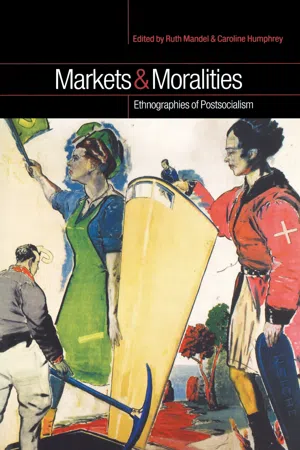
- A Note on the Cover: Weiche
- Acknowledgements
- Notes on Contributors
- 1 The Market in Everyday Life: Ethnographies of Postsocialism
- Part I Trading Cultures, Market Ambiguity, and Historical Transformatio
- Part II Consumption and Modernitie
- Part III Rural and Institutional Transformation
- Index
Trusted by 375,005 students
Access to over 1.5 million titles for a fair monthly price.
Study more efficiently using our study tools.
Frequently asked questions
Yes, you can cancel anytime from the Subscription tab in your account settings on the Perlego website. Your subscription will stay active until the end of your current billing period. Learn how to cancel your subscription
No, books cannot be downloaded as external files, such as PDFs, for use outside of Perlego. However, you can download books within the Perlego app for offline reading on mobile or tablet. Learn how to download books offline
Perlego offers two plans: Essential and Complete
- Essential is ideal for learners and professionals who enjoy exploring a wide range of subjects. Access the Essential Library with 800,000+ trusted titles and best-sellers across business, personal growth, and the humanities. Includes unlimited reading time and Standard Read Aloud voice.
- Complete: Perfect for advanced learners and researchers needing full, unrestricted access. Unlock 1.5M+ books across hundreds of subjects, including academic and specialized titles. The Complete Plan also includes advanced features like Premium Read Aloud and Research Assistant.
We are an online textbook subscription service, where you can get access to an entire online library for less than the price of a single book per month. With over 1.5 million books across 990+ topics, we’ve got you covered! Learn about our mission
Look out for the read-aloud symbol on your next book to see if you can listen to it. The read-aloud tool reads text aloud for you, highlighting the text as it is being read. You can pause it, speed it up and slow it down. Learn more about Read Aloud
Yes! You can use the Perlego app on both iOS and Android devices to read anytime, anywhere — even offline. Perfect for commutes or when you’re on the go.
Please note we cannot support devices running on iOS 13 and Android 7 or earlier. Learn more about using the app
Please note we cannot support devices running on iOS 13 and Android 7 or earlier. Learn more about using the app
Yes, you can access Markets and Moralities by Caroline Humphrey,Ruth Mandel in PDF and/or ePUB format, as well as other popular books in Social Sciences & Economic History. We have over 1.5 million books available in our catalogue for you to explore.