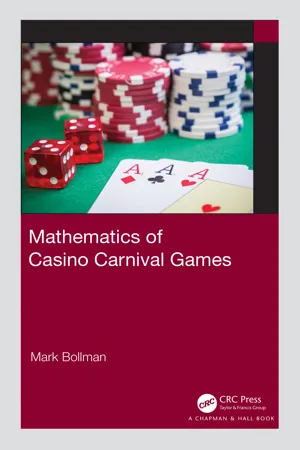
Mathematics of Casino Carnival Games
eBook - ePub

Mathematics of Casino Carnival Games

  1. 308 pages
  2. English
  3. ePUB (mobile friendly)
  4. Available on iOS & Android
eBook - ePub

Mathematics of Casino Carnival Games

About this book

There are thousands of books relating to poker, blackjack, roulette and baccarat, including strategy guides, statistical analysis, psychological studies, and much more. However, there are no books on Pell, Rouleno, Street Dice, and many other games that have had a short life in casinos!

While this is understandable — most casino gamblers have not heard of these games, and no one is currently playing them — their absence from published works means that some interesting mathematics and gaming history are at risk of being lost forever. Table games other than baccarat, blackjack, craps, and roulette are called carnival games, as a nod to their origin in actual traveling or seasonal carnivals.

Mathematics of Casino Carnival Games is a focused look at these games and the mathematics at their foundation.

Features

• Exercises, with solutions, are included for readers who wish to practice the ideas presented

• Suitable for a general audience with an interest in the mathematics of gambling and games

• Goes beyond providing practical 'tips' for gamblers, and explores the mathematical principles that underpin gambling games

Frequently asked questions

Yes, you can cancel anytime from the Subscription tab in your account settings on the Perlego website. Your subscription will stay active until the end of your current billing period. Learn how to cancel your subscription.
At the moment all of our mobile-responsive ePub books are available to download via the app. Most of our PDFs are also available to download and we're working on making the final remaining ones downloadable now. Learn more here.
Perlego offers two plans: Essential and Complete
  • Essential is ideal for learners and professionals who enjoy exploring a wide range of subjects. Access the Essential Library with 800,000+ trusted titles and best-sellers across business, personal growth, and the humanities. Includes unlimited reading time and Standard Read Aloud voice.
  • Complete: Perfect for advanced learners and researchers needing full, unrestricted access. Unlock 1.4M+ books across hundreds of subjects, including academic and specialized titles. The Complete Plan also includes advanced features like Premium Read Aloud and Research Assistant.
Both plans are available with monthly, semester, or annual billing cycles.
We are an online textbook subscription service, where you can get access to an entire online library for less than the price of a single book per month. With over 1 million books across 1000+ topics, we’ve got you covered! Learn more here.
Look out for the read-aloud symbol on your next book to see if you can listen to it. The read-aloud tool reads text aloud for you, highlighting the text as it is being read. You can pause it, speed it up and slow it down. Learn more here.
Yes! You can use the Perlego app on both iOS or Android devices to read anytime, anywhere — even offline. Perfect for commutes or when you’re on the go.
Please note we cannot support devices running on iOS 13 and Android 7 or earlier. Learn more about using the app.
Yes, you can access Mathematics of Casino Carnival Games by Mark Bollman in PDF and/or ePUB format, as well as other popular books in Mathematics & Applied Mathematics. We have over one million books available in our catalogue for you to explore.

Information

Chapter 1
Mathematical Background
Before diving into carnival games, it will be useful to review the mathematics that is essential to analysis of games of chance. In this chapter, we shall do this through the lens of familiar casino games such as craps, roulette, and blackjack.
1.1Elementary Probability
An event, in a probabilistic sense, is simply the outcome of some sort of random experiment. If A is an event, the probability of A is a function P(A) that assigns a number to A, in the interval 0 ≤ P(A) ≤ 1, as a measure of how likely A is to occur. Informally, we might define P(A) as
P(A)=Number of ways that A can happenNumber of ways that something can happen.
The set of all things that can happen in a given experiment, counted in the denominator, is called the sample space and often denoted by S. If we define a function #(A) that counts the number of elements in the event A, we can write
P(A)=#(A)#(S).
Counting the numerator and denominator of the expression for P(A) is typically done either by appealing to pure mathematical reasoning, the theoretical probability, or by looking at real data, the experimental or empirical probability.
Example 1.1. In tossing a fair coin, the theoretical probability of Heads is ½: there is one way to throw Heads, and two ways for the coin to land.
If instead we were to toss a fair coin 500 times, achieving 256 Heads and 244 Tails, the experimental probability of Heads is 256500=.512.
The connection between theoretical and experimental probability is described in a mathematical result called the Law of Large Numbers, or LLN for short.
Theorem 1.1. (Law of Large Numbers) Suppose an event has theoretical probability p. If x is the number of times that the event occurs in a sequence of n trials, then as the number of trials n increases, the experimental probability x/n approaches p, or
limnxn=p.
Informally, the LLN states that, in the long run, things happen in an experiment the way that theory says that they do. What is meant by “in the long run” is not a fixed number of trials, but will vary depending on the experiment. For some experiments, n = 500 may be a large number, but for others—particularly if the theoretical probability is small—it may take far more trials befo...

Table of contents

  1. Cover
  2. Half Title
  3. Title Page
  4. Copyright Page
  5. Dedication
  6. Contents
  7. Preface
  8. 1. Mathematical Background
  9. 2. Mathematics and Casino Game Design
  10. 3. Wheel and Ball Games
  11. 4. Card Games
  12. 5. Dice Games
  13. Appendix A: Answers to Selected Exercises
  14. References
  15. Index