- 256 pages
- English
- ePUB (mobile friendly)
- Available on iOS & Android
eBook - ePub
About this book
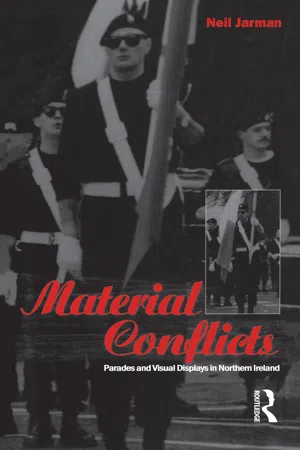
The deep and abiding sectarian divide splintering Northern Ireland has been the focus of considerable attention recently. In particular, the role parades and visual displays play in underscoring opposition has come into the spotlight with the emergence of heightened tensions, close on the heels of a tentative peace. Providing penetrating insights into the historical roots of Northern Ireland's ethnic hostilities, this timely book explores the role of images and material culture in shaping present attitudes. Ritual, identity, class and memory are shown to be potent forces informing trenchant animosities -- animosities which are visually reflected in banners and murals for unionists and nationalists alike. The pivotal role of the Twelfth of July parade in Belfast, when an estimated 100,000 either parade or watch the Orangemen, is highlighted. Anyone interested in the future of Northern Ireland and concerned about escalating conflict across the globe will warmly welcome this impressive study.
Information
Chapter 1
The Performance of Memory
Some societies need no re-enactment to reactivate history; the process seems to be ingrained, habitual. Unassuaged injuries and injustices often lead men to conflate remote with recent times and even with the present. Many Irish continue to experience the Danish invasions, the devastations of Laud, the Famine of 1847, as almost contemporaneous events. Irish memory has been likened to historical paintings in which Virgil and Dante converse side by side. But the Irish do not ‘live in the past; rather, Ireland’s history “lives in the present”. All previous traitors and all previous heroes remain alive in it’, as in the ‘bottomless memory’ of an O’Faolin character in which ‘one might see, though entangled beyond all hope of unravelling’, the entire saga of Ireland’s decay
(Lowenthal 1986:250).
The above embodies a widely held view of the Irish use of history, in which the concept of ‘folk’ or ‘race’ memory is used to explain persistent or recurrent social beliefs and practices that are transmitted apparently almost without trace (MacDonagh 1983a; Rose 1971; Smyth 1992; Stewart 1989). Although the past retains an unusual prominence in Irish social and political life, can we talk of a bottomless memory in which nothing and no one is forgotten? Are such memories really sustained habitually with no re-enactment? How is it even possible to talk of a singular ‘Irish memory’ in an island that has been subject to centuries of colonial domination, an island that now has two distinct, ideologically opposed ethnic communities? And what impact will the fact that the island has sustained a military conflict for the past generation in which one of the most prominent features has been the conflicting interpretations of Irish history, have on a sense of collective belonging? While one may criticise Lowenthal’s sweeping generalisation of the understanding and use that many Irish people have and make of their past, it is a perspective that can be accommodated within many popular interpretations of the ‘Irish problem.’ Ireland is all too readily regarded as a society trapped in the past: the contemporary conflict has been likened to medieval religious wars, or alternatively described as an unresolvable conflict between two mutually hostile tribes. Both of these approaches consign the Irish (or perhaps only those Irish who live in the northern part of the island) to a primitive or backward state that in turn perhaps makes their irrational, bottomless memory more understandable.
However, no matter how critical or dismissive one might be of the ‘religious war’ or ‘tribal conflict’ approaches (Jenkins, Donnan and MacFarlane 1986), it is impossible to ignore the prominent role that historical events and characters continue to play in the political and social life of Northern Ireland. One might ask why battles of the seventeenth century are still remembered as important events 300 years later? Why does a seventeenth-century British king who is all but unknown in England feature as an icon of British identity in Northern Ireland? What do historical and mythological figures, such as King William III and St Patrick, mean to people living in the north of Ireland? How have the complex identities subsumed within the populist rhetoric of ‘Protestant’ and ‘Catholic’ been created, developed and maintained since the arrival of colonists from England and Scotland in the seventeenth century? And why are they the most prominent anchors for collective identities? This study considers these questions by analysing some of the ways and the means by which past events are remembered in contemporary Northern Ireland. It focuses in particular on the numerous commemorative parades that are held each year to explore just what is being commemorated and remembered at those times. In Britain the practice of holding annual parades, which flourished in the nineteenth century, has now largely died out; but in the north of Ireland the practice continues stronger than ever. In tracing the history of this custom, I aim to show how parades have been used in the past and how they have changed, and to indicate why these popular commemorations and festivities have not only survived but are thriving in Ireland, when similar events have failed to survive the transition to urbanism and industrialisation in other Western European and North American countries (Burke 1978; Cressy 1989; Davis 1986; Malcolmson 1973; Storch 1982).
I will also consider the relationship between these acts of remembrance and celebration and the violence of the Troubles. While republican and loyalist paramilitary violence has been subjected to extensive analysis, less interest has been spent on understanding how political violence (as a general practice rather than any specific acts) retains some legitimacy within the population at large. From the beginning of the Troubles in the late 1960s until the ceasefires of August and October 1994, paramilitary groupings have caused a considerable amount of death, destruction and injury while still retaining substantial support within otherwise law-abiding and church-going communities. They did this while appealing to abstract ideals of nationality and to the precedent of history. To the question ‘How is the past remembered in Northern Ireland?’ one must add ‘How is political violence legitimised through the acts of commemoration?’
Finally, I am concerned with the use of visual displays as a part of this process. The two principal forms of imagery in which I am interested are painted silk banners carried on the parades and mural paintings that adorn the gable walls of the working-class areas of Belfast and Derry. The banner displays are a conservative body, and many of the images and symbols have been carried since last century In contrast, although murals have been painted in Belfast since the early part of this century, the body of work considered here is largely a product of the past twenty years. Nevertheless, many of the images and themes of the murals are linked to the images displayed on parades. To understand this contemporary use of images I discuss how and why these two bodies of images have been established, what they mean and how that meaning is changed and used within broader ideological debates. I analyse the connections and differences between images used within each community, but also explore the connections and differences between the Protestant/Unionist/Loyalist images and the Catholic/Nationalist/Republican images. This also involves looking at the media of presentation, the space, the form and temporality of display and how these factors relate to the images: where murals are painted and where they are not, where parades go and where not. Collectively the parades, banners and murals present a comprehensive display of history, symbols and icons that underpin the distinctive and opposing identities of the two dominant groups. The anniversaries and the images are an opportunity to give public expression to the collective memory of the Ulster Protestant and Irish Catholic communities.
Social Memory
Social memory is similar to, but remains distinct from, a more formal sense of history. History follows a form of logic, of structure, of pattern, of narrative and of progress that is absent from the more chaotic and disjointed content of memory. Halbwachs (1980, 1992) contrasts history, that which is concerned with documenting change, with the collective memory, which is rooted in a sense of permanence and continuity. The writing of history is concerned with imposing some sense of narrative and direction on the past, while a collective memory is more concerned with emphasising the sense of repetition, of situating the event or experience within a pre-existing category. In a similar fashion Pierre Nora regards memory as the traditional medium for understanding the past, but one that has been supplanted by reconstructed history in our ‘hopelessly forgetful modern societies, propelled by change’ (1989:8). But, as Redfield (1994) argues, this opposition and separation between history and memory is never so complete and fixed: history will always be balanced, and sometimes opposed, by a multiplicity of social or collective memories. And, just as the past recalled by memory may question that authorised by historians, so the memories of one group may contrast with those of another. This sense in which collective memories conflict with one another and with written history is one of the themes explored in this study. I am not concerned here with understanding how memory works per se, but how a collective or social memory, or rather a plurality of social memories, is generated and maintained. Here it is useful to be aware of the difference between autobiographical memory and historical memory: between events that are remembered from personal experience and are specific to the individual, and memories of past events that ‘can only be stimulated in indirect ways through reading or listening or in commemoration and festive occasions when people gather together to remember in common the deeds and accomplishments of long-departed members of the group’ (Coser 1992:24).
This idea of a memory of unexperienced events insists that memory is not simply a repository for sensory data that are merely stored away, only to be retrieved unchanged and as new when required. Instead, remembering must be an active process, in which memories have to be worked on and used in order to be maintained. Memories, as a medium for understanding the past, are a part of the wider cultural practices that are continually being adapted and rephrased to meet the needs of the present. Social memories ‘are not “recollections of times past” but part of the present understandings of the past’, people use ‘images of the past [as] a justification for the present relationship’ and not ‘images from the past’ (Morphy and Morphy 1984:462). It is the desires and aspirations of the present that shape our views of the past, while at the same time those present aspirations are partly formed by our understanding of our past. We use the past by remembering selectively those events that help to explain or justify what is happening in the present, a present that can therefore be portrayed as the inevitable and only outcome of those same events. The changing needs and circumstances of the present mean that memories are monitored and re-evaluated, and our understanding of the past is adapted to changing circumstances. Some memories will be readily abandoned and forgotten, and some long-ignored events may in turn be recalled, as history is subject to reappraisal. Usually this is a subtle process ‘of persistence and change, of continuity and newness’ (Coser 1992:26); but in periods of dramatic social change and upheaval, attempts may be made to make wholesale changes to the collective remembrance of the past. Such attempts to refocus history were made after the French Revolution (Ozouf 1988), and again more recently in Nazi Germany (Connerton 1989; Mosse 1975) and during the Stalinist period of the Soviet Union (Lane 1981). The fact that the social memories that were imposed at those times have largely been forgotten illustrates the problem of trying to create new memories of the past that conflict with an emergent understanding; of trying to rewrite history to conform to a larger ‘objective’ truth. The current restructuring of national, ethnic and political identities across much of Eastern Europe has in turn produced another refocusing of collective memories. Much of the recent past is being swept away in an attempt to recall a better and more appropriate past from which to launch new state formations. Just as the idea of Stalingrad was swept away by a previous generation, so one now is encouraged to imagine a return to the imperial glories of St Petersburg, as Lenin’s position as Soviet icon is whittled away and his preserved body removed from view. The importance that a sense of the past has in people’s daily lives, in providing continuity in the face of change, makes it almost impossible to wipe the slate clean and begin again.
Social memory is the understanding of past events that are remembered by individuals, but within a framework structured by the larger group. The group may range in scale from a single family, or residents of a particular town or village, right up to a national or state-based identity, which always relies on a particular form of social memory (Anderson 1983). As well as kinship and geographical groupings, individuals may share memories based on ethnic, class and political affiliations or structured by age and gender. Each individual is therefore enmeshed within many different pasts at any one time. Although not all will be equally important, each set of memories offers the possibility of a different future if a different sense of the past is given weight.
For this study the most important form of group affiliation is that of ethnicity. While the labels Protestant and Catholic have been widely interpreted through a religious idiom, the two communities function as discrete ethnic groups in so far as they remain largely endogamous, culturally distinct and symbolically bounded, and most importantly, see themselves as distinct (Smith 1986). The two communities emphasise this difference by claiming allegiance to opposing political nations, the British and the Irish, while living in a territory that remains contested by both states. While an ethnic or national identity is often seen as an essential and unchangeable feature of one’s being, it is in practice a much more fluid and unpredictable formation (Anderson 1983; Banks 1996; Eriksen 1993). In Ireland the formations of the distinct Ulster-British Protestant and Irish Catholic ethnicities were largely a product of the nineteenth century; but they are none the less real for all that. While the Irish Catholic identity has formed within the generalised rhetoric of nationalism, the Protestant identity sits at an uneasy intersection of Irish and British culture and history that has come to be called Ulster.
As a social construction, ethnic identity is given form and substance by being situated in time and in space. The group must have a memory of itself that recounts a sense of origin and distinctiveness (Smith 1986). A social memory becomes a central facet of the ideological armoury of the group, helping to legitimise and rationalise difference by rooting it in the far-distant past and thus placing weight on the primordial or essential nature of the antagonisms or otherness. Different media and forms of remembering may be more or less appropriate, depending on the number and range of people involved in creating a shared memory. It is difficult to produce and sustain a consensual memory of the past for a large and diverse group of people, even if they accept the common rubric of ethnicity, except when dealing with very general understanding or with the far-distant past. Even within the ethnic group, sub-groups may hold radically differing memories of what is a common past. As Papadakis (1993) discusses with reference to the recent political history of Cyprus, these differences may be a result of memories that are based on personal involvement rather than simply learnt history, but they may also be complicated by political, age and gender differences. We must therefore consider what are the most suitable means to maintain and transmit memories, both for individuals and for the group, to come to an understanding of the form and the expression in which past events are communicated.
At the level of the ethnic or national group, the historic event and symbolic icons are likely to be some way removed from individual experience. To be established as a social memory they need be conceptualised or encoded into an ‘internal context’, that is, isolated or freed from their specific history or external context and ‘transformed into images (or) arranged into stories’ (Fentress and Wickham 1992:68–73). This encoding involves a process of simplification: removing or ignoring extraneous details that blur the certitudes and so reduce the event or figure to little more than a schematic outline, the event or hero becomes mythified and decontextualised from any concrete past. The schematic structure can then be built upon and elaborated to fit different situations. Reducing the past to a formalised and generalised ideal allows for a multiple layering of memory whereby events and people over widely differing periods of time can be equated with one another. It also allows the specific individuals or actions that are remembered to be replaced by, or conflated with, others. Memory becomes less a means of conserving a distinct lineal history than a generator of meaning. The smooth temporal flow of history becomes a jumble of distinct and separate events lacking any obvious ordered narrative form, yet in which similar events seem to recur. Removed from their generating context, social memories function as signifiers without signifieds, as themes or metaphors in which the meaning is generated and added in the process of remembering. As the external context of the remembering changes, so the meaning may change, and social memory becomes an ‘active search for meaning’ in which the events of the past have a didactic as well as an explanatory function. Duplication or overlap merely serves to reinforce this feature (Harwood 1976:795).
Ritual and Memory
In reviewing Maurice Halbwachs’ work, Lewis Coser suggests that social memories are stimulated indirectly, through ‘reading or listening or in commemoration and festive occasions’ (1992:24). This formulation groups together widely differing processes of confronting the past: the quiet reflective intimacy of reading or being told a story (perhaps these days of watching a documentary on television), or of visiting a memorial, is quite different from participating in a public commemoration or festival (which in turn incorporates a broad range of events). The one focuses more on the details and meaning of the past, the other engages more with the emotive and bodily processes. Paul Connerton (1989) suggests that these are distinct and separate processes, and he argues that it is the active participation in ritual events that is the significant means of encoding social memory into the individual body. He therefore emphasises the importance of the ritual form over its content in the remembering process. However, I want to give more equal weight to both bodily and cognitive processes, and I will begin by considering the importance of the performative aspects of ‘festive occasions’ before returning to the role of extracting meaning from ritual events, in this case through the interpretation of symbols and images. Form and meaning are therefore complementary parts in the creation and maintenance of the social memory, rather than alternative approaches. Expressed through a multiplicity of media, memory moves from an intensive experience to an extensive penetration of social life, from the liminal to the habitual.
Most, if not all, states utilise ritual commemorations to celebrate their past glories and future aspirations and to help sustain the imagined community (see for example da Matta 1977; Gregory 1994; Handelman 1990; Kapferer 1988; Lane 1981; Mach 1992; Vogt and Abel 1977). These ritual events are formalised, stylised and repetitive symbolic activities that are constrained within a tightly structured format and restricted to specific times or places that are outside the normal flow of routine daily life. Although an idea of marginality or liminality is often central to an analysis of ritual...
Table of contents
- Cover
- Half Title
- Series Page
- Title Page
- Copyright Page
- Dedication Page
- Contents
- Acknowledgements
- 1 The Performance of Memory
- Part I: The Tradition of Parading
- Part II: Two Communities
- Part III: Displaying Faith
- Part IV: Painting the Streets
- Bibliography
- Index
Trusted by 375,005 students
Access to over 1.5 million titles for a fair monthly price.
Study more efficiently using our study tools.
Frequently asked questions
Yes, you can cancel anytime from the Subscription tab in your account settings on the Perlego website. Your subscription will stay active until the end of your current billing period. Learn how to cancel your subscription
No, books cannot be downloaded as external files, such as PDFs, for use outside of Perlego. However, you can download books within the Perlego app for offline reading on mobile or tablet. Learn how to download books offline
Perlego offers two plans: Essential and Complete
- Essential is ideal for learners and professionals who enjoy exploring a wide range of subjects. Access the Essential Library with 800,000+ trusted titles and best-sellers across business, personal growth, and the humanities. Includes unlimited reading time and Standard Read Aloud voice.
- Complete: Perfect for advanced learners and researchers needing full, unrestricted access. Unlock 1.5M+ books across hundreds of subjects, including academic and specialized titles. The Complete Plan also includes advanced features like Premium Read Aloud and Research Assistant.
We are an online textbook subscription service, where you can get access to an entire online library for less than the price of a single book per month. With over 1.5 million books across 990+ topics, we’ve got you covered! Learn about our mission
Look out for the read-aloud symbol on your next book to see if you can listen to it. The read-aloud tool reads text aloud for you, highlighting the text as it is being read. You can pause it, speed it up and slow it down. Learn more about Read Aloud
Yes! You can use the Perlego app on both iOS and Android devices to read anytime, anywhere — even offline. Perfect for commutes or when you’re on the go.
Please note we cannot support devices running on iOS 13 and Android 7 or earlier. Learn more about using the app
Please note we cannot support devices running on iOS 13 and Android 7 or earlier. Learn more about using the app
Yes, you can access Material Conflicts by Neil Jarman in PDF and/or ePUB format, as well as other popular books in Social Sciences & British History. We have over 1.5 million books available in our catalogue for you to explore.