The objective of Contemporary Research: Models, Methodologies, and Measures in Distributed Team Cognition is to advance knowledge in terms of real-world interactions among information, people, and technologies through explorations and discovery embedded within the research topics covered. Each chapter provides insight, comprehension, and differing yet cogent perspectives to topics relevant within distributed team cognition. Experts present their use of models and frameworks, different approaches to studying distributed team cognition, and new types of measures and indications of successful outcomes. The research topics presented span the continuum of interdisciplinary philosophies, ideas, and concepts that underline research investigation.
Features
Articulates distributed team cognition principles/constructs within studies, models, methods, and measures
Utilizes experimental studies and models as cases to explore new analytical techniques and tools
Provides team situation awareness measurement, mental model assessment, conceptual recurrence analysis, quantitative model evaluation, and unobtrusive measures
Transforms analytical output from tools/models as a basis for design in collaborative technologies
Generates an interdisciplinary approach using multiple methods of inquiry
A Lack of Shared Displays and Information Overload
Lack of Temporal Overlap
Problems with Social and Cultural Differences in Teams of Teams
Teams of Teams and Organizational Structures
Team Composition
Leadership
Ad-hoc Teams
Measurement of Team and Shared SA
Team SA Process Measures
Team SA Objective State Measures
Combined TSA
Collaborative TSA
SSA
Team Meta-SA
SA Correlation
Conclusions
References
INTRODUCTION
Situation awareness (SA) has been studied extensively in individuals and teams over the past three decades. SA, an understanding of what is happening in the current situation, has been shown to be critical for performance in a wide variety of domains, including aviation, air traffic control, military operations, emergency management, healthcare, and power grid operations (Endsley, 2015b; Parasuraman et al., 2008; Wickens, 2008). In each of these contexts people operating in various types of team settings must quickly understand the state of a complex and often rapidly changing environment in order to make good decisions, formulate effective plans, and carry out assigned duties.
At the level of the individual, SA has been defined as “the perception of the elements in the environment, within a volume of time and space, the comprehension of their meaning, and the projection of their status in the near future” (Endsley, 1988). Thus, it includes:
(1) Level 1 SA—The perception of key information relevant to the decision maker’s needs. This may include the direct perception of information when the individual is embedded directly in the world (e.g. an infantry solider observing enemy movement or a pilot observing relevant terrain), but also often involves the receipt of information from other team members via verbal or nonverbal communications, written reports, and electronic information displays (Endsley, 1995a, 1995b). Thus, it includes information from natural, engineered, and human sources. For example, an air traffic controller who receives information from a controller in an adjacent sector or from an aircraft pilot is obtaining relevant information from other team members that is then compared to and combined with information from other sources.
(2) Level 2 SA—The comprehension or understanding the significance of that information with regard to the decision makers’ goals. SA involves knowing more than just data; it also includes being able to put together disparate pieces of data to inform relevant decisions. For the air traffic controller, knowing that an aircraft is at a particular altitude, location and heading is level 1 SA; understanding that it is below its assigned altitude and therefore has a deviation is Level 2 SA. The formation of Level 2 SA is highly dependent on the goals and decision requirements of the individual, which may vary significantly, based on the person’s role, within and across teams.
(3) Level 3 SA—Projection of the current situation to inform likely or possible future situations. Projection forms the third and highest level of SA, and is the hallmark of expertise in SA (Endsley, 1995b, 2018). Situation dynamics forms an important part of SA. By constantly projecting ahead, decision makers are able to act proactively instead of just reactively. For example, the air traffic controller is able to project that two aircraft will collide in the future, based on their current assigned trajectories. Similar to Level 2 SA, there can be considerable variance in Level 3 SA projections based on the differing goals and decision requirements of different team members.
It should be pointed out that these three levels of SA represent ascending levels of SA quality (i.e. a person who is able to make accurate projections about the situation has better SA than one who only knows lower-level information), but they are not necessarily linear in terms of process (Endsley, 1995b, 2004, 2015a). While Level 1 SA many generally lead to later integration and comprehension, in many cases Level 2 and 3 SA are also used to drive the search for low-level information or to compensate for data that is unknown (i.e., provide default values for missing data).
The cognitive processes and mechanisms involved in deriving SA have received considerable attention (Endsley, 1995b, 2015a). These include (1) the important role of goal-directed processing that drives the search for information, alternating with data-driven processing that helps drive the prioritization of goals, (2) limited attention and working memory that can act to constrain SA in complex environments, particularly for novices or those in novel situations, and (3) the formation of mental models and schema that provide mechanisms for rapidly comprehending and projecting information into the future, overcoming these limits to a large degree. This foundation sets the stage for understanding the factors that drive differences in SA across team members and the mechanisms available for supporting coordinated SA with and across teams.
SITUATION AWARENESS IN TEAMS
TEAM SA (TSA)
Teams are defined as “a distinguishable set of two or more people who interact dynamically, interdependently, and adaptively toward a common and valued goal/objective/mission, who have each been assigned specific roles or functions to perform, and who have a limited life span of membership” (Salas, Dickinson, Converse, & Tannenbaum, 1992). Critical features that define a team therefore include (1) a common goal, (2) interdependence, and (3) specific roles. The specific roles of the individual team member determine their individual goals, decisions, and SA needs.
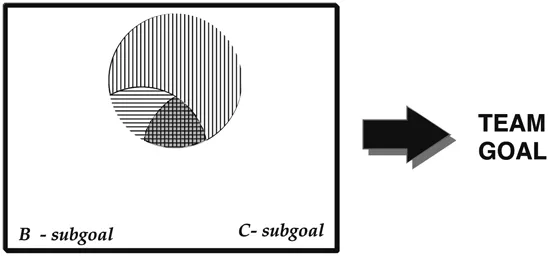
In that the performance of team members is mutually interdependent for achieving the common goal, team SA (TSA) is defined as “the degree to which every team member possess the SA required for his or her responsibilities” (Endsley, 1995b). That is, every team member must have good SA for the information associated with his or her role, in order to support overall team performance. It is not sufficient for some members of the team to have a piece of information if the person on the team who needs it does not know it. For example, in the crash of Midland Flight 92 in Kegworth, UK, the flight attendants in the back knew that the pilots had shut off the wrong engine in response to an engine fire, but the pilots in front did not, contributing to the accident (United Kingdom Air Accidents Investigation Branch, 1990). In this way, the SA of individual team members are all relevant to the effective functioning of the team, as shown in Figure 1.1.
FIGURE 1.1 Team SA arises from the unique goals and SA requirements of all team members needed to achieve overall team performance.
Source: From Endsley & Jones, 1997, 2001. Reprinted with permission from a model of inter- and intrateam situation awareness: Implications for design, training and measurement, in New trends in cooperative activities: Understanding system dynamics in complex environments, 2001. Copyright 2001 by the Human Factors and Ergonomics Society. All rights reserved.
SHARED SA (SSA)
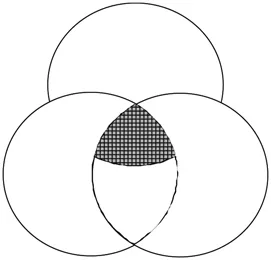
Although the specific aspects of the situation that are relevant to each team member’s SA may be different (in that they are determined by the unique goals of each role), because teams inherently involve some interdependence of their members, there also will exist a subset of information requirements that are common amongst the team members, as shown in Figure 1.2. It is this overlap in SA requirements that defines the need for shared SA (SSA). SSA is defined as “the degree to which team members possess the same SA on shared SA requirements” (Endsley & Jones, 1997, 2001). A consistent mental representation of the status of these overlapping requirements is essential for effective team coordination and performance, and drives much of the need for information sharing across teams. On these common SA requirements, two members may possess SA that is (1) shared and correct, (2) shared, but incorrect, (3) not shared, with one member correct and the other incorrect, or (4) not shared with both incorrect (Endsley & Jones, 1997, 2001).
FIGURE 1.2 The need for shared SA is a function of the overlap in individual goals.
Source: From Endsley & Jones, 1997, 2001. Reprinted with permission from A model of inter- and intrateam situation awareness: Implications for design, training and measurement, in New trends in cooperative activities: Understanding system dynamics in complex environments, 2001. Copyright 2001 by the Human Factors and Ergonomics Society. All rights reserved.
As shown in Figure 1.2, not all the SA of the team members needs to be shared—just the SA associated with common SA requirements. So for example, the air traffic controller and the pilot do not need to share everything about their current situations, which will just create overload (Endsley & Jones, 1997, 2001). They do however, need to be on the same page with respect to the aircraft’s current location, speed and altitude, clearance, the location of other aircraft that are traffic for it, its proximity to nearby terrain or restricted airspace, and the presence of turbulence or weather on its projected flight path that may create a problem for it (Endsley, Hansman, & Farley, 1998). In some cases the air traffic controller may have the more accurate information to share (such as in the case of other aircraft) and in some cases the pilot may have the more accurate information (such as is the case with weather information) (Farley, Hansman, Amonlirdviman, & Endsley, 2000).
RELEVANCE OF TSA AND SSA
SSA has been shown to be predictive of team performance in a number of studies (Bonney, Davis-Sramek, & Cadotte, 2016; Cooke, Kiekel, & Helm, 2001; Coolen, Draaisma, & Loeffen, 2019; Rosenman et al., 2018). In Bonney et al.’s (2016) study of business markets, team performance was predicted by both SSA on the team (all three levels of SA contributing over 34% of the variance) and by having a shared team strategy. Similarly, in the medical domain, Rosenman et al. (2018) demonstrated that SSA was predictive of performance, and Coolen et al. (2019) showed that SSA on both the problem and the diagnosis were highly predictive of good team performance. Cooke et al. (2001) found that both TSA and SSA of level 1 and level 3 queries was highly predictive of team performance in a study involving the operation of unmanned air vehicles (UAVs).
Overall TSA (based on combined or average SA across the team) has also been found to be predictive of overall team performance (Cooke et al., 2001; Crozier et al., 2015; Gardner, Kosemund, & Martinez, 2017; Parush et al., 2017; Prince, Ellis, Brannick, & Salas, 2007), however, some studies have not found this to be the case (Brooks, Switzer, & Gugerty, 2003; Morgan et al., 2015; Sorensen, Stanton, & Banks, 2010). For example, Prince et al. (2007) demonstrated that combined TSA scores collected on pilots in low-fidelity simulations were predictive of performance in high-fidelity simulations. Gardner et al. (2017) showed that combined TSA scores were correlated with teamwor...
Table of contents
Cover
Half Title
Title Page
Copyright Page
Dedication
Contents
Preface
Editors
Contributors
Primer (Introduction)
Chapter 1 Situation Awareness in Teams: Models and Measures
Chapter 2 Studying Team Cognition in the C3Fire Microworld
Chapter 3 The Dynamical Systems Approach to Team Cognition: Theory, Models, and Metrics
Chapter 4 Distributed Cognition in Self-Organizing Teams
Chapter 5 Unobtrusive Measurement of Team Cognition: A Review and Event-Based Approach to Measurement Design
Chapter 6 A Method for Rigorously Assessing Causal Mental Models to Support Distributed Team Cognition
Chapter 7 Quantitative Modeling of Dynamic Human-Agent Cognition
Chapter 8 Fuzzy Cognitive Maps for Modeling Human Factors in Systems
Chapter 9 Understanding Human-Machine Teaming through Interdependence Analysis
Chapter 10 Using Conceptual Recurrence Analysis to Decompose Team Conversations
Index
Trusted by 375,005 students
Access to over 1.5 million titles for a fair monthly price.
Study more efficiently using our study tools.
Frequently asked questions
Yes, you can cancel anytime from the Subscription tab in your account settings on the Perlego website. Your subscription will stay active until the end of your current billing period. Learn how to cancel your subscription
No, books cannot be downloaded as external files, such as PDFs, for use outside of Perlego. However, you can download books within the Perlego app for offline reading on mobile or tablet. Learn how to download books offline
Perlego offers two plans: Essential and Complete
Essential is ideal for learners and professionals who enjoy exploring a wide range of subjects. Access the Essential Library with 800,000+ trusted titles and best-sellers across business, personal growth, and the humanities. Includes unlimited reading time and Standard Read Aloud voice.
Complete: Perfect for advanced learners and researchers needing full, unrestricted access. Unlock 1.5M+ books across hundreds of subjects, including academic and specialized titles. The Complete Plan also includes advanced features like Premium Read Aloud and Research Assistant.
Both plans are available with monthly, semester, or annual billing cycles.
We are an online textbook subscription service, where you can get access to an entire online library for less than the price of a single book per month. With over 1.5 million books across 990+ topics, we’ve got you covered! Learn about our mission
Look out for the read-aloud symbol on your next book to see if you can listen to it. The read-aloud tool reads text aloud for you, highlighting the text as it is being read. You can pause it, speed it up and slow it down. Learn more about Read Aloud
Yes! You can use the Perlego app on both iOS and Android devices to read anytime, anywhere — even offline. Perfect for commutes or when you’re on the go. Please note we cannot support devices running on iOS 13 and Android 7 or earlier. Learn more about using the app
Yes, you can access Contemporary Research by Michael McNeese,Eduardo Salas,Mica R. Endsley in PDF and/or ePUB format, as well as other popular books in Psychology & Human-Computer Interaction. We have over 1.5 million books available in our catalogue for you to explore.