Philosophical questions surrounding skill and expertise can be traced back as far as Ancient Greece, China, and India. In the twentieth century, skilled action was an important factor in the work of phenomenologists such as Heidegger and Merleau-Ponty and analytic philosophers including Gilbert Ryle. However, as a subject in its own right it has, until now, remained largely in the background.
The Routledge Handbook of Philosophy of Skill and Expertise is an outstanding reference source and the first major collection of its kind, reflecting the explosion of interest in the topic in recent years. Comprising thirty-nine chapters written by leading international contributors, the Handbook is organized into six clear parts:
• Skill in the history of philosophy (East and West)
• Skill in epistemology
• Skill, intelligence, and agency
• Skill in perception, imagination, and emotion
• Skill, language, and social cognition
• Skill and expertise in normative philosophy.
Essential reading for students and researchers in philosophy of mind and psychology, epistemology, and ethics, The Routledge Handbook of Philosophy of Skill and Expertise is also suitable for those in related disciplines such as social psychology and cognitive science. It is also relevant to those who are interested in conceptual issues underlying skill and expertise in fields such as sport, the performing arts, and medicine.
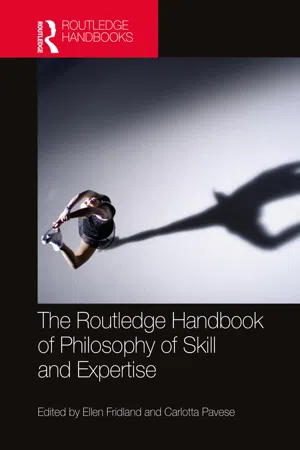
eBook - ePub
The Routledge Handbook of Philosophy of Skill and Expertise
- 526 pages
- English
- ePUB (mobile friendly)
- Available on iOS & Android
eBook - ePub
The Routledge Handbook of Philosophy of Skill and Expertise
About this book
Information
PART I
Skill in the history of philosophy (East and West)
1
SKILL AND VIRTUOSITY IN BUDDHIST AND DAOIST PHILOSOPHY
Jay L. Garfield and Graham Priest
1.1 Upāy in the Lotus Sūtra
The idea of upāya, usually translated as skillful means,1 plays a large role in Mahāyāna Buddhist ethics and epistemology, where it used to motivate hermeneutic practice, to sort out ethical conundrums, and to defend a particular approach to moral psychology and phenomenology. It comes to provide an overarching conception of what it is to live well, to live a virtuoso life of skilled perceptual and ethical engagement, and so can be seen as providing one vision of the nature of awakening, particularly in the context of a nondual understanding of samsara and nirvana—an understanding according to which there is no ontological difference between them.
Despite the centrality of this idea in Mahāyāna thought, it plays virtually no discernible role in pre-Mahāyāna Buddhist literature, except perhaps by implication. Upāya is mentioned briefly in a long list of qualities to be cultivated in the Suttanipāta and gets one brief mention in the Therigāta. Beyond that, only the frequent mention of the metaphor of the raft to describe the need to discard the Buddha’s teachings once one has achieved awakening, just as one discards a raft after using it to cross a river, can be taken as indicating the role of upāya in early Buddhist teachings.
The Lotus Sūtra, an early Mahāyāna text (possibly 1st or 2nd century BCE), is probably the earliest text that specifically thematizes upāya and takes it to be an essential ethical and pedagogical skill. The sutra deploys the example of a man whose children are in a burning house but who are oblivious to their danger and reluctant to leave. He lures them from the house by offering them various toys, none of which he actually can deliver to them. The sutra compares the probity of his using a falsehood to save the children’s lives to a bodhisattva’s use of Buddhist teachings that are not literally true to educate beginning disciples in Buddhist philosophy.
The Buddhist canon contains many sets of doctrines that are mutually inconsistent, and which are canonically arranged in a hierarchy from the most elementary to the most advanced, with only the most advanced regarded as literally true, or definitive in meaning (nithārtha), while the others are regarded as only provisional (neyārtha), to be abandoned when one is sufficiently advanced to understand a higher-level teaching (much as one might be taught Newtonian physics as true, as a prolegomenon to relativistic physics). The bodhisattva’s ability to select the right teaching for the right disciple, as opposed to trying to teach the definitive doctrine to everyone, is valorized in this sutra as upāya, skill in teaching.
But we might equally note that the fact that the behavior of the father is praised despite the fact that it violates the precept against lying indicates a more literal understanding of upāya at work, that in the ethical domain. Ethical conduct itself is regarded as requiring skill and judgment, and cannot involve merely following rules or conforming to precepts. The Lotus thus valorizes upāya in at least two domains, that of teaching doctrine, and that of ethical conduct.
So much for background. We will begin what we have to say about upāya with a discussion of the ways in which skill is treated in the Indian Madhyamaka and Yogācāra Buddhist traditions. We will then consider the way skill is treated in the Chinese Daoist tradition. This sets the stage for an examination of how these conceptions of skill inform the martial arts traditions of East Asia which emerge from this philosophical matrix. Finally, we turn to a treatment of the larger picture of skill as underlying an ethical life, as understood from these Asian perspectives.
1.2 Upāya in teaching: the Vimalakīrtinirdeśa-sūtra and Saṃdhinirmocana-sūtra
Upāya is a central theme of two Mahāyāna sutras.2 The Vimalakīrtinirdeśa (The Teaching of Vimalakīrti, henceforth VKN (Thurman 1976)) takes it as its principal topic; in the Saṃdhinirmocana (The Discourse Untangling the Thought, henceforth SNS (Powers 1995)) it is introduced only as a hermeneutical device to explain the relationship between the three cycles of Buddhist teachings distinguished in that text. Although it is a later text, it will be convenient to begin with the SNS. The SNS addresses a hermeneutical question posed by the fact that Buddhist sutra literature is apparently an inconsistent corpus, with the Buddha asserting some things in one sutra that he denies in others. The SNS resolves this conundrum by sorting this literature into three collections, referred to as the three turnings of the wheel of dharma, and by arguing that these are progressively more sophisticated articulations of Buddhist doctrine. The sutra does not, however, argue that the Buddha’s own thought evolved, since that would be to deny his omniscience; instead, it argues that the Buddha, being a highly skilled teacher, produced three sets of teachings, each ideally suited to a different audience. Skill here is explicitly pedagogical skill, and it consists in being able to adjust one’s speech and approach to one’s audience.
The VKN, on the other hand, develops an expansive theory of upāya and its role in all of life. Indeed, the two central themes of the sutra are upāya and nonduality, and, by linking them, the sutra makes a case for the nonduality of upāya and awakening, a case that sets the stage for much of the Chan/Zen tradition’s discourse about the nonduality of practice and awakening, the fact that genuine practice is already a manifestation of awakening, and that awakening can only be manifested in practice. Vimalakīrti himself, the hero of the sutra, is a layperson valorized for his mastery of upāya. He is a businessman, but earns money as a lesson to others, and for their benefit; he hangs out in bars and brothels, but does so to benefit others, etc. His life is described as one in which every action he performs and every word he speaks is a manifestation of perfect upāya, and this constitutes a complete union of ordinary life and awakened consciousness. Awakening, then, according to the VKN consists in a kind of spontaneous, skillful engagement in, rather than a withdrawal from, the world.
A striking illustration of this idea is the most famous moment in the sutra—Vimalakīrti’s “lion’s roar of silence” at the culmination of the ninth chapter. The scene for the sutra is Vimalakīrti’s house, now occupied by large assemblies of monks who follow the Śrāvakayāna, or disciples’ vehicle (the first turning sutras, if we follow the classification introduced in the SNS) and a large assembly of bodhisattvas (followers of the second). The VKN itself is a second turning (Mahāyāna, or Great Vehicle—a term comprising the second and third turnings) text, and is part of a body of literature that disparages the disciples’ vehicle as Hināyāya (an inferior vehicle) and a great deal of the sutra involves scenes that are meant to show the superiority of the bodhisattvas of the Mahāyāna over the monks of the Śrāvakayāna. These are often followed by demonstrations that Vimalakīrti, the embodiment of upāya, surpasses all of the bodhisattvas, enshrining the idea that skill—understood as the union of wisdom and practice—is the highest form of awakened knowledge.
Before we get to the dénouement of this chapter, let us consider a bit more context. In the seventh chapter of the sutra, an amusing episode is reported in which, in the midst of a complex philosophical debate, a goddess pops out of a closet in Vimalakīrti’s house. This poses a problem for the Śrāvakayāna monks, who are not supposed to be in houses with women present. Śāriputra, renowned as the wisest of the śrāvakas, enters into a discussion of this issue with the goddess which leads, after some amusing incidents involving flowers and miraculous gender reassignment surgery (all manifestations of the goddess’ upāya) to Śāriputra being asked a difficult question about how long he has been awakened.
The question is skillful because it gives poor Śāriputra no way to answer. If he speaks, he will be using language to characterize the inexpressible, and will be distinguishing awakened from non-awakened consciousness, in the context of a sutra whose very point is the nonduality of the ordinary and the awakened states; if he is silent, he does not answer a straightforward question.3 Śāriputra walks into the trap, taking the horn of silence. When the goddess chides him for not answering, he replies that since awakening is inexpressible, there is nothing he can say. She then ridicules his lack of upāya, noting that the Buddha himself said plenty of stuff. Silence, when you are asked a direct question, she suggests, is not skillful.
The ninth chapter opens with Vimalakīrti asking an assembly of bodhisattvas how one enters “the dharma door of nonduality,” that is, how one achieves a nondual understanding of reality, an understanding in which the distinction between subject and object is not thematized, and in which distinctions between apparently contrary phenomena (good and bad; conventional and ultimate; freedom and bondage; etc.) are not seen as reflecting reality, but rather our conceptual superimpositions on reality. After a long sequence of perfectly good replies by the assembled adepts, Vimalakīrti turns to Mañjuśrī, the celestial bodhisattva who embodies wisdom and asks him to comment. Mañjuśrī replies that while all of the answers were fine, they are all deficient, because each of them is expressed in language, a medium that itself embodies and reinscribes duality. This, in itself, is an indictment of the bodhisattvas for a failure of upāya. The problem, Mañjuśrī indicates, is not with what the bodhisattvas said, but in how they said it. Their method undercuts their message. The only way to really communicate nonduality, he says, is to remain silent. So far, so good.
Mañjuśrī then turns to Vimalakīrti and asks him for a comment. Vimalakīrti remains silent, a silence received with enormous admiration by all present. Mañjuśrī, chiding the other bodhisattvas for undermining their own explanations through the unskillful use of language, we now see, despite having himself spoken the truth about their failure to live up to the truths they articulated, was just as lacking in skill as were they, using language to say that only silence is appropriate as a way to communicate nonduality. Only Vimalakīrti, who remains silent, demonstrates real upāya here. Even though what he says, and what Mañjuśrī says are exactly the same, his silent affirmation is skillful; Mañjuśrī’s explicit statement of exactly the same thing is not.
But wait! Wasn’t Śāriputra’s silence just the same? A refusal to say anything when language could only undermine what one wants to say? Why was the first silence unskillful and the second skillful? The juxtaposition of these two silences is the heart of the sutra. Śāriputra’s silence has no context; it is unskillful because he is unskillful, and has been maneuvered into a spot where there is no right thing to say or to do. Vimalakīrti’s silence is skillful precisely because Mañjuśrī provided the context for him. His silence could be articulate because its content was already available. The silences are the same; their circumstances differ and so their meanings do as well; similarly, the meanings of Mañjuśrī’s speech and Vimalakīrti’s silence are the same; but in the context, only one can be skillful (and, like Śāriputra, Mañjuśrī had no good options: speaking opened him up to Vimalakīrti’s critique just as silence opened Śāriputra to that of the goddess). Everything is in the timing, the circumstance, the context. To pay attention to figu...
Table of contents
- Cover
- Half Title
- Series Information
- Title Page
- Copyright Page
- Contents
- Notes on contributors
- Acknowledgments
- INTRODUCTION TO THE ROUTLEDGE HANDBOOK OF PHILOSOPHY OF SKILL AND EXPERTISE
- PART I Skill in the history of philosophy (East and West)
- PART II Skill in epistemology
- PART III Skill, intelligence, and agency
- PART IV Skill in perception, imagination, and emotion
- PART V Skill, language, and social cognition
- PART VI Skill and expertise in normative philosophy
- INDEX
Trusted by 375,005 students
Access to over 1.5 million titles for a fair monthly price.
Study more efficiently using our study tools.
Frequently asked questions
Yes, you can cancel anytime from the Subscription tab in your account settings on the Perlego website. Your subscription will stay active until the end of your current billing period. Learn how to cancel your subscription
No, books cannot be downloaded as external files, such as PDFs, for use outside of Perlego. However, you can download books within the Perlego app for offline reading on mobile or tablet. Learn how to download books offline
Perlego offers two plans: Essential and Complete
- Essential is ideal for learners and professionals who enjoy exploring a wide range of subjects. Access the Essential Library with 800,000+ trusted titles and best-sellers across business, personal growth, and the humanities. Includes unlimited reading time and Standard Read Aloud voice.
- Complete: Perfect for advanced learners and researchers needing full, unrestricted access. Unlock 1.5M+ books across hundreds of subjects, including academic and specialized titles. The Complete Plan also includes advanced features like Premium Read Aloud and Research Assistant.
We are an online textbook subscription service, where you can get access to an entire online library for less than the price of a single book per month. With over 1.5 million books across 990+ topics, we’ve got you covered! Learn about our mission
Look out for the read-aloud symbol on your next book to see if you can listen to it. The read-aloud tool reads text aloud for you, highlighting the text as it is being read. You can pause it, speed it up and slow it down. Learn more about Read Aloud
Yes! You can use the Perlego app on both iOS and Android devices to read anytime, anywhere — even offline. Perfect for commutes or when you’re on the go.
Please note we cannot support devices running on iOS 13 and Android 7 or earlier. Learn more about using the app
Please note we cannot support devices running on iOS 13 and Android 7 or earlier. Learn more about using the app
Yes, you can access The Routledge Handbook of Philosophy of Skill and Expertise by Ellen Fridland, Carlotta Pavese, Ellen Fridland,Carlotta Pavese in PDF and/or ePUB format, as well as other popular books in Philosophy & Aesthetics in Philosophy. We have over 1.5 million books available in our catalogue for you to explore.